
The match did not “just work out.” You were left unmatched, and now you are staring at the ceiling wondering if medicine still has a place for you. It does. But only if you stop playing the same game that just beat you and start targeting the angles with the least competition and the most leverage.
This is about strategy, not ego. You are reapplying after an unmatch. Your job now is to find low‑competition opportunities and exploit them ruthlessly and intelligently.
Step 1: Be Brutally Honest About Why You Unmatched
Before we talk low‑competition specialties, you need a diagnosis. Otherwise you will just rerun the same failed application.
The real reasons people go unmatched are usually one (or more) of these:
- You aimed too high for your application strength
- You applied too narrowly (geography, program type, only “top” programs)
- Red flags: failed exams, professionalism issues, big time gaps
- Weak clinical letters or no one strongly advocating for you
- Being an IMG/DO and pretending program filters don’t exist
- Switching late from one specialty to another with no real track record
Sit down and write out, in plain language, the answers to:
- What were your board scores (and any failures, including COMLEX, Step 1/2/3)?
- How many programs did you apply to? Which specialties? Which states?
- How many interviews did you get? How many did you rank?
- What concrete feedback did you get from mentors, PDs, faculty, or advisors?
- Any personal stuff that affected performance (health, family crisis, burnout)?
Now, circle the items that are not fixable in a year: exam failures, low Step 2 score that you cannot retake, IMG status, graduation year, visa needs, big leaves on your record.
These are exactly why you need to lean into least competitive paths. You are not in the same game as a US MD with a clean record and 245+ who just miscalculated their rank list. Different rules. Different battlefield.
Step 2: Understand What “Least Competitive” Actually Means
Least competitive does not mean “anyone gets in.” It means:
- Programs that struggle to fill all their spots in the main Match
- Specialties or tracks that rely heavily on SOAP
- Community or rural programs with chronic recruiting issues
- Pathways where your weaknesses matter less and your willingness to show up matters more
Here are some categories you need to understand clearly.
| Pathway / Area | Relative Competition | Key Notes |
|---|---|---|
| Family Medicine (community, rural) | Very Low–Moderate | Often many unfilled spots; IMG/DO friendly in many states |
| Internal Medicine (community, non‑university) | Low–Moderate | Still competitive in big cities; better in Midwest/South |
| Psychiatry (select regions only) | Increasing | Some less desired locations still accessible |
| Pediatrics (community programs) | Low–Moderate | Better odds outside big coastal cities |
| Transitional Year / Preliminary IM | Variable | Some low competition, others extremely competitive |
And then there is the real low‑competition goldmine: rural, community, and less desirable geographic areas in these same specialties.
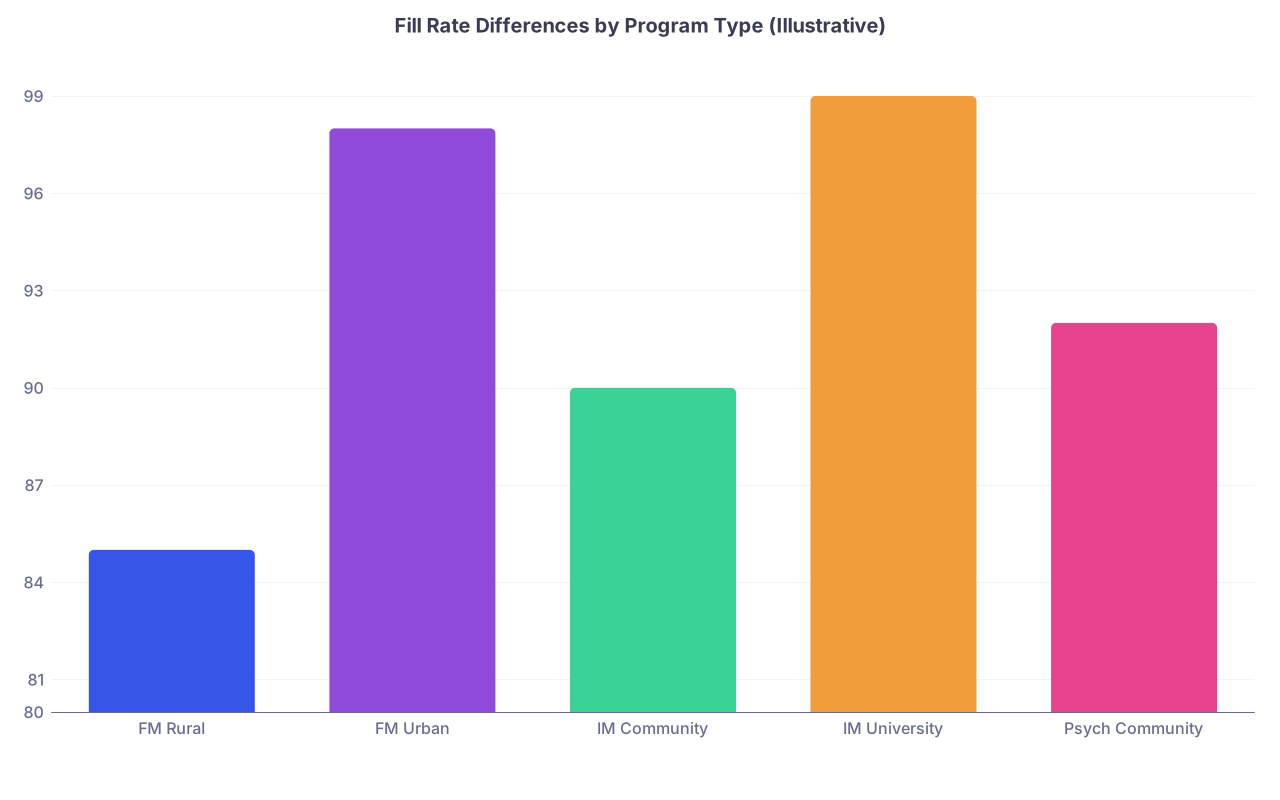
| Category | Value |
|---|---|
| FM Rural | 85 |
| FM Urban | 98 |
| IM Community | 90 |
| IM University | 99 |
| Psych Community | 92 |
Those percentages (illustrative, but directionally true) show the pattern: rural and community programs struggle more to fill all spots. That is where you belong right now if you are reapplying with a prior unmatch.
Step 3: Decide If You’re Changing Specialties or Just Strategy
You have two broad routes:
- Reapply in the same specialty but with a smarter, lower‑competition program list
- Pivot to a less competitive specialty where your odds are materially higher
Here is the blunt truth.
- If you went unmatched in derm, plastics, ortho, ENT, neurosurgery, integrated vascular, and you are not bringing new, massive firepower this year (fresh AOA, 260+, huge publications, insider letters), you probably need to pivot.
- If you went unmatched in IM, FM, peds, psych but had a few interviews and simply under‑applied or ranked badly, you may be able to try again in the same field with a much more aggressive and geographically broad list.
Ask yourself:
- Did I get zero interviews?
- Then the problem is severe: scores/filters, weak app, or catastrophic targeting. Pivot or massively downgrade program expectations.
- Did I get 3–6 interviews and still not match?
- Then your app is borderline but salvageable. You must expand and chase lower‑competition sites.
- Did I rank very few programs because of “fit” or location preferences?
- Then the issue is you, not the system. You cannot afford to do that again.
You’re not choosing your dream life right now. You’re choosing to stay in the game.
Step 4: Target the True Least-Competitive Opportunities
Now let’s talk concrete targets if you’re reapplying.
1. Family Medicine – Community, Rural, Underserved
If you need a reliable landing zone, this is it.
Programs that are more approachable when you have an unmatch in your history:
- Rural FM residencies in states like Kansas, Oklahoma, Arkansas, West Virginia, the Dakotas, Mississippi
- Community hospitals unaffiliated with big academic centers
- Programs that historically have high IMG intake and/or lots of SOAP positions
What to do:
- Build a list of FM programs with prior unfilled positions. Use NRMP’s “Results and Data” reports (by specialty and state) and talk to advisors/IMG forums.
- Emphasize any primary care, continuity clinic, outpatient, or underserved experience.
- If you are switching from a surgical specialty, write a statement that does not sound like FM is your rebound relationship. FM PDs hate being the consolation prize.
2. Internal Medicine – Community Non-Competitive Markets
Academic IM in Boston or San Francisco? Forget it. But non‑university IM in the Midwest, South, or interior states? That is business.
Look at:
- Smaller community hospitals with <10 residents per class
- Programs in cities you have never vacationed in and probably never planned to
- Places that do not have household‑name universities attached
If you had a prior IM unmatch:
- Crank your program list up into the 120–150 range if possible (yes, that many)
- Accept that geography is now a luxury, not a right
- Secure at least one strong IM‑specific letter from recent US clinical work: inpatient IM, hospitalist service, or even a prelim year (more on that later)
3. Pediatrics – Outside of Trophy Cities
Pediatrics is not ultra‑competitive overall, but big‑name children’s hospitals are. You should not be focused there.
You aim for:
- Regional children’s hospitals without major research reputations
- Combined community peds‑FM programs
- States with historically lower fill rates in peds (Midwest, Deep South, rural pockets)
Again: research the NRMP data instead of guessing.
4. Psychiatry – Only in Certain Regions
Psych used to be a classic “backup” specialty. It’s gotten hotter. But there are still community psych programs in less popular locations that take on applicants with bumps and bruises.
You focus on:
- State hospitals, community mental health‑oriented programs
- Locations far from major metro areas or coasts
- Programs with high IMG or DO populations already on their roster
Step 5: Fix the Application Itself – Not Just the Specialty Choice
You cannot just click “apply more broadly” and call it a strategy. You need structural repair.
A. Letters of Recommendation: You Need Someone to Go to Bat for You
Weak, generic letters will kill you silently.
You need at least:
- 2 strong, recent specialty‑specific letters (from your target field)
- 1 additional letter that addresses either your work ethic, turnaround story, or specific concern (e.g., Step failure, prior unmatch)
If you are out of school:
- Get a US clinical position: research fellow with clinical exposure, observer then hands‑on role, paid clinical job (scribe, care coordinator) where attendings can see you in action.
- For IM/FM: standard inpatient ward rotation with an attending who writes real letters, not canned paragraphs.
- Make it clear to your letter writers that you previously went unmatched and you need them to address that you are now ready and reliable.
Weak move: “Can you write me a letter for residency?”
Strong move: “I previously went unmatched and am reapplying to community FM/IM. I’m hoping for a letter that addresses my clinical reliability, teachability, and readiness to be an intern. Do you feel you know me well enough to do that?”
If they hesitate, back off. A lukewarm letter is deadly.
B. Personal Statement: Stop Sounding Like a Victim or a Romantic
You are not here to write poetry about your calling. You are selling one thing: I will show up, work hard, and finish this residency.
Your PS should hit:
- 1–2 concrete examples of you functioning well in a clinical setting
- A clear explanation (if needed) for switching specialties or reapplying — short, candid, no drama
- A forward‑looking tone: what kind of resident you will be and why this specialty/program type fits
If you unmatched in another specialty:
Bad: “I didn’t match in orthopedics, so now I am applying to FM.”
Better: “My early interests were in surgical problem‑solving, but through sub‑internships and continuity clinic I realized I value longitudinal relationships and comprehensive care more than the OR. I see that clearly now, and over the past year I have focused my work in primary care clinics and inpatient medicine to build skills aligned with FM.”
You are not confessing. You are explaining your evolution in a matter‑of‑fact way.
Step 6: Use the Year Before Reapplying Intelligently
You do not just “take a year off.” That phrase is poison.
Here are real, useful things to do that improve your odds:
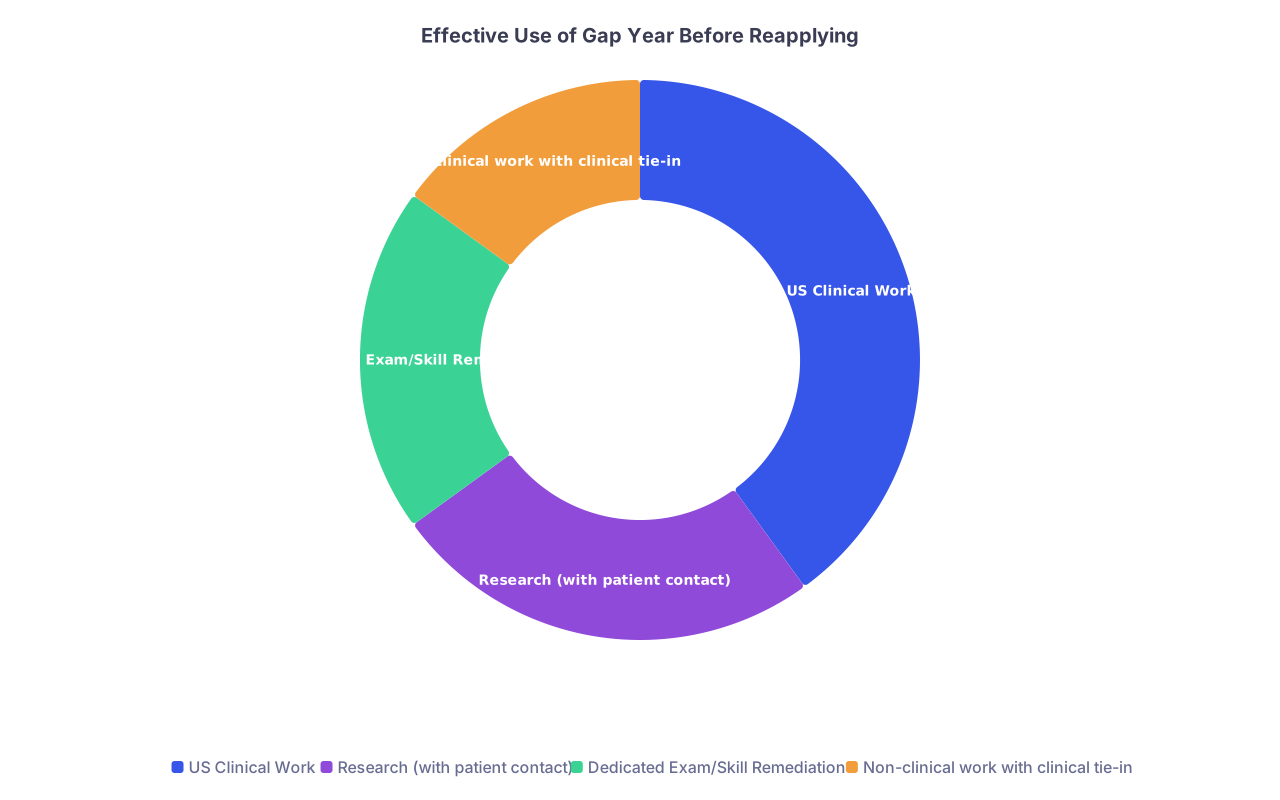
| Category | Value |
|---|---|
| US Clinical Work | 40 |
| Research (with patient contact) | 25 |
| Dedicated Exam/Skill Remediation | 20 |
| Non-clinical work with clinical tie-in | 15 |
A. US Clinical Experience (USCE)
If you are an IMG or have been out of the system:
- Aim for hands‑on or at least high‑visibility roles: research assistant on a clinical team, sub‑I style observership that translates to true involvement, MA or scribe roles where attendings see you daily.
- Target locations where residencies exist. Getting known locally matters more than a shiny national brand name.
B. Research Positions – Only If They Touch Patients or Faculty Who Can Help You
Bench work won’t help you much for FM/IM/peds/psych. But a research coordinator job on an inpatient IM service—where PDs can see you—is gold.
Ask: “Will I work closely with attendings who are involved in residency leadership or who regularly write letters?”
If the answer is no, the value drops.
C. Fixing Exams
If your issue was a Step/COMLEX failure or low score, your year should clearly show remediation:
- Formal prep course, tutoring, or structured study plan
- Passing Step 3 can sometimes blunt the impact of a prior Step 1/2 failure (especially for IM/FM, less so for competitive specialties)
- Documentable improvement: people love a comeback story, as long as the comeback is obvious and recent
D. Preliminary / Transitional Year – Double-Edged Sword
If you SOAPed or scrambled into a prelim IM or TY spot:
Pros:
- Shows you can function as an intern
- Gives you fresh letters and real-world credibility
- Some programs will “rescue” good prelims into categorical spots
Cons:
- If you struggle, you are done
- Switching specialties after a prelim year without strong support is hard
- It can trap you if you do not aggressively reapply while in it
If you are in a prelim this year: overperform. Every rotation. Get your best attendings on board early and explicitly ask: “If I work hard this month and you feel comfortable, I’d really appreciate if you could support my reapplication with a strong letter.”
Step 7: Expand Your Program List Aggressively and Intelligently
Reapplying after an unmatch is not the time for a 30‑program list with an attitude of “fit matters most.” Fit matters when you are in the 230+ clean‑record crowd. You are in survival mode.
Realistic application volume targets for reapplicants focusing on low‑competition areas:
| Specialty Target | Typical Range for Reapplicants |
|---|---|
| Family Medicine | 80–120 programs |
| Internal Medicine (community heavy) | 120–150 programs |
| Pediatrics | 60–100 programs |
| Psychiatry | 80–120 programs |
Yes, these numbers are large. Yes, it is expensive. But so is an unmatched year plus another aimless reapplication.
Use filters intelligently:
- Prefer community and rural programs over big academic centers
- Do not auto‑exclude programs that have few or no graduates matching into fellowship–you need a job, not a brand right now
- Focus on programs that already train IMGs or DOs if you are one
Don’t delude yourself into thinking you will “save money” by applying to only 40 “good fits.” That mindset put a lot of people into SOAP.
Step 8: How to Frame Your Prior Unmatch Without Tanking Yourself
Programs will see your prior ERAS history. Hiding it or pretending it didn’t happen is not an option.
What you need is a clean narrative:
- What happened
- What you did about it
- How you are now a stronger, safer bet
Example if you switched from surgery to FM after an unmatch:
- “I applied to general surgery last cycle and did not match. That forced me to step back and reassess what kind of physician I wanted to be and what environment I thrive in. Over the past year I have worked in an outpatient clinic and inpatient medicine service, where I realized I value continuity and comprehensive care more than the OR. I also learned how to handle feedback better and have specific systems in place now to avoid the disorganization that hurt my third‑year evaluations. The result is that my attendings in medicine now describe me as consistent and reliable, which is echoed in my recent letters.”
You do not overshare. You do not bash prior mentors or blame the system. You own your choices and show evidence that the story is different now.
Step 9: Use SOAP and Unfilled Positions Strategically (Not Desperately)
If you are reapplying, you should assume you may be in SOAP again. That is not pessimistic. That is preparation.
Mentally prepare for:
- Aggressively applying to every single FM, IM, peds, psych, prelim IM spot that you could stomach if needed
- Having a pre‑written 250‑word blurb about why you can start immediately, work hard, and are committed to that specialty
- Conferring ahead of time with an advisor/mentor about how far you are willing to go geographically or specialty‑wise in SOAP
Also: watch which programs and specialties consistently appear in SOAP/unfilled lists year after year. Build them into your main Match list now. Do not wait.

| Step | Description |
|---|---|
| Step 1 | Unmatched Last Cycle |
| Step 2 | Consider switching to FM/IM/Peds/Psych |
| Step 3 | Reapply with broader list |
| Step 4 | Target rural and community programs |
| Step 5 | Strengthen letters and USCE |
| Step 6 | Apply to 80-150 programs |
| Step 7 | Prepare SOAP strategy early |
| Step 8 | Got Interviews? |
Step 10: Protect Your Mindset Without Lying to Yourself
Here is the part everyone glosses over.
Being unmatched hurts. You start thinking in all‑or‑nothing terms:
- “If I do not match next year, I am done.”
- “Everyone else moved on. I am defective.”
- “Maybe I should just quit now.”
You can’t fight your way through this process if your head is already in the trash.
Do three practical things:
- Tell 2–3 people you trust exactly what happened and what you are planning. Not for sympathy. For accountability.
- Set a time budget for obsessing about the past—then stop. 30 minutes a day to review, plan, check data. The rest of the time you work on the plan or live your life.
- Decide in advance what “good enough” looks like. If you say, “I will only accept a coastal city categorical IM spot,” you are setting yourself up to reject the very opportunities that could save your career.
You are allowed to grieve. You are not allowed to self‑sabotage by clinging to a fantasy match that your current record does not support.
What You Should Do Tonight
Do not just nod and move on. Open a blank document and do this:
- Write down your last cycle: specialty, number of applications, interviews, ranks, scores, any failures.
- Circle every factor that is not changing before next Match. That’s your reality.
- Pick one lower‑competition specialty (FM, IM, peds, psych) that you are willing to commit to as your primary target.
- Go to the NRMP Results and Data report and identify 10 programs in that specialty that historically have unfilled positions or high IMG/DO percentages.
That list of 10 is the start of your new, ruthless strategy. Expand it. Talk to real advisors. Start reaching out for USCE or research roles that position you near programs like those.
You are not trying to win a prestige contest. You are trying to secure a residency contract. Tonight, take the first concrete step toward that.