
The worst time to change specialties is late MS4. And sometimes it is exactly the right move.
You’re not crazy for thinking about pivoting. You are playing with fire if you do it blindly this late. So let’s treat this like what it is: a risk management problem, not a feelings problem.
You want to pivot into an “easier match” field, late in the game, without destroying your chances of matching at all. Here’s how to do that like an adult and not like the panicked classmate updating their rank list at 1:59 pm before the deadline.
Step 1: Define “Late” And Confirm Your Timeline
“Late MS4” means very different things depending on where you are in the cycle.
Let’s line up the actual stages:
Rough categories:
- Pre-ERAS submission (summer/early fall MS4): late, but workable.
- Post-ERAS submission, before interview season/rank list: very tight, but some moves still possible.
- After rank list certification / post-Match / during SOAP: different game; you’re mostly planning for next cycle or salvaging with whatever’s open.
If you tell me, “It’s December, I’ve already applied to ortho, had 1 interview, and I now realize I hate it,” that’s a very different tactical plan than, “It’s July, I just finished my Step 2, and I’m realizing derm is not happening.”
Be brutally specific with yourself:
- What date is it?
- Have you submitted ERAS?
- Have you already interviewed? In what specialty?
- Are you in SOAP territory, or are we still in the main cycle?
Do not say “late MS4” and leave it vague. Your options live or die on the calendar.
Step 2: Know What “Easier Match” Actually Means
“Least competitive specialties” is a loaded phrase. Some are numerically easier. Some are only “easier” if you’re geographically flexible, willing to do a prelim/transitional year, or okay with community vs big-name academic.
Here’s a reality snapshot. This is not perfect, and data shifts year to year, but conceptually:
| Specialty | Relative Competitiveness | Typical USMLE Step 2 Range (Matched US MD) | Key Advantage for Late Pivot |
|---|---|---|---|
| Family Medicine | Low | ~220–235 | Many programs, broad need |
| Internal Medicine | Low–Moderate | ~225–240 | Prelim + categorical options |
| Pediatrics | Low–Moderate | ~220–235 | Generally applicant-friendly |
| Psychiatry | Moderate but growing | ~225–240 | Values personal story, fit |
| Neurology | Moderate | ~225–240 | Willing to consider late applicants |
Are these “easy”? No. Nothing is easy if you’re late, disorganized, and unrealistic. But they’re salvageable fields when you’re pivoting from something hyper-competitive (ortho, derm, plastics, ENT, neurosurg, rad onc, optho, urology).
What I’ve seen:
- Family medicine and internal medicine are where a lot of late pivots land safely.
- Psych and neuro are still accessible in many regions, but they’re tightening.
- Peds stays relatively friendly, especially community programs.
If you’ve been building a CV geared to a surgical or ultra-competitive field, you probably already have enough general horsepower (Step scores, LORs from big names, research) to be interesting to these programs—even if your stuff is not tailored yet.
Your new mindset: “I’m not shopping for my dream specialty anymore. I’m securing a safe landing with as little self-sabotage as possible.”
Step 3: Do a Ruthless Self-Inventory Before You Pivot
Before you email a single program about a new specialty, you need to know what you actually bring to the table. Not vibes. Assets.
Pull up a notepad and answer these without lying to yourself:
Exams
- Step 1: pass/fail or score. Any fails?
- Step 2 CK: score and any fails?
- Any COMLEX complications?
Transcript
- Any course or clerkship failures, LOAs, professionalism notes?
- Honors vs passes in core rotations (IM, FM, peds, psych, surgery, OB)?
Clinical exposure in new field
- Have you actually done a core or elective in this “easier” specialty?
- Can anyone in that field write you a letter?
- Do you have even one concrete patient story from that specialty?
Geography
- Are you willing to apply everywhere? Or only “NYC or bust”?
- Do you have geographic ties anywhere (family, prior school, etc.)?
What already exists in your application that can be repurposed?
- Research in another field that demonstrates work ethic, stats, academic interest.
- Leadership roles, teaching, volunteer work.
If you have major red flags (exam failures, professionalism issues) and zero clinical exposure to the new specialty, you’re not doing a clean pivot; you’re trying to pull a U‑turn on black ice. Still possible. But you favor maximum volume and low-ego choices.
Step 4: Choose Your Target Specialty Like an Adult, Not a Romantic
You don’t have the luxury of “finding your passion” at this stage. You’re choosing a specialty that:
- You can plausibly argue you’d be happy in.
- You can convince PDs you’re sincerely committed to.
- Has enough program volume that a latecomer with some general strengths can still match.
Let’s walk through a few common late-pivot landing spots and how they play if you’re switching from something more competitive.
Family Medicine
If you:
- Have decent Step 2 (even 210–220 region can work)
- Are willing to go almost anywhere
- Can pull one FM-related LOR or primary care-ish story…
FM is the single safest net.
Narrative angle: continuity of care, patient relationships, broad base of medicine, interest in underserved communities. If you did anything vaguely primary-care-ish (free clinics, community outreach, QI project in chronic disease), it plugs right in.
Internal Medicine
Works best if:
- You didn’t tank medicine clerkship.
- You have a reasonably solid Step 2 (>220 makes life easier, >230 nicer).
- You’re open to both categorical and prelim spots, and okay with community.
IM is a good match if you were originally aiming for something like cardiology, GI, heme/onc eventually but went overboard applying to something ultra-competitive early. It’s also a good pivot from surgery if you’ve realized you hate the OR but love sick patients and pathophys.
Pediatrics
Good if you:
- Like kids (or at least tolerate them).
- Can stand parents (this matters more than students admit).
- Had a decent peds rotation.
Peds is friendly, and many PDs will happily take a strong general applicant who shows genuine warmth with kids and can talk about working with families.
Psychiatry
Psych used to be the “easy” field. It is not anymore, but still more accessible than derm or plastics.
Works if:
- You have a coherent story: interest in mental health, prior psych research, volunteering in mental health spaces, campus peer counseling, etc.
- You can show you’re not choosing psych as “the leftover specialty.”
Late pivot to psych must avoid the vibe of “I heard it’s chill and I’m tired.”
Neurology
Often overlooked. But neurology has real need and a lot of programs.
Ideal if:
- You liked neuro in pre-clinicals and didn’t fail neuro exam.
- You’re comfortable with complex differential thinking.
- You can spin your prior interest (e.g., neurosurg, stroke, ICU) into “I realized I’m more about diagnosis and longitudinal care than procedures.”
Step 5: Adjust Your Application Without Nuking It
Now, tactically: how do you change direction without starting your life over?
Different scenario, different toolset.
If You Haven’t Submitted ERAS Yet
You’re in the best “late” situation.
Do this:
Rewrite your personal statement for the new specialty.
Not “I always loved derm but now I guess I want family med.” You write as if FM was always the gravitational pull, and your other experiences were explorations along the way.Get at least one letter in the new specialty.
If you haven’t rotated there yet, you need to fix that immediately. Throw this on your schedule now. Tell the attending honestly:
“I’m strongly considering your specialty and I’m late in deciding. If I do well on this rotation, would you be comfortable writing a supportive letter?”Rebuild your program list to be broad and realistic.
Heavy skew toward community programs, less-urban regions, and places outside the “Top 20 name brand” bucket.Talk to your dean’s office ASAP.
Ask directly: “If I pivot to [X], based on my record, do you think I can match if I apply broadly?” Do not sugarcoat your record.
If You’ve Submitted ERAS, But It’s Early in the Season
The messy middle. You’ve already applied to one specialty; now you’re realizing it’s not going to work or you don’t want it.
You have two parallel goals:
- Don’t burn your current specialty options yet.
- Build a parallel application to a less competitive field.
Mechanically:
- You can submit a second ERAS application in a different specialty with a different personal statement and different letter set.
- You don’t need to withdraw the first specialty right away. Let interviews shake out a bit.
- You must accept that this gets expensive in ERAS fees and you’re now double-timing emails, interviews, and scheduling.
The line you’ll use if asked about it later:
“I initially applied in [X] due to [specific reasons], but as I got deeper into my clinical experiences, I realized my long-term fit was actually more aligned with [new specialty] because [concrete, compelling reasons].”
Direct. Not apologetic. Not evasive.
Step 6: Communicate the Pivot Without Sounding Flaky
Program directors hate two things: dishonesty and flightiness. You can’t afford to look like either.
Your pitch needs three components:
A believable origin story for the new specialty
Example (surgery → FM):
“I went into medical school very procedure-focused. On my surgery rotation, I loved the acute problem-solving, but I kept finding the most meaningful part of my day was the clinic visits and post-op follow up. I realized the relationships and long-term care—the part happening outside the OR—were what actually stuck with me.”Evidence you’ve actually engaged with the new field
- A recent rotation
- A letter from an attending in that field
- A small QI project, case report, or clinic involvement
- Even a late elective with strong comments in your MSPE
A committed forward-looking plan
- Express interest in fellowships relevant to that field.
- Talk settings: community, academic, rural, urban.
- Describe the kind of physician you see yourself as in 10 years, consistent with that specialty.
Where to communicate this:
- Personal statement: major frame.
- Interviews: crisp, 1–2 minute narrative.
- Any emails to programs if you’re late-adding their specialty: short, respectful, and specific.
Do not:
- Trash your original specialty. (“Everyone was miserable, toxic culture, I hated it.”)
- Make the new field sound like your fallback. That’s death.
Step 7: Protect Your Match Odds Like They’re Your Oxygen
Your real enemy isn’t “ending up in the wrong specialty.” It’s not matching at all.
So your priorities shift:
- Safety > ego
- Volume > perfection
- Flexible geography > ideal city
This is where people screw up late pivots: they pivot into a “less competitive” field, then apply like it’s still derm.
You are not doing that.
Here’s how you stack the deck:
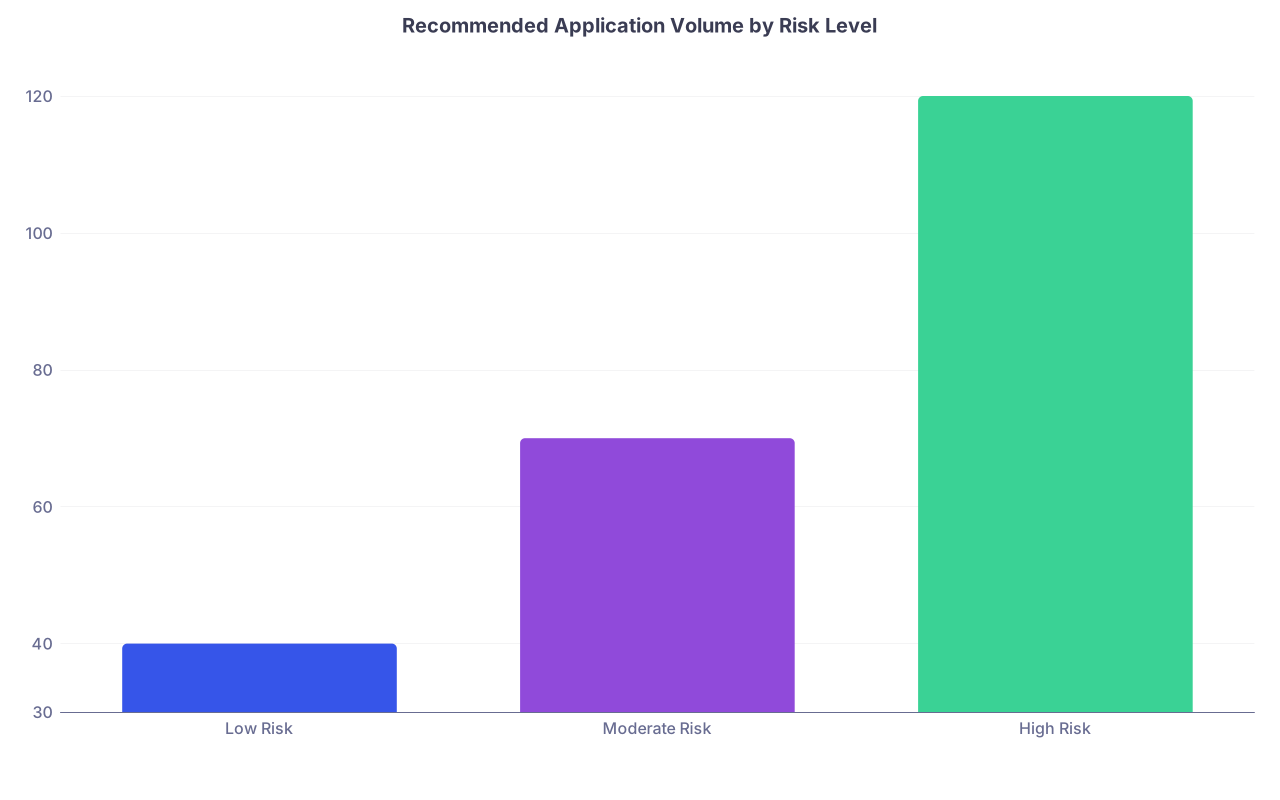
| Category | Value |
|---|---|
| Low Risk | 40 |
| Moderate Risk | 70 |
| High Risk | 120 |
Interpret this:
- If you have strong stats, no red flags, and at least one month in the new field: 40–60 apps can be fine in a less competitive field.
- If you have some weaknesses (gap year, Step failure, late decision, minimal exposure): 70–100 apps is not crazy.
- If you’re in trouble (multiple red flags, very late pivot, minimal support): 100+ apps is sometimes necessary.
You will:
- Prioritize community programs, new programs, and places outside the glam cities.
- Still apply to some stronger-name places, but they are your lottery tickets, not your backbone.
- Be clinically honest with yourself: would you rather match anywhere in this field, or risk not matching this year?
If your answer is “I’d rather take the risk and reapply than match in, say, rural IM,” that’s fine—but then face the financial and emotional cost of a likely reapplication. Do not pretend you can have both full pickiness and full safety when pivoting this late.
Step 8: If You’re Already Deep in the Season (Or in SOAP)
Different animal now.
If You’re Post-Interviews, Pre-Rank List
You’ve:
- Interviewed in a competitive specialty.
- Realized you hate it or your chances are visibly terrible.
- Maybe have 0–3 invites total.
At this point, your “pivot” this year is largely over. You’re not going to build a whole fresh application and secure enough interviews in a new specialty this late. But you have two realistic plays:
Rank what you have and commit to starting in that specialty, then plan an early-resident transfer later
Messy, not guaranteed, but people do it.Go all-in on a fresh application next year in the new field and treat this cycle as recon
That means:- Actually finishing MS4 strong.
- Securing rotations and letters in the new field.
- Maybe doing a research year or chief year or something productive, not just vibes.
Changing your rank list specialty at the last second with minimal interviews is magical thinking. Do not rely on magic.
If You’re in SOAP
SOAP is not where you “find yourself.” SOAP is where you grab a life raft.
In SOAP:
- You do not get picky about specialty if your realistic chance of a categorical position is low.
- If your heart is set on a certain general area (e.g., medicine-adjacent), look at prelim IM, transitional year, or FM/Psych/Peds/Neuro that are unfilled.
- You update your personal statement overnight for whatever you’re targeting and lean heavily on your dean’s office to push your file.
If you’re changing specialty in SOAP, your narrative is short and functional:
“I applied in [X], but as I moved through the cycle and reflected on my clinical experiences, I realized that my skills and interests are better aligned with [Y]. I’m excited about the opportunity to train in [Y] and commit my career to this field.”
Don’t make up a fairy tale. You’re not being graded on style here; you’re being evaluated on coherence and sincerity.
Step 9: Use Your School’s Infrastructure (Harder Than It Sounds)
You’re not the first MS4 at your school to panic late and change directions. Your dean’s office and advisor have seen worse.
What to actually say when you go in:
- “I’m considering changing from [old specialty] to [new specialty]. I know it is late. I want a brutally honest assessment of my match chances if I pivot this year.”
- “Can we look at last year’s Match data from our school for [new specialty] and see where a student with my grades and scores typically matches?”
- “Which attendings in [new specialty] here are supportive of late-deciders and might be willing to meet with me quickly? I need practical help, not just theory.”
- “If I do not match this year, what would you advise for a glide year to strengthen a reapplication in this field?”
Your school can:
- Call PDs on your behalf.
- Help you slide onto a late elective.
- Sometimes help you fix a toxic letter situation.
- Give you real data, not Reddit myths.
But only if you drop the pride and loop them in.
Step 10: Emotion Management So You Don’t Torch Your Future
Let me be blunt: late pivots trigger shame, FOMO, and catastrophizing.
Common self-sabotaging moves I’ve seen:
- Ghosting your original letter writers because you “feel bad,” then having no one vouch for you.
- Refusing to consider community or non-coastal programs.
- Writing a passive-aggressive personal statement about how unfair your original specialty was.
You cannot afford to be that person.
Here’s the mindset reframe:
- You are not “failing” by moving to a less competitive field. You’re reallocating your skills to where the system actually has need and where you can practice medicine instead of refreshing your email for invites.
- You have agency here. Match vs no match is not random; it’s heavily influenced by how fast and how realistically you move once you recognize the problem.
- The specialty you start in does not freeze your identity forever. People switch as interns. People discover subspecialties they love that they’d never heard of as M4s.
The only truly disastrous outcome is you detonating your own chances because you couldn’t adjust your expectations to reality.
What You Should Do Today
Open a blank document and, at the top, type:
- Today’s date.
- Your current specialty target.
- The specialty you’re considering pivoting into.
Then write three short paragraphs:
- Why your current specialty no longer makes sense for you (honest, specific).
- Why the new specialty is a plausible, sustainable fit for you.
- What concrete evidence you already have (rotations, letters, experiences) that support this new direction.
When you finish, send that one-page document to your dean’s advisor and one trusted attending and ask for a 20-minute meeting this week to discuss a safe pivot plan.
Do that today, not “after I think about it more.” The longer you wait, the fewer exits you have left.