It is early January. You have a couple of interview invites in your chosen specialty. Maybe 4. Maybe 7. Not 15. Not 20. Your classmates in EM or anesthesia are casually comparing “second look” plans and you are quietly calculating:
“If I do not match this specialty… what is my actual plan?”
This is the point where people either
- pretend it will all work out, or
- build a serious, structured backup strategy.
You are here to do the second one.
I am going to walk you from early January through the rank list deadline, step by step, with a specific focus:
- How to think about backup specialties, especially the less competitive ones
- When to pivot, when to double down, and when to split your rank list
- Exactly what to be doing each month, then each week, so you are not staring at the NRMP screen in February with a fantasy list and no safety net
Big Picture: Your January Reality Check (Week 1–2)
At this point you should stop guessing and quantify your situation. No magical thinking, just data.
1. Inventory your current season
List out, for your primary specialty:
- Total applications submitted
- Number of interview invitations received
- Number of interviews actually attended (or scheduled)
- Any serious red flags (Step failures, leaves, significant course remediation, visa issues, etc.)
Now compare yourself to norms. For many fields:
- ACGME data and NRMP “Charting Outcomes” show that:
- US MDs who ranked 10–12 programs in a specialty usually have a very high match probability.
- Below 6–7, risk rises fast.
| Primary Specialty Type | Interviews Attended | Match Risk Level |
|---|---|---|
| Very competitive (Derm, Ortho, Ortho, ENT) | < 8 | Extremely high |
| Moderately competitive (EM, Anesthesia, Gen Surg) | < 7 | High |
| IM / Pediatrics / FM (US MD) | < 5 | High |
| IM / Pediatrics / FM (US DO/IMG) | < 6 | High |
If you are well below those ranges by early January, you are in the danger zone. That is not a moral judgment. Just math.
2. Define your backup category
At this point you should decide what type of backup you are talking about:
- True backup specialty
- You are willing to train and practice in it if needed. Examples:
- Primary: EM; Backup: IM or FM
- Primary: Ortho; Backup: Prelim surgery or IM
- Primary: Radiology; Backup: TY or prelim and reapply
- You are willing to train and practice in it if needed. Examples:
- Bridge year / reapplication plan
- Preliminary year, transitional year, or a categorical spot in a less competitive field you might leave later. Messier, but sometimes necessary.
Do not pick a backup you cannot imagine actually doing. You will sabotage your own rank list.
January (Weeks 1–4): Lock Down the Backup Strategy
At this point you should actively explore backup specialties, not just think about them.
Week 1: Reality check + specialty recon
Tasks this week:
- Meet with:
- A faculty advisor in your primary specialty
- A GME / student affairs dean who understands the Match numbers at your school
Ask directly:
- “With my board scores, grades, and this number of interviews, what is your honest estimate of my match probability?”
- “What backup specialties or paths have worked for prior students like me?”
Then, for 1–2 potential backup specialties (usually less competitive ones like FM, IM community programs, Peds, Path, Psych, PM&R in some regions):
Check their current interview season status:
- Are they still sending invites?
- Do they historically interview late-cycle candidates? Some FM and community IM programs do.
Identify where you have existing ties:
- Your home institution
- Away rotations
- Regions where you have family or long-term connections
You are looking for realistic paths, not fantasy. “Maybe I could get derm somewhere” is not a plan.
Week 2: Aggressive outreach (if still possible)
If you have not applied to backup specialties at all:
- By early January, new applications to categorical programs may still be read in:
- Family Medicine
- Community Internal Medicine
- Psychiatry (in some areas)
- Pediatrics (region dependent)
- Some Pathology programs
If you already applied but have few or no interviews, now is the “polite-but-direct” outreach phase.
Action steps:
- Send targeted emails to PDs / APDs / coordinators for backup specialties:
- Very short, factual, attaching ERAS CV or referencing your AAMC ID
- Mention any tie: “I grew up in X town, family here, strong interest in community-based care.”
- Ask your home attendings or program leadership to send 1–2 advocacy emails on your behalf. This matters more than applicants think, especially in FM, IM, Peds.
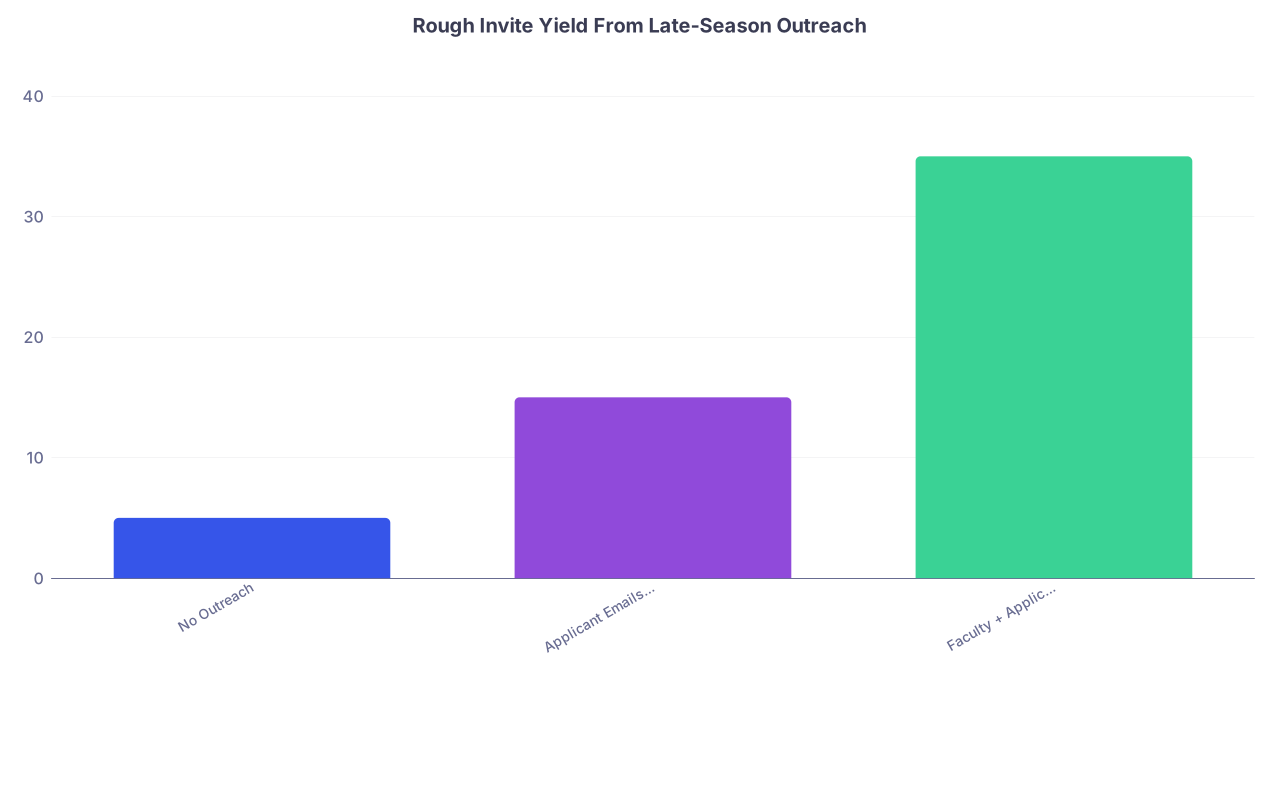
| Category | Value |
|---|---|
| No Outreach | 5 |
| Applicant Emails Only | 15 |
| Faculty + Applicant Outreach | 35 |
Numbers are illustrative, but I have watched this play out over multiple cycles: faculty-sponsored outreach is often the difference between zero and a handful of backup interviews.
Week 3–4: Decide structure of your rank strategy
Now you decide which of these you are building:
Pure primary specialty list
- You have enough interviews (and no major red flags)
- You accept the risk of SOAP if things go south
Split list: primary + backup categorical specialty
- Example:
- Ranks 1–7: EM
- Ranks 8–18: FM categorical
- This is appropriate if:
- You would be genuinely OK practicing backup specialty
- Backup specialty is realistically matchable this year
- Example:
Primary specialty + prelim/TY backup
- Example:
- Ranks 1–10: Radiology
- Ranks 11–18: TY/prelim medicine
- This is a reapply strategy, not a permanent backup.
- Example:
At this point you should have one of these three sketched on paper. You will refine the exact order later, but the architecture must be decided in January.
February (Up to Rank List Deadline): Fine-Tuning and Hard Choices
By February, the interview firehose has slowed. This is the “no new data” phase. Now you have to commit.

| Step | Description |
|---|---|
| Step 1 | Early January |
| Step 2 | Count interviews |
| Step 3 | Primary only list |
| Step 4 | Identify backup specialties |
| Step 5 | Late outreach and new apps |
| Step 6 | Backup interviews? |
| Step 7 | Split list primary plus backup |
| Step 8 | Prelim TY backup or SOAP plan |
| Step 9 | Enough for primary specialty? |
Early February: Rank list draft 1
At this point you should build Version 1 of your rank list based on where you would actually want to work, independent of fear.
For your primary specialty:
- Rank programs in true preference order
- Ignore perceived “likelihood.” NRMP is crystal clear on this. Ranking a “safety” higher does not improve your odds at the safety; it only hurts your odds at places you like more.
For your backup specialty:
- Separate programs into:
- “I would be happy here long-term”
- “I can tolerate this for a few years but ideally would move later”
- Separate programs into:
Rank the “happy” group first, then the “tolerable” ones. If you hate a program so much you know you would be miserable, do not rank it. Better to SOAP somewhere else than be locked into four years of regret.
Structuring a mixed rank list
Here is where people get confused. You can mix specialties in a single NRMP list. The algorithm does not care. It looks at training programs, not “fields.”
Example structure for someone with 5 EM interviews, 8 FM interviews:
- EM Program A
- EM Program B
- EM Program C
- FM Program D
- FM Program E
- FM Program F
- EM Program G
- FM Program H
- FM Program I
- FM Program J
- FM Program K
- FM Program L
- EM Program M
This is valid if and only if:
- You truly prefer EM A/B/C over any FM
- You truly prefer FM D/E/F over EM Program G and beyond
The critical rule: Never rank based on “what you think you can get.” Rank in the order you actually want, even across specialties.
Where Backup Specialties Actually Help
Let us be blunt: there is a mythology that “X specialty is easy, you can always fall back on it.” That thinking is how people end up in SOAP panic.
Here is the more grounded view of some classically “less competitive” specialties as backups:
| Specialty | Usually Less Competitive? | Good Backup For | Key Caveat |
|---|---|---|---|
| Family Medicine | Yes (many programs) | EM, IM, Peds, some surg reapplicants | Geographic saturation in some cities |
| Community Internal Medicine | Often | Most specialties | Academic IM can still be quite competitive |
| Pediatrics | Variable | IM, EM | Some regions full; child-heavy interest needed |
| Psychiatry | Increasingly competitive | IM, FM | Fewer spots, coastal cities are tight |
| Pathology | Variable | Research-heavy or test-heavy students | Requires genuine interest; job market regional |
I have seen FM and community IM save a lot of careers. I have also seen people casually “back up” with Psych or PM&R based on outdated advice and then get burned because those spots were already gone or selective.
At this point you should cross-check your assumptions with current year data from:
- Your dean’s office
- Recent grads from your school
- Program fill trends if your school tracks them
Final 2–3 Weeks Before Rank List Deadline: Tightening the Bolts
You now have your rough rank architecture. Time to fix the weak spots.
2–3 weeks out: Re-visit priorities and long-term reality
Work through these questions, in order:
Do I care more about field or location/lifestyle?
- Example: Would you rather be FM in your home city or EM in a city you dislike? Answer this honestly; it changes your list order.
Am I truly willing to reapply to my primary specialty if I only match prelim/TY?
- If no, then a categorical backup should move higher on your list than any prelim-only options.
If I match my backup specialty in a less desirable location, will I still be satisfied after 6 months when the relief of “I matched” fades?
Make the backs-of-the-envelope comparisons now, not on the last night.
10–14 days out: Rank list version 2 + advisor review
At this point you should have a full draft of your list and schedule one more meeting:
- Show your rank list to:
- A faculty advisor
- Someone from student affairs / career advising
You want feedback on:
- Are you over-ranking unrealistic programs in your primary specialty?
- Example: putting 3 hyper-elite programs (Mayo, MGH, UCSF) above all others when you are an average applicant with red flags.
- Are you under-ranking solid backup options because you feel guilty about “giving up” on your dream?
They cannot tell you what to want, but they can usually spot self-sabotage.
Final Week Before Rank List Deadline: No New Data, Only Decisions
This is where you stop crowdsourcing and own your list.
7 days out: Lock the structure
By now, these choices should be final:
- Whether you are:
- Primary specialty only
- Primary + categorical backup
- Primary + prelim/TY backup
- The cut point between primary and backup on your list:
- Where does “I prefer primary at a weaker or less desirable program” become “I prefer backup at a stronger or better-fit program”?
Example:
You have:
- 6 Gen Surg interviews
- 7 Categorical IM community interviews
Your internal preference might be:
- Top 4–5 Gen Surg > Any IM
- But any IM categorical > bottom 1–2 Gen Surg programs you did not like
So your list might look like:
1–5: Gen Surg (places you liked)
6–12: IM categorical
13–14: Gen Surg (places you disliked but could tolerate)
Or for some people: 1–6 Gen Surg, then all IM. It depends on your true preference.
3–4 days out: Sanity check against worst-case scenario
At this point you should explicitly imagine the morning after Match Day for each of these outcomes:
- I match at my #1–3 (great, move on)
- I match at my lowest-ranked primary
- I match at my top backup categorical
- I match at my lowest-ranked backup categorical
- I do not match and go to SOAP
Now ask:
- Is there any program on my list where, if that is the envelope on Match Day, I will wish I had gone unmatched and tried SOAP instead?
If yes, remove that program from your list. Ranking a program is consent to spend years there.
Rank List Deadline Week: Last Edits and Push Submit
Once you reach the actual week of the deadline, your job is not to rethink your life. It is to execute.
2 days before deadline
At this point you should:
- Log into NRMP
- Cross-check:
- Spelling and location of each program
- That you did not accidentally rank:
- A prelim-only position thinking it was categorical
- A program you withdrew from or had an extremely negative experience with

- Ensure backup specialties are labeled correctly:
- Categorical FM vs FM-prelim (yes, these distinctions exist)
- IM categorical vs IM-prelim at the same institution
Day of deadline: Final decision, no drama
Timeline for that day:
Morning:
- Do one last preference-only scan from top to bottom. Ask:
- “If I could choose freely, is #1 really where I want the most?”
- “Is there any pair I would flip if I had magic control?”
- Do one last preference-only scan from top to bottom. Ask:
Midday:
- Make small order changes only if your gut is clear.
- Do not massively restructure your list based on a random forum post or group chat rumor about program reputations.
Late afternoon:
- Press “Certify.”
- Double-check that the system shows the list as certified with a timestamp.
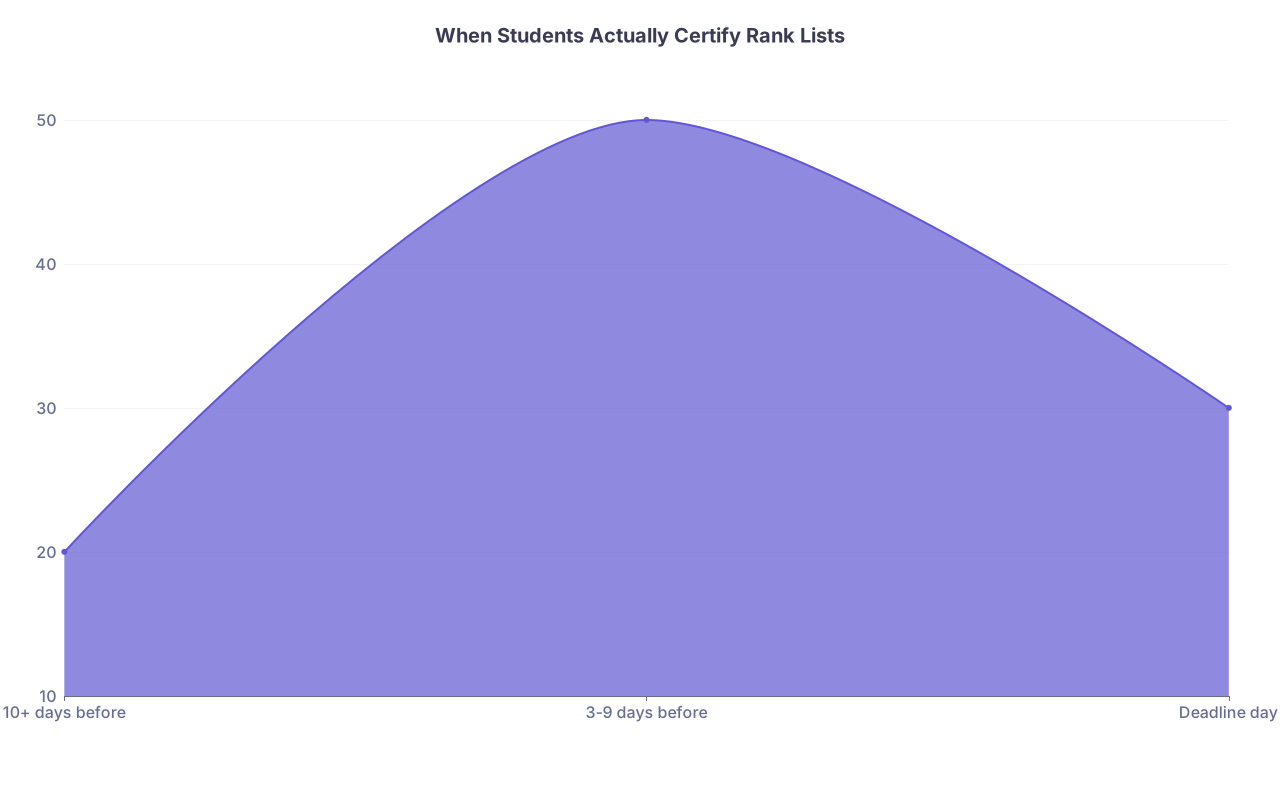
| Category | Value |
|---|---|
| 10+ days before | 20 |
| 3-9 days before | 50 |
| Deadline day | 30 |
Try to be in the middle bar, not the right one.
SOAP Contingency: Quiet Planning in the Background
While your rank list is your main play, an adult plan includes what happens if things go badly.
At this point (late January–February) you should quietly:
- Keep an updated CV and personal statement that can be repurposed for FM / IM / Peds if you may need them in SOAP.
- Know your SOAP command center:
- Where you will physically be
- Who can help you that week (advisor, dean, support person)
- Understand which backup specialties you would actually go after in SOAP versus which ones are “absolute last resort.”
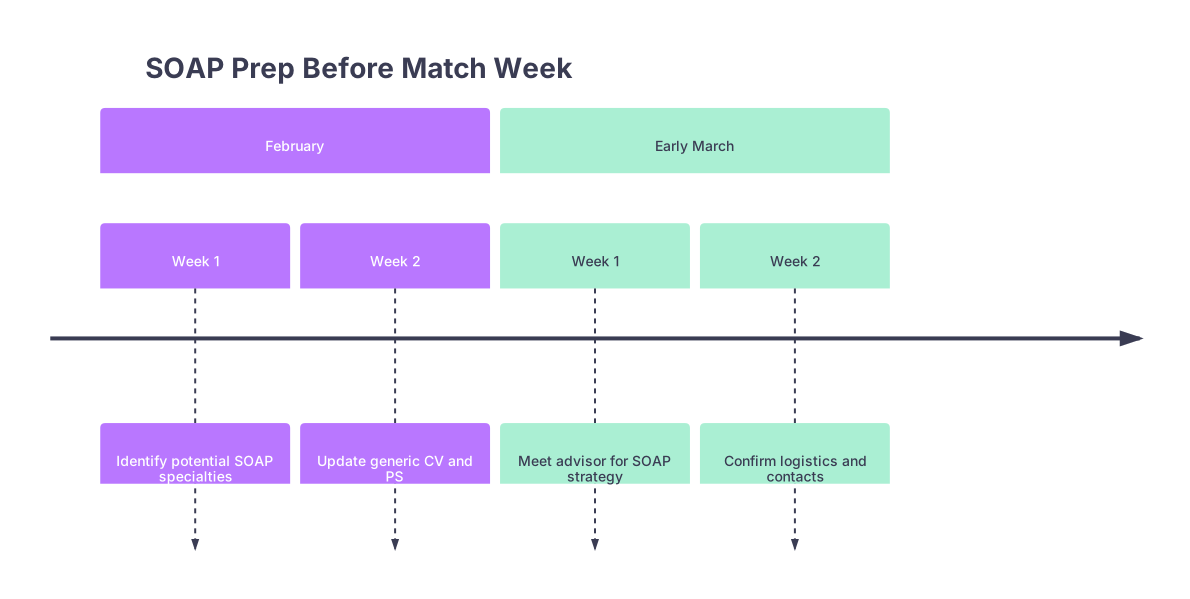
| Period | Event |
|---|---|
| February - Week 1 | Identify potential SOAP specialties |
| February - Week 2 | Update generic CV and PS |
| Early March - Week 1 | Meet advisor for SOAP strategy |
| Early March - Week 2 | Confirm logistics and contacts |
If you end up matching, this planning costs you nothing. If you do not, you will be very glad you did not start from zero on Monday of Match Week.
Quick Summary: The 3 Things That Actually Matter
Decide early if you need a real backup.
By mid-January you should know if your primary specialty interview numbers are risky. Do not wait until the rank deadline to “maybe think about FM.”Design your rank list around true preference, not fear.
Mixed lists with primary and backup specialties are fine. The only rule that matters: every step down your list should reflect “I would rather be here than anywhere below it,” regardless of specialty.Have a SOAP plan even if you never use it.
Update documents, know your backup specialties, and line up support in advance. If you do not need it, great. If you do, you will not be scrambling while everyone else is already on the phone.