
The worst way to approach electives in less competitive specialties is to treat them like they don’t matter. They do. The bar is lower, not absent.
You’re not fighting a 280 Step score bottleneck here—you’re fighting apathy, bad timing, and sloppy planning. That’s what burns people in “easy to match” fields.
This is the timeline you follow if you actually want options in undersubscribed residency programs (think: Family Medicine, Psychiatry, Pathology, PM&R in many regions, some Pediatrics and Internal Medicine community programs) instead of just hoping someone picks you up off the waitlist.
18–12 Months Before Residency Start (MS3 Early to Mid Year): Position Yourself
At this point you should stop thinking, “These specialties are easy, I’ll be fine,” and start acting like you’re making a real career decision.
Month 18–15 Before Residency Start (MS3 Early): Clarify the Target Field
Rough translation: early MS3, around July–September if you start in July.
Your jobs right now:
Pick 1–2 realistic target specialties among the less competitive ones
Examples:- Family Medicine (FM)
- Psychiatry
- Pathology
- PM&R
- Many community Internal Medicine or Pediatrics programs
Decide your backup strategy:
- Primary target: e.g., Psychiatry
- Backup: Family Medicine at community programs
Why this early? Because the best (and even the mediocre) electives require lead time. The fact these programs are “undersubscribed” does not mean their elective calendars are empty.
Concrete steps (2–3 weeks of focused effort):
Do a quick specialty reality check
- Talk to: a PGY1 or PGY2 in each specialty at your home institution.
- Ask them:
- “If someone knows by early MS3 they’re interested in your field, what would you want them to have done by ERAS time?”
- “Which away electives are actually worth it in your specialty—and which are a waste?”
- You’ll hear:
- Psych: “Show genuine interest, not just a backup plan.”
- FM: “Community experience and continuity of care matter more than big-name places.”
- Path: “One strong home rotation is usually enough, but we notice who shows up consistently.”
- PM&R: “We like students who bothered to learn the field before aways.”
Check if you need Step 2 early
- Undersubscribed ≠ anything goes.
- Some IM/FM programs still strongly prefer Step 2 by the time they rank you.
- If your Step 1 is weak, you should be planning now for an early Step 2 (spring MS3) to strengthen your application.
Start a running list of programs
- 5–10 programs per specialty:
- Local community programs
- Your home program(s)
- A few out-of-state community or mid-tier university programs
- Capture:
- Location
- VSLO use (yes/no)
- Elective blocks (4 vs 2 weeks)
- Application open dates if posted
- 5–10 programs per specialty:
At this point you should have:
- 1–2 target specialties
- A short list of programs you might want electives with
- A rough idea of when Step 2 will fit
12–9 Months Before Residency Start (MS3 Winter): Research and Calendar Lock
This is where most people either get organized or fall behind without realizing it.
Month 12–11: Map Your Fourth-Year Calendar
Approx: January–February of MS3.
You’re not just “taking electives.” You’re building a visible story.
Block out your immovable pieces
- Required MS4 rotations (sub-I, ICU, EM, etc.)
- Step 2 study window and exam date
- Any major personal constraints (weddings, childcare, religious holidays)
Define your “audition window”
- For undersubscribed specialties, the best timing for away or focused electives:
- July–October of MS4
- Ideal:
- 1 home elective early
- 1–2 aways in that July–October block
- For undersubscribed specialties, the best timing for away or focused electives:
Slot in target electives
- Example for a Psych-focused student:
- July: Home Psychiatry sub-I
- August: Away elective in Psych at a community program
- September: Away elective in Psych or related (addiction, consult-liaison)
- October: Backup specialty (FM) or a second Psych site closer to home
- Example for a Psych-focused student:
For context, here’s how your MS4 clinical time might roughly break down:
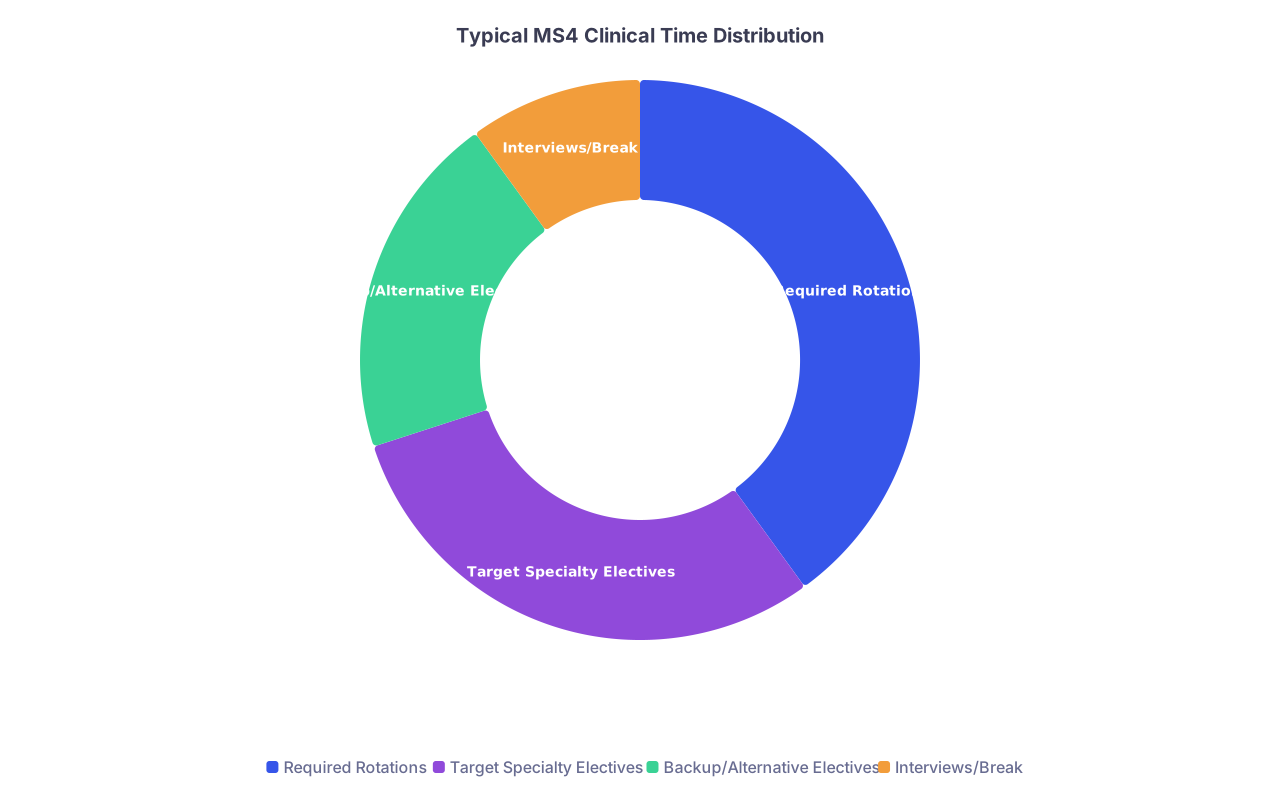
| Category | Value |
|---|---|
| Required Rotations | 40 |
| Target Specialty Electives | 30 |
| Backup/Alternative Electives | 20 |
| Interviews/Break | 10 |
Month 11–9: Deep-Dive Program Requirements
Now you translate vague interest into actual logistics.
Pick 5–8 programs per specialty and check:
- Do they accept visiting students?
- Through VSLO or direct application?
- Earliest month they accept MS4s
- Application open date for visiting students
- Immunization and documentation requirements (some are surprisingly picky)
- Need Step 1 score uploaded? Step 2?
Capture it all in a simple table:
| Program | Specialty | Application Path | First Block Open | Step 2 Required for Elective? |
|---|---|---|---|---|
| Local Comm FM | FM | Direct | July | No |
| State Univ IM | IM | VSLO | August | No |
| Regional Psych | Psych | VSLO | July | No |
| Rehab Center | PM&R | Direct | September | Sometimes |
At this point you should have:
- A draft MS4 calendar with target months for electives
- A spreadsheet or document with requirements and open dates for each program
9–6 Months Before Residency Start (MS3 Late Winter / Early Spring): Prep to Apply for Electives
This is when you gather documents and line things up so you can smash “submit” the moment applications open.
Month 9–8: Documentation and Letters
Focus: be ready to apply, not scrambling for paperwork.
Immunization and health stuff
- Get your:
- TB test or QuantiFERON
- Hep B titers
- MMR/Varicella proof
- Flu/COVID vaccines if required
- Store all PDFs in a single folder labeled clearly (you’ll thank yourself when VSLO times out on you for the third time).
- Get your:
CV and basic personal statement
- Even for less competitive fields, some electives will ask:
- Short personal statement (“Why this specialty?”)
- CV/resume
- Draft a 1-page specialty-specific statement you can tweak:
- 3–4 paragraphs, max
- Clear reason for the field
- 1–2 relevant experiences
- You’re not trying to impress Harvard. You’re trying not to look disorganized or fake.
- Even for less competitive fields, some electives will ask:
Letter of good standing / transcript
- Check how long your school takes to:
- Produce official transcripts
- Create “good standing” letters
- Build that lag into your timeline. I’ve seen schools take 3–4 weeks for something that should be simple.
- Check how long your school takes to:
Month 8–6: VSLO/Direct Application Readiness
Now you line up the portals.
VSLO
- Ensure:
- You’re activated by your school
- You know the exact date your target programs will open their spots
- Create a saved list of programs so you’re not searching from scratch on opening day.
- Ensure:
Direct applications
- For community programs not on VSLO:
- Find the medical student coordinator contact
- Ask 2 clear questions:
- “When do you open visiting student applications for [year]?”
- “What documents should I have ready before submitting?”
- Many will send you a PDF or a short checklist. Pin it. Follow it.
- For community programs not on VSLO:
At this point you should:
- Have all core documents ready
- Be activated and set up on VSLO (if needed)
- Know roughly which month you’ll apply to each elective
6–3 Months Before Residency Start (MS3 Late Spring to Early MS4): Apply and Lock Down Electives
Now it’s game time. The biggest mistake here is waiting “until I know my schedule better.” By then, the best months are gone.
Month 6–5: Submit Early Applications
Approx: April–May of MS3.
Your priority sequence:
Target specialty aways first
- Hit the programs where:
- You could realistically imagine training
- Your Step scores/academic record are in range
- They have a reputation for actually interviewing their rotators
- Hit the programs where:
Home institution electives
- Secure at least one home elective or sub-I in your target specialty in:
- July, August, or September
- Even for less competitive fields, programs want to see evidence you actually did the specialty before applying.
- Secure at least one home elective or sub-I in your target specialty in:
-
- If you’re aiming for an undersubscribed specialty as backup, still schedule:
- 1–2 rotations in that field (e.g., FM, IM) by September–October.
- Example: You think you want Psych but might need FM:
- July: Home Psych
- August: Psych away
- September: FM at a program you’d rank
- October: Research/easy elective + interview prep
- If you’re aiming for an undersubscribed specialty as backup, still schedule:
Month 5–3: Confirm and Adjust
Summer of MS3 rolling into early MS4 start.
Watch for acceptances
- As soon as you get an away elective offer:
- Decide within a week.
- Decline overlapping offers quickly so other students can grab them.
- Don’t cling to five half-confirmed electives. That chaos will wreck your schedule.
- As soon as you get an away elective offer:
Coordinate with your school
- Ensure every away elective is:
- Approved for credit
- Properly labeled on your transcript (e.g., “Psychiatry Acting Internship” vs “Elective – Other”)
- Ensure every away elective is:
Here’s how the overall planning period stacks up visually:
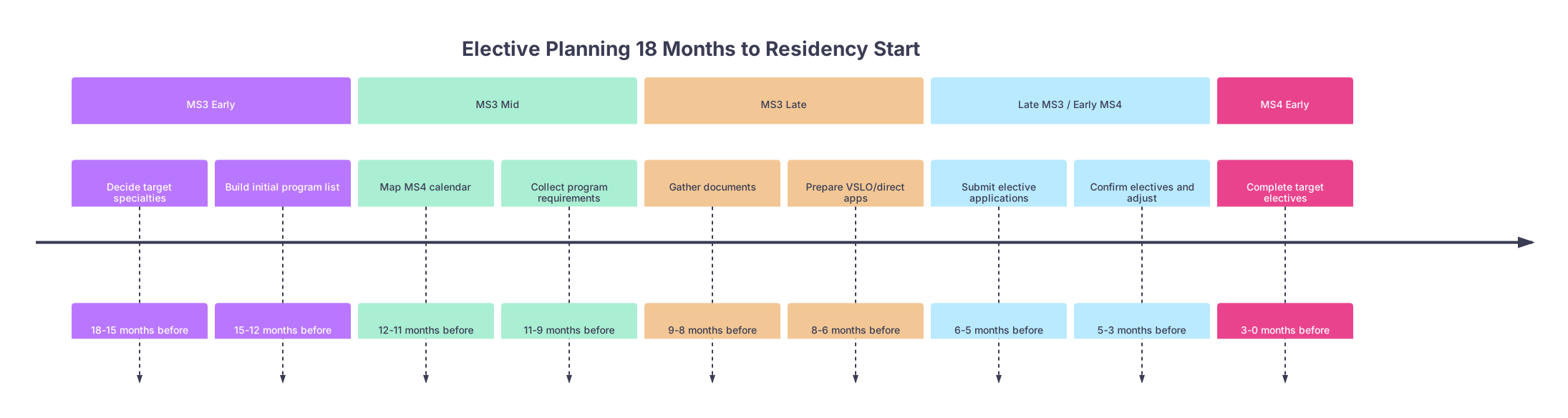
| Period | Event |
|---|---|
| MS3 Early - Decide target specialties | 18-15 months before |
| MS3 Early - Build initial program list | 15-12 months before |
| MS3 Mid - Map MS4 calendar | 12-11 months before |
| MS3 Mid - Collect program requirements | 11-9 months before |
| MS3 Late - Gather documents | 9-8 months before |
| MS3 Late - Prepare VSLO/direct apps | 8-6 months before |
| Late MS3 / Early MS4 - Submit elective applications | 6-5 months before |
| Late MS3 / Early MS4 - Confirm electives and adjust | 5-3 months before |
| MS4 Early - Complete target electives | 3-0 months before |
At this point you should:
- Have at least 1–2 target specialty electives confirmed for July–October
- Have required home rotations slotted correctly
- Know exactly which months are still flexible
MS4 Year (July–January Before Residency Start): Execute on Electives and Convert Them to Interviews
Now you’re living in the schedule you built. Time to not waste it.
July–October MS4: On-Site Electives in Undersubscribed Programs
The goal: turn “we’re not competitive” into “we know you, we like you, we’ll rank you.”
On each elective (home or away):
First 2–3 days: signal clearly
- Tell the attending or clerkship director:
- “I’m applying to [specialty] this cycle and very interested in community/university programs like this.”
- In less competitive fields, programs pay attention to students who actually say they want to be there. Many don’t.
- Tell the attending or clerkship director:
Middle of rotation: secure a letter
- Week 2 or early Week 3 on a 4-week block:
- Ask for a letter while they still remember specific cases:
- “I’ve really appreciated working with you. Would you feel comfortable writing a strong letter for my [Psych/FM/etc.] residency application?”
- Ask for a letter while they still remember specific cases:
- Do not wait until the last day when everyone’s rushing out.
- Week 2 or early Week 3 on a 4-week block:
End of rotation: close the loop
- Ask directly:
- “Do you generally interview most of your student rotators?”
- Often in undersubscribed programs the answer is yes—if:
- You showed up on time
- You did solid, reliable work
- You weren’t weird or arrogant
- Ask directly:
November–January MS4: Fill Gaps and Support Interviews
By now, ERAS is submitted and interviews are rolling.
Use this period for:
- A backup specialty rotation if not already done
- A lighter elective or research block to accommodate interviews
- A second focused rotation in your target field if you were late to decide
Remember:
Some undersubscribed specialties (Pathology, certain FM or Psych programs) will actually notice that you’re still doing rotations in their field after applications went in. It reinforces that this isn’t just your panic option.
Specialty-Specific Nuances You Time Around
Not every “least competitive” specialty behaves the same way with electives.
Family Medicine / Community Internal Medicine
- Many programs:
- Don’t need a specific “audition elective”
- But love to see a community-based experience in a region similar to theirs
- Timing priority:
- 1–2 FM/IM rotations before ERAS submission (July–September MS4)
- Strategy:
- If you’re aiming at a specific region, do an elective there. They notice locals and near-locals.
Psychiatry
- Still overall less competitive than Derm, Ortho, etc., but it’s tightening in some regions.
- Electives:
- 1 home Psych sub-I or inpatient Psych
- 1 away at a Psych-heavy community or university program you’d seriously rank
- Timing:
- Aim to have both by September MS4 for maximum impact on letters and ERAS.
Pathology
- Fewer students = more eyes on the ones who show up.
- Often:
- One strong home Path elective with real engagement is enough
- Strategy:
- Do the home Path elective by August or September MS4
- Consider 1 away if your home program is tiny or nonexistent.
PM&R
- Programs notice who did their homework.
- You want:
- At least one dedicated PM&R elective (inpatient rehab, consults, or outpatient PM&R)
- Neurology or Ortho electives can be helpful but don’t replace real PM&R exposure.
- Timing:
- PM&R elective ideally prior to ERAS submission (August/September MS4)
Quick Month-by-Month Snapshot (Relative to Residency Start)
To anchor everything:
18–12 months before (MS3 early–mid)
- Decide target specialty/backup
- Identify programs, understand Step 2 needs
- Rough-draft MS4 calendar
12–9 months before
- Lock the framework of your MS4 schedule
- Research specific elective requirements and application paths
9–6 months before
- Gather documents (health, transcripts, CV, statement)
- Activate VSLO and prep direct-application materials
6–3 months before
- Apply for electives (prioritize July–October blocks)
- Confirm offers and sync with your school
MS4 July–October
- Complete key electives
- Get letters and show clear interest
- Submit ERAS with those experiences in hand
MS4 November–January
- Buffer for interviews and backup electives
- Optional: additional rotations in target field
Final Takeaways
- Undersubscribed does not mean effortless. You still need a structured, 12–18 month elective plan if you want real choice, not just “somewhere.”
- Your July–October MS4 blocks are prime real estate. Fill them with targeted electives—home and away—that match the residency types you’d actually rank.
- Electives are signaling devices. In less competitive fields, consistent, timely involvement in the specialty is often the difference between “backup applicant” and “we’re happy to train this person.”