
The way most applicants schedule interviews at low-competition programs is backwards—and it costs them offers.
You do not “save” your easier programs for later. You also do not burn them all in the first panicked week of invites. You sequence them. On purpose. Week by week.
Here’s how to do it.
Big Picture: How Your Calendar Should Look Over 10–12 Weeks
At this point you should stop thinking in terms of “program prestige” and start thinking in blocks of practice, anchor, and safety.
Rough structure for a typical November–January season:
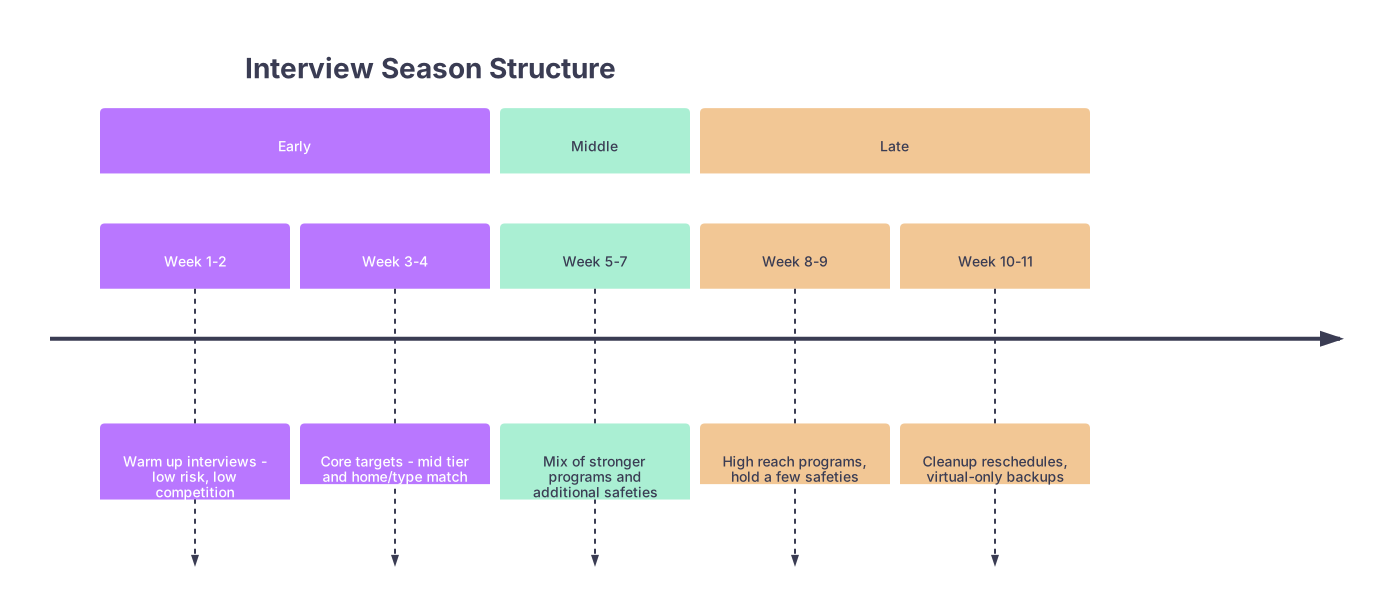
| Period | Event |
|---|---|
| Early - Week 1-2 | Warm up interviews - low risk, low competition |
| Early - Week 3-4 | Core targets - mid tier and home/type match |
| Middle - Week 5-7 | Mix of stronger programs and additional safeties |
| Late - Week 8-9 | High reach programs, hold a few safeties |
| Late - Week 10-11 | Cleanup reschedules, virtual-only backups |
That’s the skeleton. Now layer in the specialty reality: for least competitive specialties (FM, psych, peds, IM categorical at community programs, PM&R at some places, neurology in many regions), the game is not “Can I match?” It’s:
- Can I match in a location I like
- With a schedule and culture I can live with
- Without blowing up my rank list by mismanaging my safest options
Low-competition programs are your leverage. You use them to:
- Warm up before bigger interviews
- Create “anchor” options in cities you like
- Backstop the end of season when you’re fatigued and overbooked
We’re going to walk this month by month, then week by week, then down to how to handle specific days once invites start dropping.
3–4 Months Before Interviews: Set Your Strategy Now
At this point (late summer / early fall, August–September), you’re not scheduling yet. You’re setting the constraints that will control your future panic.
Step 1: Define your tiers before invites
Do this on a spreadsheet, not in your head. Rank programs into three working buckets:
- Tier 1 – Reach/”would move anywhere”
- Highly academic, big-name, or dream geography
- You’d change life plans to go there
- Tier 2 – Solid, realistic, “good fit”
- Region you like, reasonable workload, vibe aligns with you
- Most university-affiliated community programs land here
- Tier 3 – Low-competition safeties
- Undersubscribed locations, historically low fill, smaller community programs
- Places that reliably interview and rank a lot of applicants
You’re writing an article for “least competitive specialties,” but within those, some programs are still brutally selective (e.g., UCSF Pediatrics vs. a rural peds program).
Get concrete. Example for Family Medicine:
- Tier 1: University of Washington FM, UNC FM
- Tier 2: State university programs in your region, solid suburban community programs
- Tier 3: Rural Midwest/South community FM, new programs, historically high unfilled spots
Step 2: Decide your maximum interview load
Overinterviewing is the most common strategic mistake I see in these specialties.
Use this rough ceiling:
| Specialty Band | Examples | Recommended Max Interviews |
|---|---|---|
| Very Low Competition | Family Med (most), Psych (community), Peds (community) | 10–12 |
| Low-Mid Competition | IM community, Neurology, PM&R, Pathology | 12–15 |
| Higher Inside Low Band | Academic-only target within these fields | 15–18 |
If you’re trying to schedule 20+ interviews in a least-competitive specialty, you’re not being strategic. You’re hoarding out of fear.
Set a hard cap now. Write it down. You’ll need it later when your inbox is a mess.
Step 3: Pre-label “do not decline early” programs
There are some low-competition programs you should never casually decline early:
- Programs in desirable cities with historically stable faculty
- Places aligned with specific interests (addiction psych, sports FM, developmental peds)
- Programs in your home region where you actually want to live near family
Tag 5–7 of these as “priority safeties”.
These are the low-competition programs you’ll want:
- Early in the season as warm-ups
- Still on your calendar mid-season for security
- Not all lumped in the last two fatigue-soaked weeks
When Invites Start (October): Your First 72 Hours
This is where people blow it. They treat the first week like a land grab instead of like a chess opening.
At this point you should:
- Stop accepting everything.
- Stop auto-booking the earliest date offered.
- Start shaping your first 3 weeks deliberately.
Day 1–3 Rule Set
As invites start coming in (often clustered over a few days):
- Immediately schedule 2–3 low-competition programs in the first 2–2.5 weeks of your available season.
- These are your warm-up reps.
- Aim for 1–2 per week initially.
- Block out 1–2 days per week in those early weeks for potential higher-tier invites that arrive a bit later.
- Do not dump all Tier 3 interviews into December or January.
You need early safety and early practice.
Example for a psych applicant:
- Week 1:
- Wed – Community psych in nearby city (Tier 3)
- Fri – Mid-tier state program psych (Tier 2)
- Week 2:
- Tue – Rural psych program (Tier 3)
- Thu – Leave open for potential academic psych invite
- Week 3:
- One more Tier 2 or Tier 3, plus one open slot
The point: low-competition programs go early, but not only early.
November: Build the Middle of Your Schedule Intentionally
By early November, you’ll have a first wave of invites and a partially filled calendar.
At this point you should have:
- 3–5 interviews scheduled in the first 3 weeks
- At least 1–2 of those from Tier 3 (low-competition)
- Several mid-season days still open
Now you refine.
Week-by-Week Guidance
Weeks 1–2 of Interviews (early November)
Goal: Learn the format, find your voice, lock in at least one place you’d be OK matching.
Use low-competition programs to:
- Practice your story and behavioral answers
- Test your “Why this specialty?” narrative under stress
- Ask attendings and residents targeted questions you can reuse later
Do not treat these as throwaways. You may end up ranking one of them #3.
Weeks 3–4 (mid–late November)
Goal: Hit your core Tier 2 targets while you’re fresh, but keep a safety presence.
At this point you should:
- Have 2–3 Tier 2 interviews scheduled in this block
- Keep 1–2 Tier 3 programs scattered in this same time frame
- Avoid stacking 3 “reach” days in a single week if you can help it
Why still include low-competition programs here?
- They give you mental relief: “I already have 2–3 places I’d be okay with.”
- They stop you from getting seduced into overcommitting to distant, shiny names that fit your ego more than your life.
December: Guard Against Fatigue and Overbooking
December is where people in low-competition specialties accidentally sabotage themselves. They realize they’re “safe” and start:
- Accepting high-travel, low-fit interviews “because why not”
- Pushing all remaining community/safety programs into late December/January
- Showing up tired, cynical, and flat to the very programs they’re most likely to match at
At this point you should start pruning.
Early December: The Mid-Season Recount
Sit down and do three numbers:
- Total interviews scheduled
- How many you’d be okay matching at (truly okay, not pretending)
- How many Tier 3s are bunched in the last 2 weeks of your season
Use this to make moves:
- If you already have 10–12 interviews in FM/psych/peds/etc and at least 5–6 realistic fits, you can start:
- Declining new low-competition invites in locations you don’t care about
- Rescheduling lower-interest ones out of the final exhaustion weeks if possible
- If you have fewer than 8 total interviews or <4 realistic fits, you need to:
- Accept remaining low-competition invites that are at least neutral on location
- Avoid canceling any Tier 3s unless they’re truly no-go for you
Structuring December Weeks
Weeks 5–6 (early–mid December)
Goal: Maintain balance. You’re not desperate, but you’re not done.
Ideal week structure:
- 1 higher-tier/academic or geographic “reach”
- 1–2 Tier 2 fits
- 1 low-competition safety (Tier 3)
The Tier 3 that week is insurance. If you bomb the academic interview or realize a program culture is miserable, you still had a lower-stress, higher-likelihood day that week.
Weeks 7–8 (late December)
This is where people stack all their leftovers. Do not.
At this point you should:
- Make sure you’ve front-loaded at least half of your Tier 3s
- Keep no more than 2 low-competition, low-interest programs in the final 2–3 weeks
- Start canceling geographically miserable options where you know you’d be unhappy long-term
Remember: attending a program you’d rank #18 out of 18 is usually a waste of everyone’s time in a low-competition field, once you already have 10+ total interviews.
January: Final Stretch and Strategic Cancellations
By early January, your main enemy is not competitiveness. It’s burnout.
At this point you should:
- Know your true top 5–7 programs
- Have at least 6–8 interviews completed
- Be honest about your energy and travel budget
How Low-Competition Programs Fit in Late Season
Use them in three ways:
As backup if you’ve underperformed
- If you walked out of multiple interviews feeling off, keep a couple January low-competition places as “fix my performance” attempts.
As geographic insurance
- If all your favorite regions are long shots, those late community programs in solid locations might become your quiet heroes.
As cancellation leverage
- If you already have more acceptable options than you need, you can now cancel far-flung safeties and reclaim time/sanity.
A simple decision filter for each remaining Tier 3 in January:
- Would I honestly rank this in my top 10?
- If yes → Keep.
- If no → Consider canceling if you already have 10–12 total interviews and 6+ strong fits.
Day-by-Day Tactics: When an Invite Lands from a “Safe” Program
Let’s get concrete. You’re an IM applicant targeting mostly community programs. It’s November 5. Your phone buzzes with:
“You are invited to interview at Midwest General Hospital Internal Medicine.”
You vaguely remember this as a low-competition community program in a small city you’re lukewarm about.
At this point you should:
Check your current count.
- If you’re below 8 total interviews → Strong bias to accept and place it in the earlier half of your season.
- If you’re already at 12+ with many good fits → You can afford to be more selective.
Look at your week structure.
- Is Week 2 empty or light? Perfect place for this.
- Is Week 7 overloaded with random safeties? Don’t dump it there by default.
Avoid the “everything in one week” trap.
- No more than 3 interviews in any week, ideally 2.
- Don’t put 2 back-to-back full travel days if you can avoid it.
Special Cases: Couples Match and Dual-Application
If you’re couples matching or dual-applying (e.g., FM + IM, psych + neuro), low-competition programs become grid pieces.
At this point you should:
- Use low-competition interviews to anchor shared cities:
- Example: You and your partner both get community psych and community FM invites in the same mid-sized city. Those become crucial, not “extra.”
- Schedule them earlier, not later, so:
- You can adjust later invitations based on how many overlapping locations you already have.
- Be willing to cancel isolated single-program cities in January if you already have several overlapping, decent options.
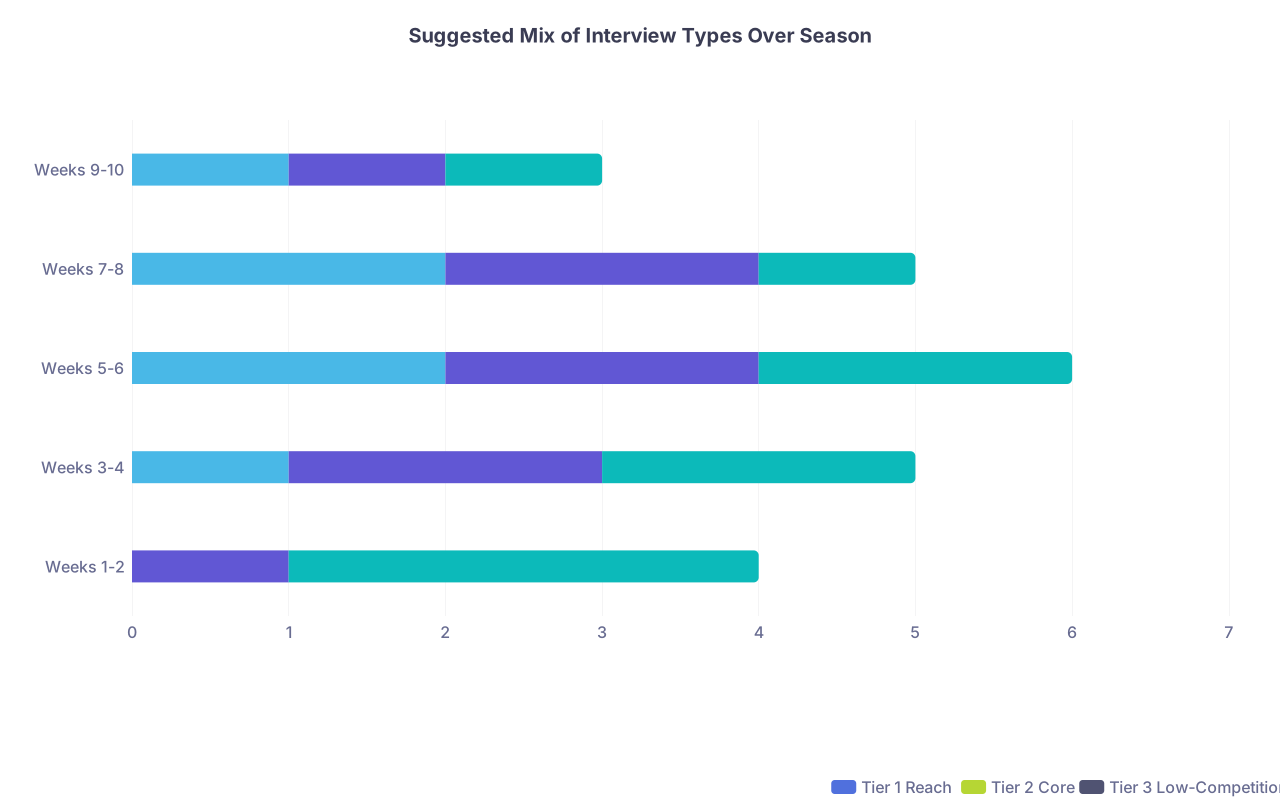
Visual Snapshot: How to Mix Program Tiers Over Time
| Category | Tier 1 Reach | Tier 2 Core | Tier 3 Low-Competition |
|---|---|---|---|
| Weeks 1-2 | 0 | 1 | 3 |
| Weeks 3-4 | 1 | 2 | 2 |
| Weeks 5-6 | 2 | 2 | 2 |
| Weeks 7-8 | 2 | 2 | 1 |
| Weeks 9-10 | 1 | 1 | 1 |
Notice the pattern:
- Tier 3 (low-competition) is strong early, present mid, light late
- Tier 2 sits in the middle of the season
- Tier 1 ramps up a bit later when you’re warmed up but not exhausted
Example Timeline: Psych Applicant in a Least Competitive Region
Let me walk you through a realistic skeleton. Say you’re applying psych and you’re not aiming for ultra-elite coastal programs.
October
- ERAS out, invites trickling in
- You pre-label:
- 4 academic-ish psych programs in your home state (Tier 2)
- 6 community psych programs within driving distance (Tier 3)
- 3 big-name academic psych programs out of state (Tier 1)
Early November (Weeks 1–2)
At this point you should:
- Book:
- Week 1 Tue – Community psych A (Tier 3)
- Week 2 Thu – Community psych B (Tier 3)
- Reserve:
- Week 1 Fri – Open
- Week 2 Tue – Open
You get a Tier 2 invite mid-week → slot it into Week 2 Tue.
Late November (Weeks 3–4)
You’ve now done 2 interviews, feel more comfortable.
You schedule:
- Week 3 Wed – State university psych (Tier 2)
- Week 3 Fri – Community psych C (Tier 3)
- Week 4 Thu – Another state-affiliated psych (Tier 2)
You still keep 1–2 days open for possible Tier 1 academic invites.
December (Weeks 5–7)
Total interviews now: 5–6. You add:
- Week 5 Tue – Academic psych in another state (Tier 1)
- Week 5 Thu – Community psych D (Tier 3, good city)
- Week 6 Wed – Local state program psych (Tier 2)
You decline a late invite to a remote, weaker Tier 3 in a location you’d hate.
January (Weeks 8–9)
At this point you should:
- Have 8–10 interviews done, with at least 5–6 realistic fits
- Keep maybe 1–2 January low-competition programs:
- Week 8 Thu – Community psych E (Tier 3, near family)
- Cancel a faraway Tier 3 you only accepted out of early panic.
You end the season not with 18 scattered interviews, but with 10 targeted ones, well-timed, where your best performances overlap with your best fits.
Quick Recap: How to Use Low-Competition Programs Wisely
Front-load, don’t back-load.
Low-competition programs belong early and mid-season as warm-ups and anchors, not piled into the last exhausted weeks.Use a hard interview cap and stick to it.
In least competitive specialties, 10–15 interviews is almost always enough. Beyond that, you’re usually burning time, money, and energy.Keep only the safeties you’d actually rank.
A “safety” in a city you’d hate isn’t safety. It’s self-sabotage. Let those go once you have enough realistic options elsewhere.