Only 27% of residents in the least competitive specialties trained in programs with a fully standardized, clearly documented curriculum when surveyed anonymously. Everyone else basically said, “We just did whatever coverage gaps existed.”
That gap between what is written in the program brochure and what actually happens on the ground is where least competitive programs live. The curriculum is technically “ACGME-compliant,” but the structure, balance, and educational intent look very different from what you see in high‑reputation, highly competitive specialties and programs.
Let me break down what that means in real terms.
1. What “Least Competitive” Actually Looks Like on the Ground
We are not talking about weak residents or “easy” medicine. We are talking about program ecosystems where:
- Applicant demand is low relative to available positions
- Geographic desirability is limited (small town, economically depressed area, distant from major academic hubs)
- Hospital resources and faculty density are modest
- The curriculum is built more around service needs than around deliberate, longitudinal education
Typical specialties in this bucket (depending on year and region):
- Family medicine (especially small community programs)
- Internal medicine at lower‑tier community hospitals
- Psychiatry in underserved or rural regions
- Pediatrics in non‑academic, non‑children’s hospital settings
- Transitional year programs attached to small community hospitals
- Preliminary medicine/surgery spots that historically scramble / SOAP
Not every program in these specialties is “least competitive.” But the pattern is consistent: the further you move from high‑volume academic centers into peripheral, service-heavy community programs, the more the curriculum takes on some distinctive structural features.
2. Core Structural Theme: Service-Driven, Not Curriculum-Driven
In highly competitive programs, the curriculum drives the service. In weaker ones, the service drives the curriculum.
You see the difference immediately in how rotations are designed, scheduled, and protected.
2.1 Rotation Design: Coverage First, Education Second
In least competitive programs, most rotation structures are built around minimum staffing needs:
- “We need X warm bodies on the wards”
- “Clinic must be staffed 5 days a week”
- “Night float must be covered 365 days”
Only after that puzzle is solved does anyone ask, “Does this actually match a logical educational progression?”
As a result, you commonly see:
Highly repetitive ward months with minimal differentiation
- Internal medicine example: “General Medicine 1, General Medicine 2, General Medicine 3” that are functionally identical—same teams, same attendings, same patient mix, just different calendar blocks.
Procedural and consult rotations that exist mostly as electives
- You “can” do GI, cards consults, or pulmonary, but there is no guaranteed structured exposure for all residents. If the service is quiet or the consultant is uninterested, your “rotation” becomes unstructured scut and random note writing.
Subspecialty exposure only when a local attending happens to be available
- An endocrinologist who covers just one day per week translates into “Endocrine clinic / rotation” that hovers between token and non‑existent.
Compare that to a strong academic IM program where PGY-1 has a designed mix of wards, ICU, ED, and structured subspecialty blocks with defined objectives. In the least competitive setting, the phrase you will hear more often is: “We just plug people in where we need them.”
3. Typical Rotation Mix and Block Structures
Let’s get specific. This is what the block structure actually looks like at many lower‑tier, least competitive programs.
| Rotation Type | PGY-1 (13 blocks) | PGY-2 (13 blocks) | PGY-3 (13 blocks) |
|---|---|---|---|
| Inpatient Wards | 5–7 | 4–6 | 3–5 |
| ICU / Critical Care | 1–2 | 1–2 | 1 |
| Night Float / Nights | 1–2 | 1–2 | 1–2 |
| Outpatient Clinic | 2–3 | 2–3 | 2–3 |
| Subspecialty Rotations | 1–2 | 2–3 | 3–4 |
The numbers are not shocking. The structure behind them is what tells you you are in a least competitive environment.
3.1 Internal Medicine: The Classic Community Template
A typical low‑competitiveness community IM program:
PGY‑1:
Heavy wards (6–7 blocks), 1 ICU, 1 night float. Outpatient is a half‑day clinic once a week on top of whatever rotation you are on. Electives exist but are minimal and not truly protected.PGY‑2:
Slight drop in wards, 1 ICU, 1–2 nights. A couple elective blocks that often get partially carved up to help cover service gaps.PGY‑3:
“Senior” wards (supervising interns), one last ICU, some consult electives. Still getting pulled for coverage more than anyone will admit on paper.
The ACGME requirements are met. But there is very little longitudinal planning. You do not see explicit “We want PGY‑1s to focus on core inpatient management, PGY‑2s on subspecialty depth, PGY‑3s on higher‑level decision making and teaching.” It is more: “We need a senior on Team B, so guess you’re on Team B again.”
3.2 Family Medicine: Clinic Heavy… on Paper
Least competitive FM programs often talk a lot about outpatient continuity. The brochure promises “1000+ continuity patient encounters.” In reality:
- Continuity clinic schedules are often inconsistent and frequently disrupted by inpatient coverage, OB call, and cross‑coverage for other services.
- OB exposure can be highly variable. If the hospital’s OB volume has been dropping, the FM residents get less delivery experience and more charting or triage.
Curriculum structure:
PGY‑1:
Months of general inpatient adult medicine, a couple of pediatrics months, some OB, and clinic half‑days shoehorned into all of it. You live in a time‑fragmented world.PGY‑2 and PGY‑3:
More clinic, “electives” in sports medicine, geriatrics, behavioral health, but not consistently structured. It is common to see electives repurposed ad hoc: “We lost a hospitalist this month, so your sports med elective is now inpatient.”
The defining feature: everything is flexible. But flexible in the wrong direction—toward service, away from planned education.
4. Didactics: The Weakest Link
If you want one question that instantly reveals curriculum quality, it is this: “What do your didactics actually look like? Who runs them, and who is guaranteed to be there?”
Least competitive programs tend to have:
- Inconsistent schedules
- Frequent clinical interruptions
- Faculty who “drop in” rather than take ownership
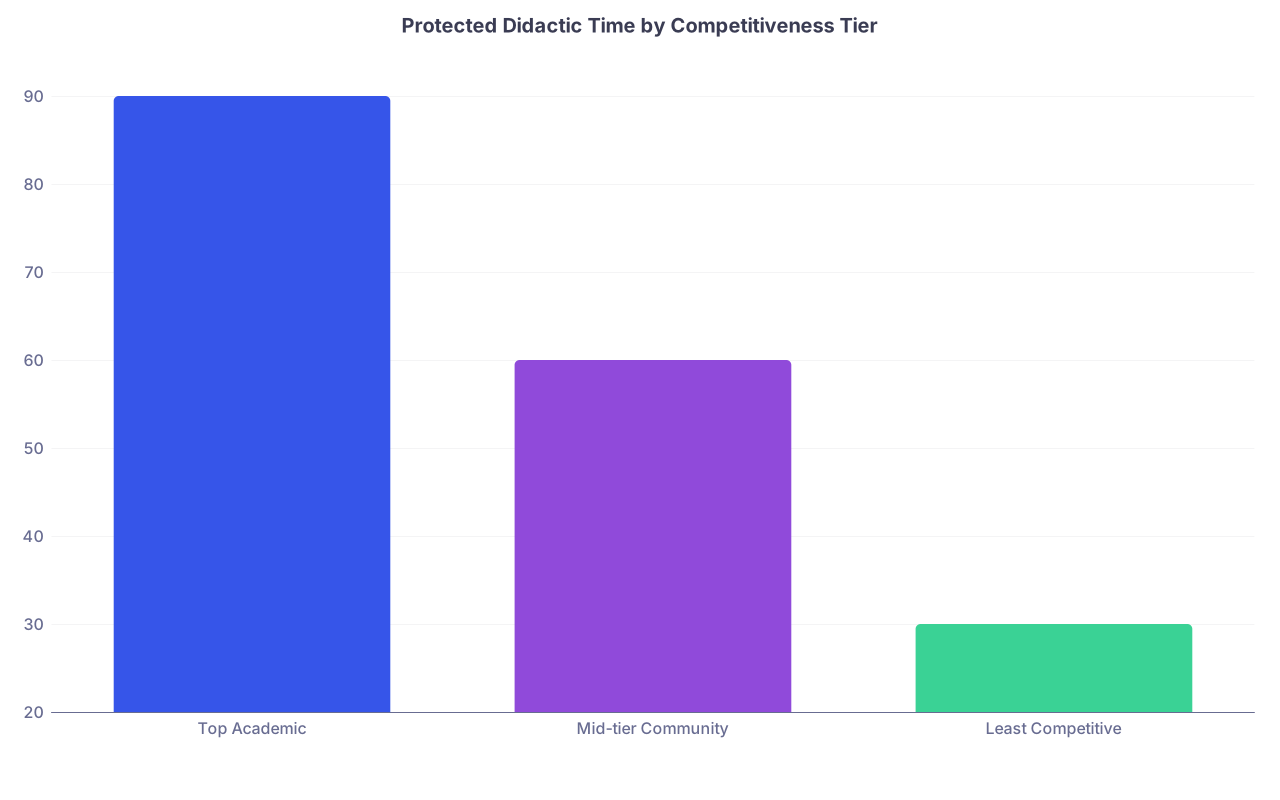
| Category | Value |
|---|---|
| Top Academic | 90 |
| Mid-tier Community | 60 |
| Least Competitive | 30 |
(Values are approximate minutes of truly protected teaching time per week where residents are not paged, pulled, or guilted.)
4.1 Common Didactic Patterns in Least Competitive Programs
You will see a mix of:
- Noon conference, daily or a few days a week
- Weekly grand rounds (often poorly attended by residents who are stuck on wards)
- Journal club once a month
- Morbidity and mortality conference monthly or quarterly
- Occasional board review sessions when someone remembers
The structural issues:
No real protection.
“Protected” often just means “we scheduled teaching then layered patient care on top and hope you figure it out.” Interns answering pages throughout “lecture” is the default, not the exception.No longitudinal didactic plan.
In stable academic programs, there is often a 12–18 month rolling curriculum with mapped topics by week. In low‑tier programs, the scheduler is often an overwhelmed chief resident or single APD who emails, “Anyone free to give a talk next Wednesday?”Faculty inconsistency.
A hospitalist giving the same pneumonia or DKA talk every year, a cardiologist who cancels half their sessions because cath lab is busy. I have seen programs where residents literally keep a “bingo card” of who will cancel next.
4.2 Exam and Board Preparation
Board review is usually bolted on as an afterthought:
- Sporadic question‑based sessions with MKSAP or UWorld questions
- Senior residents running informal review sessions when they are not exhausted
- Very few programs in this tier pay for structured question banks for residents
So residents end up self‑studying. Not a tragedy, but it means the curriculum is not doing the heavy lifting that a well‑structured program would.
5. Clinic and Continuity: Fragmented and Under‑Supervised
For primary care‑leaning specialties, continuity clinic should be the spine of the curriculum. In least competitive settings, it rarely is.
5.1 Scheduling and Structure
Patterns you will notice:
Floating clinic half‑days.
Residents have 1–2 half‑days per week of continuity clinic, constantly moved around to fit ward coverage. Some weeks it vanishes entirely because “we need you on nights.”High no‑show rates and unstable panels.
Underserved populations, transportation issues, unstable insurance coverage – and no robust system to track true continuity panels. Residents may believe they have “their” patients, but EMR data tells a different story.Limited subspecialty integrated clinics.
Co‑located behavioral health, diabetes education, complex care management – those are luxuries in many small programs.
5.2 Supervision Quality
Attending coverage often looks like:
- One overextended preceptor covering 3–4 residents and a PA or NP
- Very brief case discussions: “Stable? OK, send refill. Next.”
- Little time for in‑depth counseling on diagnostic uncertainty, complex multimorbidity, or end‑of‑life care
The curriculum rarely includes:
- Structured video review of encounters
- Direct observation tools used consistently
- Longitudinal tracking of resident-specific patient outcomes
This is where “least competitive” quietly becomes “less educational.”
6. Night Float, Call, and ICU: The Overload Zones
Another structural hallmark: the way nights and ICU are handled.
6.1 Night Float as Dumping Ground
In more robust programs, night float is:
- Clearly defined
- Staffed with adequate backup
- Embedded with intentional teaching (morning/night report, simulation, direct critical care teaching)
In many least competitive programs, night float is simply: “You are the person in the building after 5 pm.”
Common structures:
- Single resident covering wards + cross‑cover for multiple units
- Minimal attending in-house presence
- “Teaching” reduced to occasional phone calls with sleepy attendings and sign‑out at 6:30 am that is purely transactional
Residents get “experience” quickly. They do not get structured feedback or teaching on rapid response management, triage decisions, or subtle early decompensation. A lot of near‑misses get chalked up to “you will learn.”
6.2 ICU: An Afterthought Block
ICU experiences in least competitive community settings:
- 1–2 months per year, often co‑staffed by hospitalists with varying levels of critical care training
- Limited exposure to advanced therapies (CRRT, ECMO, complex mechanical ventilation modes)
- Few or no formalized, daily bedside teaching rounds focused on physiology and vent management
The curriculum documents may list robust objectives. The lived experience is often “manage pressors, titrate drips, call transfer for really sick patients because we cannot keep them here.”
7. Research, QI, and Scholarly Work: Token and Thin
You can usually tell how competitive a program is by how they talk about scholarly activity. In highly competitive ones, there is structure, mentorship, and publication pipelines. In least competitive ones, there is a policy and a checkbox.
7.1 Structural Realities
What you tend to see:
- One generic “scholarly activity” requirement
- Journal club counted as “scholarly” for some residents
- Quality improvement projects that are:
- Often resident‑designed with minimal data support
- Seldom completed in a rigorous way
- Almost never presented beyond local poster days
There is usually no:
- Protected research time
- Embedded statistician or research office support
- Formal mentorship matching process
So residents with genuine academic interest either:
- Grind out small retrospective chart reviews on personal time
- Or defer serious research ambitions to fellowship or post‑residency jobs
The curriculum structure pays lip service to scholarship while funneling almost all time and energy into service coverage.
8. How Least Competitive Curricula Differ from Stronger Programs
To make this concrete, contrast a typical least competitive community IM program with a mid‑tier academic IM program.
| Feature | Least Competitive Community IM | Mid-tier Academic IM |
|---|---|---|
| Rotation Planning | Coverage-driven | Competency-driven |
| Didactic Protection | Weak, often interrupted | Strong, institutionally backed |
| Continuity Clinic | Fragmented, unstable panels | Structured, panel-tracked |
| Subspecialty Exposure | Opportunistic, elective-only | Required, longitudinal |
| Research Infrastructure | Minimal, ad hoc | Defined pathways, mentorship |
That last row matters more than people think. Curriculum structure reflects institutional priorities. If administration only cares about coverage and billing, you will feel that in every rotation decision.
9. Signals You Are Looking at a “Least Competitive” Curriculum
If you are a student or applicant trying to read between the lines, pay attention to how programs describe specific things.
Here is a mental checklist that residents learn the hard way:
“Our schedule is very flexible.”
Translation: rotations are constantly reshuffled to plug service holes.“We are a resident‑run service.”
Translation: residents carry most of the load with limited PA/NP or hospitalist support.“We really value autonomy.”
Translation: you may be effectively unsupervised at times.“You will see a LOT of volume.”
Translation: documentation and cross‑coverage may overwhelm actual learning.“Electives are wide open and can be whatever you want.”
Translation: there is no structured subspecialty curriculum and no guarantee of meaningful mentorship.
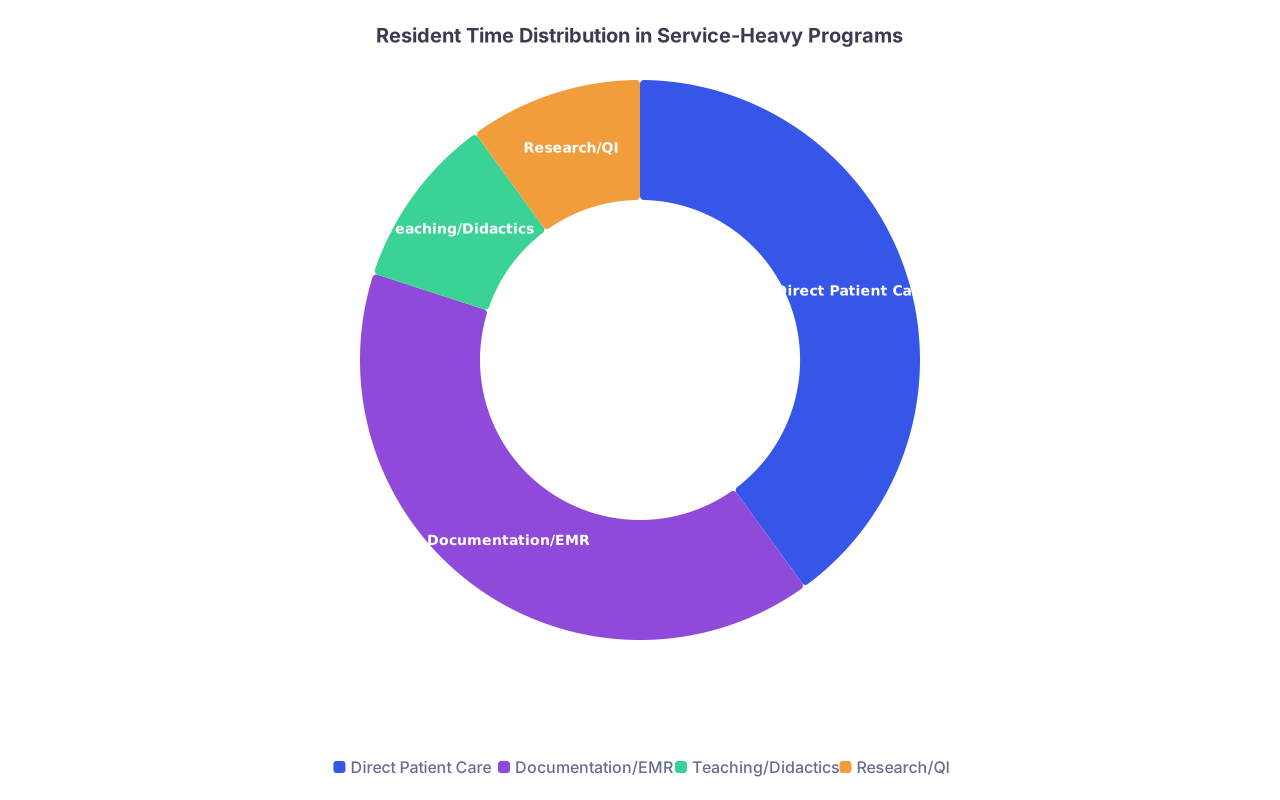
| Category | Value |
|---|---|
| Direct Patient Care | 40 |
| Documentation/EMR | 40 |
| Teaching/Didactics | 10 |
| Research/QI | 10 |
Those percentages are not unusual. But strong programs work aggressively to protect and increase the “Teaching/Didactics” slice. Least competitive programs usually do not.
10. Strengths Hidden Inside These Curricula
Not everything is bleak. Some of the features of least competitive curricula produce real strengths—if you know how to exploit them.
10.1 Immense Clinical Volume and Responsibility
You will handle:
- High patient loads early
- A wide range of bread‑and‑butter pathology
- Frequent cross‑coverage, rapid responses, and overnight crises
This intensity often produces residents who:
- Are comfortable being primary decision makers
- Function independently and confidently as new attendings
- Adapt well to community practice where perfection of documentation and throughput is prized
I have seen fellows from modest community IM programs outperform peers from brand‑name places in terms of pure clinical efficiency.
10.2 Flexibility for Self-Directed Learners
Because formal curriculum structure is weak, a motivated resident can:
- Carve out niche experiences (e.g., arrange 1:1 time with the only cardiologist, negotiate an outside elective at a larger center)
- Take ownership of QI projects that no one else cares about and turn them into something meaningful
- Step into leadership roles early, because there is less competition and less institutional inertia
The problem is that this system punishes residents who are less organized or less assertive. The curriculum will not carry them; they must construct their own.
11. What a Thoughtful Applicant Should Actually Ask
You cannot trust the brochure or the slide deck. You have to interrogate the structure.
When you talk to residents, ask questions that force them into specifics:
- “How many truly protected hours of didactics do you get weekly, when you are not answering pages?”
- “How often are your elective blocks compromised by last‑minute coverage needs?”
- “In a typical month on wards, what is your average census and how many new admissions per call?”
- “How is continuity clinic scheduled across your three years? Have they changed the structure in the last few years?”
- “Who tracks your panel and outcomes—do you see your own QI or performance data?”
- “Can you show me this year’s didactic calendar? Is it actually followed?”
If they cannot answer, or they laugh and say “it depends,” you have your answer.

| Step | Description |
|---|---|
| Step 1 | Review Program Website |
| Step 2 | Obtain Block Schedule |
| Step 3 | Ask Residents Specific Questions |
| Step 4 | Assess Fit and Goals |
| Step 5 | High Service Drift Risk |
| Step 6 | Consider Other Programs |
| Step 7 | Curriculum Consistent? |
12. Who Actually Thrives in These Programs
These curricula are not universally bad. They are just misaligned with certain goals.
You are more likely to thrive if:
- You want to be a strong, efficient community clinician rather than a subspecialist researcher
- You are self‑directed and not reliant on tightly structured teaching
- You handle ambiguity and chaos reasonably well
- You value autonomy over hand‑holding
You are more likely to struggle if:
- You need external structure to keep you on track academically
- You are aiming for highly competitive fellowship spots in saturated markets
- You rely heavily on frequent, detailed feedback and coaching
- You are easily burned out by owning both clinical and administrative chaos
13. Final Thoughts: What “Least Competitive” Really Buys You
Let me be blunt:
Least competitive programs usually give you:
- A curriculum shaped by hospital service demands far more than by educational design.
- Patchy didactics and subspecialty exposure that require you to self‑build your education.
- High responsibility and volume, which can either forge you into a very capable clinician—or just wear you down, depending on your temperament and support.
If you understand those three realities going in, you can choose deliberately. And if you land in one of these programs, you will know exactly where the structural gaps are—and where you will have to build your own curriculum on top of the one they hand you.