
You are sitting in a cramped resident workroom at a 250‑bed community hospital. No medical students. One other resident on nights with you. It is 2:30 a.m. and you are the only physician physically in the building who has laid hands on most of the patients in the ED.
The irony? This is the “low‑competition” community program you ranked as your so‑called backup. The same program your classmates dismissed with, “I mean…if you have to.” Yet tonight, you are running the place.
Let me be blunt: a lot of people talk nonsense about low‑competition community programs. They are either romanticized (“you get crazy autonomy, bro”) or written off (“you will never be competitive for anything coming from there”). Both extremes are wrong.
If you are aiming at the less competitive specialties—family medicine, internal medicine, psychiatry, pediatrics, pathology, prelim/transitional years—and you are looking at community programs, you need a very specific mental model: training quality, case mix, and autonomy are not automatically good or bad because the program is “low competition.” They are patterns. With landmines and opportunities.
Let’s go through this like adults.
1. What “Low-Competition Community Programs” Actually Means
People throw around “low‑competition” and “community” like they are self‑explanatory. They are not.
Low-competition specialties
In the current environment, the specialties that consistently have the lowest Step/COMLEX cutoffs and highest match rates (for U.S. MD and DO) include:
- Family Medicine
- Psychiatry
- Pediatrics
- Internal Medicine (categorical at non‑university/community)
- Pathology
- Neurology (at many community programs)
- Transitional Year / Preliminary Medicine / Preliminary Surgery
You can still absolutely miss the match in these. I have watched people do it. But on a purely numbers basis, they are less competitive than derm, ortho, ENT, plastics, rad onc, etc.
Community vs university programs: the real differences
Forget the brochure language. Here is what usually distinguishes a community program:
- Affiliation: Not the primary teaching hospital of a medical school. Might be “affiliated” with one, but they are not the flagship university hospital.
- Volume and acuity: Often high volume, mixed acuity. Less quaternary referral complexity; more bread‑and‑butter and undifferentiated ED patients.
- Faculty: More clinicians than academic researchers. Often older attendings who trained in big centers then moved “back home.”
- Resources: Fewer subspecialists on site, fewer research coordinators, fewer “centers of excellence.”
- Learner hierarchy: Few or no fellows, often fewer students. The resident sits closer to the top of the food chain.
That last point matters a lot. If there are no cardiology fellows, guess who gets the first pass at managing the NSTEMI at 2 a.m.
2. Training Quality: What Actually Makes a Community Program Strong vs Weak
“Community” is not a synonym for “weak.” I have seen family medicine residents at so‑called “no-name” Midwest hospitals who could out‑manage complex bread‑and‑butter inpatient medicine better than PGY‑3s at big‑name institutions. I have also seen malignant, chaotic community programs where residents graduate underprepared and burned out.
You have to dissect the components.
Core clinical training: who covers what, when
Look very specifically at:
Who covers nights and admits?
If you are in IM/FM/Peds: Is there a night float system or true 24‑hour call? How many residents per night? Is there in‑house attending coverage, or home call? Autonomy without immediate supervision can be either golden or dangerous depending on how accessible the attending actually is.ED coverage and cross‑coverage
At some community IM programs: the night resident covers the entire inpatient census, cross‑covers surgery/OB post‑ops, and takes all new admissions. That can be phenomenal training. Or pure chaos if census regularly sits >80 with one resident.Continuity clinic structure
For FM, IM, Peds, Psych: How many clinic sessions per week? Are continuity patients truly yours, or do they constantly cycle? Does the clinic see a meaningful range of pathology or just hypertension, refills, and minor URIs?
A strong community program will have clearly defined roles, realistic coverage, and attending back‑up that is present even if not hovering.
Faculty quality and culture
Forget the glossy website. You want to know:
- Are attendings fellowship‑trained where it matters? (e.g., in IM: cards, pulm/CC, GI, ID; in psych: addiction, child, consult‑liaison; in peds: NICU, PICU, outpatient subspecialties)
- How often do they physically sit down and teach? Not just “attendings are very approachable,” but: are there daily case conferences, chalk talks, bedside teaching?
- Do they know current guidelines, or are they practicing 1997 medicine?
I have sat in morning reports where attendings quote the latest trial off the top of their head and pull up primary data. And I have watched others shrug off clear evidence and just endorse “how we have always done it.” Both can occur in community hospitals. You need to figure which one you are buying.
Educational structure: conferences and curriculum
You cannot hand‑wave this away. In community programs without fellows, the residency must be more intentional about education or it just evaporates into service.
Ask about:
- Scheduled didactics: frequency, protected time, who teaches (residents vs attendings vs outside speakers), attendance expectations.
- Board review: built‑in or just “we recommend you do questions.”
- Morbidity & mortality: Does it exist? Is it blame‑oriented or system‑focused? You will learn a lot about culture from one M&M.
Weak sign: “We have noon conference most days, but coverage is busy so we often cannot go.” That means service has eaten education. That is not a badge of honor.
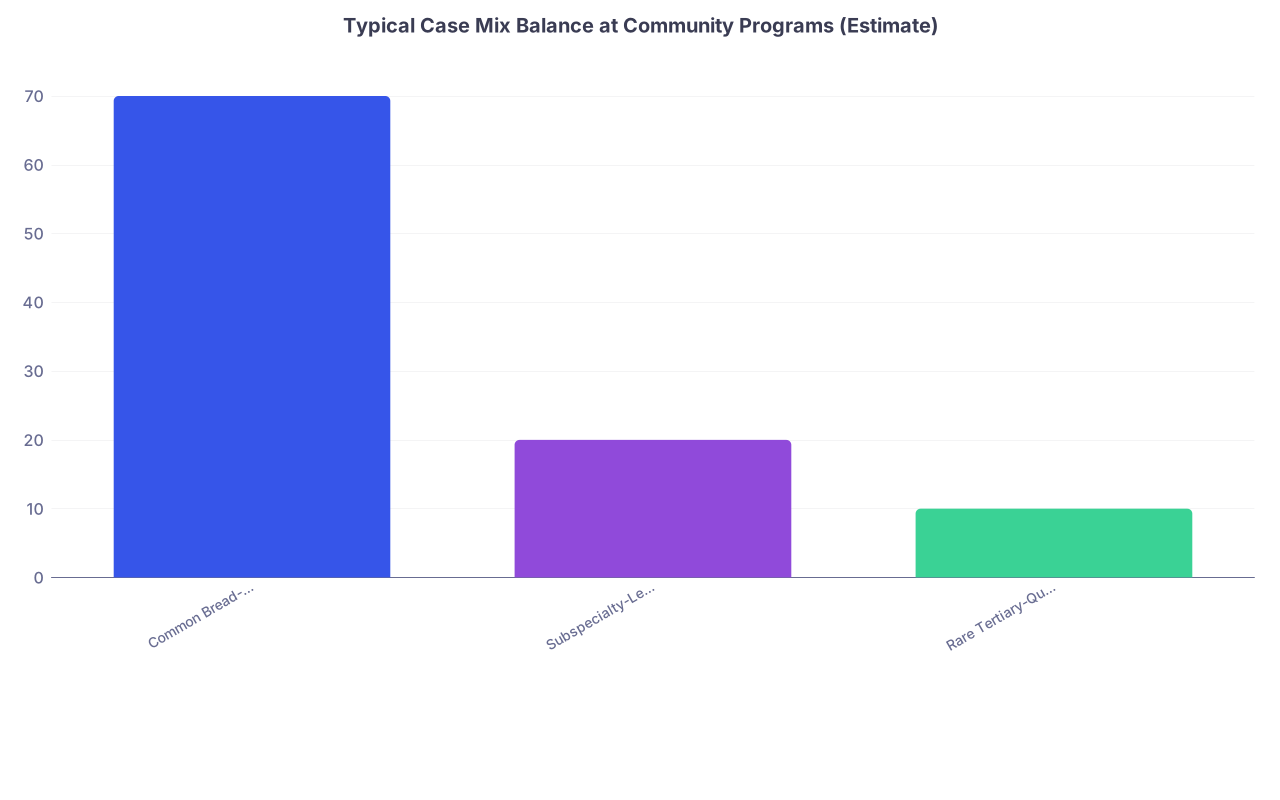
3. Case Mix: Bread-and-Butter, Gaps, and Where “Low Competition” Bites You
Let me break this down specialty by specialty, because the patterns differ.
| Category | Value |
|---|---|
| Common Bread-and-Butter | 70 |
| Subspecialty-Level Cases | 20 |
| Rare Tertiary-Quaternary | 10 |
Internal medicine at community hospitals
You will usually get:
- Massive exposure to: CHF, COPD, diabetic DKA/HHS, sepsis, pneumonia, cellulitis, alcohol withdrawal, AKI, NSTEMI, stroke initial management.
- Variable exposure to: advanced heart failure therapies, complex oncologic regimens, transplant medicine, complicated rheumatology, advanced ID (e.g., transplant ID, complex HIV).
Diagnostic challenge is often underrated. At a community site, many people hit your ED first. You are not just “co‑managing” after someone else made the diagnosis. You are the first to decide: is this weird chest pain ACS, PE, aortic dissection, or costochondritis?
Red flag: IM programs where all complicated patients are immediately transferred to the tertiary partner, and residents are barely involved in workup, stabilization, or follow‑up. That guts your learning.
Family medicine in the community
Family medicine in a true community setting can be superb if:
- You have strong inpatient exposure (L&D, nursery, adult medicine).
- You do procedures: skin, joints, maybe even OB if the program is one of the declining numbers still doing full‑scope.
- Your clinic sees a wide socioeconomic and age distribution.
The danger zones:
- FM programs that are essentially outpatient urgent care mills with minimal inpatient exposure. You will graduate weak on inpatient medicine and you will feel it.
- OB experience that is all “OB clinic” without actual delivery and L&D management. For broad‑scope FM, that is a problem.
Psychiatry at community sites
Psych is an interesting one. Many community psych programs are in relatively low‑competition markets yet offer:
- Heavy exposure to acute inpatient psych, ED psych holds, involuntary admissions.
- Strong consult‑liaison exposure since general medical floors are often under‑resourced.
- Solid community psychiatry with ACT teams, outpatient clinics, and substance programs.
Watch for:
- Overreliance on outdated pharmacology (polypharmacy, excessive sedating meds) and underexposure to psychotherapy modalities.
- Little exposure to subspecialty clinics (child, geriatric, addiction). Some programs “solve” this with a one‑month away rotation and call it good. It is not.
Pediatrics at community hospitals
Peds in community settings lives or dies on:
- Volume of inpatient pediatrics and NICU
If your hospital has a 4‑bed pediatric unit and a level II NICU that transfers anything under 32 weeks or moderately complex, your inpatient learning will be limited. - Outpatient complexity
You must see more than well‑child checks and otitis. Asthma, behavioral/developmental, obesity, complex chronic kids—if those are all being sent out to the regional children’s hospital, your skillset will skew.
Good community peds programs often have a strong affiliation with a children’s hospital, with residents rotating there for PICU, NICU, complex subspecialty, then returning to run the bread‑and‑butter at the home community site. That is a good compromise.
Pathology and neurology
Pathology at small hospitals can under‑expose you to certain surgical subspecialty specimens and complex molecular work. Neurology can miss higher‑end neuroimmunology or neuromuscular care if everything complex goes to the university across town. You correct this with:
- Away rotations
- Electives at tertiary centers
- Intentional board review and case conferences using digital archives
But you have to know the gap exists.
4. Autonomy: The Good, The Bad, and the Malignant
Everyone loves to say “I want autonomy.” Until they are the only senior in-house with a crashing GI bleed, a new stroke, and an unstable OB patient—while the attending is 25 minutes away “available by phone.”
Community programs tend to sit at one of three autonomy levels:
| Profile | Supervision Style | Resident Experience |
|---|---|---|
| Micromanaged | Attending at bedside | Limited decision making |
| Graduated, appropriate | Attending easily available | Strong growth |
| Unsafe pseudo-attending | Attending remote/absent | High stress, risky |
Micromanaged community programs
Yes, they exist. Especially newly accredited ones worried about ACGME citations.
Features:
- Attending sees every patient before any orders are placed.
- Residents become scribes who “present” but do not truly decide.
- Nights: attending in‑house, heavily directing every move.
Result: protection from big mistakes, but poor independent thinking. These graduates often feel unstable starting as attendings.
Graduated, appropriate autonomy
This is what you actually want:
- Intern year: close oversight. You propose, attending disposes.
- PGY‑2: you run the floor/ED or unit, call the attending for major decisions, but you are doing first‑line resuscitation and management.
- PGY‑3+: you are effectively acting as junior attending with backup: running codes, making disposition decisions, teaching juniors, but attending is genuinely easy to reach and will show up for big events.
You can get this at both community and academic programs. But community often hits it more naturally because there are fewer layers (no fellow buffer).
Pseudo-attending with unsafe supervision
This is where residents get burned. And occasionally patients.
Red flags:
- Attendings consistently covering multiple sites, physically off‑site, slow to respond.
- Residents routinely making admission and discharge decisions alone, with chart co‑signs the next day.
- “We trust our residents” used as a euphemism for under‑staffing.
I have heard residents brag about “running the ICU alone at night.” Sometimes that is a badge of competence. Sometimes that is a system failure disguised as machismo.
You want high responsibility with real back‑up, not abandonment.
5. How Low-Competition Interacts with These Factors
The fact that a program is in a low‑competition specialty and is located at a community hospital affects who it attracts, who it can recruit, and how it is resourced.
Resident caliber and peer group
You will see a wider academic range:
- Some sharp residents who actively chose community for lifestyle, location, or autonomy.
- Some residents who barely passed Step 1 and have obvious knowledge gaps.
- Some FMGs / IMGs / DOs who are excellent clinically but may not have had strong preclinical or research exposure.
This is not inherently bad. But your peer group matters. Day‑to‑day, you learn at least as much from the resident next to you as from the attending.
Ask current residents, off‑script:
“How is the spread between your strongest and weakest co‑residents? Does it affect workload?”
If they roll their eyes and say, “We carry some people hard,” that is your answer.
Faculty recruitment and retention
Low‑competition specialties + community setting = less leverage to pull superstar subspecialists. Especially in peds subspecialties, advanced ID, or niche psych areas.
But you do not need R01‑funded stars. You need:
- Clinical competence
- Commitment to teaching
- Enough subspecialty presence to cover your core curriculum
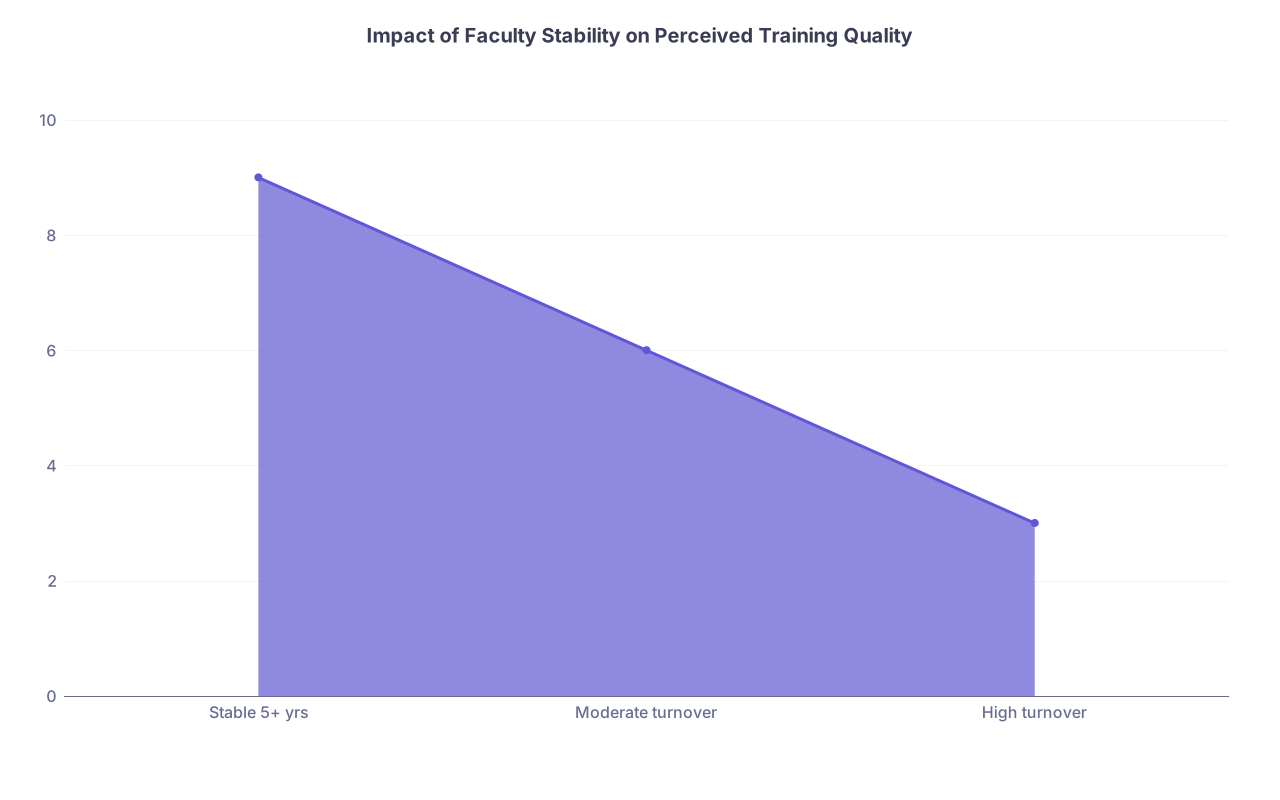
Pay attention to turnover. A chronic pattern of “we just lost two cardiologists, three hospitalists, and our PD” is a metastasis of something deeper: administration issues, toxicity, or financial instability.
| Category | Value |
|---|---|
| Stable 5+ yrs | 9 |
| Moderate turnover | 6 |
| High turnover | 3 |
(Values here representing rough 1–10 perceived training quality reported by residents in my experience.)
Administrative priorities
Many community hospitals view residency programs as:
- Cheap labor
- A prestige upgrade (“teaching hospital”)
- A long‑term recruitment pipeline
If administration is primarily in the first category, you will feel it. Residents become service cogs. Conferences get canceled because “the ED is busy.” PGY‑3s are treated as attending‑equivalents for staffing without appropriate compensation or backup.
You want leadership that clearly sees residents as learners first, workforce second.
6. Evaluation Checklist: Training Quality, Case Mix, Autonomy
Let me give you a concrete framework you can use on interview day or when you are combing websites.
Training quality: what to ask and notice
Questions to PD / residents:
- “What are common reasons graduates feel underprepared in their first job or fellowship?”
A reflective program will have specific answers and tell you how they address them. - “How often do residents fail boards?” Ask for numbers, not vibes.
- “How often do residents switch programs or leave medicine from here?”
Look for:
- Protected didactic time that is actually protected.
- A functioning evaluation and feedback system, not just end‑of‑rotation one‑liners.
- PD and APDs who have been there for several years, not revolving doors.
Case mix: how to get past the marketing
Ask:
- “What percentage of the inpatient census is staffed by your residents versus hospitalists not involved in teaching?”
- “Which conditions or procedures do residents rarely see here, and how do you compensate?”
- “Where do you send out transfers, and do residents follow those cases or participate in initial management?”
If everyone suddenly gets very vague, assume there are big blind spots.
Autonomy: drilling into the messy part
Concrete questions:
- “Who responds to codes at night? Who runs them?”
- “On a typical night, how many patients is the admit resident responsible for, and how many cross‑cover?”
- “Can you tell me about the last time an attending disagreed with a resident management plan? How was it handled?”
Then talk to interns and senior residents separately. Autonomy feels different at each level. Interns will tell you if they feel abandoned. Seniors will tell you if they feel suffocated.
7. Low-Competition Community Programs and Fellowship / Career Prospects
Now the part everybody worries about: “If I go to a low‑competition community program, am I dead for fellowship or future options?”
No. But the ceiling you hit is determined by your own initiative plus the program’s baseline resources.
Realistic patterns
From solid community programs in low‑competition specialties, I have seen:
- FM graduates go straight into hospitalist roles, rural full‑scope practice, sports medicine, palliative, and OB fellowships.
- IM graduates match into cards, GI, pulm/CC, ID, hem/onc at mid‑tier university programs. Occasionally top programs if they have outstanding research and letters.
- Psych residents move into competitive child and addiction fellowships, including at university centers.
- Peds residents match into NICU, PICU, endocrine, heme/onc, though less frequently than those at massive freestanding children’s hospitals.
The tradeoff is you will likely:
- Have to create your own research. That means retrospective chart reviews, QI projects, case series.
- Attend regional and national conferences and hustle for connections.
- Be deliberate about electives at tertiary centers if your home program is weak in an area.

| Step | Description |
|---|---|
| Step 1 | Community Residency |
| Step 2 | Strong Clinical Base |
| Step 3 | Research Projects |
| Step 4 | Good Letters |
| Step 5 | Regional Networking |
| Step 6 | Fellowship Interviews |
| Step 7 | Academic or Hybrid Career |
Notice what is not on that chart: “Program name prestige.” Does it help? Yes. Is it fatal to lack it? Not if you compensate aggressively in the other branches.
8. Concrete Examples of How This Plays Out
Let me walk through two composite examples. These are amalgams of real programs and residents I have known.
Example 1: Community Internal Medicine, Rust Belt, low-competition
- 300‑bed hospital, no med school, one IM program.
- No cardiology fellowship. Two cards groups, one EP, one interventional.
- ED sees 45k visits/year, heavy substance use population, lots of sepsis and COPD.
Training quality:
Morning report daily with chief resident and rotating faculty. Noon conference most days, genuinely protected. PD has been in place 8 years, respected by residents. ABIM pass rate > 90% 3‑year rolling.
Case mix:
Tons of heart failure, COPD, DKA. ICU is 12 beds, mixed med‑surg with intensivist group. Complex MV disease, LVADs, transplant, complex oncology go to the university 90 minutes away. Residents are involved in initial stabilization and transfer decisions.
Autonomy:
Interns have capped lists. PGY‑2 and PGY‑3 run night float with in‑house hospitalist attending until midnight, then home call but responsive. Residents run codes, then debriefs.
Outcome:
Most grads go to hospitalist or primary care roles locally. Each year 2–3 match into cards/pulm/CC/nephro fellowships at regional universities, one every few years at a “name” center. This is a very respectable, high‑functioning low‑competition community program.
Example 2: Community Family Medicine, Sunbelt, extremely low-competition
- 150‑bed hospital, heavy surgical and ortho presence; medicine serviced largely by hospitalists not linked to the residency.
- FM residents have 1 required inpatient rotation/yr, rest clinic and nursing home. OB is largely covered by OB/GYN group; FM residents see prenatal clinic but rarely deliver.
Training quality:
Didactics exist on paper but frequently canceled when clinic overbooks. PD is overextended, also runs hospitalist shifts. Faculty turnover high. Board pass rate hovers around minimum ACGME standards.
Case mix:
Clinic dominated by hypertension, diabetes follow‑up, minor acute complaints. Very little complex chronic care because those patients are routed to subspecialists miles away. No continuity OB, minimal pediatric complexity.
Autonomy:
Interns are essentially seeing walk‑in patients independently with quick attending sign‑off but little feedback. Residents cover night call for nursing homes by phone. No codes, no real inpatient responsibilities.
Outcome:
Graduates are technically “family physicians” but many feel uncomfortable managing hospitalized adults, pediatric acute issues, or OB. They succeed in low‑acuity outpatient settings but struggle if asked to take on broader rural roles. This is the downside version.
9. How to Decide If a Low-Competition Community Program Is Right for You
Strip away the anxiety and look at your goals.
If you want:
- Strong, broad clinical skills in a primary care or hospitalist‑type role
- High direct responsibility with meaningful back‑up
- A realistic chance at mid‑tier fellowships if you put in extra work
Then a good community program in a low‑competition specialty can be an excellent choice.
If you want:
- Niche, ultra‑subspecialized academic careers
- High‑volume exposure to rare diseases or advanced procedures (like transplant ID, LVAD program management, complex pediatric cardiac surgery)
- Built‑in research infrastructure and pipelines to top fellowships
Then low‑competition community programs will not automatically block you, but you will be swimming upstream and should seriously consider at least one academic anchor—either for residency or for fellowship.

10. Practical Moves If You Match at a Low-Competition Community Program
If you already matched or know you are likely to:
Treat PGY‑1 like a boot camp for fundamentals.
Own common conditions: sepsis, CHF, COPD, diabetes, common psych, pediatric respiratory illnesses—whatever your specialty’s bread‑and‑butter is. Become disgustingly good at them.Seek complexity intentionally.
Volunteer for rotations/lines that give you higher‑acuity exposure: ICU months, OB/L&D, ED shifts, consult services. If there is a chance to rotate at a tertiary affiliate, grab it.Create your own academic ecosystem.
Use online board review, podcasts, primary literature. Start simple QI or retrospective chart reviews; submit to regional meetings. Build letters from the few academic‑minded faculty who exist.Guard against bad autonomy.
Draw a line: if an attending is consistently unavailable for dangerous situations, escalate through your chief, PD, and if needed the GME office. Being “the only one around” sounds cool until someone dies because you were hung out to dry.

- Document your case mix and procedures.
Keep a log. Number of intubations, central lines, deliveries, complicated diagnoses. When fellowship or employers ask what you have actually seen, you will have data.

Key Takeaways
“Low‑competition community program” is not shorthand for bad training. Training quality, case mix, and autonomy vary widely; some of the best clinicians I know came from these places.
The core questions you must answer are simple: Will I see enough complexity? Will I have real but supported responsibility? Are there faculty who actually teach and care?
If you understand the limitations—fewer rare cases, less built‑in research—and you compensate intentionally, a strong community program in a less competitive specialty can give you exactly what you need: real-world skills, fast growth, and more control over your path than you probably think.