
It is late January of your PGY-2 year. You are post-call in a community hospital workroom. Someone just said, “Honestly, if you wanted cards or GI you should’ve gone to a better program. From here, you’re not getting that.”
You are looking at your own badge: Internal Medicine, small community program. Or Family Medicine. Or Psych. And you are wondering:
Did I just cap my fellowship ceiling by matching into a “less competitive” residency? What actually changes for me compared to my classmates at name-brand academic programs?
Let me break this down specifically, because there is a lot of mythology and half-truth here. Some of it is brutal. Some of it is overblown. And the details vary dramatically by specialty.
We will walk specialty by specialty through the “least competitive” residencies and spell out what your fellowship landscape really looks like afterward—what is plausible, what is uphill, and what is fantasy unless something major changes.
Big Picture: How Your Residency Competitiveness Shapes Fellowship Reality
Here is the core truth up front:
Fellowship chances are not just about “least vs most competitive specialty.” They depend on four levers:
- The specialty you trained in (FM vs IM vs Psych vs Peds vs Path vs Neuro, etc.).
- The type of program you’re in (community-only vs community with strong university affiliation vs flagship academic).
- Your individual output (Step/COMLEX, in-training scores, research, letters, reputation).
- The competitiveness of the fellowship you are targeting.
If you want a quick mental model, this is roughly how the funnel looks:
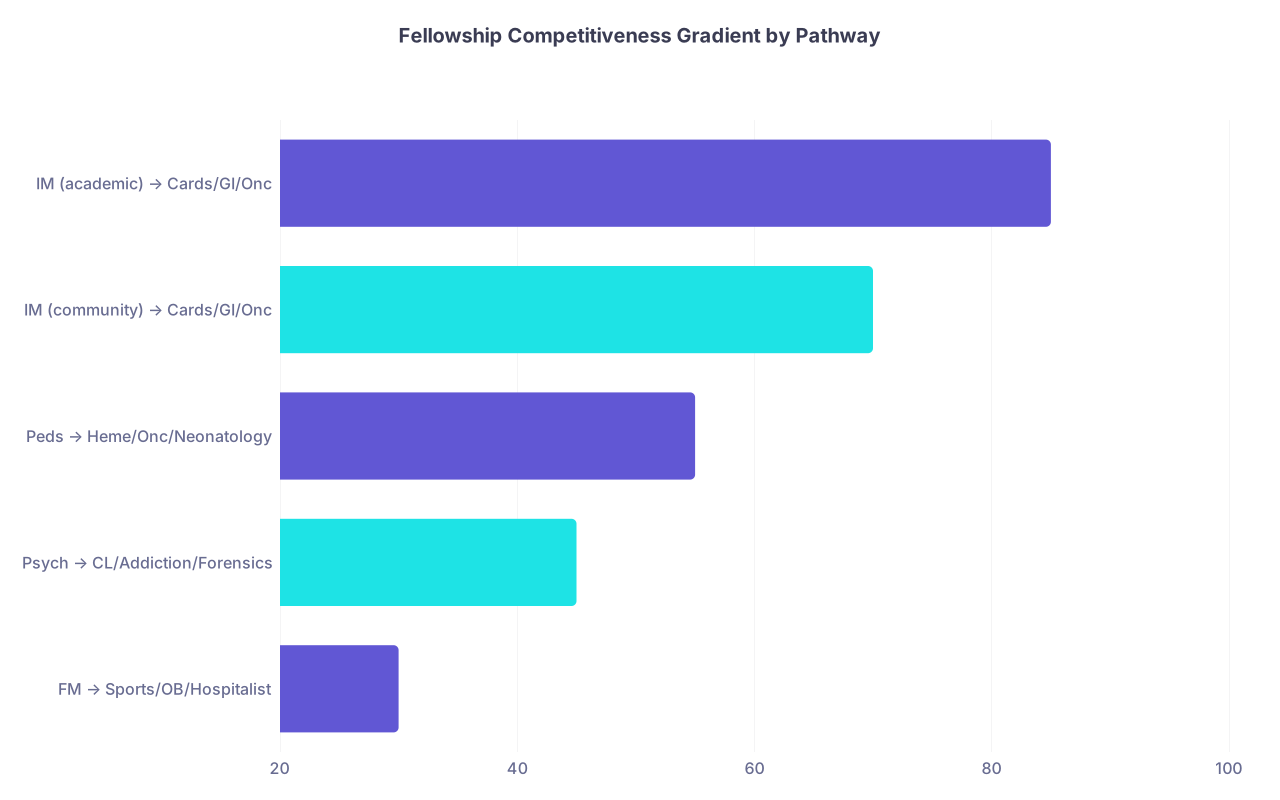
| Category | Value |
|---|---|
| FM → Sports/OB/Hospitalist | 30 |
| Psych → CL/Addiction/Forensics | 45 |
| Peds → Heme/Onc/Neonatology | 55 |
| IM (community) → Cards/GI/Onc | 70 |
| IM (academic) → Cards/GI/Onc | 85 |
Higher number = generally stronger access and probability when the applicant is “solid” for that pathway.
Community vs academic matters. But not the way many interns think. Being at a least-competitive residency does not slam the door shut on fellowship. It reshapes which doors are wide open, which are cracked open, and which require you to essentially break them open with a crowbar (research + networking + a top-tier application).
Let’s get specific, by base specialty.
Internal Medicine (Community / Less Competitive IM) → Fellowship Options
Internal Medicine is technically “mid-tier” in competitiveness, but many applicants land in less competitive, community-based programs: low Step averages, minimal research, limited subspecialty faculty. This is the classic scenario where people panic about cardiology or GI later.
1. What is realistically open to you?
You can absolutely match into fellowship from a “weak” IM program. I have seen:
- Community IM → Hem/Onc at a solid university program
- Community IM → Pulm/CC at regional academic centers
- Community IM → Cards at lower-tier university or strong community fellowship
- Community IM → Endo, Rheum, ID, Geri, Hospice/Pall Care on a regular basis
Where you will feel the difference is for the top-shelf, hyper-competitive spots:
- Big-name GI programs (think BIDMC, Mayo, UCSF)
- Big academic cards programs that want 5+ first-author papers
- Hem/Onc fellowships that treat research output like currency
From a community IM program with no research infrastructure, your odds for these are lower. Not zero. Just not in your favor by default.

2. How your specific IM program changes the equation
Not all “least competitive” IM programs are the same. Three broad types:
| Program Type | Academic Affiliation | Typical Fellowship Access |
|---|---|---|
| Pure community, no university | Minimal to none | Local community fellowships, selective academics harder |
| Community with university tie | Moderate | Better shot at university fellowships, especially affiliated |
| Small university, low prestige | Good | Decent access to a wide range of fellowships, name helps a bit |
The more your site sends residents to fellowship at all, the safer you are. Look at your program’s last 3 years of fellowship matches. Not what the PD says. The actual list.
If nobody from your program has gone into cards or GI in 5 years, that is a reality check, not a coincidence.
3. Where you will have a relative advantage vs others
From a less competitive IM residency, your best “yield” fellowships (assuming you are an above-average resident with decent letters and some attempt at scholarship):
- Endocrinology
- Infectious Disease
- Geriatrics
- Rheumatology
- Hospice & Palliative Care
- Nephrology (less popular but not “easy,” just relatively undersubscribed)
These are absolutely attainable from community IM if you put together a coherent application and a narrative that makes sense.
4. Hyper-competitive IM fellowships: what it will cost you
For cardiology, GI, hem/onc from a non-name community program, the bar goes up:
You will likely need:
- Strong Step 2 or Level 2 (even if Step 1 was pass/fail later, older grads are still judged).
- High in-training exam scores.
- Research that is actually real:
- Abstracts/posters at ACC, ACG, ASH, ATS, etc.
- PubMed-indexed papers (case reports are fine, but they are the floor, not the ceiling).
- Letters from recognized subspecialists, ideally with some regional or national reputation.
- Rotations (electives) at the fellowship program where you want to match.
If you are doing none of this and you are also not a star clinically, then yes, your odds are bad. That is not because of “least competitive IM.” It is because you are invisible on paper.
Family Medicine → Fellowship: Very Different Game
Family Medicine is routinely labeled as “least competitive.” That is true on the entry side. But the fellowship landscape after FM is not the same as after IM, and people who conflate the two get confused fast.
1. What family medicine fellowships actually exist?
Most FM graduates are not aiming for subspecialty, but for the ones who are, the menu is very specific:
Common FM fellowships:
- Sports Medicine
- Obstetrics / Maternal-Child Health
- Geriatrics
- Palliative Care
- Addiction Medicine
- Academic Medicine / Faculty Development
- Point-of-Care Ultrasound (POCUS) or limited procedural fellowships
- Behavioral Medicine
More “crossover” fellowships where FM can sometimes match:
- Hospice & Palliative Care (multi-pathway: IM, FM, Anesthesia, EM, etc.)
- Addiction Medicine (multi-pathway)
- Sleep Medicine (multi-pathway, but IM/Neuro/Pulm are more favored)
- Integrative Medicine
2. The hard ceiling: true IM subspecialties are mostly closed
If you are in FM thinking you will later “do a cards or GI fellowship,” stop. That path is essentially closed in the U.S. except for very rare, legacy, or non-standard exceptions. Cardiology, GI, Hem/Onc, Pulm/CC, Nephro, Rheum, Endo etc. are almost universally designed as internal medicine-based fellowships.
Could you re-train in IM after FM and then do subspecialty? In theory, yes. Practically, it is a long, painful, and uncommon route.
So the biggest way FM being less competitive hits you is this: the fellowship menu is narrower. Not worse. Narrower and more procedurally limited. You trade breadth and outpatient continuity for less access to traditional subspecialties.
3. Within FM, competitiveness still exists
Sports Medicine and OB-heavy FM fellowships can be surprisingly competitive, especially at big academic centers or sports-heavy programs.
From a small, low-profile FM residency, your odds for:
- Community-based sports med → decent if you:
- Work with ATCs, local teams.
- Do sideline coverage.
- Show procedure and MSK enthusiasm.
- Academic sports med tied to big-name universities or pro teams → tougher; you will need:
- Strong letters from sports med physicians.
- Research or at least abstracts/posters in MSK/sports.
- A CV that screams “this person lives on the sidelines and in the training room.”
Same story for OB/MCH fellowships: if your FM program barely delivers, your case log and comfort will limit where you can go. Programs that send FM fellows to surgical backup L&D units and let them do C-sections are not picking residents from FM programs where you only did clinic-based prenatal care.
Psychiatry → Fellowship After a “Less Competitive” Psych Residency
Psychiatry has become much more competitive in recent cycles, but there are still plenty of lower-tier or community-heavy psych programs. Fellowship access out of these is… kinder than IM, frankly.
Why? Because many psych fellowships are not as obsessed with hardcore bench research or “top-ten-name” branding.
Common psych fellowships:
- Child and Adolescent Psychiatry
- Addiction Psychiatry
- Consultation-Liaison Psychiatry (Psychosomatic)
- Forensic Psychiatry
- Geriatric Psychiatry
- Sleep Medicine (multi-pathway)
- Pain (multi-pathway, but often dominated by Anesthesia/PM&R)
1. Child and Adolescent Psych: wide open, even from low-tier
If your psych program is small, community-focused, and you did not match into a top name, you can still very realistically get into Child and Adolescent Psychiatry. Many programs are actively trying to fill spots; some go unfilled.
What they care about:
- Genuine interest in working with kids and adolescents.
- Rotations or electives on child psych.
- Some related scholarly work (not mandatory at every site).
- Letters from child psych faculty.
If your program barely has child psych exposure, you may need outside electives or away rotations. But the door is open.
2. Addiction, Forensic, CL: realistic with modest effort
Addiction, forensic, and consultation-liaison psychiatry are all accessible from less competitive psych residencies for residents who do:
- Targeted electives.
- Minimal but relevant scholarly work (case presentations, QI projects).
- Solid fellowship-facing letters.
The pressure here is much less than for, say, cardiology after IM. A mediocre applicant from a famous psych program does not automatically beat a strong applicant from a smaller one. Names matter, but less.
3. Where being at a weaker psych program might hurt
- Ultra-academic CL or neuropsychiatry fellowships at places like MGH, Columbia, UCSF: these often want residents who have research, publications, and a strong pipeline from their home institutions.
- Programs building a heavy NIH-funded research profile may pass on applicants from residencies with zero measurable research infrastructure unless your personal CV is exceptional.
But overall, psychiatry is a specialty where fellowship doors are relatively open if you show focused interest, have clean evaluations, and make some effort to connect with subspecialty mentors.
Pediatrics → Fellowship from Less Competitive Peds Programs
Pediatrics sits in an odd middle ground. Not wildly competitive to enter (especially in many community settings), but certain pediatric fellowships are extremely competitive.
Common peds fellowships:
- Neonatology
- Pediatric Cardiology
- Pediatric Hematology/Oncology
- Pediatric Critical Care
- Pediatric GI
- Pediatric Endocrinology
- Pediatric Pulm
- Pediatric Emergency Medicine
- Pediatric ID, Rheum, Nephrology, etc.
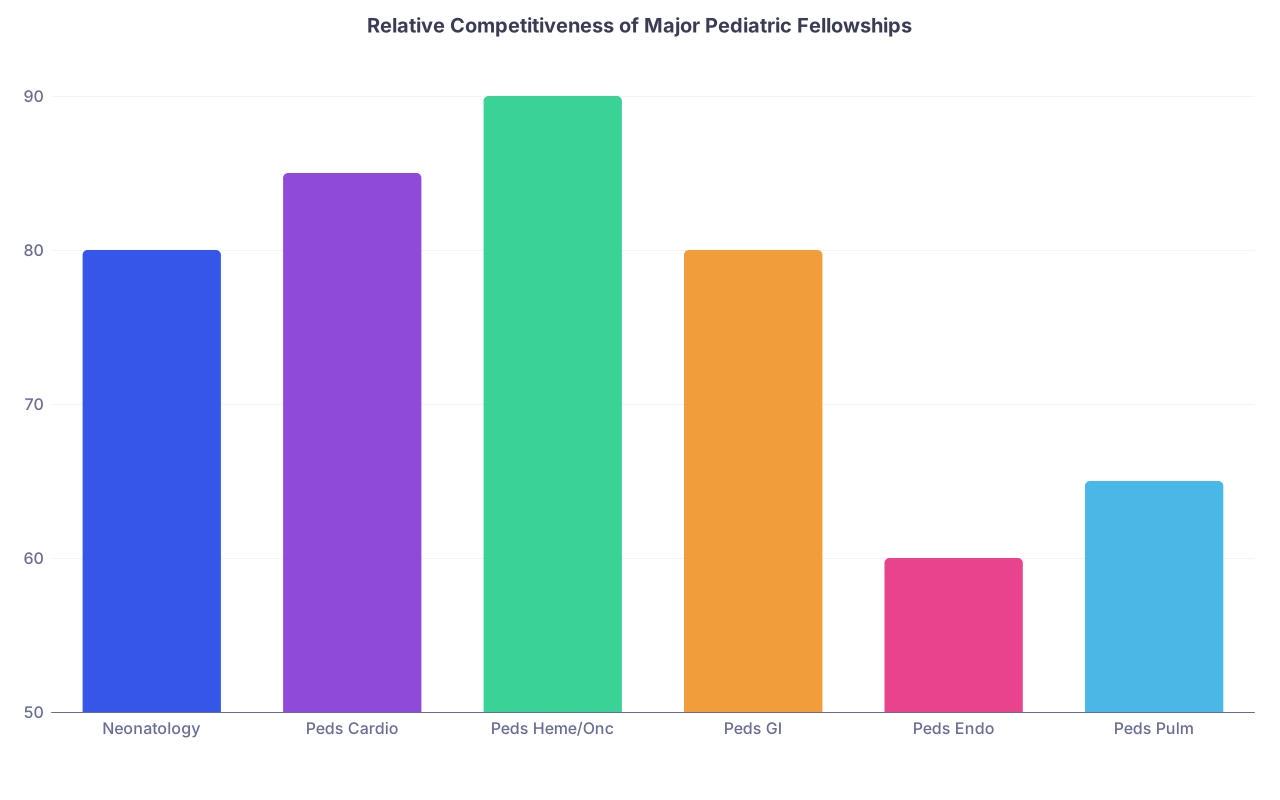
| Category | Value |
|---|---|
| Neonatology | 80 |
| Peds Cardio | 85 |
| Peds Heme/Onc | 90 |
| Peds GI | 80 |
| Peds Endo | 60 |
| Peds Pulm | 65 |
(Rough conceptual scale, not literal match data.)
1. What a low-tier peds residency changes
If your pediatric residency:
- Has minimal subspecialty presence (mostly general peds attendings).
- Sends few or no graduates to fellowship.
- Has no resident research program.
Then aiming for competitive peds fellowships (heme/onc, cardio, neonatology at major academic centers) is possible but steeply uphill.
Programs that train peds subspecialists usually want:
- Evidence of scholarly work (QIs, retrospective studies, clinical research).
- Strong letters from subspecialists in that exact area.
- Some demonstration of academic interest (presentations, posters, etc.).
If your training environment cannot provide that easily, you will have to be the one who creates those opportunities.
2. Which peds fellowships are more accessible
From a less competitive peds residency, you can still realistically target:
- Pediatric Endocrinology
- Pediatric Infectious Disease
- Pediatric Nephrology
- Pediatric Rheumatology
- Some Neonatology programs (especially non-flagship ones)
- Pediatric Emergency Medicine at non-top-tier children’s hospitals
Where you will have trouble:
- Highly selective peds heme/onc at major children’s hospitals.
- Pediatric cardiology at academic powerhouses.
- PICU at programs that are used to residents with heavy research backgrounds.
Again, not impossible. But if no one from your program has matched those fellowships recently, you are trying to be the outlier.
Pathology, Neurology, and Others: “Least Competitive” but Fellowship-Rich
Let me say this clearly: some of the least competitive residencies on the front end have excellent fellowship pipelines. Pathology is a prime example. Neurology too.
Pathology
Pathology residencies (AP/CP) have lower match competitiveness, but almost everyone does a fellowship:
- Surgical Pathology
- Cytopathology
- Hematopathology
- Transfusion Medicine
- Molecular Genetic Pathology
- GI Path, GU Path, Breast Path, etc.
From a “less competitive” path residency, you can still land strong fellowships if:
- You are competent and not a problem resident.
- You get involved in some basic pathology case-based research.
- You have good letters from subspecialty attendings.
There is some prestige stratification (a surg path fellowship at MSK or Hopkins is not the same as a local community program), but the overall access is much less punishing than in internal medicine subspecialties. The field simply needs fellows.
Neurology
Neurology residencies (especially community or lower-tier university programs) are not ultra-competitive. Yet neurology fellowships are everywhere:
- Stroke/Vascular Neurology
- Epilepsy
- Movement Disorders
- Neuromuscular
- Neurocritical Care
- Headache
- Behavioral/Neurocognitive

From a lower-profile neurology residency, you still have excellent odds of doing at least one fellowship, often more. The real limit is your own interest and tolerance for additional training, not the residency name.
Program Type and Research Infrastructure: The Invisible Gatekeeper
Across all these least-competitive-entry residencies, one theme keeps coming up: research and mentorship access.
Fellowships live on:
- Letters from recognized subspecialists.
- Evidence that you can do scholarship.
- A narrative that “fits” the field.
If you match at a small, service-heavy community program with:
- No research office.
- No IRB process that residents understand.
- No faculty publishing much of anything.
Then by default you are handicapped for fellowships that value these things.
That does not mean you are doomed. It means you cannot coast.
You will need to:
- Actively hunt for projects:
- Case reports with subspecialty attendings.
- Retrospective chart reviews that are actually IRB-approved.
- Use external opportunities:
- Remote, multi-site projects.
- Professional society programs for residents (e.g., ACC, AASLD, ATS, APA).
- Block elective time to rotate at academic centers where fellowships exist.
Strategy: How to “Outperform” Your Least Competitive Residency
I am going to give you the actual levers that move the needle, not the motivational poster version.
1. Know your program’s track record
Pull the last 3–5 years of fellowship outcomes from:
- Your program handbook.
- Internal slide decks your PD shows.
- Asking chief residents, “Where have recent grads gone for fellowship?”
If the answer is “mostly hospitalist” or “mostly outpatient” and fellowship data are vague, assume there is no strong pipeline.
Then set your expectations accordingly, and realize you will be the one building that path.
2. Decide early if fellowship matters enough to you
If you are IM PGY-1 in a small community program and you want cards or GI, you do not have until PGY-3 midyear to decide. You need to start:
- Finding cardiology or GI mentors.
- Doing case reports or small projects PGY-1/2.
- Attending national or regional meetings if you can.
- Scoring well on ITEs so they see you as “one of the top residents.”
Same if you are FM wanting sports, psych wanting forensic, or peds wanting heme/onc.
3. Leverage away rotations and visiting electives
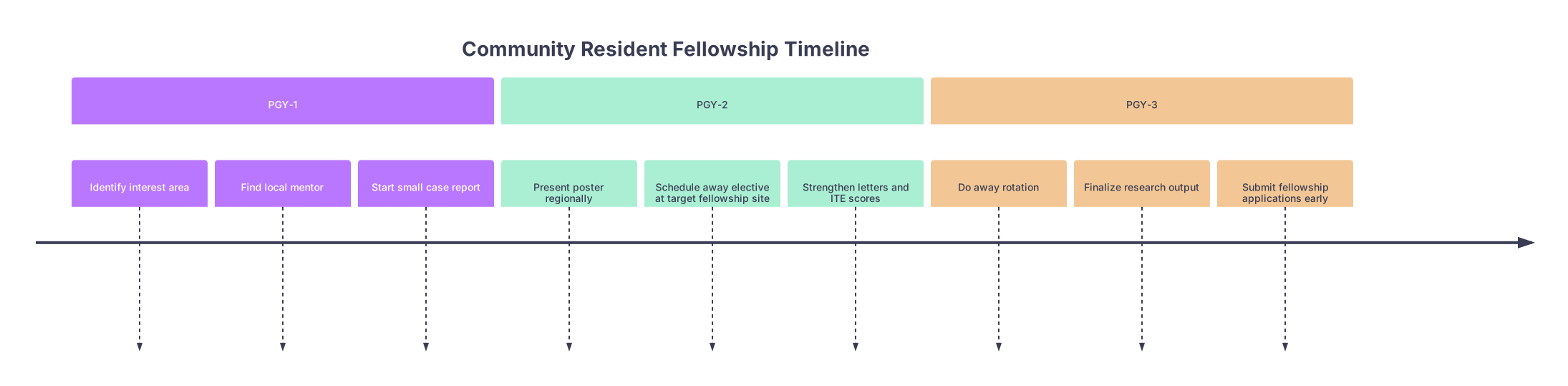
A well-executed away elective at the fellowship institution you want:
- Lets them see your work ethic in person.
- Allows you to secure at least one strong letter.
- Helps override some bias about your home program’s reputation.
Residents from community programs who crush an away month at an academic center often end up near the top of that program’s rank list. You are a known quantity. The unknown candidate from “Top 10 University” is less safe than the person they watched work on their own wards.
4. Stop obsessing over name and start building signal
Program name is a proxy for:
- Alleged quality of training.
- Likelihood of research and mentorship.
- Peer group strength.
If you do not have that name, you can still provide signal:
- Strong objective metrics:
- Above-average in-training exam performance.
- Solid Step 2/Level 2 if still visible.
- Real scholarly output:
- A few first- or second-author papers.
- Regional or national poster/oral presentations.
- Focused narrative:
- Not “I am interested in everything.”
Instead: “I have been working on X for 2 years; here are outcomes and what I want to study next.”
- Not “I am interested in everything.”
Fellowship directors review dozens of generic application essays. A clear, credible story attached to actual work stands out, even from a program they barely recognize.
How the Fellowship Picture Differs By “Least Competitive” Base Specialty
To make this concrete, here is a side-by-side comparison:
| Base Residency (low-competitiveness) | Breadth of Fellowship Options | Access to Highly Competitive Fellowships | Typical Main Barriers |
|---|---|---|---|
| Community Internal Medicine | Very broad | Difficult but possible with strong CV | Weak research, no pipeline for cards/GI/HO |
| Family Medicine | Narrow but defined | IM-style subspecialties essentially closed | Fellowship menus limited by pathway rules |
| Psychiatry (lower-tier programs) | Moderate and growing | Top research-heavy sites harder | Limited research, fewer big-name mentors |
| Community Pediatrics | Broad but skewed | Top peds HO/cardio/PICU tough | Sparse subspecialty exposure, minimal research |
| Pathology | Very broad | Top branded fellowships selective | Program reputation and personal connections |
| Neurology (community/low-tier) | Broad | Top NIH-type programs harder | Research scarcity, lack of national visibility |
Notice what is not on that table: “Not possible.” That word is almost always an exaggeration. But the gradient in difficulty is very real.
One More Ugly Truth: Behavior and Reputation Matter More When Your Program Name Is Weak
If you are from a top-tier academic program and you are somewhat average, the name can carry you into the low-middle of rank lists anyway.
If you are from a low-visibility, least-competitive residency, then:
- Bad evaluations.
- Rumors of being unreliable.
- Any whiff of professionalism issues.
…will destroy your fellowship chances quickly. Because the risk tolerance for “unknown program + concerning behavior” is essentially zero.
Conversely, being the resident that every attending describes as:
- “Strongest resident we have had in years.”
- “Functions like a fellow already.”
- “Absolute workhorse with excellent clinical reasoning.”
That is your branding. On paper and on phone calls. That branding is your multiplier when the program name itself is neutral or weak.

Distinct Specialty Patterns You Should Not Ignore
Let me run through the most common miscalculations I see, specialty by specialty.
IM residents in small community programs who think they can “decide cards in PGY-3.”
Wrong. By then, your peers from academic programs already have 2–3 abstracts and letters from division chiefs. You are a year behind.FM residents expecting IM-style subspecialty options.
Wrong field. If you want cards, GI, HO—IM was your gateway. FM gives you strong primary care, some procedural niches (sports, OB), but not that menu.Psych residents underestimating fellowship selectivity.
They assume, “Fellowship is easy, everybody gets one.” For Child, often yes. For the most competitive forensic or CL programs at top places, you still need a solid CV, not just a warm body.Peds residents in community programs who wait too long to seek subspecialty mentors.
You match into peds at a hospital with one part-time heme/onc doc and then decide PGY-3 you want HO at CHOP. That mismatch is severe if you never built a connection or did any work in that field.
The Bottom Line
Do least competitive residencies limit fellowship options? Yes—but very differently depending on which specialty you are in and what you are aiming for.
Three takeaways to keep:
Your base specialty dictates the menu; your residency strength dictates the difficulty.
FM simply does not lead to IM subspecialties. Community IM can still lead to cards/GI/HO but at higher effort. Psych, peds, path, and neuro have relatively generous fellowship ecosystems, but top-tier academic fellowships still care a lot about research and mentorship.Program reputation is a tiebreaker, not destiny—your output is the actual currency.
From a weaker program, you must generate your own signal: strong ITE scores, real scholarly work, subspecialty letters, and focused interest. Without that, you are just another anonymous application from a place they do not recognize.If you want a competitive fellowship from a least competitive residency, you cannot be a passive passenger.
Decide early, seek mentors, use away rotations strategically, and behave like the best resident in your program. That is how you bend the curve in your favor—regardless of what name is on your badge.