
Most residents in the “least competitive” specialties see more real-world pathology in one week than some hyper-competitive subspecialists see in a month. The myth that low-competition means low-pathology is flat wrong.
Let me break this down precisely. You are trying to decide: do you want wide exposure to many diseases (breadth) or intense, focused expertise in a narrower set (depth)? And how does that actually play out in the least competitive residencies—family medicine, psychiatry, pediatrics (at many programs), internal medicine at mid-tier community sites, prelim/TY years, maybe PM&R in some regions?
This is not just an academic question. Your daily call nights, your burnout risk, the confidence you feel in clinic five years from now—all of that ties directly to whether your residency gave you breadth, depth, or a coherent blend of both.
We are going to walk through:
- What “breadth” and “depth” of pathology really mean in residency
- How specific least competitive specialties actually shape your exposure - The tradeoffs at community vs academic programs
- How to intentionally choose and then shape your training path
Breadth vs Depth: Stop Using These Words Vaguely
Residents throw these words around without defining them. That is how people end up surprised PGY-2.
Breadth of pathology exposure usually means:
- Large variety of disease categories and organ systems
- Multiple levels of severity, from benign to life-threatening
- Frequent “first-contact” with undifferentiated problems
- Seeing rare things occasionally but not necessarily managing them long-term
Depth of pathology exposure usually means:
- Managing the same disease types repeatedly
- Handling severe and complex versions of those diseases
- Understanding nuance: edge cases, treatment failures, unusual presentations
- Following patients longitudinally through complications, escalation, and recovery
Now, crucial nuance: “Least competitive” specialties often maximize breadth at the front door (the patient walking in with no diagnosis yet) and vary widely in depth depending on program type and your own choices.
You want examples, not abstractions. Let’s go specialty by specialty.
Family Medicine: Maximal Breadth, Selective Depth
Family medicine is the poster child of breadth. At many programs, especially community ones, you are the human net for almost everything that is not obviously surgical or immediately critical.
You will see:
- New-onset diabetes, CHF, COPD, HTN—by the dozen
- Undifferentiated abdominal pain, headache, fatigue, weight loss
- Depression, anxiety, basic psychosis triage
- Prenatal care and postpartum follow-up (variable by program)
- Pediatrics and geriatrics in the same half-day clinic
- Skin lesions from acne to melanoma to “I found this thing three years ago”
Where is the depth?
It depends heavily on your program culture:
- Some FM residencies basically operate as mini-internal-medicine + OB-lite. You run inpatient services, manage sepsis, DKA, advanced CHF, complicated pneumonia. That is depth.
- Others are aggressively outpatient-centric. You triage anything moderately sick to ED/hospitalist. You manage stable chronic disease and preventive care with real depth, but you do not see a lot of crashing patients.
A quick comparison:
| Program Type | Breadth Level | Depth in Acute Adult Disease | OB Depth | Psych/Peds Depth |
|---|---|---|---|---|
| Community, unopposed | Very High | High | High | Moderate |
| Community, opposed (big IM) | High | Moderate | Variable | Moderate |
| Academic, urban safety-net | Very High | Moderate to High | Low | Moderate |
| Suburban, outpatient-heavy | High | Low | Low | Moderate |
“Least competitive” in FM usually refers to smaller community or rural programs. Those often give you huge breadth and surprisingly serious depth in bread-and-butter pathology:
- Hyperosmolar hyperglycemic state on your FM inpatient service
- New severe CHF in a patient who has never seen a cardiologist
- End-stage COPD in a smoker who lives 90 minutes from the nearest tertiary center
The tradeoff: You do not get deep subspecialty nuance. You will not be doing chemo regimens, complex arrhythmia management, or advanced IBD biologic decision-making. You will be the first one to see almost all of those patients before a specialist ever gets involved.
If you want:
- Breadth: FM is almost unbeatable.
- Depth: You must intentionally pick programs with strong inpatient, OB, or dedicated tracks (e.g., sports, addiction, hospitalist-focused curriculum).
Psychiatry: Underestimated Depth with Strange Breadth
Psychiatry is “least competitive” at many mid-tier community programs, and people assume it is a lifestyle, chill, non-acute field.
Then they hit an inner-city inpatient psych ward with 20 admission holds in the ED and realize: They were wrong.
Breadth in psychiatry:
- Mood disorders, anxiety disorders, psychotic disorders—predictable
- Substance use disorders: alcohol, opioids, stimulants, polysubstance
- Personality disorders, trauma-related disorders
- Neurocognitive disorders in older adults (dementia, delirium interface)
- Consultation-liaison cases with complex medical overlap
But notice: This is breadth within one organ system—the brain/mind. You are not typically managing CHF, ARDS, or complicated infectious disease. So the global breadth is narrower compared with FM or IM.
Depth, however, can get intense:
- Treatment-resistant psychosis on clozapine with metabolic syndrome, neutropenia, and suicidality
- Severe OCD, eating disorders, or personality disorders requiring high-level psychotherapeutic nuance
- Neuropsychiatric syndromes in medically ill patients (autoimmune encephalitis, steroid-induced psychosis, hepatic encephalopathy masquerading as psych)
Program differences are huge:
- County or safety-net psych → extreme volume, high acuity, dramatic presentations. Deep experience with severe pathology, not much polished psychotherapy training unless program deliberately protects that time.
- Academic psych → more subspecialty clinics (early psychosis, mood disorders, addiction, CL, neuropsych, women’s mental health). More balanced depth.
- Community psych, low-volume → good for outpatient med management and basic psych, but you risk missing true depth in sick bipolar, schizophrenia, complex comorbidities.
Here is the pathology exposure reality in psych:
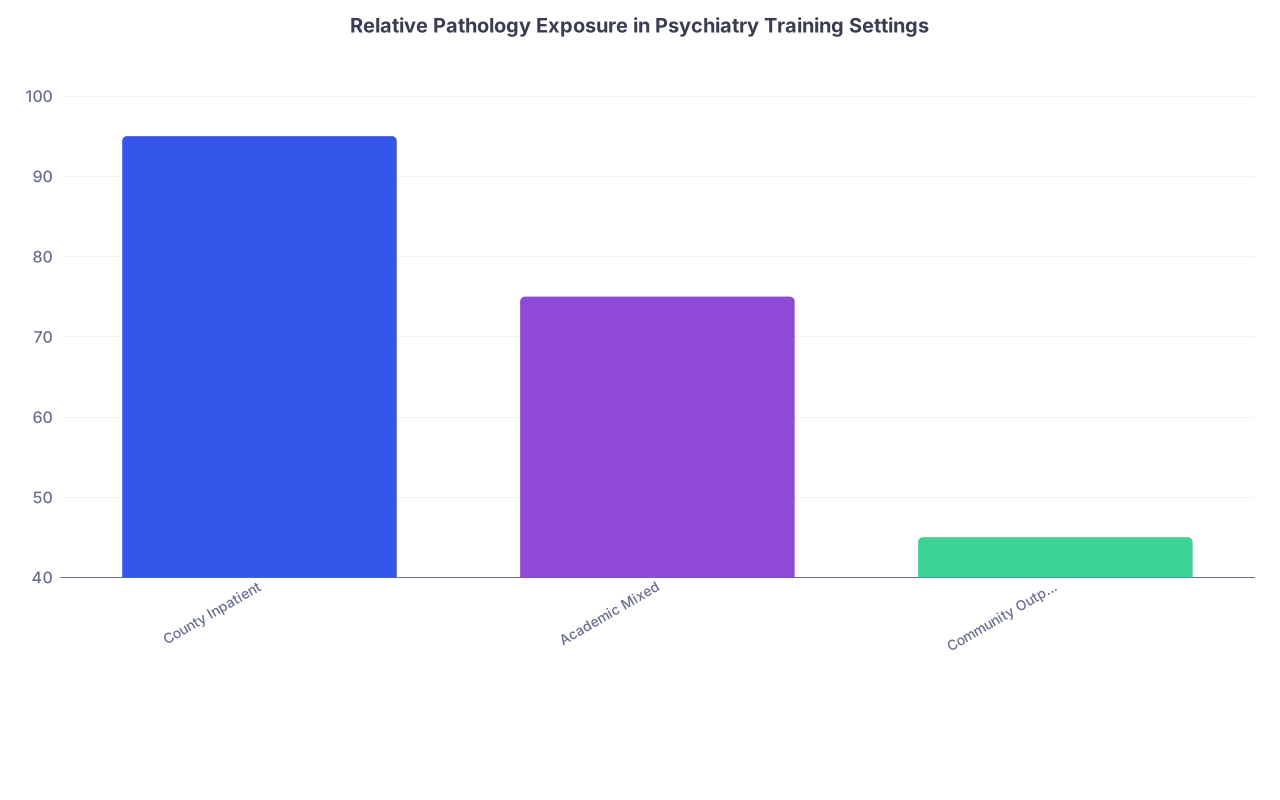
| Category | Value |
|---|---|
| County Inpatient | 95 |
| Academic Mixed | 75 |
| Community Outpatient-Heavy | 45 |
(Think of this as a rough index of severity/complexity exposure, not a precise number.)
If you are choosing psych in a less-competitive program and you want depth:
- Prioritize places with strong inpatient C/L rotations
- Ask bluntly: “What percentage of your inpatients are involuntary? How often do you see clozapine? How many ECT procedures per week?”
- Check if they have robust addiction exposure; that is where you see brutal, complex pathology intersecting with medical issues.
Psych is not broad in the “all organ systems” sense. But in the domain of severe mental illness, the depth at many “least competitive” psych programs is absolutely real.
Internal Medicine (Non-Top Programs): Underrated Pathology Workhorses
People obsess over matching categorical IM at MGH/Brigham/UCSF. Then they rotate through a 400-bed community hospital in the Midwest with a mid-tier IM program and see a different truth: the sickest patients in the region get dumped there, and residents run the show.
In the “least competitive” IM programs (relatively speaking) you still get:
- Bread-and-butter: CHF, COPD, pneumonia, DKA, sepsis, cirrhosis exacerbations
- Oncology admissions (sometimes all oncology is on medicine service)
- Renal failure, complex endocrinology, poorly controlled autoimmune disease
- Undifferentiated fever, weight loss, constitutional symptoms where you actually have to think
Breadth: High across adult medicine, particularly if there is no large competing subspecialty presence to siphon off cases.
Depth: Variable and often underestimated.
Key axis is community vs academic, but the story is not as simple as “academic = deeper pathology.”
- Community IM at a regional referral center may see more volume and more end-stage disease than some academic centers where everything is quickly subspecialized.
- Academic IM will give you depth in subspecialty exposure (ID, cards, GI, heme/onc), but sometimes residents become “traffic controllers” more than primary decision-makers.

Here is a crude side-by-side:
| Feature | Community Regional Center | Academic Tertiary Center |
|---|---|---|
| Volume of decompensated CHF | Very High | High |
| Exposure to rare diseases | Moderate | High |
| Autonomy in sick patients | High | Moderate |
| Subspecialty clinic depth | Low to Moderate | High |
| “First call” on complex cases | Often resident | Often fellow/attending |
So in a “less competitive” community IM program, you may get:
- Excellent depth in common but severe pathology (think: managing multiple pressors on a DKA + sepsis patient in a small ICU)
- Limited depth in rare zebras or cutting-edge therapies
- Solid breadth across adult medicine, minimal pediatrics/OB/psych except through consult interactions
If you want extensive general adult pathology and you are not chasing a hyper-competitive fellowship, many of these programs are actually ideal. They teach you to manage what you will really see as a hospitalist or primary care internist.
Pediatrics and PM&R: Narrower Windows, Deep Within Their Lane
Pediatrics (general, non-elite programs)
Pediatrics is not uniformly “least competitive,” but outside top coastal academic centers, many community peds programs are accessible.
Breadth: Within the pediatric age range, yes. From newborn nursery to PICU to adolescent medicine. But it is age-limited and organ-system-limited compared with IM/FM.
Depth: Also age-bounded but real. For example:
- Severe bronchiolitis, asthma exacerbations, septic neonates
- Complex congenital anomalies if your program has NICU/peds subspecialists
- Complex social determinants—neglect, abuse, failure to thrive
Smaller community pediatric programs often:
- See tons of viral respiratory disease, asthma, dehydration, common infections
- Less exposure to super-rare metabolic or genetic diseases unless they refer everything out
If you want depth in complex pediatric pathology and you land at a less competitive peds program, make sure it is tied to a children’s hospital or at least has a NICU/PICU presence.
PM&R (Physiatry)
PM&R in some regions is relatively non-competitive. Pathology exposure is highly specific:
- Spinal cord injury, traumatic brain injury
- Stroke rehab, post-ICU debility
- Neuromuscular disorders, amputees, chronic pain
Breadth: Moderate, but heavily limited to neuromuscular and functional disease. You are still dealing with cardiopulmonary, renal, and other systems as they intersect with rehab, but not at the same surgical/critical care depth.
Depth: Can be intense in:
- Spinal cord injury patients with recurrent autonomic dysreflexia, neurogenic bladder issues, pressure injuries
- Neurorehab patients with complicated spasticity, contractures, cognitive/behavioral sequelae
- Chronic pain with significant psychiatric and social overlay
A mid-tier PM&R program at a trauma center can expose you to extremely complex pathology—but within that rehab niche. If you imagine yourself as a “general doctor,” PM&R depth will feel narrow but deep.
Transitional Year and Preliminary Year: Breadth Sampler, Depth Nowhere
Transitional years (TY) and many prelim IM years are classically “least competitive” in smaller hospitals. People use them as a soft landing when they pivot paths or are headed into derm, rad onc, ophtho, etc.
Pathology exposure reality:
- You get a sampler of common adult medicine, ED, maybe some ICU
- Moderate inpatient volume, limited continuity
- Almost no longitudinal depth—by design, you are there for 12 months
Breadth: Reasonable across adult acute care, but shallow.
Depth: Minimal, unless the program is malignant and overworks you on a busy IM service; then you get depth in pure survival and DKA/pneumonia/CHF cycles.
This is not where you train for long-term independent broad-spectrum practice. It is where you survive and collect enough exposure to function in a more specialized field later.
Community vs Academic: The Real Breadth-Depth Battle
The biggest mistake I see applicants make: they talk about “least competitive specialties” as if competition level is the main driver of pathology exposure.
No. The driver is program structure and hospital ecosystem.
Let us pin it down:
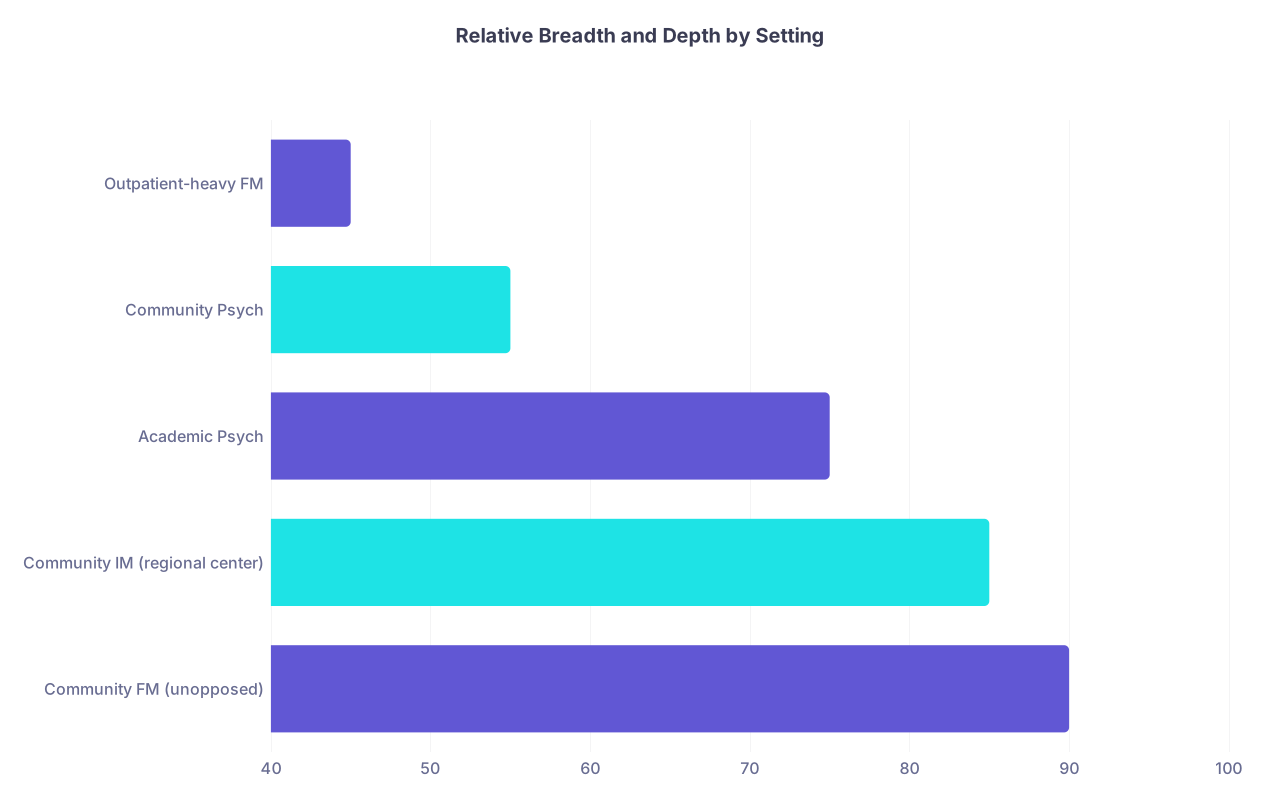
| Category | Value |
|---|---|
| Community FM (unopposed) | 90 |
| Community IM (regional center) | 85 |
| Academic Psych | 75 |
| Community Psych | 55 |
| Outpatient-heavy FM | 45 |
Think of that as a rough “overall pathology training value” index. Obviously not scientific, but it matches what many residents experience.
Patterns I have seen repeatedly:
- Unopposed community FM: You admit everything that is not surgical. Huge breadth, decent depth in acute adult and OB if they have strong maternity care.
- Community IM at a referral center: Less breadth outside adult internal medicine, but heavy depth in serious illness and autonomy.
- Academic psych: Less physical medicine breadth, very strong mental health depth, subspecialty variety.
- Outpatient-heavy FM: You will know chronic primary care cold, but your comfort with real-time crashing patients will lag.
You cannot just search “malignancy” or “reputation.” You need to ask very specific, pathology-focused questions on interview day.
How to Choose If You Care About Pathology Exposure
If you are serious about becoming clinically sharp and not just coasting through an easy three years, you need to stop asking, “Is this program competitive?” and start asking, “What exactly will I see and manage here?”
Here is how I tell applicants to approach it:
Clarify your endgame.
- Do you want to be a broad generalist (FM, hospitalist IM, general peds)?
- Or a focused expert (psych, PM&R, future subspecialist)?
Breadth matters more in the first group; depth in a narrower set matters more in the second.
Audit the inpatient census.
- Ask: “What are the top 5 DRGs or main diagnoses on your inpatient services?”
- If all you hear is “uncomplicated chest pain eval, social admits, and mild COPD,” be wary.
Ask about who runs the codes and sick patients.
- “Who runs codes here—residents, hospitalists, ICU attendings?”
- Programs where you never lead resuscitations will not give you deep acute care skills, no matter the specialty.
Look at clinic variety.
- FM: Do you see peds, OB, geriatrics, procedures, behavioral health, or just routine 15-minute adult chronic visits?
- Psych: Are there dedicated specialty clinics (addiction, early psychosis, ECT, women’s mental health)?
Find out what gets shipped out.
- “What percentage of your sickest patients go to a tertiary or quaternary center?”
- If everything challenging leaves, your pathology exposure shrinks fast.
Talk to PGY-3s about cases they will never forget.
Pay attention to whether they mention:- Real medical disasters they were central in managing
- Or mostly “interesting social situations” and low-acuity anecdotes
Shaping Your Own Breadth and Depth During Residency
Let us say you have already matched into a “least competitive” specialty at a solid but not famous program. You are worried about becoming “too shallow.” You can still fix a lot of this yourself.
Concrete moves:
Maximize your heaviest rotations.
If your FM or IM program has one brutal inpatient or ICU block where residents complain about being crushed—good. That is where you push for responsibility, read aggressively, and see sick pathology.Electives with intentionality.
FM resident? Do extra ID, cards, ED, and ICU. Psych resident? Do CL, addiction, and neuro. PM&R? Load up on stroke, trauma ICU, and complex neuro rotations. Not just “sports clinic because I like MSK.”Own follow-up.
Do not just sign out the interesting cases and forget them. Track their course through consults, rehospitalizations, clinic. Depth is built on seeing what happens after your initial decision.Procedures and critical events.
Any time there is a code, rapid response, LP, central line, joint injection, ECT, TMS, spinal injection—show up. Repetition builds both confidence and depth.Read case-based, not just guideline-based.
Take one complex patient per week and read deeply on that scenario, not just generic “hypertension guidelines.” Pathology depth comes from grappling with nuance.
Your specialty and program set your starting field. Your choices determine how far you actually explore it.
FAQ (Exactly 5 Questions)
1. Are least competitive residencies “worse” for learning pathology than competitive ones?
No. They are different. Many less competitive community programs see higher volumes of very sick, late-presenting, poorly controlled disease. What you may lose is exposure to ultra-rare zebras and cutting-edge therapeutics. But for real-world practice, especially as a generalist, those less competitive programs can produce very strong clinicians.
2. If I want maximum breadth of pathology, what specialties and settings should I target?
For maximum breadth: unopposed community family medicine, community internal medicine at a regional referral center, or general pediatrics tied to a children’s hospital. These expose you to wide organ-system variety and multiple disease severities. Academic psych or PM&R give depth but narrower systemic breadth.
3. Is academic always better than community for depth?
Not automatically. Academic centers offer depth in subspecialty exposure and rare diseases. Community regional centers often provide deeper autonomy and repeated experience with advanced, common pathology (CHF, COPD, sepsis, DKA) in very sick patients. It depends what “depth” you care about—zebras vs. mastery of bread-and-butter in real-world conditions.
4. How can I tell from a program’s website what kind of pathology exposure I’ll get?
Honestly, you mostly cannot. Websites are marketing. You need to look for clues: presence of ICUs, trauma designation, whether they list subspecialty services or just “hospitalist-run,” and case logs if provided. The real answers come from asking residents direct questions about common diagnoses, transfer patterns, and what kinds of cases they actually manage versus consult out.
5. If I am in a less competitive program and feel my pathology exposure is too shallow, what should I do?
Load your schedule with higher-acuity rotations (ICU, ED, inpatient wards), seek electives at busier or tertiary centers, directly ask attendings for more responsibility on sicker patients, and actively follow complex cases longitudinally. You can also use away electives or short-term rotations at larger institutions to deepen exposure in specific areas like cardiology, ID, or critical care. You cannot change your match now, but you can absolutely change the intensity and focus of what you learn.
Key takeaways:
Breadth vs depth of pathology in “least competitive” residencies is not a simple scale; it is specialty- and program-structure–dependent. Community FM and IM often deliver enormous breadth and real-world depth in common severe disease, while psych and PM&R offer intense depth in narrower domains. If you want to come out strong, stop fixating on prestige and start interrogating exactly what pathologies you will see, how sick those patients will be, and how central you will be to their care.