
The biggest myth about “less competitive” programs is that the mentorship is automatically worse. Often, it is the opposite problem: the mentorship is stronger, but sloppily structured.
Let me break that down.
In smaller, less competitive specialties and community-heavy programs, you usually get more face time with faculty than at the big-name powerhouses. But the way that mentorship is organized—if it is organized at all—varies wildly, and that can make or break your training, your fellowships, and your sanity.
We are going to talk about the actual mentorship models you will see on the ground in these programs: who does what, how formal it is, how it impacts your career options, and what you should quietly probe for on interview day.
The focus here is on least competitive specialties and smaller / less competitive programs in fields like:
- Family medicine
- Internal medicine (community-heavy, lower-tier academic)
- Psychiatry (non-flagship programs)
- Pediatrics (community or mid-tier)
- PM&R at smaller institutions
- Community-based prelim / transitional year programs
These places do not usually have a Mentorship Office with a slick PDF. They have people. Personalities. Habits. That is what you are navigating.
1. Why Mentorship Looks Different in Less Competitive, Smaller Programs
In a big-name, hyper-competitive program, mentorship often looks polished: formal advising systems, research committees, subspecialty “tracks.” It is structured because they are churning out fellowship-bound grads at scale.
Smaller, less competitive programs usually have:
- Fewer residents per class (4–12 instead of 20–40)
- Fewer fellows (or none)
- A handful of stable core faculty
- Fewer research obligations
- A heavy service / clinical focus
That combination changes the texture of mentorship.
You get:
- More direct attending contact (on wards, in clinic, on call)
- Less competition from fellows for attending attention
- More “informal” advice in hallways and after sign-out
- Fewer formal mentorship structures and written policies
- More variability by rotation and by attending
In other words: high access, low structure. That is the basic tradeoff.
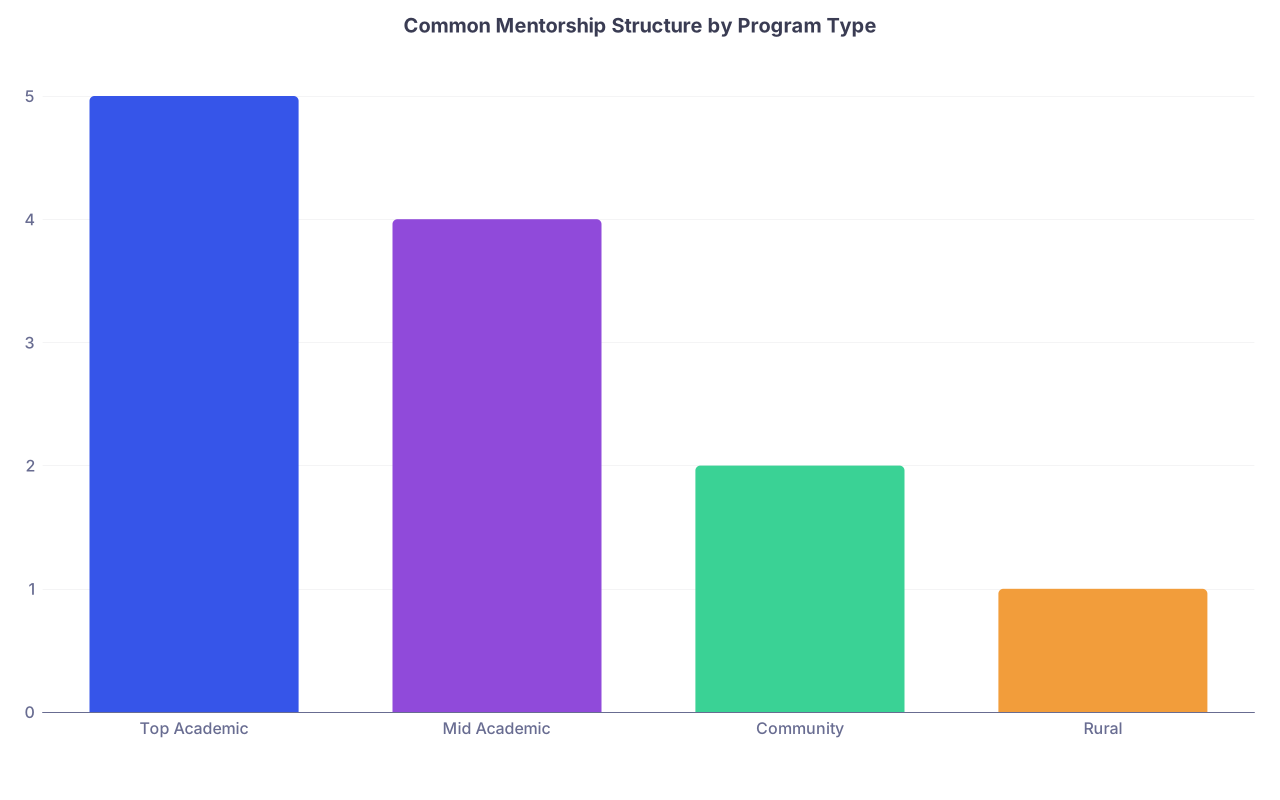
| Category | Value |
|---|---|
| Top Academic | 5 |
| Mid Academic | 4 |
| Community | 2 |
| Rural | 1 |
(Here, higher numbers mean more formal/complex mentorship structure. Smaller and rural programs are usually at the bottom of that list.)
If you are heading into family medicine in a 6-resident-per-year Midwest community program or a psychiatry residency in a non-flagship state hospital system, your mentorship reality will not look like Harvard’s. You need to understand the models that actually show up in these settings.
2. The Core Mentorship Models You Actually See
Most smaller, less competitive programs stitch together some combination of these models. They rarely call them by names, but you will recognize them quickly once you are there.
2.1 Assigned Faculty Advisor Model (“You’re with Dr. X now”)
This is the most common baseline. During orientation, someone hands you a piece of paper or sends an email:
- “Your faculty advisor is Dr. Patel.”
- “You will meet twice a year to discuss progress.”
- “Let us know if you wish to change advisors.”
In small / less competitive programs, this advisor is usually:
- A core teaching faculty member (often program leadership)
- Someone you will definitely work with clinically (wards, clinic, or both)
- Not necessarily matched to your career interests
Strengths:
- Guaranteed at least one person “on paper” advocating for you
- Easy for programs to administer
- In small programs, this person genuinely knows your work habits
- Works reasonably well for residents who are flexible in career goals
Weaknesses:
- Matching is often random or based on schedule convenience, not fit
- Meetings can devolve into checkbox exercises: “everything OK?” “Yep”
- Career-specific mentoring (fellowships, niche interests) can be thin
- Some advisors are more engaged than others, and that disparity is huge
In less competitive specialties like family medicine, this model often morphs into life coaching:
- Talking about wellness, burnout, schedule issues, exam anxiety
- Balancing OB call with small children at home
- “Do I even want to do a fellowship?” questions
If the program is small and decent, this can be quite powerful. You are not student #142. You are the resident they have seen at 2 a.m. on night float.
Red flags to listen for on interview day:
- “We technically assign you an advisor, but mostly mentorship is informal.” Translation: expect inconsistency.
- “You meet your advisor annually for a required eval form.” Translation: compliance, not guidance.
2.2 Clinic-Preceptor-as-Mentor Model
In primary care–heavy specialties (family med, peds, IM at community sites), your continuity clinic preceptor becomes an unofficial primary mentor.
This is often the most influential relationship in a small program.
What it looks like:
- You are paired with one preceptor (or a very small pool) in continuity clinic
- You see them weekly for 3 years
- They observe your growth, style, and patterns closely
- They naturally end up writing your strongest letters
Strengths:
- High longitudinal contact—more real feedback, less fluff
- Builds trust; they see your bad days and your improvement curves
- Great for outpatient-focused careers, rural practice, community jobs
Weaknesses:
- If you want a subspecialty fellowship, this mentor might lack that network
- Quality is heavily personality-dependent
- If the match is poor (style clash, misaligned values), it is hard to escape
- Some preceptors are chronically overbooked and distracted
A strong clinic preceptor in a small program can launch you into:
- Chief resident roles
- Local community jobs they directly connect you to
- Teaching roles at the same residency after graduation
But if you are the one family medicine resident who wants sports medicine fellowship at a top-tier place and your preceptor is clinically solid but academically disconnected, you will need a second mentorship layer.
2.3 PD/APD-Centered Mentorship (“Leadership Is Your Mentor”)
In many smaller, less competitive residencies, the program director (PD) and associate/assistant PDs essentially function as the primary mentors for the majority of residents.
The reason is simple: there is no army of subspecialty faculty. There is a small core of 3–6 people who do most of the teaching, scheduling, and career advising.
Common patterns:
- PD meets with each resident 2–4 times per year
- APDs manage specific classes (PGY1, PGY2, PGY3)
- Many residents turn to PD/APDs for fellowship letters and job advice
Strengths:
- PDs often have the broadest view of your performance and trajectory
- They have direct insight into program politics, opportunities, and risks
- In small programs, they genuinely know your strengths and weaknesses
Weaknesses:
- Bandwidth. A PD with 24–30 residents and heavy clinical load cannot be an intensive mentor for everyone
- Advice can skew toward what is best for the program’s stability, not your long-term ambition
- Some PDs are excellent administrators but mediocre mentors
You can usually spot a mentorship-heavy PD on interview day:
- They can recall where recent grads matched or took jobs without notes
- They talk about specific alumni by name and path
- Residents mention “I talk to our PD a lot about my career plans” without hesitation
Or the opposite:
- Residents say, “We mostly interact with the chief residents about our plans.” Translation: leadership is distant.
2.4 Peer-Led / Senior-Resident Mentorship
This one is underappreciated and extremely common in less competitive environments.
Formal version:
- The program pairs PGY1s with PGY3 “big sibling” mentors
- There may be check-ins built into semiannual wellness or retreat days
Informal version (far more common):
- You gravitate toward one or two seniors who actually help you
- They tell you which attendings write decent letters, which rotations are fluff, and how to not get crushed on night float
Strengths:
- Senior residents are brutally honest in a way faculty rarely are
- They know the current application landscape for your specialty or fellowship, not the one from 15 years ago
- They can share “here is the email I used; copy this structure” level help
Weaknesses:
- Variability—some seniors are stars, others are burned out or disengaged
- Peer mentors cannot always open doors; they can only point at them
- Programs may dump too much advising burden on seniors if faculty are weak
In smaller, less competitive specialties, the distance between a strong PGY3 and faculty is often thinner. I have seen senior residents essentially function as unofficial chief mentors for whole intern classes, especially in community internal medicine and psychiatry programs.
If a program explicitly says, “We rely heavily on our senior residents to mentor juniors,” ask how they support and train those seniors. If the answer is, “We do a one-hour talk during orientation,” expect hit-or-miss.
2.5 “Organic” Mentorship (The Chaos Model)
Many smaller, rural, or low-structure programs live here.
There is no real formal pairing. No system beyond vague statements like:
- “Mentorship happens naturally; we are a family here.”
- “You can always talk to any attending if you need something.”
What actually happens:
- A few residents click well with certain attendings and get strong, organic mentorship
- Others drift, never quite attaching to anyone, and get bland letters and generic advice
- Residents who are assertive and socially skilled do better in this environment
Strengths:
- When it works, it can feel very genuine and powerful
- No forced “you must like this person” relationship
- You can assemble a mentorship “board” of multiple attendings organically
Weaknesses (and they are serious):
- High risk of inequity—some residents get heavy support, others get almost none
- Quiet, non-assertive residents can essentially fall through the cracks
- There is often no oversight of mentorship quality at all
This model is absolutely survivable. But you must be intentional and proactive. If you are the type who waits to be assigned things, you will be under-mentored.
3. Specialty-Specific Nuances in Less Competitive Fields
Mentorship does not look identical across the “least competitive specialties.” The values, workflows, and end goals differ.
3.1 Family Medicine
Common setting: Small community programs, unopposed or lightly opposed, often in suburban or rural areas.
Dominant mentorship patterns:
- Clinic preceptor as primary mentor
- PD/APD as secondary mentors
- Organic local physician mentors for job placement
Content of mentorship:
- Career planning: outpatient vs inpatient-heavy jobs, OB vs no OB, rural vs urban
- Scope-of-practice discussions: “How much procedure work do you really want?”
- Community integration: many mentors help you navigate local systems, including school health, SNFs, addiction clinics
Where it can fall short:
- Limited deep mentorship for academic careers or niche fellowships (sports med, OB, geri, underserved medicine at elite sites)
- Research mentorship thin or superficial unless you are at a more academic FM program
You need to ask very direct questions:
- “Who mentored your last resident who matched into sports medicine?”
- “Who would I work with if I wanted to build a niche in addiction medicine?”
If the answer is “we have not really had anyone do that,” you will have to reach outside the program for that type of mentorship.
3.2 Community Internal Medicine (Non-Flagship)
Here we mean the IM programs that are not feeding the big-name cardiology/GI fellowships every year. They exist in community hospitals, smaller university affiliates, or lower-tier academic centers.
Common mentorship structures:
- Assigned advisors (often general IM faculty)
- PD/APD-driven mentorship for residents pursuing fellowships vs hospitalist jobs
- Subspecialty attendings as targeted mentors for fellowship applicants
Mentorship focus splits along two tracks:
- Residents planning hospitalist or primary care careers
- Residents fighting upstream for fellowships from a less-famous program
For track 1, mentorship is pretty solid in many smaller programs:
- Local job connections, contract advice, scheduling preferences
- Guidance on balancing nights, procedures, and lifestyle
For track 2, mentorship quality is highly variable:
- You need attendings who know how to craft a compelling fellowship narrative from a non-elite program
- You need faculty who will help you find presentable projects, even if the program’s research infrastructure is minimal
A red flag: “We have not had many residents go into competitive fellowships recently.” Often code for poor mentoring on that front.
3.3 Psychiatry (Non-Flagship, Community-Oriented)
Psych programs in smaller systems or state hospitals lean heavily on a few core attendings, plus a lot of clinical exposure.
Mentorship tends to emphasize:
- Psychotherapy vs psychopharm career shaping
- Forensic vs community vs consult-liaison tracks
- Work-life boundaries and burnout, especially in under-resourced settings
Models:
- Strong PD/APD involvement in career mentoring
- Organic mentorship with a few influential psychotherapy supervisors
- Senior residents as key sources of fellowship and job insight
Psych is interesting because the culture of reflection and supervision lends itself to quasi-mentorship:
- Supervision sessions sometimes bleed into career talks
- Faculty who trained in psychoanalysis or related fields often think in “developmental” terms and apply that to residents
The risk in smaller, less competitive psych programs:
- Narrow exposure to subspecialists (forensic, addiction, CL, child)
- Limited national presence of faculty, which matters when you are applying for top fellowships
So you ask:
- “Who mentors residents interested in addiction psychiatry?”
- “What does the support look like when applying to fellowships out of state?”
If the answer is vague, plan for outside mentorship (national organizations, virtual mentors, etc.).
3.4 Pediatrics in Community or Mid-Tier Programs
Peds mentorship in small programs often centers on:
- Continuity clinic preceptor
- PD/APDs
- A small cadre of subspecialists who also wear multiple hats
Pediatrics leans heavily toward:
- Longitudinal relationships with a few faculty
- Soft-skill mentorship: communication, family dynamics, grief, chronic disease management
For residents eyeing general peds jobs, the mentorship tends to be strong and practical.
For those pushing for intensive subspecialties (NICU, heme/onc from small sites), the mentorship is more fragile. You rely heavily on one or two subspecialists who might be clinically excellent but not deeply plugged into national fellowship circles.
Again: ask about specific recent fellowship matches and who mentored those residents.
4. Structural Variations: How Programs Try to Organize Mentorship
Beyond those base models, several structural variations show up repeatedly in smaller, less competitive settings.
4.1 “Mentorship Committees” (Rare but Powerful When Done Right)
A few smaller programs have borrowed an idea from larger institutions: each resident has 2–3 faculty on a loosely defined “mentorship committee.”
What it looks like:
- One generalist, one subspecialist, sometimes the PD or APD
- Brief annual or semiannual group meetings
- Ongoing ad hoc one-on-one contact
Strengths:
- Diversifies your mentorship inputs
- Reduces risk of being stuck with one disengaged advisor
- Better for residents with non-standard paths (part-time, dual interests, etc.)
Weaknesses:
- Administrative burden for a small faculty pool
- Easy for this to exist on paper but not in reality
If a smaller program genuinely runs this model well, that is a major plus. Press for details: “How often do they meet?” “What do those meetings actually look like?”
4.2 Interest-Based Pairing (Emerging, Still Patchy)
In some programs, especially those trying to “up their game” without large infrastructure, you will hear:
- “We try to match residents with faculty who share their interests (rural, OB, geriatrics, etc.).”
This is far better than random emails assigning you to whomever.
Factors that limit it:
- Many small programs simply do not have enough diverse faculty interests
- You might be the only PGY1 interested in sports medicine and there is only one semi-interested attending who did a fellowship 10 years ago
Still, if you care about niche training, interest-based pairing—when it exists—is a high-yield question to ask about.
4.3 Longitudinal Mentor Check-ins vs One-Off Meetings
Watch for frequency.
| Model | Typical Frequency |
|---|---|
| Assigned Advisor | 1–2 times/year |
| PD/APD Check-ins | 2–4 times/year |
| Clinic Preceptor | Weekly/biweekly |
| Organic/Ad Hoc | Unpredictable |
| Senior Resident Mentor | As needed |
If your only structured meetings are:
- One annual advisor check-in
- One PD meeting for evaluation
You are under-mentored structurally, and everything depends on organic initiative.
Programs that schedule predictable check-ins (e.g., PGY1 October, PGY2 February, PGY3 early fall for fellowship planning) tend to produce more coherent career outcomes, even if they are smaller and not “elite.”
5. How These Models Affect Your Career Outcomes
Here is the part people gloss over. The mentorship model in your small / less competitive program will shape:
- How strong and specific your letters are
- How early you get steered toward realistic career options
- Whether you know the unwritten expectations for fellowship or job applications
5.1 For Residents Seeking Local or Regional Jobs
Less competitive specialties + smaller programs = often excellent pipelines into:
- Local hospitalist groups (IM, peds)
- Area family medicine clinics, FQHCs, rural sites
- State mental health systems (psych)
Mentorship model impact:
- Strong clinic-preceptor or PD-centered mentorship usually gives you more job offers than you need
- Organic mentorship can still work if faculty are well-connected locally
You are mostly fine as long as at least one attending likes you and is respected in the local system.
5.2 For Residents Targeting Competitive Fellowships or Academic Careers
Here the mentorship model matters a lot more.
You need:
- Faculty who understand how to compensate for your program’s brand name
- Early identification of what you need: research, presentations, letters from well-known people
- Tactical advice: which conferences, who to email, how to frame your case logs
In a small, less competitive program, that usually means:
- A subspecialist mentor who still has some active national presence
- A PD/APD who will take your goals seriously and not talk you out of them due to program convenience
- Proactive residents who ask, repeatedly and early, “What exactly do I need to do if I want X fellowship from this program?”
If the program’s mentorship is purely organic and there is no track record, getting a competitive fellowship is absolutely still possible—but it will be harder and will require you to build some mentorship outside your institution.
6. What You Should Be Asking on Interview Day
Do not ask, “Do you have mentorship?” They will say yes. Everyone says yes.
Ask questions that force them to describe their actual model:
- “How are mentors assigned, if at all? Can you change mentors if the fit is not good?”
- “How often do residents meet one-on-one with faculty about career planning?”
- “Who mentored your last resident who matched into [fellowship X] or took [job type Y]?”
- “Can you walk me through what mentorship looks like for someone who is not sure what they want to do yet?”
- “If I were interested in an academic path from here, what faculty tend to support that?”
And then ask residents, privately:
- “If you needed serious help with fellowship applications or a big life decision, who would you actually go to?”
- “Have you felt pushed into a path because it is what the program usually does?”
- “Do any residents feel like they have no real mentor here?”
Answers will tell you more about the actual mentorship culture than any brochure.

| Step | Description |
|---|---|
| Step 1 | New PGY1 |
| Step 2 | Advisor Meetings |
| Step 3 | Organic Mentors |
| Step 4 | Primary Mentor Relationship |
| Step 5 | Clinic Preceptor |
| Step 6 | PD or APD |
| Step 7 | Senior Resident |
| Step 8 | Career Advice |
| Step 9 | Job or Fellowship Applications |
| Step 10 | Formal Advisor Assigned |
| Step 11 | Satisfied With Advisor |
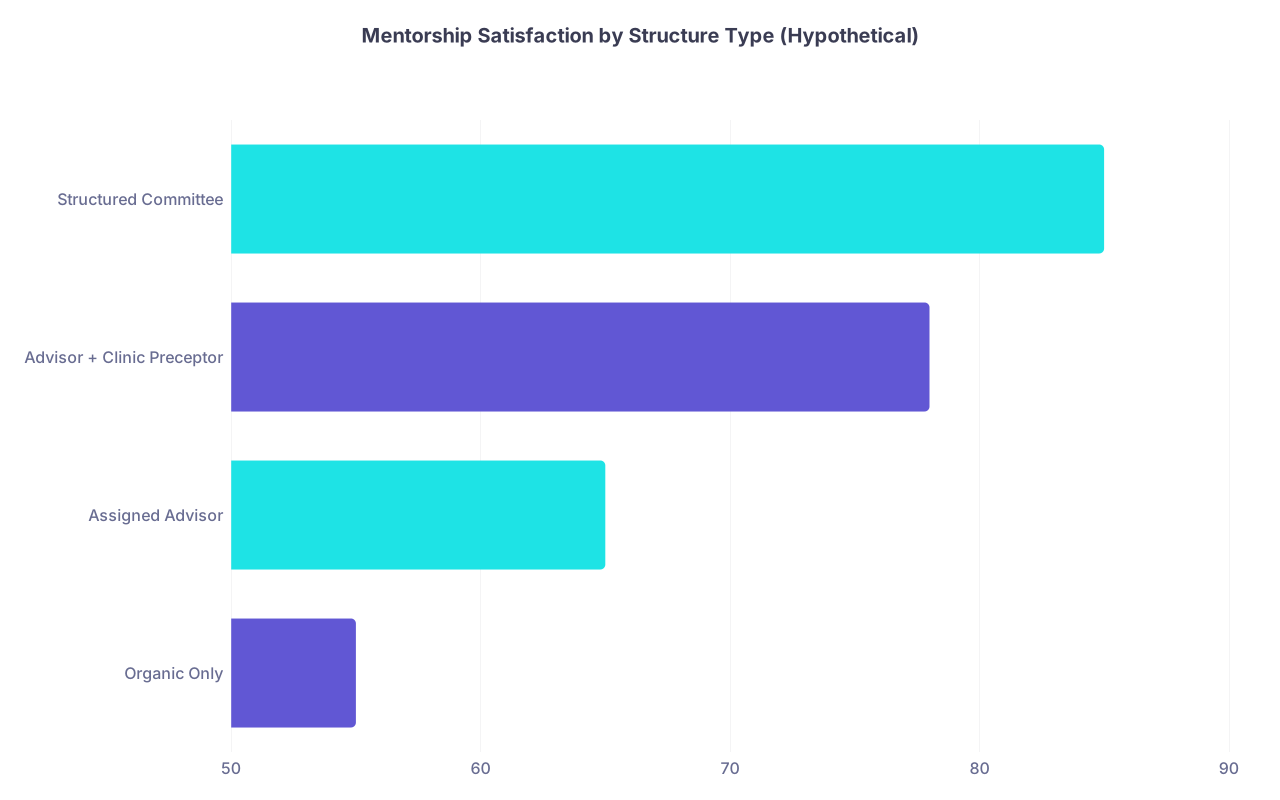
| Category | Value |
|---|---|
| Organic Only | 55 |
| Assigned Advisor | 65 |
| Advisor + Clinic Preceptor | 78 |
| Structured Committee | 85 |

7. How to Survive and Thrive in Imperfect Mentorship Models
Let me be blunt: most smaller, less competitive programs do not have beautifully designed mentorship systems. They have a mix of well-meaning people and patchy structure.
You cannot fix the system as a PGY1. But you can work it.
Basic playbook:
Identify 2–3 potential mentors early (first 6 months):
- One who sees you often clinically
- One who aligns with your career interest (even loosely)
- One in leadership (PD/APD or similar)
Treat mentorship as a portfolio, not a monogamous relationship.
- You do not need one “perfect” mentor; you need 2–3 decent ones for different domains: career, skills, wellness.
Be direct with faculty.
- “I am thinking about [fellowship or job type]. What did your last resident who achieved that do differently?”
- Small-program attendings generally respond well to clear signals of motivation.
Use external mentorship if the local ecosystem is weak.
- Specialty societies, virtual mentorship programs, alumni from your med school now at bigger centers.
Document your work and growth.
- Small-program mentors often feel you are good but struggle to articulate it in letters. Help them with CVs, bullet lists of projects, specific cases you managed.
If you walk into a less competitive, smaller program assuming mentorship will be “handled” by the institution, you will probably underperform your potential. If you treat the existing models as scaffolding that you can climb on and extend, you will be fine.

FAQ (Exactly 6 Questions)
1. Are mentorship opportunities in smaller, less competitive programs objectively worse than in big academic centers?
No. They are usually less structured, not inherently worse. You often get more direct faculty access, especially without fellows in the way. The tradeoff is fewer formal systems and less subspecialty depth. Strong mentorship absolutely exists in these programs; you just have to be more intentional in finding and shaping it.
2. How much does the mentorship model matter if I only plan to do general practice or hospitalist work?
It still matters, but the stakes are lower compared with competitive fellowship goals. For general practice or hospitalist careers, a solid clinic preceptor or PD who knows the local job market can be more valuable than a fancy academic mentor. You want someone who will be honest about workload, contracts, and lifestyle, and who will pick up the phone for you when you apply for local positions.
3. Can I get a competitive fellowship from a small, less competitive program with weak research infrastructure?
Yes, but you will work harder for it. You need at least one mentor who understands the fellowship landscape and is willing to help you build a credible application: some scholarly work, strong letters, and clear narrative of why you want that path. You may need to reach outside your program for research or niche mentorship, especially via national societies, electives at larger centers, or remote collaboration.
4. What is the biggest red flag about mentorship I should listen for during interviews?
Vague answers. If faculty or residents cannot name: (a) who actually mentors residents, (b) how often they meet, and (c) specific examples of recent mentorship success (jobs or fellowships), that usually means there is no real structure and outcomes are highly personality-dependent. “We are like a family and mentorship just happens” is not enough by itself.
5. How soon after starting residency should I worry about finding a mentor?
By 6 months in, you should have a good sense of which attendings you click with and who actually pays attention to your growth. That is when you start intentionally cultivating those relationships: asking for feedback, scheduling brief check-ins, and expressing your early career thoughts. Waiting until late PGY2 to look for mentorship, especially if you are fellowship-leaning, is a classic mistake.
6. If my assigned advisor is disengaged, what is the right way to handle it in a small program?
Do not waste a year hoping they change. Keep things cordial, meet the basic requirements, but quietly build a parallel mentorship network: identify another faculty member who is responsive and ask if you can meet to discuss your goals. Many programs will let you formally change advisors if you ask politely; even if they do not, nobody will stop you from having unofficial mentors. In small systems, people know who the real mentors are, regardless of what the paperwork says.
Key takeaways:
First, smaller, less competitive programs usually offer more faculty access but less structured mentorship; you must be proactive.
Second, your clinic preceptor, PD/APDs, and one or two engaged subspecialists will shape most of your real mentorship experience; choose them deliberately.
Third, if the internal mentorship ecosystem is thin, build an external one early—your career will not wait for your program to catch up.