
The biggest myth about low-competition specialties is that residents are “babied” and never get real autonomy. That is wrong. The autonomy is there. It just matures differently, and often more quietly, than in high-stakes surgical or critical care fields.
Let me break this down specifically: in the “least competitive” specialties, you usually get earlier cognitive autonomy, slower procedural autonomy, and variable systems autonomy depending on whether you land in a community program or big-name academic shop. And if you misunderstand that trajectory, you will pick the wrong program and be frustrated for three years straight.
We will focus on the classic lower-competition fields as they’re talked about on the trail:
- Family Medicine (FM)
- Internal Medicine – community-focused, non-elite (IM)
- Psychiatry
- Pediatrics (general peds focus)
- Pathology
- PM&R (often mid-tier competitive, but the autonomy story fits here)
I am not talking about derm, ortho, plastics. Different universe.
The Three Types of Autonomy You Actually Care About
Before we go specialty by specialty, you need a cleaner framework. “Autonomy” is vague. In residency, it splits into three buckets:
Cognitive autonomy – Making the medical decision yourself.
- Choice of tests
- Diagnosis
- Treatment plan
- Knowing when to escalate
Procedural autonomy – Your freedom to perform procedures.
- Basic (lines, LPs, joint injections, endometrial biopsies, etc.)
- Advanced (endoscopy, interventional pain, complex biopsies, EMGs)
Systems autonomy – How independently you function in the hospital/clinic ecosystem.
- Running your own clinic
- Calling consults without staff holding your hand
- Managing throughput: discharges, admissions
- Supervising juniors and students
Each specialty and each year of training push those three levers at different speeds. That is what you’re actually experiencing when you say, “I feel micromanaged” or “I feel on an island.”
General Pattern: PGY-1 vs PGY-3 in “Easier to Match” Fields
In low-competition specialties, programs are often more service-oriented and rely heavily on residents to keep the machine running. That can either accelerate your autonomy or stunt it, depending on how the attending corps behaves.
Here’s the big pattern I see over and over:
PGY-1:
- Cognitive: constrained but not zero
- Procedural: very guarded, mostly observation or simple stuff
- Systems: minimal; you are the note, the order, the “can you check vitals again” person
PGY-2:
- Cognitive: big jump; overnight calls start to force your hand
- Procedural: selective autonomy if you show you are not dangerous
- Systems: you begin to be the person moving admissions/discharges
PGY-3 (or PGY-4 in some fields):
- Cognitive: near-attending level in bread-and-butter cases
- Procedural: variable; heavily dependent on case volume and attending trust
- Systems: you run teams, staff clinics, and shape the flow of the day
To make this concrete, here is how autonomy typically ramps by year in three representative low-competition fields: FM, psych, and pathology.
| Specialty | PGY-1 Autonomy | PGY-2 Autonomy | PGY-3+ Autonomy |
|---|---|---|---|
| Family Medicine | Mostly supervised decisions, limited procedures | Runs own panels with backup, performs common procedures | Near-independent clinic, broad procedural autonomy |
| Psychiatry | Heavy attending input on meds/dispo | Independently manages common cases on call | Leads teams, manages complex cases with minimal input |
| Pathology | Shadowing, shared sign-out | Independently works up straightforward cases | Near-independent sign-out of routine cases |
This is the skeleton. Now let us put flesh on it by specialty.
Family Medicine: Fast-Tracked Cognitive Autonomy, Patchy Procedural Independence
If you want early real-world autonomy, a strong community Family Medicine program is one of the fastest ways to get it.
PGY-1: You Are the Front Door, Even If They Pretend You Are Not
On inpatient FM or medicine services, you are taking first crack at everything:
- You write the admitting H&P
- You decide initial labs and imaging
- You put in the first management plan (fluids, antibiotics, DVT prophylaxis)
Attending reviews and changes what they do not like. But the cognitive work is done by you first. By November or December, good programs start backing off the “rewrite every note” habit.
Clinic is the other piece: from day one you usually have your own panel, though narrowed.
- 30–40 minute visits at first
- Supervision of nearly every case initially
- By mid-year, quick staffing on straightforward HTN/DM follow-ups
Procedural autonomy PGY-1 in FM tends to be restricted. You observe or assist:
- Joint injections
- Pap smears and endometrial biopsies
- Simple skin procedures (shave biopsies, punch, cryotherapy)
- Bedside contraception procedures (IUD, Nexplanon)
Some rural or unopposed programs will have you doing these significantly earlier. Those are gold if you want procedural FM.
PGY-2: The Program Decides Whether You Grow or Just “Cover”
This is the pivot year. Strong programs start behaving like this:
In clinic:
- You see most patients independently
- You present briefly and get rubber-stamped, not micromanaged
- Attending only deeply engages with diagnostic dilemmas or high-risk cases
On inpatient:
- You run the list in the morning
- Intern presents to you first if you are senior
- You call the shots on dispo and major management changes, then staff
Procedurally, a PGY-2 at a good FM program should be:
- Doing their own joint injections
- Independently performing skin procedures under indirect supervision
- Managing contraceptive procedures with attending in another room vs at the elbow
Bad programs keep everything “attending-driven” in clinic and treat residents as scribes who are allowed to click orders. Watch for this on interview day. If residents consistently say, “I send all procedures to the attending,” that is a red flag.
PGY-3: Near-Attending in Clinic, But Inpatient Style Varies Wildly
By PGY-3, a strong FM resident in a community setting should be:
- Running their own continuity clinic nearly independently
- Handling bread-and-butter primary care with minimal staffing
- Comfortable fielding after-hours calls for the practice or clinic
Cognitive autonomy is almost complete in routine primary care. Attending involvement is for:
- New cancer diagnoses
- Complex polypharmacy
- High-risk OB (if you still do OB)
Procedurally, PGY-3 autonomy is only as strong as your case volume. Some programs graduate residents who:
- Regularly perform colposcopy, LEEPs, vasectomies, OB ultrasound, C-sections (OB-heavy programs)
- Are fully independent with joint injections, skin excisions, and IUDs
Others graduate people who have only done a handful of basic dermatologic procedures and simple contraceptive inserts. Same specialty, totally different autonomy trajectory.
Systems autonomy: by now you should be:
- Supervising juniors
- Leading interdisciplinary rounds
- Making disposition decisions without calling your attending for every social admit
If you want true procedural and systems autonomy in FM, unopposed community programs, especially in rural or semi-rural regions, usually beat big academic names.
Internal Medicine (Community-Focused): Autonomy Shaped by Service Pressure
I am not talking about MGH, Hopkins, UCSF tiers. Think mid-tier university-affiliated or community IM programs that most average applicants match into.
Here, “least competitive” does not mean low stakes. It means you are often the workhorse, and that can go either way.
PGY-1: You Own the Notes, Not Yet the Decisions
Most community IM programs run some version of:
- Intern sees patient, writes note, puts in orders
- Senior resident and attending adjust and cosign
- Night float: intern cross-covers with senior backup
Cognitive autonomy early is heavily moderated. You propose plans, but seniors and attendings fine-tune or overhaul. The learning happens fast though. You are seeing 8–12 patients on a typical ward day.
Procedural autonomy is minimal unless you are in an ICU rotation with line-friendly attendings. You may get:
- Paracenteses
- Thoracenteses
- Occasional central lines in some programs
But “I did 50 lines as a PGY-1” is rare in non-ICU-heavy community IM.
Systems autonomy? You are the pager. You answer nursing calls, adjust fluids, handle “BP 90/60 but asymptomatic” at 3 AM. It is low-level systems autonomy that teaches you what actually matters.
PGY-2: Suddenly You Are the One People Look At
PGY-2 in IM is where autonomy steepens, or you get stuck in “intern plus 1” mode.
On a well-run service:
- You supervise interns or medical students
- You run table rounds: “We will discharge X today, work up Y for GI bleed, escalate Z to ICU”
- You field most pages from nursing and consultants; attending gets the summary version
On nights (if non-night-float systems):
- You do most of the initial sepsis bundles, stroke code workup (with neuro), and rapid responses
- You call the attending after you have stabilized and formed a plan, not before every order
Procedural autonomy depends on culture:
- Some IM programs give strong PGY-2 autonomy for lines, paracenteses, thoracenteses, lumbar punctures
- Others shift all procedures to dedicated teams (IR, procedure services), which stunts your hands-on autonomy but may improve patient safety
Cognitive autonomy in outpatient IM is slower than FM, because many community IM residents do not own a large panel in the same way, or clinic is structured around high-volume quick follow-ups. You may get 20-minute slots and minimal complex longitudinal care.
PGY-3: Running the Show, If They Let You
By PGY-3 in a community IM program, your autonomy should look like this:
On wards:
- You set the team plan, juniors carry it out
- You lead family meetings with attending support, not the other way around
- You own disposition decisions and only staff tricky discharges
In ICU (if IM-run):
- You manage vents, pressors, sedation plans, and consult specialists
- Attending guides on higher-level judgment, but hour-to-hour management is yours
In clinic:
- You may have more complex panels (multi-morbid elderly, heart failure follow-up, CKD)
- You decide referrals and testing, staff becomes a safety check not the primary brain
Where autonomy often lags in these less-competitive IM programs is academic and research autonomy. Many residents are never pushed to design studies, run QI with real ownership, or present at regional meetings. If you want that piece, you must seek it.
Psychiatry: Cognitive Autonomy Blooms Early, Legal Risk Keeps a Leash On
Psych is a fascinating outlier. It has historically been less competitive, although that is shifting. Autonomy dynamics are different because the “procedure” is your chart and your legal risk is sky-high for suicide, violence, and involuntary treatment.
PGY-1: Hidden Autonomy in the Call Room
On inpatient psych as a PGY-1:
- You do full psych evaluations
- You propose meds and therapy plans
- You write the admission note and initial orders
Attending ultimately signs off on critical decisions: involuntary holds, high-risk discharges, clozapine starts. But they increasingly rely on your assessment if you show sound judgment.
The real autonomy punches you on call. Overnight, you get:
- ED consults for “psych clearance”
- Agitation management (IM haldol vs droperidol vs restraints)
- Deciding: hold on psych? clear back to medicine? safe for discharge with follow-up?
On paper, you staff everything. In practice, you often have to decide an initial pharmacologic strategy or whether to escalate security and then retroactively justify it.
Procedural autonomy is negligible; ECT is rarely resident-run early. Systems autonomy is limited; psych units are protocol-heavy for safety.
PGY-2: You Start Making the Ward Feel Like “Your Unit”
By PGY-2:
- You run daily rounds, present patients with your full plan
- Attendings often ask: “What do you want to do?” and then agree unless you say something obviously unsafe
- You negotiate with families, social work, and case management about post-discharge plans
On call, cognitive autonomy expands:
- You decide admission vs discharge in many gray-zone cases
- You titrate meds more aggressively (lithium levels, antipsychotic dosing)
- You may start making solo decisions around seclusion/restraints within protocol
Legal/systems autonomy is still gated. You do not sign court commitment paperwork alone in many states; attending signatures are tied to hospital bylaws and legislation.
PGY-3 and PGY-4: Near-Independent Outpatient Practice
Outpatient psych in later years is where autonomy really takes off:
- You manage full panels of mood disorders, psychosis, substance use, and personality pathology
- 30–60 minute visits depending on clinic model; you drive therapy and med management
- Attending reviews complex or risky adjustments but rarely micromanages stable chronic care
You should be comfortable with:
- Clozapine management, lithium titration, and monitoring
- Multi-drug regimens in treatment-resistant depression and bipolar disorder
- Coordinating with therapists, social workers, and community resources without direct attending hand-holding
Systems autonomy blossoms as you:
- Lead interdisciplinary treatment teams
- Run case conferences, supervise students, junior residents on rotations
- Interface with courts and external agencies (probation, guardianship services)
The “low competition” label here hides the fact that good psych residencies graduate residents with substantial real-world autonomy, particularly cognitively. If you want to function like a near-attending by PGY-4 in outpatient psych, choose places with heavy continuity clinic and robust call experience.
Pediatrics: Autonomy Limited By Culture and Anxiety About Risk
Pediatrics is often lower-competition than adult IM, but it is autonomy-poor at many big children’s hospitals because everyone is terrified of bad outcomes in kids. The programs that buck this trend are usually smaller, more community-oriented children’s hospitals or mixed adult-peds institutions.
PGY-1: Supervised to Death on Rounds, More Freedom at 2 AM
Daytime pediatric services:
- Interns write notes and propose plans
- Attendings are heavily involved, often in the room during family discussions
- Every antibiotic dose, fluid bolus, and imaging order is scrutinized
This is not inherently bad. Kids compensate and then crash. However, it slows the feeling of autonomy.
At night, especially in community pediatric units or mixed EDs, interns get:
- More responsibility stabilizing bronchiolitis, asthma, dehydration
- Some say in admission vs discharge decisions, though often with phone staffing
- More leeway ordering labs and imaging first, then getting attending agreement
Procedural autonomy (LPs, IVs, intubations) is constrained by:
- Limited volume in smaller programs
- Competition with anesthesia and PICU fellows in big centers
- Anxiety about procedural complications in tiny patients
PGY-2: Expected to Be the Workhorse Senior, Not Always Treated Like One
By PGY-2, you are often “senior” on floors or in the ED.
- You run the list, triage admissions, oversee PGY-1s
- You call subspecialties and negotiate plans and discharges
- You manage most bronchiolitis/asthma/FEVER x 1 day without deep attending input
But some children’s hospitals maintain a very attending-centric culture. In those places, PGY-2s are glorified interns. If residents complain that attendings round twice a day and redo every plan, autonomy is being throttled.
Procedural autonomy remains an issue. You might:
- Get good at LPs if you are in a high-volume nursery or NICU
- Do a handful of intubations, mostly under close supervision
- Rarely get central lines; often owned by PICU/anesthesia
PGY-3: Autonomy Depends Almost Entirely on Program Personality
A PGY-3 in peds should, theoretically, be:
- Running ward teams
- Making admit/discharge decisions with attending agreement, not permission
- Handling bread-and-butter pediatric ED presentations independently overnight
In reality:
- Some programs fully empower PGY-3s—residents effectively function as junior hospitalists
- Others keep attendings hyper-involved, and residents never feel true cognitive independence
For outpatient pediatrics, later-year residents should have:
- Continuity clinics where they manage routine peds with little interference
- Autonomy in vaccine schedules, developmental screening decisions, referrals for early intervention
If you want strong peds autonomy, pay more attention to program culture than brand name. Smaller programs often provide better independence.
Pathology: Late, Then Very Steep Autonomy Curve
Pathology is classically “low competition,” but its autonomy story is different. You do not get high-stakes independence until later, but once it clicks, it is dramatic.
PGY-1: Shadowing and Shared Responsibility
Most junior path residents:
- Sit at the microscope with attendings in sign-out
- Preview cases, write basic reports, but do not finalize anything alone
- Rotate through grossing, autopsy, and basic lab management
Cognitive autonomy is embryonic; you are mostly learning morphology and differential construction. Systems and procedural autonomy are next to zero.
PGY-2–PGY-3: Preview Now, Decide Later
As you advance:
- You preview more cases independently, write full draft diagnoses
- In common entities (classic colon adenocarcinoma, basic breast cores), your impression often matches your attending’s, and they start to trust your reads
- You handle frozen sections under more pressure, making intraoperative calls with attending backup
Procedural autonomy is niche: fine-needle aspiration (FNA) clinics, some bone marrow biopsies, etc., if your program uses residents instead of PAs or fellows.
Systems autonomy grows when you:
- Participate in lab management, blood bank calls, and quality issues
- Field calls from clinicians with “can I trust this lab value?” or “what else should I order?”
PGY-4: Almost Attending-Level in Straightforward Cases
By late PGY-3/PGY-4 (depending on structure):
- You should be independently comfortable with the majority of routine surgical pathology
- Attending review is still required legally, but they correct less and less
- You may be assigned “independent sign-out preview” where attendings only spot-check your work
Autonomy is binary in pathology: no intermediate zone. You are either signing out independently (post-residency, with CP/AP boards), or you are not. Residency is one long ramp up to that on/off responsibility.
PM&R: Procedural Autonomy as a Function of Geography and Turf Wars
Physical Medicine and Rehabilitation sits in a strange middle space. In many regions it is not brutally competitive, but certain fellowship tracks (pain, sports) are cutthroat. Autonomy is tightly tied to who “owns” procedures locally.
Early Years: Ward and Consult Autonomy Comes First
PGY-2 (after transitional or prelim) on inpatient rehab:
- You run daily rounds with a heavy focus on functional goals, disposition, and family training
- You own the pain plan, bowel and bladder protocols, spasticity management
- Attendings often let you drive, because the bread-and-butter is less acutely life-threatening than ICU medicine
Consult services (e.g., inpatient consults for rehab needs) give you:
- Autonomy in recommending rehab vs SNF vs home with services
- Early sense of systems-level thinking
Procedural autonomy initially revolves around:
- Botox injections for spasticity (under supervision)
- Joint injections and trigger points
- Some EMG exposure but little independence
Later Years: Either You Become Procedural or You Do Not
By PGY-4 in a strong PM&R program:
- You should independently manage most rehab inpatients
- You dictate care plans and goals; attendings mostly agree unless off-base
- You supervise junior residents and therapy teams
Procedural autonomy heavily depends on:
- Does your program have interventional pain fellows who cannibalize injections?
- Are fluoroscopy and ultrasound suites accessible to residents, or locked down by attendings?
- How aggressive your mentors are about letting residents take the needle
Residents at certain programs graduate with:
- Hundreds of guided spine injections, RFAs, advanced EMG competency
- True readiness for pain or sports jobs
Others, same specialty, leave with a decent spasticity and joint injection skillset but minimal advanced procedural autonomy.
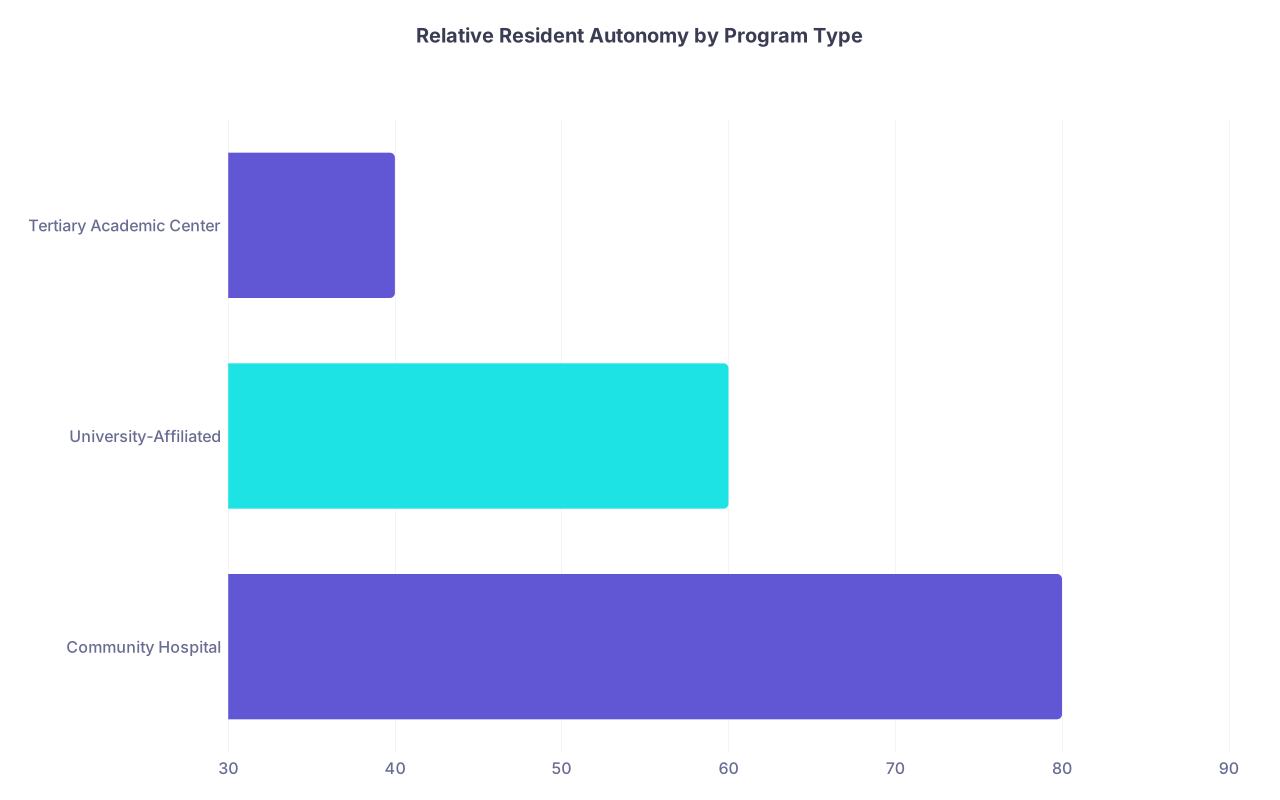
How Program Type Modulates Autonomy in Low-Competition Fields
You cannot ignore training environment. Same specialty, same city, two very different autonomy trajectories.
| Category | Value |
|---|---|
| Community Hospital | 80 |
| University-Affiliated | 60 |
| Tertiary Academic Center | 40 |
Rough pattern:
Community programs (especially unopposed):
- Higher cognitive and procedural autonomy
- Attendings more hands-off by PGY-2/3
- Residents often run services and do more procedures because no one else is around at 2 AM
University-affiliated midsize programs:
- Moderate autonomy; some services attending-heavy, others resident-driven
- More subspecialist involvement → more consult calls, sometimes more oversight
Big-name tertiary/quaternary centers:
- Very case-rich but autonomy-choked at times
- Layers of fellows and subspecialists that insert themselves between resident and decision
- Great for exposure, not always great for independent decision-making
Pay attention during interviews to:
- Who runs codes and rapid responses
- Who decides admissions in the ED
- Whether residents say “I manage X” vs “the attending/fellow usually does X”
How Autonomy Evolves Within a Single Resident
Autonomy is not just structural; it is personal. I have watched two PGY-3s in the same program have completely different real independence.
Why?
- Clinical judgment: If you consistently overreact or under-react, attendings will hover.
- Reliability: Show up on time, follow through, call back consultants promptly. People back off.
- Communication: Clear, concise page and handoff style makes attendings trust you to handle more.
- Self-awareness: Knowing when to say, “I am not sure; I want you to see this” paradoxically earns you more freedom long-term.
Programs nominally “grant” more autonomy by year, but attendings tighten or loosen the leash based on these traits. In low-competition specialties, with generally less cutthroat atmospheres, attendings are often willing to individualize autonomy if you prove you are safe and thoughtful.
A Simple Mental Model of Autonomy Progression
To tie it together, here’s a high-level flow of how autonomy tends to shift over residency years in low-competition fields.

| Step | Description |
|---|---|
| Step 1 | PGY-1 |
| Step 2 | PGY-2 |
| Step 3 | PGY-3+ |
| Step 4 | Cognitive - propose plans, heavy oversight |
| Step 5 | Procedural - mostly observe or basic tasks |
| Step 6 | Systems - respond to pages, minimal control |
| Step 7 | Cognitive - manage routine cases, staff exceptions |
| Step 8 | Procedural - independent common procedures in some programs |
| Step 9 | Systems - run list, supervise juniors |
| Step 10 | Cognitive - near-attending for bread and butter |
| Step 11 | Procedural - full autonomy only if volume and culture allow |
| Step 12 | Systems - lead teams, clinics, and flow |
If you understand which kind of autonomy matters to you—cognitive, procedural, systems—you will read between the lines on interview day and choose a program that actually matches your goals.
Key Takeaways
- “Low-competition” does not mean “low-autonomy.” It means autonomy grows differently—usually earlier cognitively, more variably procedurally, and heavily shaped by program culture.
- Community and unopposed programs in these fields often deliver far more real-world independence than shiny tertiary centers, especially for procedures and systems-level responsibility.
- Within any given program, your actual autonomy will depend as much on your reliability and judgment as it does on your PGY level; residents who are safe, concise, and self-aware get treated like near-attendings by the end of training.