
It’s February. You’re on your “backup” rotation – maybe Family Med, Psych, Path, PM&R, or Neuro – the stuff everyone online calls “less competitive.”
You’re standing at the workroom computer, debating whether to tell the attending, “I’m actually going for ortho/derm/ENT, this is my backup.”
Down the hall, the attending and two senior residents are talking about you. Not in a cartoonishly evil way. In the real way faculty talk:
“Is this one actually interested in us, or just passing through?”
“Worth a letter, or are we wasting our time?”
“Good kid, but I’m not putting my name on someone who’ll rank us 14th.”
You need to know what those whispers actually sound like. Because they decide whether your “backup” becomes a match…or a quiet rejection from a supposedly “safe” specialty.
Let me walk you through what really happens behind the doors.
The Dirty Secret: “Least Competitive” Doesn’t Mean “You’re Safe”
Programs in the so‑called “backup” specialties don’t think of themselves as backups. At all. They think:
“We are a small field. We get crushed by people gaming us every single year. We want lifers, not tourists.”
Here’s what faculty are juggling when you show up as a maybe‑backup:
- They know their specialty is used as a soft landing by people who missed the cut in more competitive fields.
- They remember the PGY‑1 who matched with them, then tried to transfer a year later to rad onc, anesthesia, derm, whatever.
- They’ve been burned by students who swore they were “100% committed” and then ranked them 12th and ghosted.
So they’ve built informal filters. Quiet screens. The stuff nobody writes on a website.
To them, a “backup” applicant is not neutral. It’s a liability. They worry about morale, culture, retention, and their own reputation in the program director network.
And that’s where your behavior – on rotations, in emails, in your ERAS – gets dissected.
What They Really Say in the Workroom
Let’s pull the curtain back on a few specialties often labeled “least competitive” or “backup”: family medicine, psych, path, PM&R, neurology. Different flavors, same underlying paranoia.
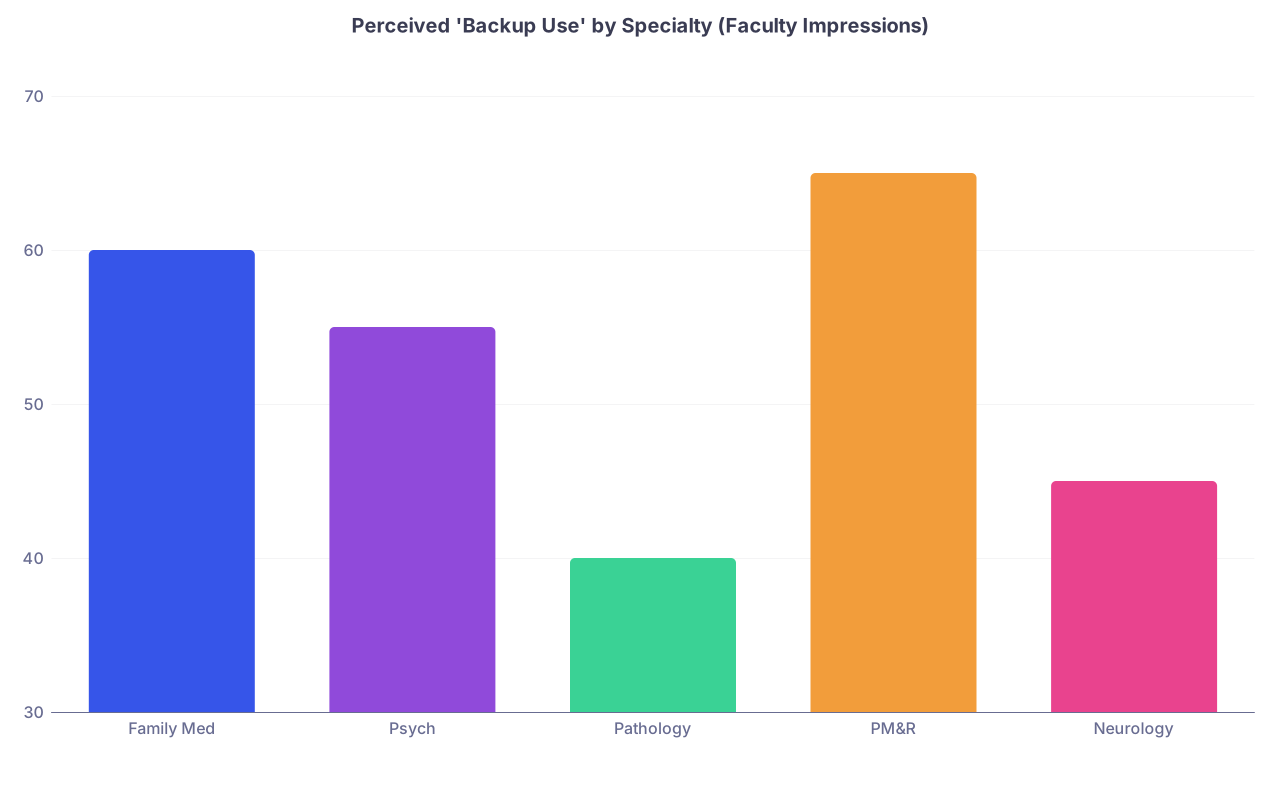
| Category | Value |
|---|---|
| Family Med | 60 |
| Psych | 55 |
| Pathology | 40 |
| PM&R | 65 |
| Neurology | 45 |
These numbers are not official. They’re the vibes you hear in faculty meetings. “Feels like 60% of these applicants are here because something else didn’t work out.” And they act accordingly.
Family Medicine
What they say:
- “Is he truly FM, or is this an EM fail?”
- “Look at her app. EM sub‑Is, EM research, EM SLOEs. Fourth‑year FM elective in January. Come on.”
They know EM, anesthesia, even some IM folks use FM as a late catch‑all. They scan ERAS for signs:
- No early FM exposure
- Zero longitudinal primary care work
- Four 4th‑year EM rotations, FM only at the home institution
- Generic PS: “I want to care for a wide variety of patients” (they hate that line, by the way)
The FM whisper: “We will happily take a 230‑Step, genuine FM‑leaning student over a 255 who clearly wanted EM and is now slumming it.” And they mean it.
Psychiatry
Psych faculty are sharper about this than students realize.
What they say:
- “Is this a near‑miss neurology or IM applicant?”
- “Why is their entire pre‑clinical research in cardiology and then suddenly… ‘lifelong passion for psychiatry’?”
They look for:
- Last‑minute psych rotations stacked in Jan–Feb
- Personal statements saying “After not matching, I realized my real calling…” with no psych paper trail
- Very little actual behavioral health experience (no clinics, no psych volunteering, no therapy shadowing, nothing)
The psych whisper: they’re willing to take a rebrand if it’s honest and if you’ve done the work to pivot. They are not willing to be your lifeboat if you still radiate resentment about “having” to do psych.
Pathology
Path is a classic “backup” when clinical stuff goes sideways. They’ve seen every variant of this.
What they say:
- “Another one who realized they hate patients and now wants to ‘always loved histology’ their way in.”
- “He’s got three failed clinical clerkships and now says he’s an academic pathologist. No.”
They’re not blind. They know:
- Path gets picked when Step 2 is rough and IM/FM look shaky.
- IMGs and DOs sometimes get pushed there by advisors as a “stable” backup.
- A terrifying number of people apply without a single meaningful path experience.
They look for:
- Any real engagement: elective, autopsy experience, tumor board attendance, a mentor who actually knows you
- Signals of discipline and independence – path residency is not for people who need constant hand‑holding
The path whisper: “If you treat us like a trash bin for bad clinical evals, we’ll treat your app like trash.”
PM&R
PM&R is notorious among faculty for being the specialty that attracts people who just want a “cush” lifestyle after failing to break into ortho, sports, or anesthesia.
What they say:
- “Let me guess: wanted ortho, didn’t get the score, now ‘discovered PM&R.’”
- “She keeps talking about the OR and spine surgery. She doesn’t understand what we actually do.”
They scan for:
- Genuine rehab exposure (inpatient rehab, outpatient, SCI, TBI, sports, pain) vs a single elective thrown in late
- Letters from actual physiatrists vs only surgeons or neurologists
- Whether you talk about function and recovery or just “I like MSK and procedures”
The PM&R whisper: they’re sick of being Plan B for broken ortho dreams. If you show up like that, they can smell it.
Neurology
Neuro sits in a weird middle ground. Not as competitive as some; not truly “backup” status. But they know they get re‑routes from IM and psych.
What they say:
- “Internal medicine was first love until he realized he hates rounding for 12 hours. Now suddenly he’s ‘always fascinated by the brain.’”
- “If her only neuro exposure is this rotation, I’m not buying the narrative.”
They check:
- Timing of neuro rotations relative to other core decisions
- Whether your story tracks: MCAT psych major, EEG research, neuro electives early vs last‑minute pivot
- Consistency: do letters back up this “lifelong brain interest” or contradict it?
The neuro whisper: they prefer an honest late‑pivot med student over a scripted “since childhood” story that clearly doesn’t match your CV.
How Program Directors Actually Do the Math on “Backup” Applicants
There’s a myth that “Oh, it’s a less competitive specialty, they’ll just be happy to have me.”
No. That’s not how they think.
Here’s their real calculus:
Do I believe this person will actually rank us high enough to match?
If no, they will not waste an interview on you, especially in smaller programs.Will this person be happy here for 3–4 years? Or are they already halfway out the door mentally?
They’ve had miserable residents before. They don’t want more.If this person tries to transfer, how bad does that make us look?
PDs talk. A lot. “Oh, you took that ortho reject? Did he stay?” That stuff circulates.Is this applicant using us as a safety net because they have red flags, or because they genuinely pivoted?
Big difference. They’re open to pivots. They’re not open to dumping grounds.
So what do they do with that?
They give disproportionate weight to:
- Letters from within the field – especially from people they know
- Timeline – when did you engage with this specialty? Early genuinely trumps late, but late + convincing beats nothing
- How you talk – body language, tone, questions, and whether you still slip and say things like, “In ortho—uh, sorry, I mean, in PM&R…”
The Tells That You’re Treating a Specialty as a Backup
This is what faculty pick apart when the door closes.

In Your Application
I’ve sat in those meetings. Here’s what gets called out:
- Personal statement that could be used for 5 specialties with two nouns swapped. They read dozens of these and roll their eyes.
- No continuity: early years all-in on another specialty, then a sudden, unspecific “I found my true calling in X.”
- Research all in one field, zero attempt to even fake interest in the new one.
- No home rotation or away rotation in the specialty – just a single elective, often at the tail end of 4th year.
One PD I know literally said:
“If I can Ctrl‑F the old specialty name in your PS draft and find where you forgot to change it, I’m rejecting you on the spot.”
You’d be shocked how often that happens.
On Rotations
Residents and attendings notice:
You drop that you’re “actually going for [prestige specialty] but keeping options open.”
Translation in our heads: “I’m not taking you seriously.”You ask zero real questions about how the specialty works long term. Training path. Fellowships. Lifestyle. Nothing.
You’re clearly phoning it in because “this isn’t my real field.” You can’t hide that as well as you think.
One FM attending put it bluntly to me once:
“I’ll take the student with average shelf scores who is all‑in on primary care over the gunslinger who spends the whole month telling me how they almost did ortho.”
In the Interview
The subtle tells:
- Your stories default back to another specialty.
- You can’t answer, “Why this field specifically and not IM/EM/ortho/etc.?” without rambling.
- You don’t know the basic current controversies, directions, or scope of the field.
They walk you out, close the door, and someone says, “Backup.” Then you move down the pile.
How to Use a “Backup” Without Marking Yourself as Dead on Arrival
Let me be clear: having a backup specialty is not wrong. It’s smart. Faculty are not stupid; they know students protect themselves. What they hate is dishonesty and laziness.
You have three viable paths.
| Strategy Type | Faculty Reaction | Risk Level |
|---|---|---|
| Hidden Backup | Suspicious if detected | High |
| Honest, Thorough Pivot | Respectful if genuine | Moderate |
| Dual-Commitment Plan | Mixed but workable | Moderate |
1. The Hidden Backup (Most Common, Most Dangerous)
This is the classic: you tell everyone you’re applying to Specialty A. Secretly apply broadly to Specialty B “just in case.”
Faculty can smell this when:
- Your PS for Specialty B is paper-thin and generic.
- Your letters come almost entirely from Specialty A.
- Your interview answers sound rehearsed and hollow.
What happens?
They’ll either:
- Not interview you at all, or
- Rank you, but low – and if anything shifts in the match dynamics, you’re not safe
If you insist on this route, at least:
- Get at least one real rotation and at least one strong letter in the backup specialty.
- Write a PS that doesn’t sound like it was generated 5 minutes before ERAS submission.
- Learn how to talk about that specialty like an adult who’s thought it through.
2. The Honest Pivot (Underused, Often Respected)
This works a lot better than students think if you do it correctly.
The story looks like this:
- You pursued a more competitive field early (say ortho, EM, anesthesia).
- By mid‑MS3 or early MS4, you realized your fit or your score doesn’t line up.
- You genuinely engaged with the new specialty – rotations, mentorship, actual reflection.
And then you say, clearly and calmly, some version of:
- “I started out aiming for X. Over the course of third year, I realized I was more drawn to Y because of [specific reasons]. I intentionally pivoted, spent time in Y, found it was a better fit, and now I’m committed to training in Y.”
Program directors prefer this to the cheap “Since I was five years old, I always knew…” nonsense when your CV screams otherwise.
Key here: you must show work. Real experiences. Real conversations. Real thinking.
3. The Dual‑Commitment Plan (Risky, But Sometimes Realistic)
Sometimes you’re truly 50/50 between, say, IM and psych. Or FM and PM&R. Or neuro and IM. That’s not inherently bad.
What faculty hate is being lied to, not being one of two realistic fits.
If you do this:
- Your application content for each must stand alone and make sense.
- You do not cross‑contaminate letters that say, “X will be a great internist” in a psych file.
- Your answer to “What other specialties did you consider?” is honest but thoughtful, not panicked.
You can say:
“I seriously considered internal medicine as well. I loved the cognitive aspect. What drew me more strongly to neurology was [specific patient types / management style / clinic structure]. Once I recognized that, I focused on neurology.”
That’s fine. That reads as adult, not flaky.
What Makes Faculty Say: “Backup or Not, I Want This One”
Here’s the part students undervalue: many faculty care more about fit and attitude than about whether we were your childhood dream. They’re not children. They know medicine is messy.
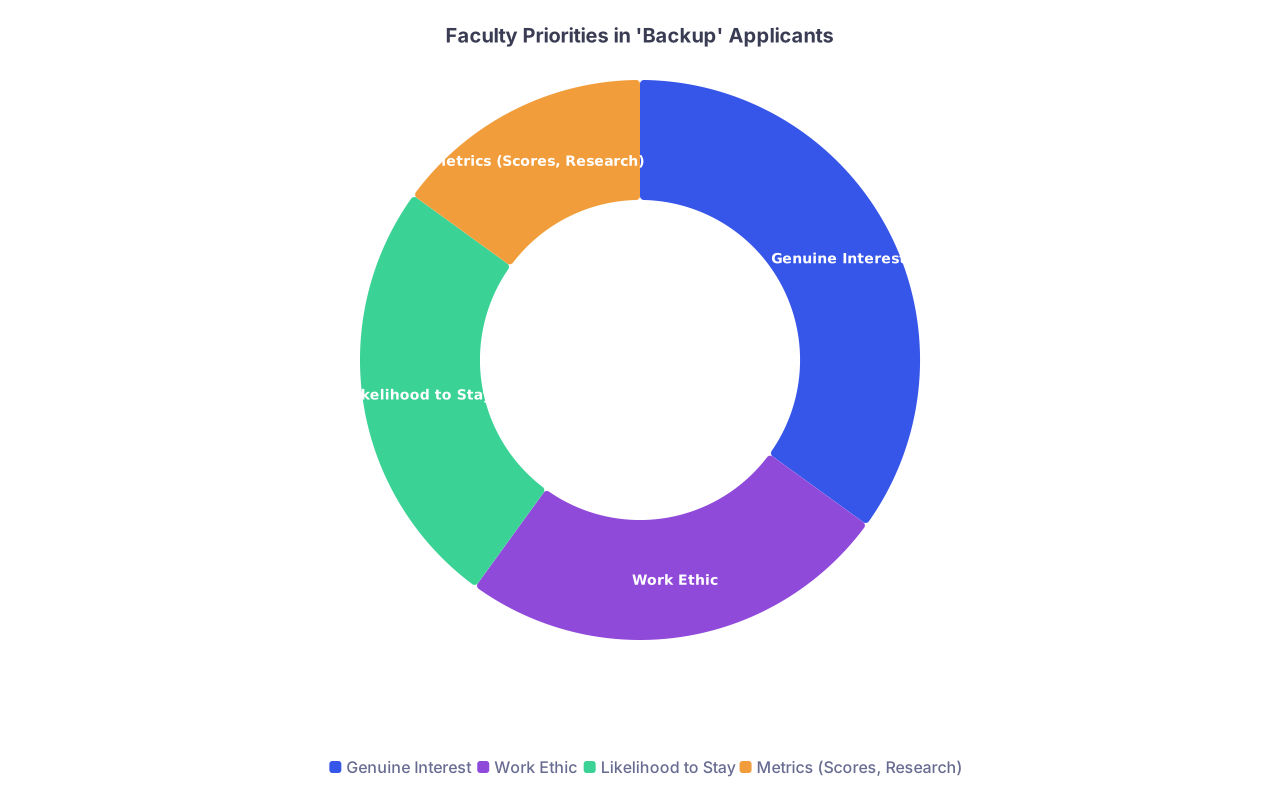
| Category | Value |
|---|---|
| Genuine Interest | 35 |
| Work Ethic | 25 |
| Likelihood to Stay | 25 |
| Metrics (Scores, Research) | 15 |
The candidates who win them over – even if they once wanted Something Else – do a few things consistently.
They:
- Show up to that rotation like it’s their first choice. Prepared, curious, present.
- Ask real questions about the field’s future, not just “So how’s the lifestyle?”
- Get at least one faculty member in the specialty to say in a letter:
“I would be thrilled to have this student in our field. They’re not here by default; they’ve actively chosen us.”
They make it easy to envision them as a core resident, not someone already halfway to transferring out.
One PD in psych told me over coffee:
“Give me the EM near‑miss who fell in love with psych and can clearly explain how that happened, over the kid who claims they’ve wanted psych since birth but can’t name a single current issue in our field.”
That’s the bar. Not perfection. Convincing, coherent, adult thinking.
How Your School and Advisors Actually Talk About This
Your school’s “official” advising is usually sanitized: “Have a parallel plan.” “Stay open to different paths.” That’s partially for liability and morale.
Behind the scenes, the conversation is different.
I’ve heard this in advisor meetings:
- “We need to push him to seriously consider FM/psych. His scores are not getting him into EM.”
- “She’s insisting on derm. I’m worried she’ll refuse to apply broadly enough in her backup field and end up SOAPing into something she’ll hate.”
- “If he comes around to PM&R, we need to get him a real elective and a letter fast, or programs just won’t buy it.”
Some schools unofficially categorize you:
- “Safe primary match”
- “High‑risk primary, must have strong backup”
- “SOAP‑risk, backup field needs to be realistic and engaged now”
They’ll rarely tell you those labels. But they drive how aggressively they push you toward “least competitive” specialties and how much they try to sell your pivot to faculty they know.
If you’re being gently (or not so gently) nudged toward FM/psych/path/PM&R/neuro, assume there have already been closed‑door conversations about you. Your best move is not to fight reality with delusion. It’s to decide if you can authentically commit to that field if you land there—and then behave accordingly.
Making the “Least Competitive” Specialties Work For You, Not Against You
Let’s be blunt. If you’re playing with so‑called “backup” specialties, it usually means one of three things:
- Your metrics are marginal for your dream field.
- You discovered late that your dream field isn’t the right fit.
- You started tardy and are trying to catch up.
None of that is fatal—if you stop pretending and start acting strategically.

| Step | Description |
|---|---|
| Step 1 | Realize primary plan is risky |
| Step 2 | Assess realistic backup fields |
| Step 3 | Get early rotation or elective |
| Step 4 | Secure at least one strong letter |
| Step 5 | Write field specific personal statement |
| Step 6 | Address pivot honestly in interviews |
| Step 7 | Rank list that reflects true willingness |
The programs in “less competitive” specialties are not desperate. They want people who actually want to be there, or at least who can grow into wanting to be there. If you treat them as second‑class, your application will read that way.
But if you:
- Build a coherent story
- Do the actual legwork in the new field
- Stop lying to yourself and to them
Then the whispers behind closed doors change from:
“Backup. Pass.”
to
“Yeah, they started somewhere else, but they’ve come around. I believe this kid will show up and do the work. Let’s bring them in.”
That’s the difference between a match in a “backup” that becomes a career you love—and a SOAP panic into something you barely understand.