
Last winter a PGY‑3 from a “no‑name” internal medicine program sat in my office with two fellowship offers on the table: one from a mid‑tier academic center, one from a big‑name university everyone flexes on their CV. She’d trained at a small, chronically under‑applied community program that most students scroll past on FREIDA. Her co‑resident from a “top” program? Didn’t even get an interview at the same places.
Let me tell you what actually happens behind the scenes: some of the best training in the country is happening at programs you and your classmates have never heard of—and most of you are too prestige‑blinded to see it.
What “Undersubscribed” Really Means From the Inside
Program directors never say this on Zoom open houses, but they talk about it all the time behind closed doors.
When we say a residency is “undersubscribed,” we’re talking about places that:
- Consistently get fewer applications per spot than the national average for that specialty
- Sit on your school’s “backup list” or don’t get mentioned at all
- Sometimes go partially unmatched and scramble/SOAP
- Spend half of interview season anxious they won’t fill, not deciding who to cut
These are often in the least competitive specialties on paper—family medicine, psych (in certain regions), neurology, pathology, PM&R, peds, prelim medicine or surgery. But “least competitive specialty” is a lazy label. What matters is program‑level demand.
Inside the PD meeting, the actual breakdown looks more like this:
| Program Type | Avg Applications per PGY-1 Spot |
|---|---|
| Big-name academic university | 800-1200 |
| Mid-tier university/large community | 400-700 |
| Undersubscribed community program | 120-250 |
| Rural or new program | 60-150 |
The unsaid truth: lower application pressure fundamentally changes how PDs and faculty treat residents. It changes how much they invest in you. And how much freedom you have to shape your own training.
The Power of Being Valuable Instead of Replaceable
Here’s the first big secret: at undersubscribed programs, you are not fungible.
At hyper‑competitive places, one resident leaves, and there are two dozen people on a waitlist willing to step in. Faculty like you, sure—but structurally you’re replaceable. At programs that scrape each year to fill? They hang on to you.
I’ve sat in meetings where PDs at these programs say things like:
- “If we lose our PGY‑3s this year we can’t staff the ICU.”
- “Whatever she needs to get into cards, we’re doing it. We can’t afford another person leaving for a transfer.”
- “Give him the research time—if he matches GI from here, that’s huge for us.”
That desperation works in your favor.
You get:
- Easier access to schedule favors (research electives, lighter interview months, away rotations)
- More willingness to bend rules for conferences, courses, and side projects
- Faculty who actually push you out front—because when you succeed, the program’s reputation rises
I watched a small midwestern community EM program completely rebuild their ultrasound reputation on the back of one resident who was motivated. They gave him:
- A tailored elective schedule
- Funding to attend multiple national courses
- Protected time to collect data and present at SAEM
That doesn’t happen as easily at name‑brand places with ten other people already in line for that exact role.
Visibility vs. Anonymity
Another quiet truth: in undersubscribed programs, the PD and Chair know you as a person by month two.
At large, saturated programs you can be “that solid PGY‑2 on Blue Team” for years. At under‑applied ones, they know your partner’s name, your career goals, and—critically—your weaknesses. This sounds scary, but it’s actually leverage. They tailor your training because they need you to function at a high level.
You become a known quantity. That matters when they get emails from fellowship directors asking, “Tell me who your top two residents are this year.”
Procedural Volume and Clinical Autonomy: The Stuff We Don’t Put in Brochures
This is the one that shocks people when they arrive.
At undersubscribed programs—often community or non‑glamorous locations—residents do a ridiculous amount of hands‑on medicine because there is no shiny fellowship layer sopping up procedures and complex cases.
No PICU fellow, no cards fellow, no GI fellow. Just… you and the attending.
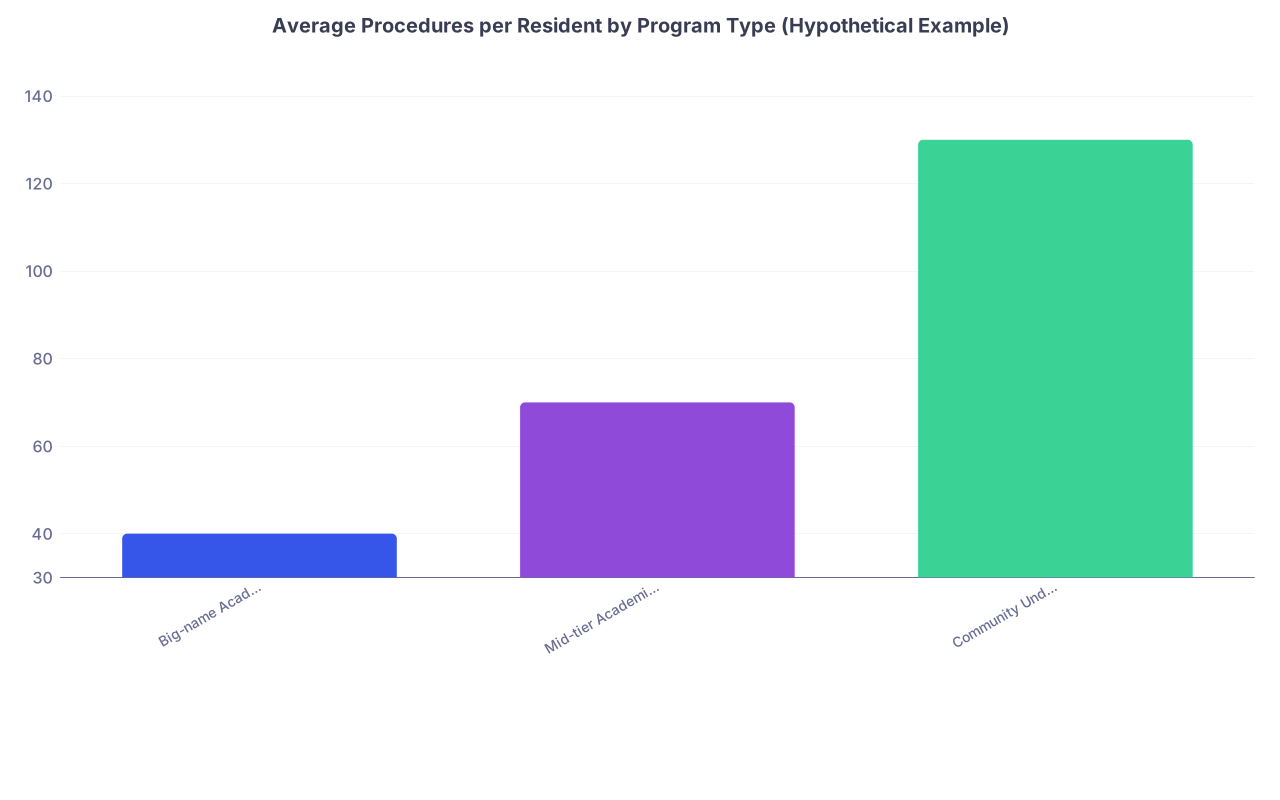
| Category | Value |
|---|---|
| Big-name Academic IM | 40 |
| Mid-tier Academic IM | 70 |
| Community Undersubscribed IM | 130 |
I’ve seen this play out in:
- Family medicine: residents in under‑applied rural FM programs doing more OB deliveries and basic procedures in a year than some “urban university” FM grads do in three.
- Community surgery: PGY‑3s acting like chiefs—running rooms, doing big cases early—because there simply aren’t enough hands.
- Undersubscribed neurology programs: residents getting first crack at tPA decisions, thrombectomy triage, and ICU neuro consults without competing with three fellows.
Faculty say this quietly: “Our grads are clinically stronger than a lot of big‑name folks. They’ve just never had the brand to advertise it.”
Autonomy starts earlier. Supervising residents aren’t as territorial; they need help. Attendings trust you because they’ve watched you sink or swim from day one.
You feel it when you rotate at another site for electives. I’ve heard visiting residents from smaller programs get comments like, “You’re a PGY‑2? You run these codes like a senior.” That didn’t happen by accident.
Mentorship That’s Actually Personal, Not Just Branded
Let’s be honest: every program claims “strong mentorship.” Most of it is accidental—maybe you click with an attending, maybe you don’t.
At undersubscribed programs, mentorship is often less glossy but far more real. Here’s why:
- Faculty aren’t pulled in ten directions by a dozen research fellows, PhD students, and MPH candidates
- There are fewer residents, so the ambitious ones are obvious
- Programs quietly need success stories to advertise later
So when you walk in saying, “I want cards / GI / EM critical care / child psych,” you’re not the 40th person this week saying that. You might be the only one.
I know a small community IM program in the South that placed one resident into an elite GI fellowship. Do you know what happened the next three years? That GI attending basically adopted every resident who even hinted they might like endoscopy. Hands‑on scopes. Direct calls to fellowship PDs. “If my name means anything, you’ll interview this kid.”
That’s the hidden advantage: your wins don’t get lost in the noise. They’re amplified.
Research and Leadership: The Low-Competition Gold Mine
Here’s the part that premeds and med students completely miscalculate.
Everyone assumes research is only at big academic centers. Not true. What’s true is that competition for the good projects is brutal at those centers.
At an oversubscribed, research‑heavy program, you’re resident number 87 trying to get on Dr. Famous’s R01. You get a spreadsheet with 10 other names on your project. Authorship politics. Delays. A poster in year three if you’re lucky.
At a smaller or undersubscribed site, the limiting factor usually isn’t funding—it’s resident interest and follow‑through.
I’ve seen:
- Residents become first authors on multi‑center QI projects because they were the only one willing to grind through data extraction
- PM&R residents at low‑key programs co‑author guideline revisions because their attendings were plugged into national societies and had no competition at home
- Psychiatry residents in “no‑name” programs build telepsych outcome datasets that ended up in solid journals simply because no one else cared to do the work
The table looks more like this in reality:
| Program Type | Projects per Interested Resident | Likelihood of First-Author Role |
|---|---|---|
| Big-name Academic | 0.5-1 | Low to Moderate |
| Mid-tier Academic | 1-2 | Moderate |
| Undersubscribed Community | 2-4 | High |
And it’s not just research. Leadership roles are easier to grab when there aren’t 15 hyper‑competitive gunners ahead of you.
Chief resident? QI committee lead? House staff council? At under‑applied programs, when you raise your hand, people say “thank God” instead of “take a number.”
Those titles matter when fellowship and job applications hit someone’s inbox. “Chief resident with three institutional roles and multiple QI projects” from a smaller program stands out more than “one of many research residents” from a powerhouse.
Less Competitiveness = More Bandwidth for You
Another unspoken perk: the overall vibe.
At elite, overfilled programs, the baseline resident profile is anxious, type‑A, hyper‑aware of fellowship odds. That culture bleeds into everything. Constant quiet comparison. Subtle competition for the best letters, the best cases, the best research groups. You feel it.
At undersubscribed programs in “less competitive” specialties, you tend to get:
- More normal humans, fewer Step‑score robots
- A broader mix of backgrounds—IMGs, non‑traditional grads, people with previous careers
- People who are happy they matched and not living with an inferiority complex about ranking #1 vs #3
I’m not romanticizing hardship—these programs have their flaws. But the competitive pressure valve is lower. You can actually think about:
- Who do I want to be clinically?
- What kind of practice do I want after this?
- How can I use this time to build something that’s mine?
And program leadership, knowing they aren’t the “cool kids,” often lean into resident wellness and flexibility harder than name‑brands that coast on reputation. They have to, to retain people.

The Referral Web No One Teaches You About
You’re obsessing over “name recognition.” Faculty obsess over something else: “Do I know someone there who can vouch for this person?”
From the hiring side—whether it’s fellowship or first job—here’s how it often goes:
Fellowship director gets 600+ apps. Filters by minimum criteria. Ends up with 150 “competitive” piles that all look the same. So they ask:
- “Who do I know that knows this PD?”
- “Who trained this resident? Do I trust their judgment?”
- “Has this program sent us strong people before?”
Guess what many under‑applied programs do very well: build intense, loyal networks.
Residents from these places are often grateful. They don’t walk around with the entitlement you sometimes see from big‑name programs. So they send jobs, fellowships, and opportunities back to their home program’s graduates.
I’ve watched sleepy community IM programs quietly feed graduates into:
- Hospitalist director roles in big systems
- Fellowship spots at “reach” places where alumni are now faculty
- Niche clinical jobs (wound care, addiction, informatics) that never hit open market
This doesn’t show up in glossy match lists the way “we sent someone to MGH” does. But over ten years, those hidden pipelines become very real.
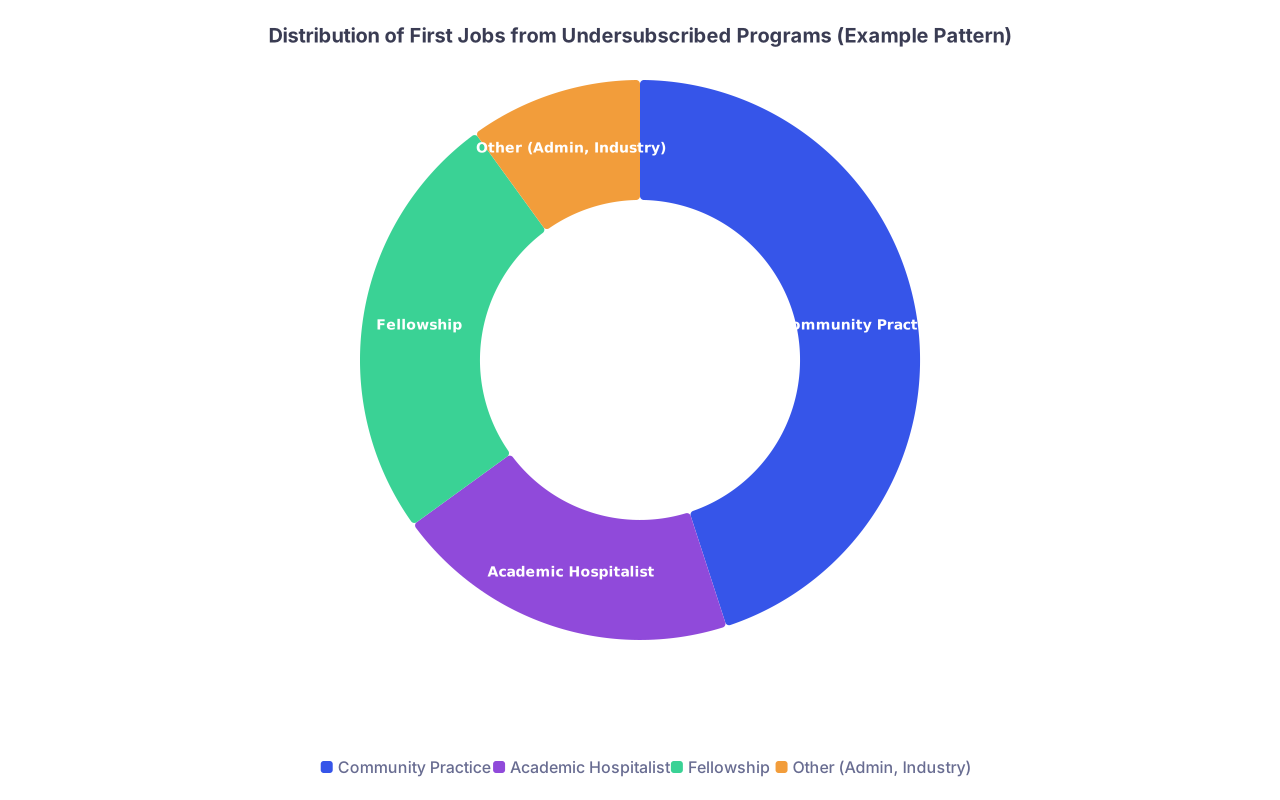
| Category | Value |
|---|---|
| Community Practice | 45 |
| Academic Hospitalist | 20 |
| Fellowship | 25 |
| Other (Admin, Industry) | 10 |
Notice that “academic hospitalist” and “fellowship” are not small slices. The myth that you’re career‑capped coming from these programs is exactly that—a myth, usually repeated by people who’ve never hired or matched anyone.
The Flip Side: What You Must Compensate For
Now the part most mentors gloss over: this is not all upside. Training at an undersubscribed program gives you leverage, but it also means you cannot coast.
The hidden contract looks like this:
You get more autonomy, more opportunity, more visibility. In return, you shoulder more responsibility for architecting your own path.
The common weaknesses you’ll see:
- Less structured research infrastructure
- Fewer big‑name faculty who automatically open doors
- Occasionally weaker didactics or chaotic administration
- Less brand recognition for blind applications
So you have to be deliberate.
You:
- Proactively seek out mentors, often outside your program (national societies, previous alumni, virtual mentors from conferences)
- Initiate projects instead of waiting to be handed one
- Learn how to tell your story convincingly on paper and in person so that “unknown program” isn’t a handicap
This is where most residents blow it. They treat a low‑pressure environment like extended school, not a launchpad. They graduate clinically fine but unremarkable on paper, and then complain about “coming from a small program.”
The ones who win look different. By PGY‑2 they’ve:
- Blocked elective time strategically around career goals
- Identified one or two faculty willing to go to bat for them and invested heavily in those relationships
- Taken on visible roles (curriculum projects, committees, QI leads) that give them something concrete to show
Think of it as the difference between walking a paved, crowded path (big academic programs) and a mostly empty field. The paved path is easier to follow but you’re stuck in traffic. The field is harder to navigate—but if you’re willing to draw your own lines, you can end up somewhere better than the main road.

| Step | Description |
|---|---|
| Step 1 | Start PGY 1 |
| Step 2 | High Clinical Volume |
| Step 3 | Early Visibility to PD |
| Step 4 | Autonomy and Procedures |
| Step 5 | Targeted Mentorship |
| Step 6 | Stronger Clinical Skills |
| Step 7 | Customized Opportunities |
| Step 8 | Competitive Fellowships and Jobs |
How to Spot a “Hidden Gem” vs. a True Red Flag
This is where being an insider matters.
Not every undersubscribed program is secretly incredible. Some are undersubscribed because they’re legitimately dysfunctional—malignant leadership, unsafe workloads, no support. You need to separate “hidden gem” from “dumpster fire.”
Things PDs and faculty look at when we quietly recommend these programs to our own mentees:
- Graduates’ outcomes: Not the one superstar—look at the pattern. Are people getting decent jobs, fellowships, leadership roles?
- Faculty stability: Has the PD been there a while? Are core attendings sticking around, or is there constant churn?
- Resident tone: Not the scripted info session. The off‑hand comments on interview day. Do they sound tired or bitter? Or busy but proud?
- Clinical exposure: Do they do the bread‑and‑butter cases? Are they the main game in town for certain services (trauma, OB, stroke, etc.)?
One internal metric I’ve used: if the residents repeatedly say, “We work hard, but I feel ready for anything,” that’s usually a green light. If they say, “We’re trying to survive,” that’s your sign to walk.
How to Actually Use These Advantages
Let me give you a concrete blueprint, because theory isn’t going to help you at 2 a.m. when you’re wondering if you sabotaged your career by ranking that “no‑name” program high.
If you’re at—or likely heading to—an undersubscribed program in a “less competitive” specialty, do this:
By end of PGY‑1:
- Identify two attendings: one clinically outstanding, one connected (research or leadership). Tell them explicitly what you think you might want. Ambivalence kills opportunities.
- Say yes to high‑yield cases and procedures even when you’re tired. Reputation at these places is built on “who shows up” more than “who has the best Step score.”
- Start attending national or regional meetings early. These conferences become your virtual “big name” network.
By mid‑PGY‑2:
- Carve out at least one substantial project with your name clearly on it—QI, research, curriculum, something real. You need something that says, “I didn’t just survive residency; I built something.”
- Ask your PD directly: “If you had to call three people in my desired field on my behalf, who would they be?” Push them to open their Rolodex. Most won’t volunteer until you ask.
- Shape electives with intention. Stop wasting time on random rotations just because they’re easy.
By PGY‑3+:
- Get your PD and key attendings on the same narrative: what your strengths are, where you’re heading, and what story your letters will tell. You don’t want scattered, generic praise—you want a theme. “This resident operates like a fellow already” or “This resident built X from nothing.”
- Apply broadly, but with highly targeted, personal outreach where your mentors have connections. This is where the “small program but big autonomy” story resonates.
None of this is theoretical. It’s the exact playbook I’ve seen work for residents in low‑visibility programs who ended up in competitive fellowships and dream jobs, while some of their Ivy‑badge peers stalled out.
Three things to remember.
First, prestige is a loud signal but a weak guarantee. Clinical volume, autonomy, and people willing to fight for you are stronger—and they’re often better at undersubscribed programs.
Second, at these places you are not background noise. You’re a vital node. That means more responsibility, more scrutiny, and far more upside if you lean into it.
Third, no program—fancy or forgotten—will build your career for you. Undersubscribed residencies give you more room to run. What you do with that space is on you.