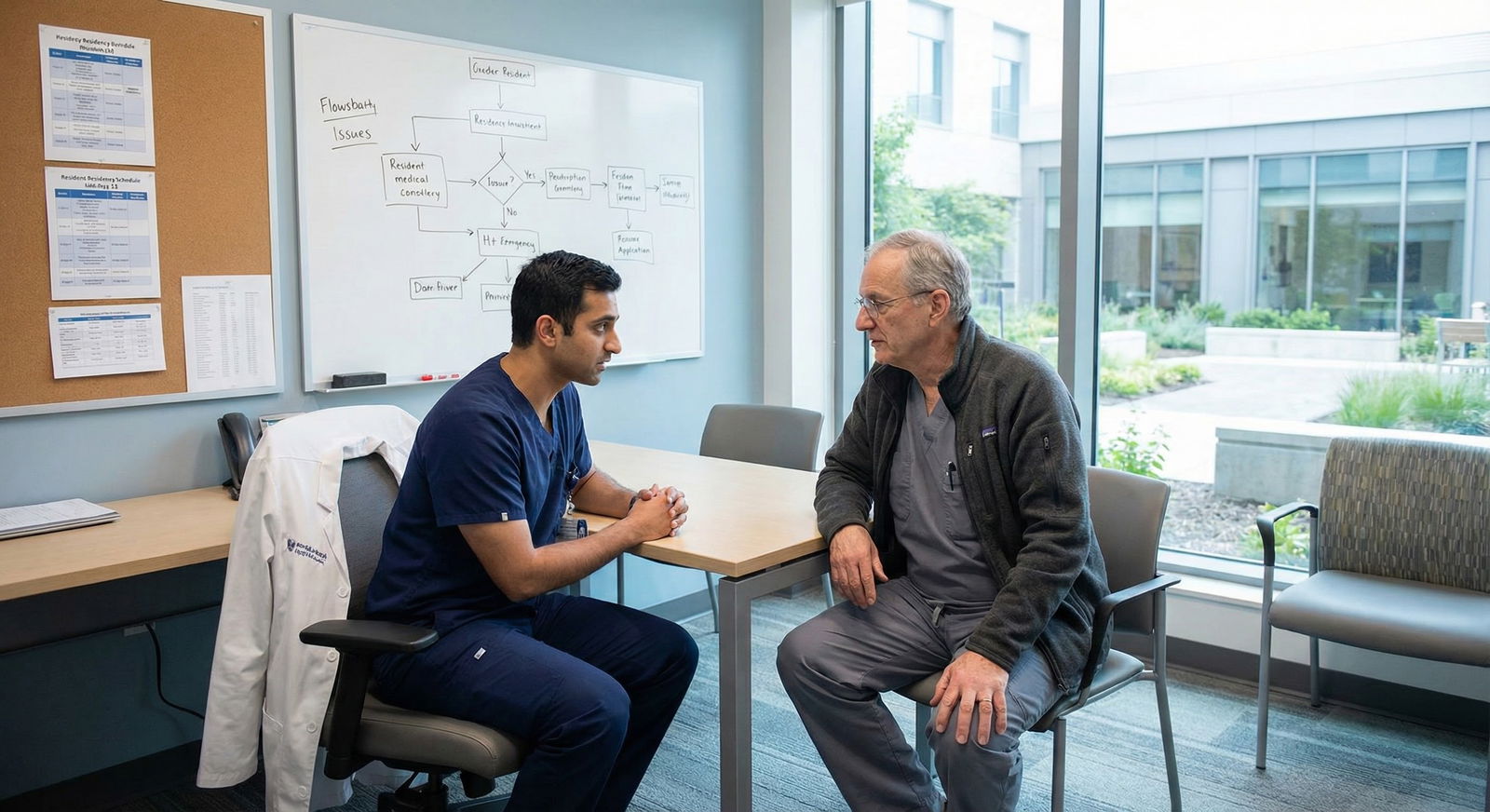
You are sitting in a quiet call room, half-eaten sandwich on the table, scrolling through NRMP data you wish you had looked at a year ago. Your current specialty? Brutal. Competitive. Soul-sucking at times. The one you are eyeing now has lower Step averages, more unfilled spots, and everyone calls it “easier.”
You catch yourself rehearsing the line: “I realized my true passion is…” and you cringe. Because you know how that sounds. And you know that if you do not buy it, no program director will.
Let me be direct: you can absolutely move into a less competitive specialty without tanking your credibility. But the narrative has to be airtight. Honest. Strategically framed. And it cannot smell like “I could not cut it, so I settled.”
Here is how you fix it.
Step 1: Get Clear on What You Are Actually Doing

| Step | Description |
|---|---|
| Step 1 | Current Specialty |
| Step 2 | Reassess values |
| Step 3 | Rebuild plan |
| Step 4 | Collect evidence |
| Step 5 | Target new field |
| Step 6 | Craft narrative |
| Step 7 | Apply or transfer |
| Step 8 | Why change? |
Before you craft any narrative, you need to tell yourself the unvarnished version:
- Are you switching because:
- You failed to match your original ultra-competitive choice (derm, ortho, plastics, ENT, rad onc)?
- You are in a malignant or bad-fit residency and need out?
- You realized your personality and energy do not line up with the field’s day-to-day?
- You want a more predictable lifestyle, location flexibility, or lower burnout risk?
Most people are doing a mix of:
- “This field is too competitive for me right now”
- “This other field is more attainable and frankly more liveable.”
You do not have to confess every insecurity. But you do have to know them. Because your narrative must integrate your reality, not pretend it does not exist.
Write this down in three versions:
Brutal truth (private):
“I applied ortho, did not match, my scores are not stellar, and I want a field with jobs in secondary markets and more reasonable hours.”Honest but professional (for mentors):
“I went all in on orthopedics, came up short, and the process made me reassess what I want long term. I am now leaning toward PM&R because it still touches musculoskeletal medicine but aligns better with my interests and realistic competitiveness.”Program director version (polished, positive):
“Through my ortho-focused experiences I realized I am most engaged by longitudinal functional recovery and multidisciplinary rehab care. That led me to pursue additional exposure in PM&R, and I have decided to fully commit to this specialty.”
If you skip this step and go straight to “I’ve always loved X,” you will sound fake. And residency leadership can smell fake in the first 30 seconds.
Step 2: Know How “Easier” Fields See Themselves
None of the so‑called “easier” fields think of themselves as the backup plan aisle. If you communicate that—even indirectly—you are done.
Typical “less competitive” or “backup” specialties people pivot into:
- Family Medicine
- Internal Medicine (categorical)
- Pediatrics
- Psychiatry
- PM&R
- Pathology
- Neurology
- Preventive Medicine / Occupational Medicine
- Some community programs in EM, Anesthesia, OB/GYN depending on the year
| Specialty | Stereotype | What They Actually Respect Most |
|---|---|---|
| Family Med | Backup for everyone | Breadth, continuity, community focus |
| Internal Med | Generic default | Clinical reasoning, reliability, teaching |
| Pediatrics | Soft, less intense | Patience, communication, advocacy |
| Psychiatry | Lifestyle choice | Insight, empathy, emotional maturity |
| PM&R | Ortho backup | Function, rehab systems thinking |
| Pathology | For introverts | Precision, responsibility, diagnostics |
Your narrative must:
- Reject the “backup” framing.
- Emphasize what the specialty is proud of.
- Show you understand the field beyond Reddit stereotypes.
Example shift for psychiatry:
- Bad line: “I realized psychiatry has a much better lifestyle and is less competitive than neurosurgery.”
- Good line: “During neurosurgery rotations I was struck by how much untreated mood and cognitive issues influenced outcomes. I found myself more engaged in those conversations than the procedures themselves, which drove me to pursue more deliberate psychiatry exposure.”
Same honest root (neurosurgery was not it). Very different framing.
Step 3: Build a Concrete Evidence Trail (Fast)
Words are cheap. Program directors want receipts.
You need to create a timeline of actions that support your switch, not just a sudden pivot when the Match blows up. That means:
Minimum evidence set you should aim for
Clinical exposure in the new field
- At least one rotation or elective in the specialty.
- Ideally with strong written feedback or at least people willing to pick up the phone.
Someone in that field who will vouch for you
- Not just “nice student.”
- “This person understands what our field entails, showed up consistently, and I would be comfortable training them.”
-
- Case report, QI, chart review, curriculum project, clinic protocol change.
- Does not have to be published; it has to show commitment.
Clear timeline you can defend
- “I did X, then I realized Y, so I did Z to test the new direction.”
If you are still in med school, you have more flexibility. If you are already in a residency trying to transfer, things are tighter but the same logic applies.
Step 4: Construct the Narrative Spine
Every convincing narrative for switching into an “easier” field needs four beats:
- Past alignment – why your original path made sense at the time
- Catalyst – what shifted your perspective (specific trigger, not vague “reflection”)
- Exploration – what you did to test the new interest
- Commitment – why this new specialty is the right long-term fit and not just an escape hatch
Think of it like a short case presentation about your own career:
“Initially, I pursued X because…
During Y experience, I realized…
To explore this, I did Z rotations/projects in [new specialty]…
Having compared both, I am now committed to [new specialty] because…”
Let’s walk through two concrete examples.
Example 1: Ortho to PM&R (Classic “Backup” Move)
You know the stereotype: “Ortho gunner did not match, now wants cush PM&R.” PM&R programs hear versions of this every year.
Here is a bad version:
“I applied orthopedics but did not match, and I realized that PM&R has a better lifestyle and still lets me work with musculoskeletal issues, so I decided to switch.”
What that tells a PD:
- You only care about lifestyle.
- You came here because the door you actually wanted closed.
- You might jump again if something “better” appears.
Here is a structured, defensible version:
- Past alignment
“I entered third year strongly interested in musculoskeletal medicine and procedures, which led me to pursue orthopedic surgery. I liked the anatomy, the immediate structural solutions, and the team environment in the OR.”
- Catalyst
“During my sub‑I, I noticed that the part of the day I looked forward to most was following patients into post‑op clinic and speaking with rehab about functional goals and limitations. I also saw several patients whose surgical outcomes were technically good, but who were limited by chronic pain, deconditioning, or neurologic issues. That disconnect stuck with me.”
- Exploration
“On the advice of my faculty mentor, I scheduled an elective in PM&R at [institution]. During that rotation, I was able to manage patients on the stroke rehab unit and in an outpatient spine clinic. I found that I enjoyed the long‑term relationships, team coordination, and emphasis on function over imaging. I then joined a small QI project focused on early mobilization protocols on the ortho floor, which gave me a glimpse into system‑level rehab care.”
- Commitment
“Comparing both experiences honestly, what I enjoyed most about ortho was actually the overlap with rehab: restoring function, setting realistic goals, and coordinating across disciplines. PM&R gives me that focus full time. I am no longer applying to orthopedics and am fully committed to building a career in rehabilitation medicine, ideally at an institution that values close collaboration with surgical services.”
Notice:
- No denial that ortho was the initial plan.
- Clear sequence of exposure, reflection, then action.
- Strong respect for PM&R’s identity.
Example 2: Failed ENT Match → Psychiatry
This is a harder sell if you handle it poorly, because the fields look very different on paper.
Do not say:
“ENT was too competitive and I realized I care more about patients’ mental health anyway.”
Try this instead:
- Past alignment
“I have always liked anatomically focused medicine and procedural work, which led me to ENT. I committed to research and electives in that field and went through one match cycle.”
- Catalyst (failed match + deeper insight)
“Not matching forced me to step back for the first time in several years and really examine what parts of patient care I found most meaningful. I realized that I consistently remembered stories where patients’ anxiety, depression, or trauma histories shaped their experience of illness and recovery more than the actual pathology.”
- Exploration
“Over the last year I deliberately pursued psychiatry experiences: a consult‑liaison elective, work in an integrated primary care clinic, and participation in a resident‑run CBT group. I also completed a QI project examining screening rates for depression in ENT cancer patients. In all of these, I found myself more energized by understanding the person and their context than by the procedural aspect alone.”
- Commitment
“These experiences convinced me that I am best suited to a field where longitudinal relationships and psychological insight are central. I am applying to psychiatry with a particular interest in collaborative care and consultation work within medical specialties, building on my prior surgical exposure rather than abandoning it.”
Again—no lying. No fake “I always wanted psych.” Just a clear arc.
Step 5: Anticipate the Skeptical Questions
Program directors and interviewers will test your story. You should walk in already prepared for the questions they are actually asking themselves:
- Are you running away from something, or running toward something?
- Is this just about competitiveness and lifestyle?
- Will you actually be happy in our field, or are we a one‑cycle experiment?
- Do you understand the unglamorous parts of our day‑to‑day?
Here is how to answer a few of the classics.
“So… why did you not stay with [original specialty]?”
Bad:
“It was not a good fit” (vague)
“Too competitive” (self‑diminishing)
Better:
“As I gained more exposure, I realized the aspects of patient care I found most meaningful were different from what that specialty focuses on day to day. I was most engaged when I was [insert specialty‑appropriate activity: managing chronic conditions over time, coordinating rehab, doing diagnostic work, etc.], which is central to [new specialty]. Once that became clear, it made sense to pivot rather than forcing a poor fit.”
“Is this mainly because matching into [new field] is easier?”
You cannot dodge this. You have to own part of it without making it your core reason.
Example:
“Competitiveness did force me to pause and reassess, but it was not the sole driver. The more I compared my actual experiences, the more it became clear that I enjoyed [new specialty’s core activities] far more than [original specialty’s core activities]. I would not be applying if I did not believe I could be happy and effective in this field long term.”
Short. Clean. You acknowledged reality without centering it.
“How do you know you will not just switch again?”
You counter this by:
- Showing you did structured exploration.
- Describing specific tasks in the new field that you like and accept the downsides.
Example:
“In exploring this decision, I worked on both inpatient and outpatient services, and I spent time asking residents and attendings about their day‑to‑day, including what they like least. I am very aware that [new field] has its own challenges—[examples: high documentation load, emotionally heavy cases, lots of chronic disease management]. Even knowing that, I feel more aligned here than I did before. This was not a rushed or last‑minute decision.”
Step 6: Fix Your Application Materials to Match the Story
Your CV, personal statement, and letters must all whisper the same narrative. Not scream contradiction.
Personal statement: structure it like a case
Use the four‑beat structure we already outlined:
- Initial interest and prior path
- Crucial experiences that shifted your thinking
- Concrete exploration in the new field
- Clear forward‑looking commitment
What you must not do:
- Pretend you always wanted this new field if your application screams otherwise.
- Dump your trauma about not matching or about malignant experiences.
You can mention failure to match if timing forces it:
“After not matching into [field], I took the opportunity to reassess my long‑term fit, which ultimately led me to pursue [new field].”
One sentence. Not three paragraphs.
Focus 80% of the statement on:
- What you learned from the pivot.
- What you bring to this specialty.
- Where you see yourself (teaching, rural practice, academic niche, etc.).
CV: highlight the transferable stuff
Even if your research and experiences are in your previous field, reframe them:
- Ortho research → PM&R: “Functional outcomes, mobility, pain control.”
- ENT research → Psych: “Quality of life, anxiety, body image in head and neck cancer.”
- Neurosurgery → Neurology: “Neuroanatomy, acute neuro management, stroke care.”
Reorder sections so that:
- Anything related to your new field is toward the top.
- Old‑field projects still appear but are not dominating your “identity.”
Letters of recommendation
You want at least:
- 1–2 strong letters from the new specialty.
- 1 letter from your current department (if you are in a residency) saying you are reliable and not running from disasters you created.
Coaching your letter writers (yes, you should):
When they ask what to say, tell them:
- “It would help me if you could comment on my understanding of what your specialty involves, how I integrated into the team, and whether you would feel comfortable having me as a resident in your program.”
You are prompting them to directly address the PD’s unstated worry: “Is this person actually a fit, or just desperate?”
Step 7: Handle Timing and Red Flags Explicitly
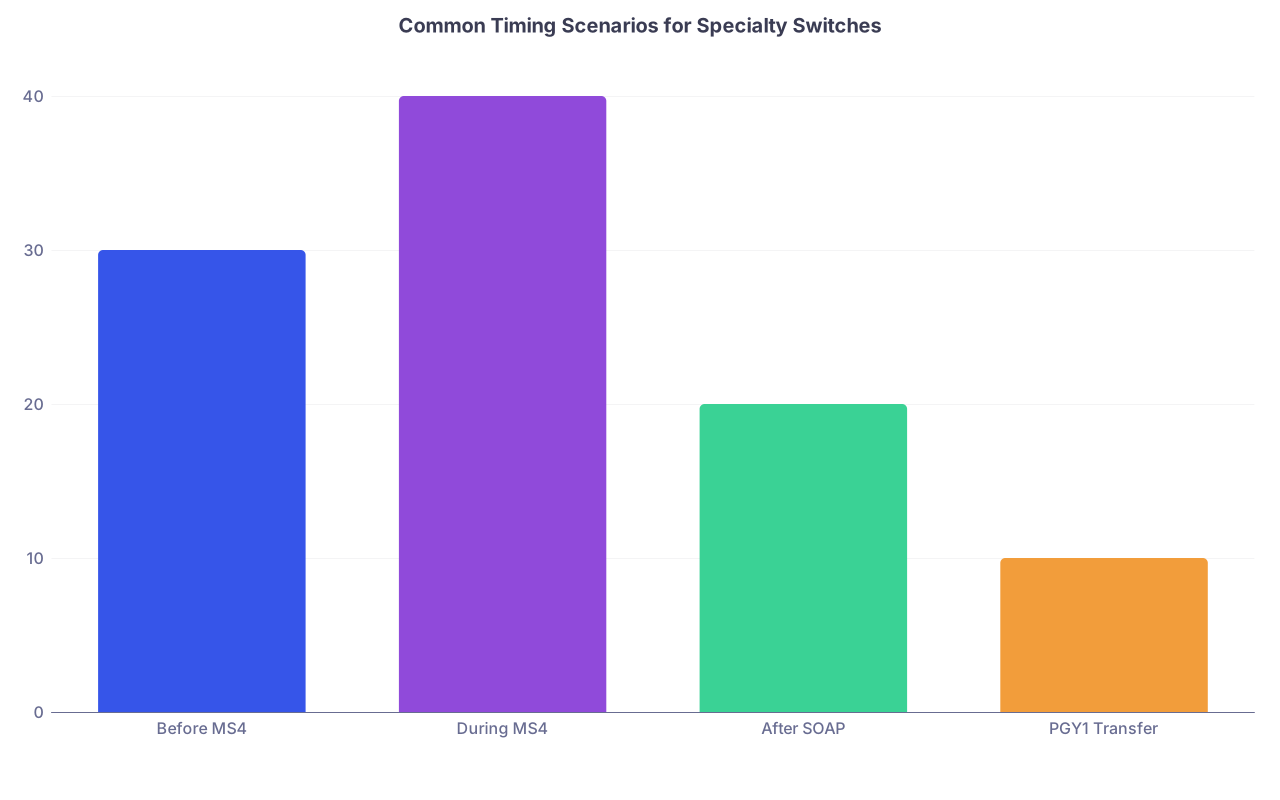
| Category | Value |
|---|---|
| Before MS4 | 30 |
| During MS4 | 40 |
| After SOAP | 20 |
| PGY1 Transfer | 10 |
How you frame your narrative will depend heavily on when you are switching.
1. Pre‑MS4 / early MS4: easiest version
You:
- Can still schedule electives in the new field.
- Can get fresh letters.
- Do not necessarily have to mention “easier” or failed match at all.
Your narrative here can be almost identical to a normal applicant’s, with a single line acknowledging that you initially leaned another direction.
2. Mid‑cycle switch after failed match
You are in SOAP territory or planning a re‑application year. The basic constraints:
- People know you did not match your first choice.
- Hiding that fact looks worse than acknowledging it.
Your move:
- Briefly acknowledge failure.
- Immediately pivot to what you did with that year: observerships, electives, research, clinical work that aligns with the new field.
- Stress maturity, adaptability, and clarified goals.
3. PGY1 or PGY2 transfer from another residency
Here, the red flags amplify:
- Programs worry you are difficult, unsafe, or unreliable.
- They will absolutely call your current PD.
You must:
- Maintain good standing where you are (no burning bridges).
- Get your current PD on your side or at least neutral. That means early, honest conversation—not blindsiding them after you start sending out applications.
The narrative shifts slightly:
“I have valued my time in [current field] and it has taught me [concrete skills]. Over the past year, though, I realized that the aspects of medicine I enjoy most align more closely with [new field]. To confirm this was not a transient reaction to a tough rotation, I arranged [electives/clinics] in [new field]. After those experiences and with the support of my current leadership, I am seeking a formal transfer.”
No trashing your current program. Even if they deserve it.
Step 8: Show You Actually Understand the “Easier” Field
This is where most people fall apart. They describe stereotypes instead of reality.
You should be able to have a fluent conversation about:
- Bread‑and‑butter cases.
- The annoying parts of the work.
- The training structure.
- Where people in the field actually end up practicing.
Use a simple 3‑column grid for yourself when prepping:
| Category | Example for Psychiatry | Example for Family Medicine |
|---|---|---|
| Bread and butter | MDD, GAD, bipolar, schizophrenia | HTN, DM2, obesity, pediatric well visits |
| Annoying parts | Documentation, chronic non‑adherence | Prior auths, 15‑min visits, endless forms |
| Long‑term rewards | Seeing patients stabilize and reconnect | Caring for whole families over decades |
You should have a similar mental table for whatever field you are pivoting into.
If you breeze into a psych interview talking only about “work‑life balance” and nothing about:
- Collaborative care,
- Involuntary holds,
- Substance use,
they will smile politely and rank you at the bottom.
Step 9: Practice Saying It Out Loud Until It Sounds Like You
Your story will land or fail based on delivery. If you sound apologetic, evasive, or rehearsed, you are toast.
How to practice:
Record yourself answering:
- “Walk me through your path to [new specialty].”
- “Why did you decide not to continue with [old specialty]?”
- “What specifically attracts you to [new specialty] now?”
Listen for:
- Over‑explaining failure.
- Passive language (“it just did not work out,” “I kind of realized”).
- Defensiveness (“I know it looks like I am just choosing something easier…”).
Rewrite answers to be:
- Shorter.
- More specific: “I enjoyed X and Y tasks…” not “I like helping people.”
- Forward‑looking: talk more about what you want to build than what collapsed behind you.
You want a tone that says:
- “I made a big, thoughtful decision.”
Not: - “Please believe I am not a screw‑up.”
Step 10: Use the Advantages You Actually Have
One final point people ignore: coming from a hyper‑competitive “hard core” field into a “less competitive” one is not always a liability. If framed correctly, it can be a strength.
Examples:
A former surgery‑bound applicant entering IM:
- “Comfortable with acutely ill patients.”
- “Understands peri‑op medicine.”
- “Brings procedural interest to a generalist field.”
An ex‑radiology applicant entering FM:
- “Strong imaging literacy.”
- “Can manage basic reads before formal reports.”
An ortho‑leaning student entering PM&R:
- “Knows surgical indications and hardware.”
- “Can speak both ‘surgery’ and ‘rehab’ when coordinating care.”
Do not erase your past. Recycle it.

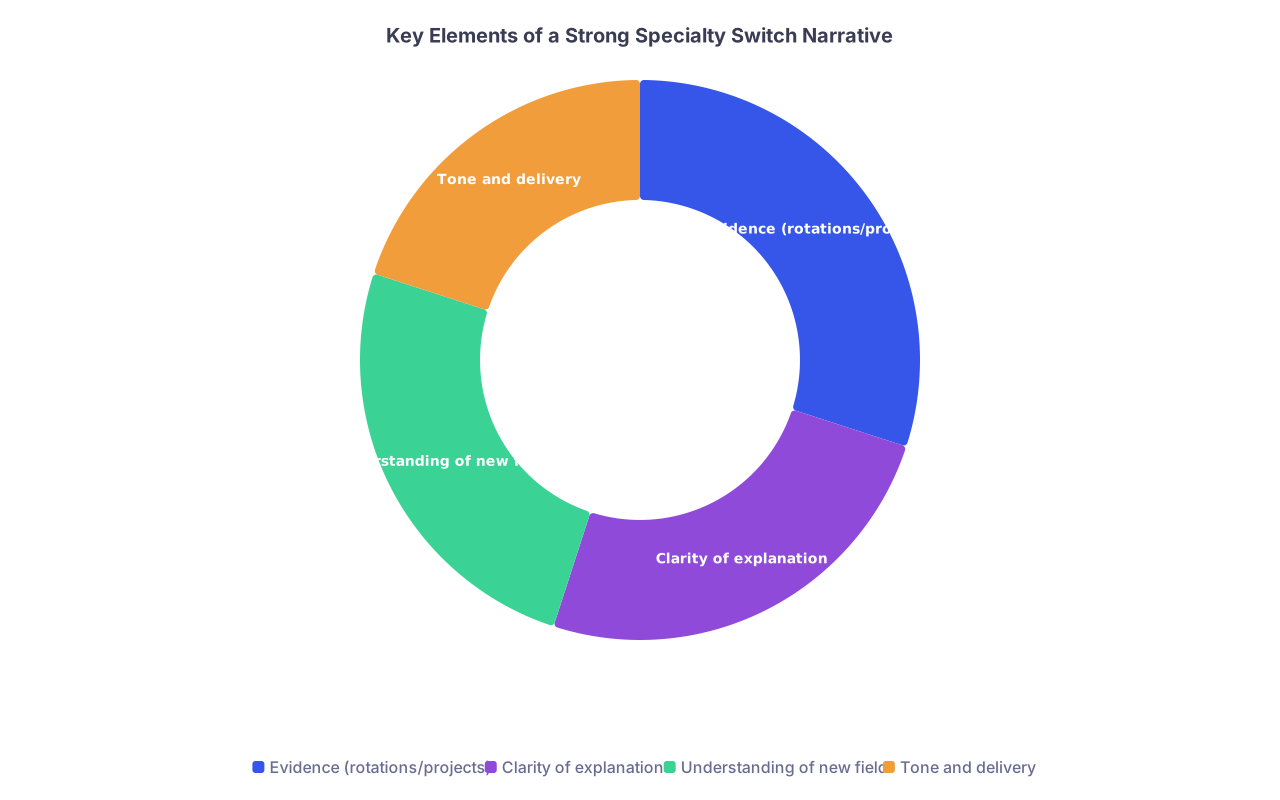
| Category | Value |
|---|---|
| Evidence (rotations/projects) | 30 |
| Clarity of explanation | 25 |
| Understanding of new field | 25 |
| Tone and delivery | 20 |


| Step | Description |
|---|---|
| Step 1 | Core Narrative |
| Step 2 | Personal Statement |
| Step 3 | CV Framing |
| Step 4 | Letters of Recommendation |
| Step 5 | Interview Answers |
| Step 6 | Consistent Story |
The Short Version: What Actually Matters
Three things decide whether your “easier field” switch sounds convincing or desperate:
Coherent story with a clear arc.
Past interest → catalyst → exploration → committed decision. No amnesia about your original plan, no melodrama about failure.Evidence that you did the work.
Rotations. Mentors in the new field. A small project or two. A PD who can say, “This was not a last‑minute panic move.”Respect for the new specialty on its own terms.
You talk about the reality of the work, not just lifestyle or competitiveness. You show you understand their pride and their pain points.
Get those right, and switching into a less competitive specialty stops looking like surrender. It looks like judgment. And judgment is exactly what programs want in a resident.