
Practical Blueprint: From No Research to Competitive in Easier Specialties
It is January of your third year. You are post‑call from medicine, sitting in the residents’ workroom, and someone just said the quiet part out loud: “Honestly, if you don’t have research, anesthesia is going to be tough from here.”
Your ERAS account is still empty.
You have zero PubMed entries. Zero posters. Zero anything-that-looks-like-research.
But you are not trying to match dermatology or neurosurgery. You are eyeing the so‑called “easier” lanes:
- Family Medicine
- Internal Medicine (community / mid‑tier academic)
- Psychiatry
- Pediatrics
- PM&R (at least at less competitive programs)
- Pathology
- Neurology (non-elite programs)
Here is the reality:
These specialties are more forgiving, but they are not charity. Even here, programs will use anything objective—research, Step scores, class rank—to separate the “easy yes” pile from the “maybe later” pile.
You are behind. But you are absolutely not out.
I am going to give you a blueprint: how to go from no research and no plan to solidly competitive for the less competitive specialties in about 6–12 months, assuming you are an average student with average scores and no magical connections.
Step 1: Pick a Realistic Target and Stop Fantasy-Browsing Programs
Your first mistake right now is thinking too vaguely:
“I just want something not that competitive.”
That is not a strategy. That is a wish.
You need to pick one or two primary target specialties based on who you are today, not who you wish you were.
Here is a blunt breakdown.
| Specialty | Overall Competitiveness | Research Emphasis (Typical) |
|---|---|---|
| Family Med | Very Low | Low |
| Psych | Low–Moderate | Moderate |
| Pediatrics | Low–Moderate | Moderate |
| Internal Med | Moderate (wide range) | Moderate–High (at top tiers) |
| PM&R | Moderate | Moderate |
| Neurology | Moderate | Moderate |
| Pathology | Low–Moderate | Low–Moderate |
You do not need perfection to match these. You need coherence.
How to pick realistically
Use this quick filter:
USMLE/COMLEX performance
- Step 2 CK > 235 or COMLEX 2 > 500: you have options across all the “easier” specialties, including many academic IM and psych programs.
- Step 2 CK 220–235: family med, psych, peds, pathology, PM&R and many community IM/neurology are in play.
- Step 2 CK < 220 or COMLEX 2 < 450: lean heavily toward family med, community psych, some peds, and community IM. Research will help but will not erase low board scores at more academic places.
Clinical performance
- Strong comments like “great team player,” “takes ownership,” “patients love her”: good sign for FM, psych, peds, IM.
- Better with procedures and ICU intensity, not a talker: you might like IM, neuro, pathology, PM&R.
Lifestyle tolerance
- Flexible with hours and variety: FM, peds, psych.
- Okay with more call, higher acuity: IM, neuro.
- More interested in diagnostics, lab/EMG/imaging: pathology, PM&R, neurology.
You are going to:
- Pick one main specialty (e.g., Family Medicine)
- Pick one backup that is equal or less competitive (e.g., Psych or another FM-heavy region)
Once you decide, everything else—research, rotations, networking—funnels into that.
Step 2: Understand What “Competitive Enough” Actually Looks Like
Stop comparing yourself to people matching MGH or UCSF. It is not helpful.
Here is what actually makes you competitive for these specialties from the perspective of program directors I have worked with or talked to:
- Board scores: Not catastrophic, no failures, Step 2 CK taken before rank list.
- Clinical evals: No professionalism disasters, progressively better comments.
- Evidence of interest in the field: A bit of research, a couple of electives, some meaningful experiences that are not obviously padded.
- Letters of recommendation: 2–3 field‑specific letters from attendings who actually know you.
- Geographic signals: Ties to the region, rotations there, or a clear story why you want that area.
Notice what is missing:
No one is saying “needs three first‑author publications in JAMA.”
But here is the catch: in application piles where 70–80% of applicants now list “some research,” having nothing is a negative. It signals disorganization, lack of curiosity, or not understanding the current game.
So your aim is not to become a researcher.
Your aim is to go from zero to enough that no one can toss your application out for lack of scholarly activity.
For the easier specialties, “enough” usually means:
- 1–3 low‑intensity projects (case reports, QI, retrospective chart reviews)
- Maybe 1 poster or presentation
- Maybe 1 publication (case report or small paper) if timelines allow
That is it. Stop imagining R01-level output.
Step 3: Secure a Low‑Friction Research On-Ramp (Fast)
You are behind. So we are not going to chase high‑impact, multiyear projects.
You need something that:
- Starts quickly (days to weeks, not months)
- Has a defined scope
- Does not require IRB from scratch if you can avoid it
- Is directly relevant to your chosen specialty
Best options by specialty
Let me be concrete.
Family Medicine / Pediatrics / Psych / IM / Neurology:
- Case reports (interesting patient you saw on rotation)
- Retrospective chart reviews using existing IRB databases
- QI projects (clinic no‑show reduction, screening rates, follow‑up adherence)
PM&R / Neurology:
- Case reports on stroke rehab, spinal cord injury, EMG findings, unusual rehab approaches
- Small retrospective reviews of outcomes in a rehab population
Pathology:
- Case series of rare tumors or variants seen at your institution
- Validation of certain stains, correlation studies (these often already have templates)
How to actually get on a project (not theoretical)
You send a targeted, short email. Not a desperate essay.
Subject line example:
- “MS3 interested in psych – available to help with ongoing projects”
- “MS3 seeking small FM project (case report/QI) – flexible and fast”
Email template (tweak for your field):
Dear Dr. [Name],
I am a third‑year medical student interested in [specialty] and currently have limited research experience. I am hoping to become involved in a small project that I can contribute to consistently over the next 3–6 months (case report, QI, or retrospective review).
I am comfortable with [basic skills you actually have: chart review, data entry in Excel/REDCap, basic literature searches], and I can commit [X] hours per week reliably.
If you have an ongoing project that needs additional help, or a case you think could work for a report, I would be grateful for the opportunity to assist.
Thank you for your consideration,
[Name, MS3, School, contact]
You send this to:
- 3–5 faculty in your chosen specialty at your home institution
- 1–2 chief residents (they often sit on projects needing grunt work)
- Any fellow who presented something at conference and seemed approachable
You do not wait for the perfect project. You take the first reasonably legit, ethical project that:
- Has a clear path to a poster, abstract, or paper
- Has a supervising faculty member who has produced work before
- Can fit into your next 3–6 months
Step 4: Play to the Fastest Output Types
Let me rank types of “research” by speed and signal strength for your situation.
| Activity Type | Time to Output | CV Signal Strength | Realistic for Late MS3+ |
|---|---|---|---|
| Case Report | 1–3 months | Moderate | Yes |
| QI Project + Poster | 3–6 months | Moderate–High | Yes |
| Retrospective Review | 4–9 months | High | Maybe, if joining midstream |
| Basic Science Lab | 1–2 years | High | No (you are late) |
You are going farthest, fastest with:
Case reports / small case series
- Easiest entry.
- You can often write a draft in 2–3 weeks once data is gathered.
- Many specialty-specific journals actively welcome them.
Quality improvement (QI) projects
- Extremely attractive to:
- Family Medicine
- IM
- Peds
- Psych
- These scream “I understand systems of care and patient safety,” which PDs love.
- Extremely attractive to:
Joining a nearly-done retrospective study
- Sometimes you find a resident or fellow who is already 70% done and just needs:
- More chart abstraction
- Literature review
- Reference management
- You are not first author, but you get on the paper. That still counts.
- Sometimes you find a resident or fellow who is already 70% done and just needs:
How to keep yourself from being dead weight (and getting dropped)
Once you are on a project, you deliver. No excuses. That is the currency.
Basic rules:
- Answer emails within 24 hours.
- When given a task, respond with a clear ETA: “I can finish this by Sunday night.”
- Beat your deadlines.
- Ask for next steps as soon as you finish your assigned component.
You want the attending thinking: “This student is unusually reliable.”
That is what turns into both a CV line and a strong letter.
Step 5: Align Everything With Your Specialty Story
Research is one piece. If the rest of your application screams “confused and random,” it will not save you.
You are going to build a coherent story around your chosen specialty—especially important in easier fields, where fit and interest matter more than raw prestige.
Example: Family Medicine track
You line up:
- Research: small QI project on hypertension control in a community clinic; one case report on complex multi‑morbid patient management.
- Clinical electives: 2 FM sub‑Is (home + away or rural); 1 outpatient IM; maybe 1 psych or peds rotation in a continuity clinic.
- Extracurricular: free clinic, patient education workshops, community health projects.
Now your application says: “This person lives and breathes longitudinal primary care.”
Example: Psychiatry track
You line up:
- Research: chart review on inpatient psych readmissions; case report on catatonia; QI on antipsychotic monitoring and metabolic labs.
- Clinical electives: consult‑liaison psych, inpatient psych sub‑I, addiction clinic if available.
- Extracurricular: mental health advocacy, hotline, or peer counseling roles.
Now the PD reads your app and sees “this person actually cares about psych,” not “backed into psych because they failed surgery.”
Example: PM&R track
You get:
- Research: case report on stroke spasticity management; QI in inpatient rehab fall prevention; poster on functional outcomes post-ICU.
- Clinical electives: inpatient rehab, outpatient MSK, neuro elective, maybe sports med.
- Extracurricular: adaptive sports, rehab-related volunteering.
Same logic.
Step 6: Use Research As Leverage for Letters and Mentors
The hidden benefit of even small research projects is not the line on the CV. It is the relationships.
Program directors in easier specialties are still swayed by strong, personal letters. A well‑written letter from an attending in their field who knows you and has watched you work on a project is worth much more than a generic “rotated with me for two weeks” letter.
Your goal with your research mentor:
Show up as the reliable student who:
- Does the grunt work
- Shows curiosity
- Follows through without being chased
Then, as the project matures:
- Ask to present at a local or regional meeting
- Ask for feedback on your personal statement
- If appropriate, ask if they would be comfortable writing a letter of recommendation
How to actually phrase the ask:
Dr. [Name],
I have greatly appreciated working with you on [project], and I have learned a lot from both the clinical and research sides of [specialty]. I am planning to apply to [specialty] this coming ERAS cycle.If you feel that you know my work well enough, I would be very grateful if you would consider writing a strong letter of recommendation for my residency applications.
If they say yes but then drag their feet, you send one gentle reminder 3–4 weeks later with:
- Your updated CV
- Draft of your personal statement
- A short bullet list of projects/strengths they have seen directly
Make it easy for them to write you a strong letter.
Step 7: Build a 6–9 Month Timeline From Where You Stand
You do not need vague inspiration. You need a calendar.
Let us say:
- Today: January of MS3
- Goal: Apply this September to “easier” specialties with no current research
Here is a concrete timeline.
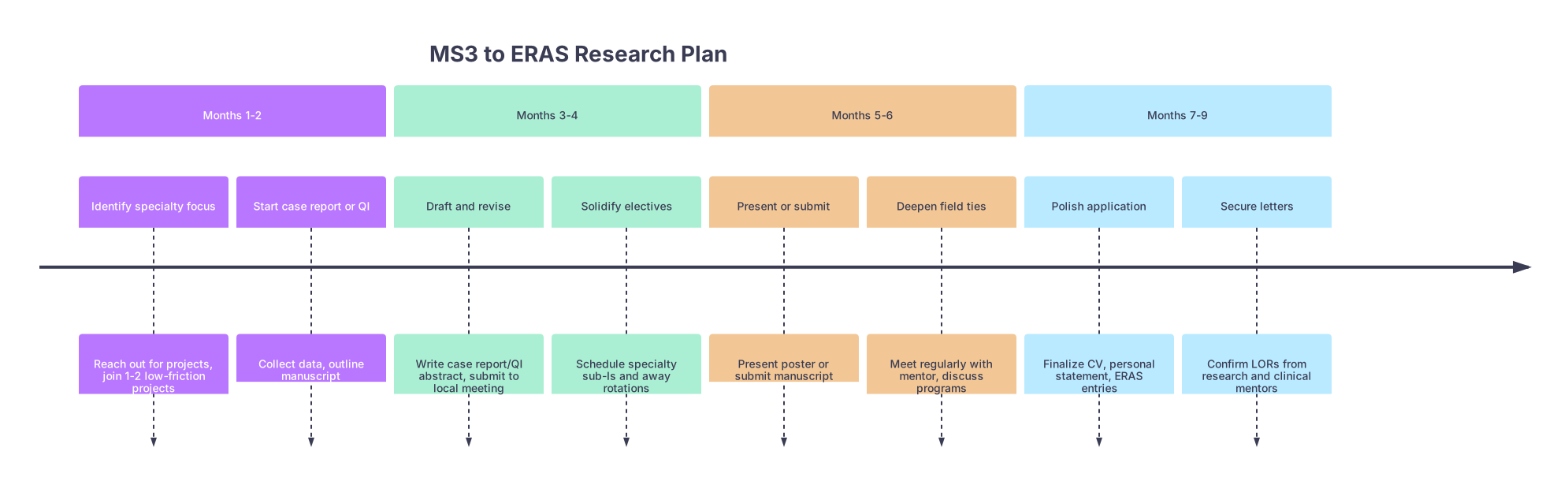
| Period | Event |
|---|---|
| Months 1-2 - Identify specialty focus | Reach out for projects, join 1-2 low-friction projects |
| Months 1-2 - Start case report or QI | Collect data, outline manuscript |
| Months 3-4 - Draft and revise | Write case report/QI abstract, submit to local meeting |
| Months 3-4 - Solidify electives | Schedule specialty sub-Is and away rotations |
| Months 5-6 - Present or submit | Present poster or submit manuscript |
| Months 5-6 - Deepen field ties | Meet regularly with mentor, discuss programs |
| Months 7-9 - Polish application | Finalize CV, personal statement, ERAS entries |
| Months 7-9 - Secure letters | Confirm LORs from research and clinical mentors |
Notice:
- In about 2 months, you can be actively on a project.
- In 4–6 months, you can have at least a submitted abstract/poster, maybe even an accepted one.
- By ERAS submission, you have:
- “Submitted” or “Accepted” entries to list
- One or two mentors who know you well in your target field
You are not going to transform into a physician‑scientist. But you will not be the applicant with a blank “Research” section.
Step 8: Customize the Plan by Specialty
The general playbook is the same, but let me tighten it by specialty because expectations differ.

Family Medicine
Programs care heavily about:
- Commitment to primary care
- Community engagement
- Patient‑centered mindset
Minimal acceptable “research”:
- 1–2 QI projects (e.g., diabetes control, cancer screening rates)
- A case report involving complex outpatient management
- Possibly a community health project with basic outcomes (attendance, reach, satisfaction)
If you do nothing else: get one QI project with tangible outcomes and present it at a local or state FM meeting.
Psychiatry
Psych has quietly ratcheted up in competitiveness at many places.
Programs like:
- Some evidence of academic curiosity: descriptive studies, chart reviews, anything around mental health outcomes
- QI in safety, readmits, or medication monitoring
Minimal acceptable “research”:
- 1 psych‑relevant project
- Case report of interesting neuropsychiatric or psychopharm scenario
- Or small chart review (e.g., predictors of readmission in inpatient psych)
If you can present at a regional psych meeting, that is a strong plus.
Pediatrics
Peds directors care a lot about:
- Advocacy
- Systems of care for vulnerable patients
- QI and patient safety
Minimal acceptable “research”:
- 1 QI project (vaccination rates, asthma action plans, NICU handoff improvements)
- Case report on rare condition, complex social/family dynamic in care
If you land a peds QI project, lean into it hard. Peds loves QI.
Internal Medicine (non-elite)
The competitiveness gradient is steep here. But for community and many mid‑tier academic programs:
- You do not need heavy bench research.
- You do need to show you can engage with data and clinical questions.
Minimal acceptable “research”:
- 1–2 projects in IM or a closely related domain (FM, cards, pulm, hospital medicine)
- Could be:
- Retrospective outcomes study (e.g., sepsis bundle outcomes)
- QI (readmission reduction, VTE prophylaxis compliance)
- Case series of unusual presentations
Try to have at least one IM-labeled project if IM is your main specialty.
PM&R
Many applicants underestimate PM&R. Spots are not infinite, and good programs are picky.
They like:
- Rehab‑focused projects
- Functional outcomes, MSK, neuro, pain, stroke, SCI, TBI topics
Minimal acceptable “research”:
- 1 PM&R-flavored project (case report or case series; rehab outcomes)
- Extra credit if you present at a PM&R meeting
Align any neuro or ortho‑adjacent research with rehab themes if possible.
Pathology
Path programs care about:
- Attention to detail
- Commitment to the diagnostic side
- Some exposure to pathology as an academic discipline
Minimal acceptable “research”:
- 1 pathology project (case series, tumor board spinoff, stain validation)
- Case report on a rare or interesting pathology finding
Many departments have “publishable” cases lying around. You just have to ask.
Neurology (non-elite)
Neuro sits between IM and psych in expectations.
Minimal acceptable “research”:
- 1 neuro‑related project (stroke, epilepsy, MS, movement disorders, neuromuscular)
- Case report or small series is fine
- QI in stroke pathways, thrombolysis door‑to‑needle times, etc.
You will stand out more with some neuro flavor than generic medicine QI.
Step 9: Fix the Rest of Your Application While the Research Simmer
Research alone will not rescue:
- Red flags (failures, professionalism issues)
- Weak letters
- Late or sloppy ERAS submissions
So while your project is in progress, you simultaneously:
Schedule and crush your sub‑Is in your chosen field.
- Show reliability, ownership, and good team behavior.
- Ask explicitly for feedback mid‑rotation so you can correct course.
Identify 3–4 letter writers early.
- At least 2 in your chosen field.
- 1 can be from research mentor if they know you clinically or via significant work.
Draft a personal statement that matches your actual path.
- Tie in your research as evidence of curiosity and follow‑through.
- Do not oversell it. “I led a major project” when you did data entry will sound fake.
Build a program list that matches your real competitiveness.
- Apply broadly across a range of program types.
- Use home PDs or mentors to sanity-check your list.
Step 10: How to Present Your Thin Research Without Looking Embarrassing
You will still not have 10 pubs. That is fine. Your job is to present what you do have in a clean, confident, honest way.
On ERAS:
List all scholarly work, even if “submitted” or “in preparation,” but:
- Do not lie about status. “Submitted” means submitted.
- “In preparation” is weaker; use sparingly and only if real work is done.
For each entry:
- Use clear titles.
- Clarify your role (“Data collection and literature review”).
On your CV:
- Group your few items smartly:
- “Publications and Submitted Manuscripts”
- “Posters and Presentations”
- “Quality Improvement and Scholarly Projects”
During interviews, when asked about research:
You say something like:
I came to research a bit later, during clerkships. Once I realized I wanted [specialty], I focused on small, clinically relevant projects that I could see through. I worked on [brief description], where my main roles were [your actual tasks]. It gave me a better understanding of [clinical/research lesson] and I plan to continue pursuing similar QI projects in residency.
Confident. Accurate. No pretending to be something you are not.
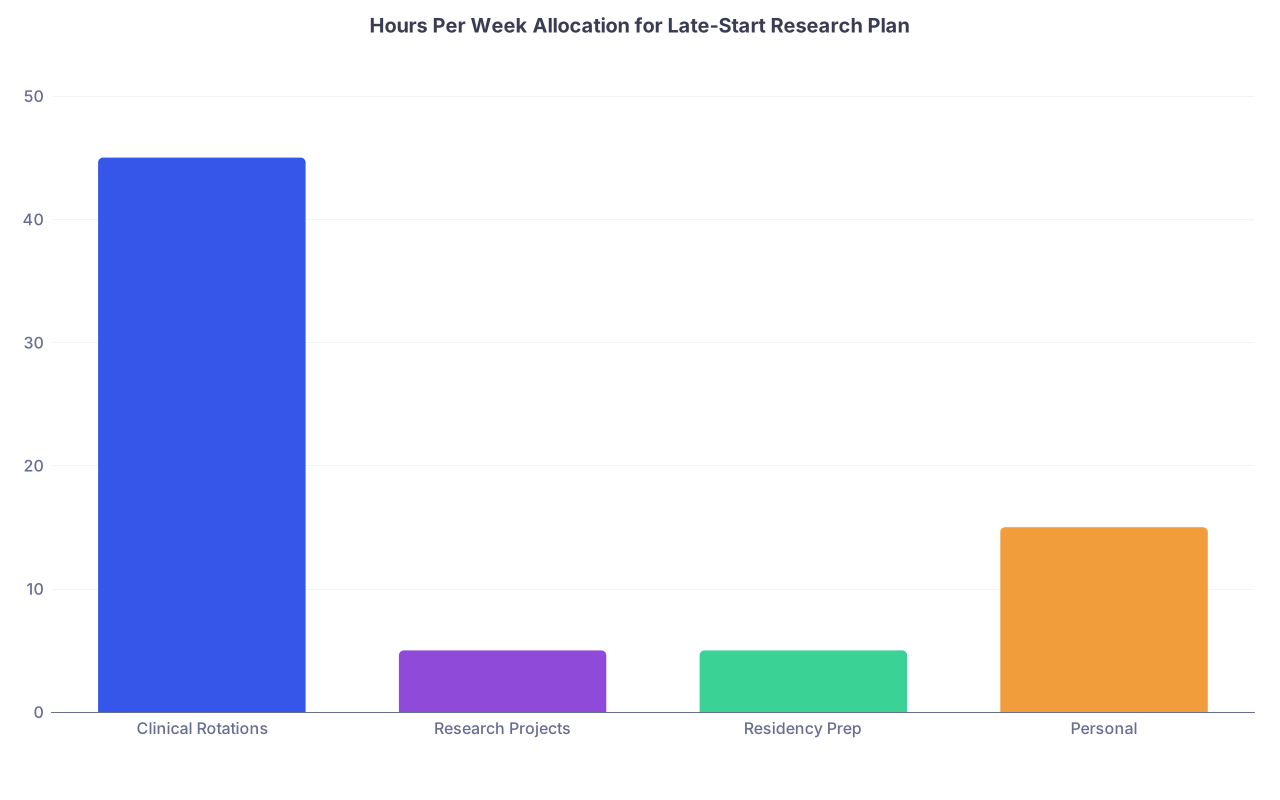
| Category | Value |
|---|---|
| Clinical Rotations | 45 |
| Research Projects | 5 |
| Residency Prep | 5 |
| Personal | 15 |
Final Check: Are You On Track?
If you follow this blueprint for 6–9 months, by the time you submit ERAS you should have:
- 1–3 concrete scholarly entries tied to your chosen specialty (case reports, QI, or chart reviews)
- At least one field‑specific mentor who knows you well and is writing a strong letter
- A specialty story that looks deliberate, not panicked
- A program list that matches your actual competitiveness, increasing your odds of plenty of interviews
You started with nothing. That will not be true by the time your application goes out.

Key Takeaways
- You do not need heavy research to match into the less competitive specialties, but you cannot afford zero; 1–3 focused, low‑friction projects are enough.
- Align everything—research, rotations, letters—around one primary specialty so your application tells a coherent story.
- Use small, fast projects (case reports, QI, existing chart reviews) plus reliable follow‑through to turn “no research” into “solidly competitive” in under a year.