
It is late evening. You are staring at your ERAS portal on one screen, a half-finished Excel sheet on the other, with a dozen Reddit tabs open arguing about which residencies are “easy” to match into. Your Step score is mediocre. Your dean’s letter is… fine. You want to match, not play hero in some prestige contest.
You have one clear goal: build a ruthlessly targeted program list that maximizes your chance of matching into a less competitive specialty.
This is where most applicants screw up.
They hear “least competitive” and think “I can apply anywhere.”
Wrong.
You are not trying to match “in general.” You are trying to match once, into a specific specialty, at a real program that will actually rank you. That requires strategy, not vibes.
I will walk you through that strategy step by step.
Step 1: Be Honest About What “Least Competitive” Actually Means
First fix: clear up the fantasy.
There is no truly “easy” specialty anymore. There are less competitive ones. But if you apply lazy and generic, even those will reject you.
Right now (and this does shift slowly over the years), the relatively less competitive categorical specialties in the U.S. typically include:
- Family Medicine
- Internal Medicine (non-elite university programs)
- Pediatrics
- Psychiatry (rising in competitiveness, but still reasonable outside big names)
- Pathology
- Neurology
- PM&R (Physical Medicine & Rehabilitation) – variable, but often mid-range
- Transitional Year and Preliminary Medicine (for one-year slots, not full training)
Surgical fields, dermatology, radiology, anesthesia, EM, ortho, etc., are not in the “least competitive” bucket, even if some lower-tier or community programs are more forgiving.
Here is a rough feel comparing specialties by competitiveness tier. Not step scores, not precise math. Just how it plays on the ground.
| Specialty | Relative Competitiveness Tier |
|---|---|
| Dermatology | Very High |
| Orthopedic Surgery | Very High |
| Plastic Surgery | Very High |
| Anesthesiology | High |
| Emergency Medicine | High–Moderate (rising again) |
| Radiology | High |
| Specialty | Competitiveness (Current) |
|---|---|
| Family Medicine | Lower |
| Internal Medicine | Moderate (wide range) |
| Pediatrics | Lower–Moderate |
| Psychiatry | Moderate (rising) |
| Neurology | Moderate |
These charts do not mean “you are guaranteed FM” or “you must abandon IM.” They just help you choose your battlefield.
Your first decision:
Pick one primary target specialty in the lower- or mid-competitiveness tier. Not three. Not “FM or IM or Psych or maybe Anesthesia.” One.
Then, if you are truly at risk (low scores, red flags), you pick:
- 1 primary target specialty (e.g., Family Medicine)
- 1 backup specialty at least as non-competitive, not more (e.g., Psychiatry or Pathology depending on your profile)
Do not pick a backup that is harder than your primary. That is not a backup. That is self-sabotage.
Step 2: Define Your Personal Risk Profile First, Not the Program List
Before you start adding programs, you must know where you stand. Programs are not asking “Is this student decent?” They are asking:
“Is this student too risky for us to rank?”
Your risk comes from a few main areas:
- US vs IMG vs DO
- Step/COMLEX scores and failed attempts
- Medical school reputation
- Gaps, LOA, professionalism flags
- Lack of home specialty exposure / weak letters
Write this down. Literally. On paper or in your spreadsheet.
Create three columns: Green, Yellow, Red.
Examples:
Green:
- US MD, no gaps, no failures.
- Step 2: 230+ (if scored).
- Solid clinical grades, decent letters.
Yellow:
- DO with average COMLEX, no failures.
- US MD with 1–2 lower clerkship grades.
- Limited research, but good continuity experiences.
Red:
- Any Step failure.
1 year gap unexplained or poorly explained.
- Older graduate (>3–5 years out with no current US clinical work).
- IMG without strong US clinical experience or letters.
If you are Red in multiple areas, your strategy is extremely different than someone who is Green. You cannot use their program lists. You cannot copy the “I applied to 60 programs and matched IM” story you saw online from a US MD with no red flags.
You build your list based on your risk category, not your fantasy peer.
Step 3: Understand What Makes a Program “Less Competitive”
Next misconception: people think specialties are competitive, but programs are all the same inside that specialty.
No. Within Family Medicine, you have wildly different tiers:
- University flagship FM programs in big cities = much more competitive.
- Midwest community FM in rural areas = less competitive, often interviewing broadly.
You want to identify lower-competition programs inside a lower-competition specialty. That is how you stack the odds.
Look for these features that generally make programs less competitive:
- Geography
- Rural or semi-rural locations
- Midwest, South, some interior West regions
- Far from coastal magnets (Boston, SF, NYC, LA, Seattle, Miami, Chicago core)
- Program Type
- Community hospital based, not big-name academic centers
- Newer programs (<5–7 years old) still building a reputation
- Smaller cities where recruitment is harder
- Applicant Pool
- Programs that traditionally take many IMGs or DOs
- Programs with historically high match fill but lower Step averages
- Specialty Culture
- Family Med and Pediatrics: many community and rural-focused programs with broad applicant acceptance
- Psychiatry and Neurology: some university programs, but still less saturated outside top cities
Here is a quick comparison of what “less competitive” looks like at the program level.
| Feature | More Competitive Program | Less Competitive Program |
|---|---|---|
| Location | Major coastal city | Small city / rural / Midwest / South |
| Affiliation | Big-name university | Community-based |
| Age of program | Established, >20 years | New / recent expansion |
| IMG/DO percentage | Low | Moderate to high |
| Research expectations | Strong, mandatory scholarly work | Light or optional |
| Fellowship placement | Highly placed in subspecialties | Generalist-focused |
Your job: actively seek programs in the right column.
Step 4: Build the Initial Long List (Quantity Phase, Not Quality Yet)
Now we get tactical. You are going to build a long list first, then cut it down brutally.
Tools you should use:
- FREIDA (AMA)
- NRMP Charting Outcomes in the Match (latest version)
- Program websites
- Your school’s match list / advising office
- Colleagues who matched in your target specialty
Concrete process for the long list
- Go to FREIDA.
- Filter by:
- Specialty (e.g., Family Medicine)
- Country: United States
- Accreditation: ACGME
- Export or copy program names into a spreadsheet. All of them.
Then start tagging with simple flags in new columns:
- Region (Northeast, South, Midwest, West)
- Setting (Urban, Suburban, Rural)
- Type (University, Community, University-affiliated)
- Takes IMGs? (Yes / No / Unknown)
- Takes DOs? (Yes / No / Unknown)
- New program (Y/N)
You are not judging yet. You are organizing.
Next, apply the first pass filters:
- If you are an IMG → mark any program that openly states “No IMGs” as Exclude.
- If you have a Step failure → highlight programs that mention “no prior failures” as High-risk.
- If you are location-limited (partner job, kids) → mark only realistic geographic regions.
You will end up with:
- A huge initial list
- A lot of highlighting and notes
- The beginnings of a strategic map
This is when things start feeling less chaotic. Because now it is structured.
Step 5: Convert “Less Competitive” into Actual Application Numbers
You cannot apply to 300 programs. You also cannot apply to 15 and call it strategy.
You need target numbers based on your risk profile and specialty competitiveness.
Here is a rough, practical map for least competitive specialties (FM, Peds, lower-tier IM) in terms of how many programs to apply to:
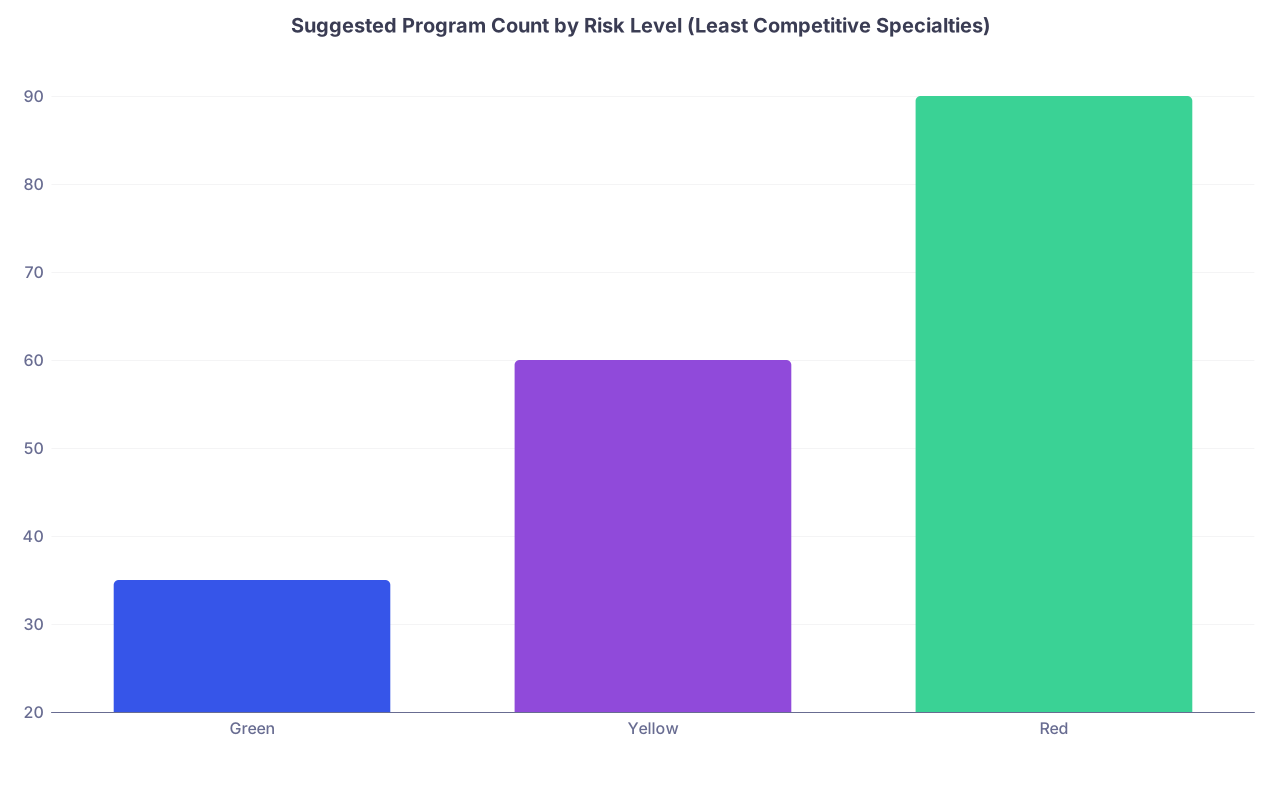
| Category | Value |
|---|---|
| Green | 35 |
| Yellow | 60 |
| Red | 90 |
Interpretation:
- Green profile (US MD/DO, no big red flags):
25–40 programs in FM / Peds / non-elite IM is often enough. - Yellow profile (some concerns, DO or mild academic weakness):
50–70 programs is safer. - Red profile (IMG, failures, gaps):
80–120+ programs in truly less competitive fields is not crazy. It is sometimes necessary.
Do not under-apply because someone on YouTube matched with “20 apps total.” That is survivor bias talking, not a plan.
Step 6: Rank and Tier Your Programs (Cutting Phase)
Now you have a long list. Time to cut. This is where most people freeze.
Here is a simple, effective system: create three tiers.
- Tier 1: High-chance programs (safety-ish for you)
- Tier 2: Reasonable-chance programs
- Tier 3: Reach programs
You should have more Tier 1 and 2 than Tier 3. Especially with a weaker application.
How to classify quickly
Use these criteria:
Tier 1 (your bread and butter) if:
- Program in a less desirable location (to most people): rural, small town.
- Community-based, not prestige-focused.
- Historically takes:
- DOs and/or IMGs regularly.
- Mid-range Step scores.
- No strict score cutoffs on their website, or clearly moderate ones.
Tier 2 if:
- Mid-size city.
- University-affiliated community program.
- Takes some DO/IMG applicants but not heavily.
- Slightly stronger academic environment but not “elite.”
Tier 3 (reaches) if:
- Major metro area, popular city.
- Strong university name.
- Website lists high Step averages, strong research expectations, or selective IMG policies.
You should aim roughly for something like:
Green applicant:
- 40–50% Tier 1
- 30–40% Tier 2
- 10–20% Tier 3
Yellow applicant:
- 60–70% Tier 1
- 20–30% Tier 2
- <10% Tier 3
Red applicant:
- 75–85% Tier 1
- 10–20% Tier 2
- 0–5% Tier 3 (if any)
If your spreadsheet shows you with 50%+ Tier 3 programs as a Red-risk IMG with a Step failure, that is not a plan. That is wishful thinking disguised as work.
Step 7: Use Your Geography Wisely (Not Emotionally)
Geography is not just about where you want to live. It is a lever for competitiveness.
Programs in big, desirable cities get flooded. You are competing with people who would probably never look at that small-town Midwest community program.
If you genuinely want to maximize match odds in a less competitive specialty:
- Embrace unpopular locations.
- Avoid limiting yourself only to:
- California
- New York City core
- Boston
- Seattle
- San Francisco Bay Area
- Miami
- Chicago downtown
Use them sparingly as Tier 3 programs, not the backbone of your list.
You can always move later after residency. You cannot “move later” out of not matching.
Here is what tends to be friendlier to at-risk applicants:
- Midwest states (outside Chicago): Indiana, Ohio, Iowa, Kansas, Missouri, Nebraska, etc.
- South and Southeast (non-coastal big cities): Alabama, Arkansas, Kentucky, Tennessee, the Carolinas, parts of Texas outside Austin/Dallas/Houston hot spots.
- Rural-oriented states with strong primary care focus: North Dakota, South Dakota, Wyoming, Idaho, etc.
Does this mean you will love every location? No. But you will love not scrambling.
Step 8: Align Your Story With the Specialty and Program Type
A “targeted” program list is not just about where you apply. It is about how well your application story matches what those programs want.
For least competitive specialties, programs still care about:
- Commitment to primary care or that specific field.
- Willingness to work in underserved or less glamorous settings.
- Fit with their mission: rural health, community-based care, continuity clinic.
If you are applying to:
Family Med in rural-heavy programs → you need to highlight:
- Continuity clinic, outpatient experience.
- Work with underserved / rural populations.
- Genuine interest in broad-spectrum care, not “I failed to get Radiology.”
Pediatrics → you should show:
- Consistent exposure to kids (peds rotation, peds electives, maybe volunteer work).
- Comfort with families, chronic care.
Psychiatry → emphasize:
- Long-term patient relationships.
- Behavioral health, mental health interest.
- Rotations/electives in psych, not zero exposure.
You do not need 1,000 hours of research. You do need a coherent story that says, “I actually belong in this field and will stay.”
Step 9: Add a Backup Specialty Intelligently (If You Truly Need One)
For some of you, one specialty is enough. For others, given your risk, that is not safe.
If you are:
- IMG with a Step failure
- Older graduate
- Multiple red flags
Then a backup specialty inside the least competitive group is reasonable.
What is not reasonable:
- Primary: Neurology
Backup: Anesthesiology
or
- Primary: Psychiatry
Backup: Emergency Medicine
You pick lateral or easier, not harder.
Common rational backups:
Primary: Internal Medicine (mid-tier focus)
Backup: Family MedicinePrimary: Pediatrics
Backup: Family Medicine or Psychiatry (depending on your history)Primary: Psychiatry
Backup: Family Medicine or Neurology (depending on geography and your experiences)
If you add a backup specialty:
- Do not dilute your main specialty statement.
- Adjust your personal statement and program signals accordingly.
- Maintain separate spreadsheets for each specialty’s program tiers. Do not mash them.
Step 10: Execute a Tight Timeline and Tracking System
Here is where people trip: they build a good list then manage it like a pile of sticky notes.
You want a system that lets you:
- Track where you applied
- Track interview offers
- Update tiers as reality hits (who actually interviews you)
Build a simple but functional spreadsheet with columns like:
- Program name
- City, State
- Tier (1, 2, 3)
- IMG/DO friendly (Y/N)
- Sent application (Y/N)
- Interview offer (date)
- Interview completed (date)
- Post-interview impression (1–5)
- Rank list position (later)
Then, once interview season starts, you update your mental tiers:
- Programs that interview you become “realistic,” even if they were Tier 2/3 before.
- Programs that ignore you move down in practical priority.
This also helps with rank list creation later. Because your lived experience in the interview matters more than your pre-season imagination.
Here is a simple view of the application pipeline as a process.

| Step | Description |
|---|---|
| Step 1 | Assess Risk Profile |
| Step 2 | Select Primary Specialty |
| Step 3 | Build Long Program List |
| Step 4 | Tag Geography and Type |
| Step 5 | Assign Tiers 1 2 3 |
| Step 6 | Finalize Application Numbers |
| Step 7 | Submit Applications |
| Step 8 | Track Interviews and Updates |
| Step 9 | Adjust Perceived Tiers |
| Step 10 | Create Rank List |
If your current state is “randomly applying,” you want to get into that structured flow.
Step 11: Common Dumb Mistakes That Kill Otherwise Fixable Applications
I have watched people with fully salvageable profiles crash and burn because they did one or more of these:
Location arrogance
- Only applying to big-name cities or coasts “because I cannot imagine living elsewhere.”
- Result: massive self-induced competition.
Under-applying
- A Red-risk IMG applying to 25 IM programs and 15 Psych ones.
- Then acting surprised at not matching.
Ignoring program signals
- Applying to “no IMG” programs as an IMG in bulk.
- Applying to “Step 2 > 240 preferred” programs with a 210 and a failure.
No specialty alignment
- Generic personal statement clearly reading as “I just want a job.”
- No elective or sub-I in the target specialty.
Copying someone else’s list
- Blindly using a “Google doc of programs that take IMGs” without considering your own gaps or timeline.
You can avoid all these with the structure I laid out.
Step 12: If You Are Already Late or Reapplying
If you are reapplying or starting late in the season, your list needs to be even more targeted.
Reapplicants:
- Overcorrect your prior mistakes.
- Expand your program volume, especially Tier 1.
- Add or switch to a less competitive specialty if you previously targeted something mid- or high-tier.
Late applicants:
- Do not waste time mass-emailing 300 coordinators.
- Focus on:
- Programs that historically interview late.
- Newer programs and community-based hospitals.
- Lean heavily on any geographic or personal ties you can truthfully claim.
A brutal reality: if you failed to match once with a weak or sloppy strategy, you do not get to repeat that. The second attempt must be calculated, or you are just walking into the same wall again.
Key Takeaways
- “Least competitive” is relative. You still need a disciplined, data-driven program list that matches your risk level and profile.
- Maximize your odds by stacking advantages: less competitive specialty + less competitive programs + unpopular locations + clear alignment with the field.
- Use structure: long list → tiering → realistic application numbers → tracking. No vibes. No copying random lists. Just a targeted, ruthless plan to match once.