
It is late January of your third year. You are sitting in your car outside a small community hospital, the kind with faded signage and a cafeteria that shuts down at 2 p.m. You have an 8‑week family medicine or psych or peds rotation here.
You want something “non-competitive” — family, psych, peds, IM at a solid community program. Nothing fancy.
But you are also not delusional. You know:
- You are not coming from a top‑tier school.
- Your scores are fine, not spectacular.
- Your school’s big-name university hospital is crawling with gunners fighting for the same handful of “big letter” attendings.
So you are asking yourself:
How do I make this out‑of-the-way community rotation actually help me? How do I turn “random community site” into a real advantage when I apply to lower‑competition specialties?
Let me be blunt: most students waste community rotations. They show up, see their patients, type notes, maybe impress a preceptor a bit, then walk away with “Pass, good student” and nothing else.
You are not doing that.
Here is how you turn community rotations into a weapon for your application in lower-competition fields.
Step 1: Understand What Low-Competition Fields Actually Care About
Before you micromanage your behavior on rotation, you need to understand what programs in less competitive specialties actually rank highly.
Think:
- Family Medicine
- Internal Medicine (community-heavy programs)
- Psychiatry
- Pediatrics
- PM&R at smaller institutions
- Neurology (at many non-ivory-tower hospitals)
These fields are not primarily filtering you by 260+ Step scores and first-author NEJM papers. They are looking for:
- Reliability. Do you show up, do the work, and not create drama?
- Teachability. Do you respond well to feedback, adjust quickly, and not act like you know everything after UpToDate?
- Team fit. Nurses, MAs, case managers, social workers: can you function on a real-world team?
- Genuine interest in bread-and-butter medicine and longitudinal patient care.
- Strong clinical performance with specific examples (procedures, complex patients, follow-up).
- Solid, detailed, behavior-based letters of recommendation from people who actually saw you work.
Community rotations are perfect for this. The problem is only if you move through them like a visitor instead of like a temporary junior colleague.
Here is the playbook.
Step 2: Choose the Right Community Rotations and Sites (If You Still Can)
If you still have any control over scheduling, stop thinking purely about prestige and think about outcomes.
You want rotations that can give you:
- Direct attending contact
- Autonomy with supervision
- Stable team (same attendings/nurses most days)
- Reasonable patient volume
- Opportunities to follow patients over time
These are often:
- Community family medicine clinics
- Outpatient psychiatry practices tied to a hospital
- General pediatric clinics with continuity
- Community internal medicine wards at non-academic hospitals
Avoid purely “shadowing” setups where:
- The attending sees every patient alone and you just stand in the corner
- You are just doing scut and not making decisions or presenting real cases
If your school gives you a choice of sites, ask previous students very specific questions:
- “Did you get to write your own notes or just templates?”
- “How many patients did you see per day, solo or with the attending?”
- “Did anyone get strong letters from that site?”
- “Did they ever let you call consults, admit patients, or do basic procedures?”
Pick the place that sounds busy but structured, not chaotic and not dead.
Step 3: Treat the Community Rotation as an 8-Week Audition
You are not a tourist. You are auditioning. Even if this site does not have a residency program, you are auditioning for:
- A letter of recommendation
- A story you can tell on your personal statement and in interviews
- A pattern of behavior that your MSPE (Dean’s letter) will reflect
- A type of clinician you are training yourself to be
So, from day one, you do the following.
3.1. Set Expectations Explicitly
On the first or second day, say this to your attending:
“I am very interested in [family medicine / psych / peds / IM / PM&R]. I want this rotation to be a real growth step for me. I would like as much responsibility as you are comfortable giving me, with feedback along the way. At the end, I will be asking for a letter of recommendation if I earn it, so please let me know how I can improve during the rotation.”
This does three things:
- Signals seriousness.
- Gives them permission to push you harder.
- Sets up the letter conversation early.
If the attending seems disinterested or overwhelmed, repeat a shorter version a week later. Some community preceptors are not used to students being this proactive. That is fine. You are training them too.
3.2. Behave Like the Intern You Want to Be
In low-competition specialties, programs care a lot about “Can this person function as a PGY-1 from day one?”
You signal that on community rotations by taking on intern-like responsibilities:
- Own a patient list. Keep your own mini census: diagnoses, meds, pending labs, follow-up needs.
- Anticipate next steps:
- “This kid with asthma will need a school form and inhaler teaching.”
- “This depressed patient will need safety planning and follow-up in 1–2 weeks.”
- Call consults or referrals under supervision. Draft what you will say, present to attending, then make the call.
- Write real notes. Not just half-finished student notes. Complete histories, assessments, and plans, even if they do not all get used in the final chart.
Tell your attending:
“I would like to manage a panel of patients today and do the initial workup and plan before presenting to you.”
Then follow through.
Step 4: Build the Kind of Relationships that Produce Strong Letters
You do not need a “famous” letter writer for family, psych, peds, or community IM. You need a compelling one. That comes from a preceptor who:
- Has seen you repeatedly
- Watched you improve
- Observed you with patients and the team
- Knows what you want to do
You are going to engineer that.
4.1. Identify Your Best Letter Writer Early
By week 2–3, ask yourself:
- Which attending has seen me the most?
- Who gives me direct feedback?
- Who actually seems engaged in teaching?
That is your primary target letter writer.
If you have multiple preceptors, do not be passive. Preferences:
- One attending who saw you for most of the rotation.
- Site director or core preceptor who read your evaluations from several attendings and is willing to “synthesize.”
- If split evenly, pick the one who:
- Worked with you on harder cases
- Knows your interest in that specialty
- Seems to like teaching
4.2. Make It Easy for Them to Write a Strong Letter
A “good” letter is generic. A “strong” letter is specific.
You are going to provide ammunition:
Two weeks before the end:
“Dr. X, I have really appreciated working with you. I am planning to apply to [specialty] and this has reinforced that. If, by the end of the rotation, you feel you can write me a strong letter of recommendation, I would be very grateful. If not, that is completely fine and I still appreciate your teaching.”
Then, once they say yes, send them a concise email with:
- Your CV
- Draft personal statement (even if not final)
- Board scores / transcript summary
- A short bullet list of specific cases and behaviors they saw you do:
- “Followed Mr. J with decompensated CHF over 3 hospital days.”
- “Led family meeting for dementia patient with caregiver burnout.”
- “Independently saw and presented 8–10 clinic patients per day by week 3.”
You are not fabricating. You are reminding.
You also give them language:
“Residency programs are particularly interested in my reliability, communication, and ability to function like an intern. If you can comment on these with examples from our time together, that would be especially helpful.”
Most community attendings appreciate the clarity. They are busy. You are doing the work for them.
Step 5: Turn Everyday Community Cases into Application Gold
Programs in low-competition specialties read hundreds of applications from students who all say the same vague things: “I value continuity of care,” “I enjoy working with underserved patients.”
You need actual stories. Community rotations are full of them, if you bother to track.
5.1. Start a Simple “Case Log” for Narrative Use
Every day, after you leave the hospital or clinic, jot down 2–3 patients:
- Age / key features (de-identified)
- Diagnosis or main issue
- What you did
- What you learned
- Any follow-up you performed later
Example:
- “Middle-aged man, new-onset auditory hallucinations, homeless, brought in by police. I took full history, presented to attending, participated in safety planning and admission.”
- “Single mom with poorly controlled type 2 diabetes, missed multiple appointments. I explored barriers, coordinated with social worker, and set realistic follow-up goals.”
This log becomes:
- Personal statement fodder
- Interview answers
- Bullets in your CV or supplemental experiences
- Talking points for letters (when you remind your attending)
You are not just “doing clinic.” You are building a portfolio of clinical experiences.
5.2. Frame Cases the Way Program Directors Think
When you write about or talk about these cases, focus on:
- Your role, not just the diagnosis
- Specific actions you took
- How you handled uncertainty, social complexity, or systems issues
For example, in family medicine:
Bad:
“I saw many diabetic patients in clinic, which showed me the importance of chronic disease management.”
Better:
“On my community family medicine rotation at X Clinic, I followed a panel of diabetic patients over several weeks. For one patient with repeated no-shows, I worked with the MA and social worker to identify transportation and childcare barriers, arranged a telehealth follow-up, and simplified her medication regimen. Her A1c improved over subsequent visits. That experience showed me how much real progress is made through small, persistent system-level adjustments.”
Same rotation, completely different power level.
Step 6: Squeeze Procedural and Practical Skills from Community Sites
Lower-competition fields still want residents who are functionally useful from day one. You can acquire concrete skills at community sites that students at ivory-tower hospitals sometimes never touch.
Target skills by specialty:
| Specialty | Practical Skills to Seek |
|---|---|
| Family Med | Joint injections, skin procedures |
| Internal Med | Admissions, discharge summaries |
| Psychiatry | Safety assessments, capacity evals |
| Pediatrics | Vaccine counseling, growth tracking |
| PM&R | Functional assessments, rehab plans |
Now, aggressively but respectfully ask for them.
Examples:
- “Dr. X, I would really like to get comfortable doing knee injections. If any appropriate patients come in, could I walk through the procedure with you and maybe do part of it?”
- “Can I write the first draft of this patient’s discharge summary?”
- “Could I lead the family meeting for this depression follow-up, then debrief with you after?”
Each time you do something concrete, add it to your log. Later, you can quantify:
- “Performed or assisted with ~15 joint injections during my family medicine community rotation.”
- “Independently drafted 10+ discharge summaries on the community internal medicine service.”
Those numbers look very good on ERAS and in interviews.
Step 7: Milk Community Rotations for Research and QI Without Overcomplicating It
You do not need R01-level research for family, psych, peds, or most community IM programs. But a project that shows initiative and follow-through helps a lot — especially from a community site.
You want something in one of three categories:
- Simple quality improvement (QI)
- Chart review with clear clinical relevance
- Educational project tied to the site
7.1. QI Project Blueprint
You are not redesigning the health system. You are finding something that annoys everyone and fixing it a bit.
Ask your attending or clinic manager:
“Are there any recurring problems here that you wish someone would work on? Missed follow-ups, vaccine rates, screening adherence, anything like that?”
Common low-hanging fruit:
- Low colorectal cancer screening rates
- Poor depression follow-up at 6–8 weeks
- Missed vaccination opportunities
- High no-show rate in a particular clinic
Then:
Define 1–2 simple metrics you can track (before/after).
Implement a small change:
- Reminder calls or texts
- Standardized template in the EHR
- Handout or checklist used in visits
Collect data for a limited period (even 4–8 weeks is fine).
Write it up as:
- Poster for your school’s research day
- Short presentation at clinic staff meeting
- Abstract for a regional specialty conference
You can now say:
- “Led a QI project at a community clinic that improved [X] by [Y]% over [Z] weeks.”
Which is far better than, “Interested in QI.”
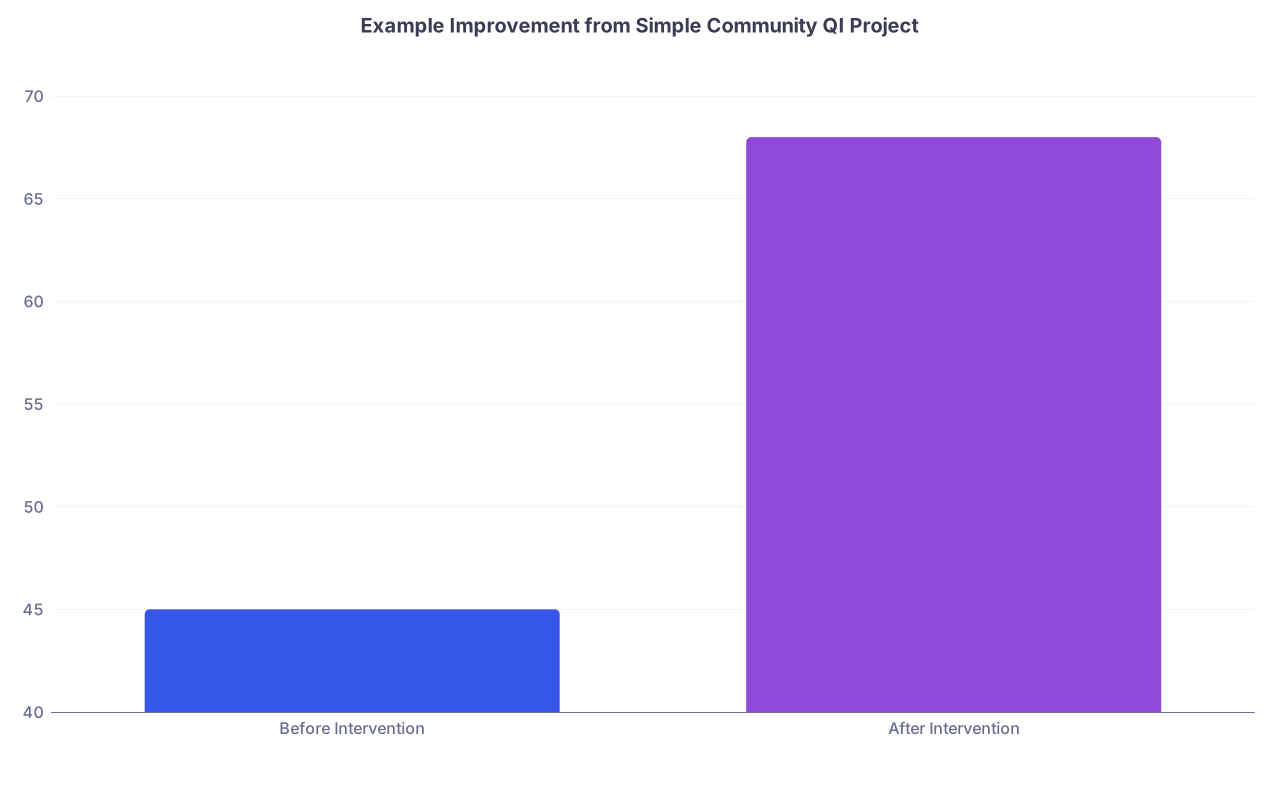
| Category | Value |
|---|---|
| Before Intervention | 45 |
| After Intervention | 68 |
(Imagine this is, for example, depression follow-up visit completion rates in a community psych clinic.)
7.2. Small Chart Review
If your attending has a clinical question they care about, you can propose something focused:
“You mentioned seeing many patients with uncontrolled hypertension who are not taking meds. Would you be interested in a small chart review looking at adherence patterns or barriers at this clinic? I could help with IRB and data collection.”
Keep it tight:
- 50–200 patients
- 1–3 primary outcomes
- No insane statistics; just descriptive data and maybe simple comparisons
Even if this never becomes a full publication, you still get:
- A line on your CV
- Evidence that you can complete a scholarly project
- Another angle for your letter writer to describe
Step 8: Document and Translate Everything into ERAS Language
It is not enough to “have good experiences.” You must translate them into application-friendly content.
8.1. Convert Actions to Bullets
For each community rotation, write 3–5 bullets like this in your own notes (later adapted for ERAS):
- “Independently saw and presented 8–12 outpatients per day in a high-volume community family medicine clinic, managing chronic disease, acute complaints, and preventive care under supervision.”
- “Led safety assessments and initial care plans for patients with suicidal ideation at a community psychiatry clinic, collaborating with social work and crisis teams.”
- “Performed basic office procedures including [list] on rotation at [site].”
- “Participated in coordinated care for underserved patients with complex social needs, including housing instability and limited transportation.”
You are describing responsibility, volume, and context.
8.2. Embed Community Experience in Your Personal Statement
If you are applying to a lower-competition specialty, a strong personal statement might revolve around a few anchor experiences — at least one from a community rotation.
Use one tight, specific anecdote:
- Set the scene (briefly)
- What was hard about the case?
- What did you personally do?
- What did it teach you about the specialty and the kind of physician you want to become?
Then connect:
“That rotation showed me that I want to train in a program that serves a diverse, often underserved population, where residents are trusted with real responsibility early, alongside close supervision. Community-based [specialty] programs offer exactly that environment.”
Now your community work is not “what I had to do because I could not get the university hospital.” It is a deliberate choice and a training preference.
Step 9: Use Community Attendings as Network Nodes
You are not just getting a letter and walking away. You are building a small professional network that may actually help you match.
Many community preceptors:
- Went through residency at programs you are targeting
- Know PDs or faculty at nearby hospitals
- Attend local or regional specialty meetings
- Have trained multiple students who are now residents at various programs
So you ask directly, but respectfully:
“I am strongly considering [Program A], [Program B], and [Program C] for [specialty]. Do you know anyone there, or have any advice about those programs or similar ones?”
If they say, “Oh yes, I know Dr. ___ at Program B,” your reply is:
“If you feel comfortable, would you mind reaching out or mentioning my name? I am very interested in programs like that, and I would appreciate any insight or informal connection.”
Do not expect miracles. But informal vouching from someone in the community is not nothing. Especially in lower-competition fields where PDs still talk and word-of-mouth matters.
Step 10: Fix Common Mistakes Students Make on Community Rotations
You want to avoid the behaviors I see over and over again that quietly sink applications.
10.1. Acting Bored or Above the Setting
Big red flag. Program directors in FM, psych, peds, community IM do not want residents who think community work is “lesser.”
If the patient volume is low one day, do not roll your eyes and scroll your phone. Use the downtime:
- Read about the last few patients you saw.
- Ask to review charts of “interesting” cases with your attending.
- Ask the nurse or MA how the clinic triages calls, handles medication refills, etc.
- Work on that small QI idea.
10.2. Hiding Weakness Instead of Asking for Feedback
You are not trying to look perfect; you are trying to look coachable.
Every 1–2 weeks, ask:
“What is one thing I should focus on improving over the next week? And is there anything I am doing particularly well that I should keep doing?”
Then implement. A good letter will say:
“By mid-rotation, I gave them feedback on X, and they immediately improved Y. By the end, they were functioning at the level of an intern in [specific context].”
That line alone can carry weight.
10.3. Waiting Until the Last Day to Ask for a Letter
Too late. They have already mentally filed you away.
You want the seeds planted early, as we covered. Then on the last or second-to-last day:
“Dr. X, I mentioned earlier that I was hoping for a strong letter if you felt you could write one. After working together these past weeks, do you still feel comfortable doing that?”
If they hesitate, accept it and move on. Better no letter than a lukewarm one.
Step 11: Align Your Community Experience with the Right Programs
Your endgame is matching. You want to connect what you did in community settings with the type of programs you apply to.
Look especially at:
- Community-based residencies
- University-affiliated but primarily community-serving programs
- Programs with explicit language about underserved care, continuity, and broad clinical exposure
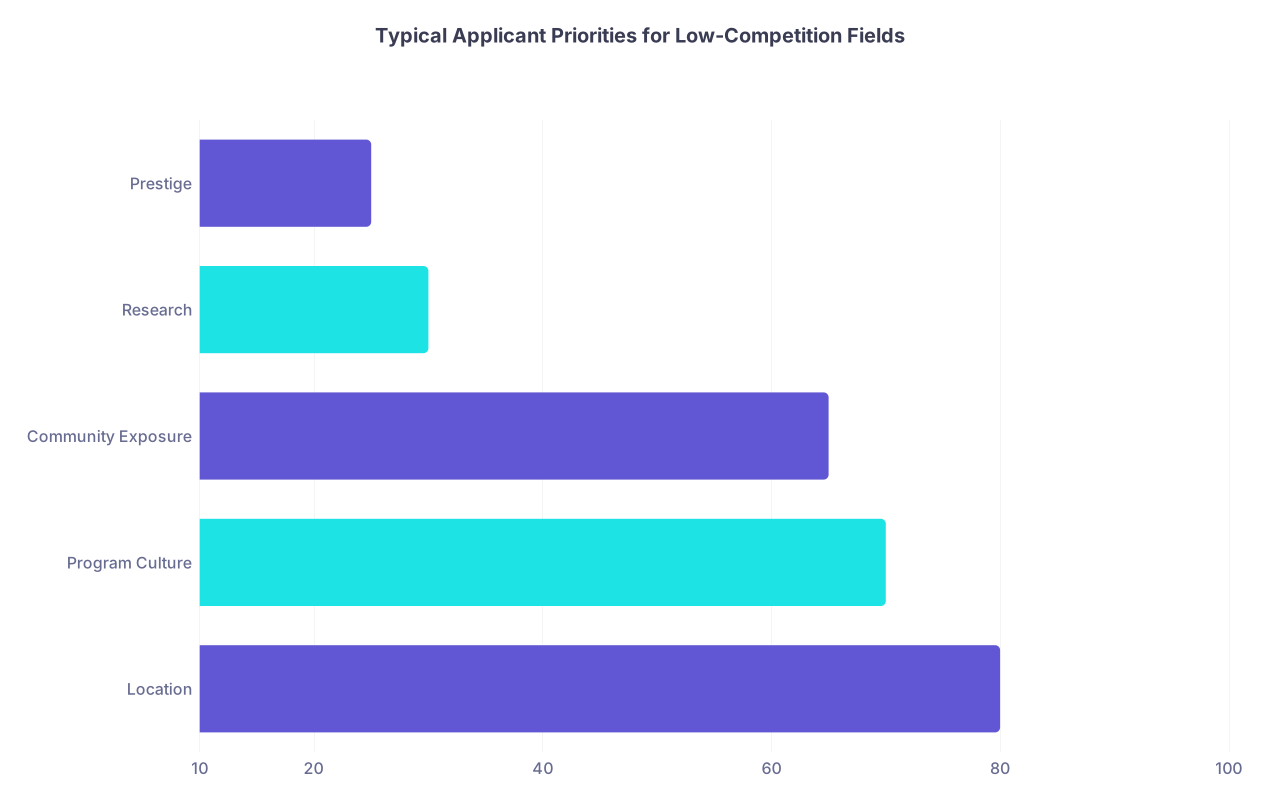
| Category | Value |
|---|---|
| Location | 80 |
| Program Culture | 70 |
| Community Exposure | 65 |
| Research | 30 |
| Prestige | 25 |
(Percentage of applicants who report each factor as “very important” when applying to less competitive specialties — approximate pattern many PDs report anecdotally.)
Tie your statements and interviews to what those programs value:
- “I want a program where residents run busy community clinics like the one I worked at in [town], with real responsibility for chronic disease management.”
- “I learn best in smaller teams where attendings know me well, like my community rotation where I worked with the same attending almost every day.”
You look like a good fit. Not someone who “settled.”
Step 12: Put It All Together During Interview Season
By the time interviews roll around, your community rotations should have given you:
- 1–2 strong, specific letters.
- A handful of strong patient stories.
- At least one small QI or scholarly project.
- Concrete skills and responsibilities you can rattle off.
- A clear sense of the practice environment you want.
Use them surgically in interviews:
- “Tell me about a time you managed a difficult patient interaction.” → Pick a community case.
- “What attracts you to our program?” → Reference your community rotation and how their program structure aligns.
- “How do you see yourself contributing here?” → Mention your QI project or team-based work at the community site.
You are no longer just another applicant with average scores applying to a “less competitive” specialty. You are the applicant who has already functioned in exactly the kind of setting these programs live in.

| Step | Description |
|---|---|
| Step 1 | Start Community Rotation |
| Step 2 | Signal Interest in Specialty |
| Step 3 | Take Intern Level Responsibility |
| Step 4 | Build Relationship with Key Attending |
| Step 5 | Log Cases and Skills Daily |
| Step 6 | Identify Simple QI or Project |
| Step 7 | Request Strong Letter with Specifics |
| Step 8 | Translate Experiences into ERAS Content |
| Step 9 | Leverage in Interviews and Program Fit |
Your Next Step Today
Do one concrete thing right now.
Open your calendar and pick one current or upcoming community rotation that aligns even loosely with the specialty you are leaning toward.
Then write down:
- The attending or site preceptor most likely to become a strong letter writer.
- One specific skill or responsibility you will ask for (e.g., “lead discharge summaries,” “do joint injections,” “run depression follow-ups”).
- One small, annoying clinic or workflow problem you have noticed that could become a QI project.
Tomorrow, go in and have a 5‑minute conversation with your attending:
“I am interested in [specialty]. I would like to take on more responsibility with [specific task] and, if possible, help with a small project related to [clinic problem]. Could we talk about how to make that happen over the rest of this rotation?”
That is how you stop “doing time” on community rotations and start building a stronger application in low-competition fields.