
You are sitting at your desk in late October. ERAS is submitted. You have a handful of interviews in a competitive specialty… and exactly zero invites after October 15th. Group chats are buzzing; classmates are posting “so grateful” screenshots. You are refreshing your email like it owes you money.
Your advisor casually says, “Have you thought about dual-applying? Maybe internal medicine or family, just as a backup.”
Your stomach drops. Because you know the stories:
- The applicant who “backed up” and then got no interviews in either field.
- The PD who questioned their commitment: “So… do you want my specialty or not?”
- The fear that by trying to be safe, you are actually sabotaging both options.
This article is about fixing that problem. How to use “easier” specialties strategically without lighting your primary specialty chances on fire.
I am going to walk you through a concrete dual-application strategy: when to do it, how to choose the right backup, how to structure your application materials, and how to talk about it without sounding flaky.
1. First Reality Check: Do You Actually Need to Dual-Apply?
Dual-applying is not automatically smart. Done wrong, it dilutes your story and confuses everyone. Done right, it is a controlled insurance policy.
You should seriously consider dual-applying if:
One or more of these are true:
- You are applying to a very competitive field:
- Dermatology
- Plastic surgery
- Neurosurgery
- Ortho
- ENT
- Radiation oncology
- Integrated vascular / CT / IR
- You have objective weaknesses that matter:
- You are a DO or international graduate targeting hyper-competitive fields
- You are geographically rigid (must stay in one city or narrow region)
- You are already in the late application cycle with red flags:
- Very few or no interview invites by November in a competitive specialty
- Not enough programs applied to in your primary field
If that is you, dual-applying may be the difference between:
- Matching into something you can live with
- Or scrambling/SOAPing into whatever is left
You probably should not dual-apply if:
- You are applying to:
- Internal medicine
- Pediatrics
- Psychiatry
- Family medicine
- Pathology
- Neurology
…and you:
- Have no major red flags
- Are willing to be geographically flexible
- Applied broadly and on time
In those cases, “backing up” inside the same specialty with:
- Community programs
- Less desirable locations
- Newer programs
…is usually enough.
Dual-application is a tool for asymmetric risk. Use it when the risk of not matching in your primary is high enough that a second specialty is justified.
2. Which “Easier” Specialty Makes Sense For You?
This is where people screw it up. They pick a backup that looks easy on paper instead of one that fits their profile and narrative.
Backup should be:
- Plausible for your background
- Logically connected to your interests
- Not so competitive that it is just a second way to fail
Rough competitiveness snapshot
No numbers are perfect, but directionally:
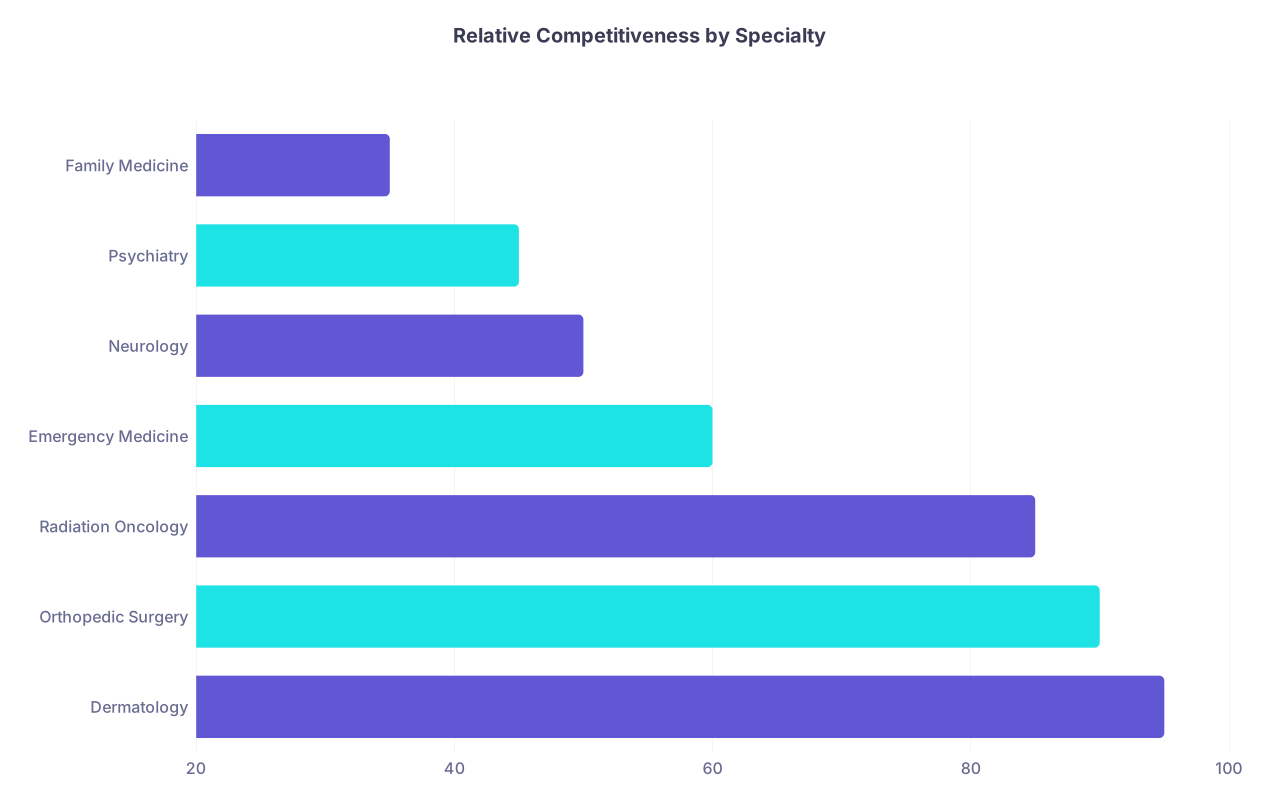
| Category | Value |
|---|---|
| Dermatology | 95 |
| Orthopedic Surgery | 90 |
| Radiation Oncology | 85 |
| Emergency Medicine | 60 |
| Neurology | 50 |
| Psychiatry | 45 |
| Family Medicine | 35 |
Interpretation:
- 80–100: Dangerous to rely on alone if you are not a top applicant.
- 50–70: Moderately competitive, good “backup” for some.
- <50: Often used as backup, but still requires a coherent story.
Common primary–backup pairings that actually work
These combos make narrative sense and are used all the time:
| Primary Specialty | Common Backup Option |
|---|---|
| Dermatology | Internal Medicine, Pathology |
| Ortho / Neurosurgery | General Surgery, PM&R |
| ENT / Plastics | General Surgery |
| IR / Vascular / CT | Diagnostic Radiology, IM |
| EM | IM, FM, Psychiatry |
| Anesthesiology | IM, Transitional Year, PM&R |
Use those as a starting point, not a script. You still need alignment with your own CV.
How to pick your backup specialty step-by-step
Inventory your strengths
- Clerkship honors in: IM? Surgery? Psych?
- Research: which department? What topic?
- Letters: from what specialties?
Look for natural connections
- Example: You are going for ortho
- You did well in surgery, have MSK research, like procedures.
- Backup that makes sense: General surgery, PM&R.
- Example: You are going for derm
- You like chronic disease management, outpatient, have IM letters.
- Backup that makes sense: Internal medicine, maybe pathology if you have any pathology exposure.
- Example: You are going for ortho
Eliminate bad fits
- Do not jump to family medicine if you have zero continuity clinic vibes and all your experience is trauma surgery. PDs will smell the desperation.
- Do not pick neurology as a backup for derm with absolutely no neuro exposure.
Sanity-check lifestyle and long-term reality
- Could you actually do this for 30 years?
- Backing up into something you will resent is a recipe for burnout.
If your backup choice cannot pass the “tell me why this specialty?” interview question without sounding like Plan B, it is the wrong choice.
3. The Core Problem: How Dual-Application Can Sabotage You
Let me be blunt. Program directors hate feeling like they are your safety school.
Common ways applicants sabotage themselves:
Generic, obviously copy-paste personal statements
- Same structure, just swapping “dermatology” with “internal medicine”
- Feels fake because it is
Letters that scream “this person is not sure”
- Faculty mention your interest in a different specialty
- Letter is lukewarm, generic, or clearly based on minimal interaction
Mixed signals in ERAS
- Activities, research, and honors all in one field
- Backup field shows up only in the personal statement and specialty selection
- PDs think: “So they settled for us.”
Disastrous interview answers
- “So, why psychiatry?”
- Applicant: “…I like talking to patients and, um, work-life balance.”
- Translation: “I did not match derm so now I am here.”
You fix this by designing your dual-application from day one instead of bolting on a backup specialty in panic mode in November.
4. Build Two Coherent Stories, Not One Watered-Down Story
If you want to dual-apply correctly, you need two distinct but believable narratives that share a core theme.
Step 1: Identify your core clinical theme
Examples:
- Loving procedures and anatomy
- Longitudinal patient relationships and chronic disease
- Diagnostic puzzles and pattern recognition
- Neurobiology and behavior
- Cancer care and oncology
This theme must:
- Fit your primary specialty
- Also fit your backup specialty
Example:
- Theme: “Complex chronic disease management and long-term relationships”
- Works for: Derm + Internal Medicine
- Theme: “Function, movement, and restoring physical ability”
- Works for: Ortho + PM&R
- Theme: “Critical decision making and acute care”
- Works for: EM + IM
Step 2: Write completely separate personal statements
You are writing two different essays, period.
For the primary specialty:
- Go all in
- Deep specialty-specific motivation
- Research and niche interests are fair game
For the backup specialty:
- Still authentic and positive
- Focus on the overlapping theme
- Avoid making it sound like a consolation prize
Bad backup PS line:
- “Although I initially considered dermatology, I realized internal medicine would also be a great fit.”
Good backup PS line:
- “My best days in medical school were on the inpatient medicine wards, managing complex patients over several days, adjusting therapy as their clinical picture evolved.”
Notice: You do not even mention the primary specialty in the backup PS. You present IM as a primary passion.
Step 3: Align your experiences differently for each field
Same activities, different framing.
Example: Research experience – “Biologic therapies in psoriasis”
- Derm PS: focus on skin disease, immunology, clinical trials in dermatology
- IM PS: focus on systemic disease, multi-organ implications, chronic disease management, immunology broadly
Same project, two angles.
5. Letters of Recommendation: The Most Dangerous Landmine
If anything will expose your dual-application and destroy credibility, it is sloppy letters.
Target structure for letters
For a serious dual-app:
- Aim for:
- 3+ letters in your primary specialty
- 2+ letters in your backup specialty
- 1 “universal” letter (e.g., IM or surgery attending who can apply to either, if appropriate)
Do not use a derm letter for internal medicine if:
- The entire letter is about your “promise as a dermatologist” and “future derm leader” Same in reverse.
How to ask for letters without sounding flaky
You can be honest and still sound committed.
Script example – applicant dual-applying Ortho (primary) and PM&R (backup):
“Dr. Smith, I am applying primarily to orthopedic surgery because of my interest in operative management of musculoskeletal disease. Given the competitiveness of the field and my Step 2 score, I am also applying to PM&R, focusing on rehab of MSK and neurologic conditions.
I truly valued my time on your PM&R service and felt I fit well with the team and patient population. Would you feel comfortable writing a strong letter specifically for my PM&R applications?”
You:
- Acknowledge reality
- Show you are not randomly backing up
- Ask for a letter custom to that specialty
Avoid these letter mistakes
- Re-using a letter that:
- References the wrong specialty
- Explicitly mentions your primary field when being uploaded to backup programs
- Having only primary specialty letters for a backup field → PDs assume they were your second choice and you did not invest in their area at all
- One-size-fits-all letters that do not mention any specialty → usually weak
6. ERAS Logistics: How to Structure a Dual-Application Properly
You cannot send entirely different ERAS applications. But you can control some key levers:
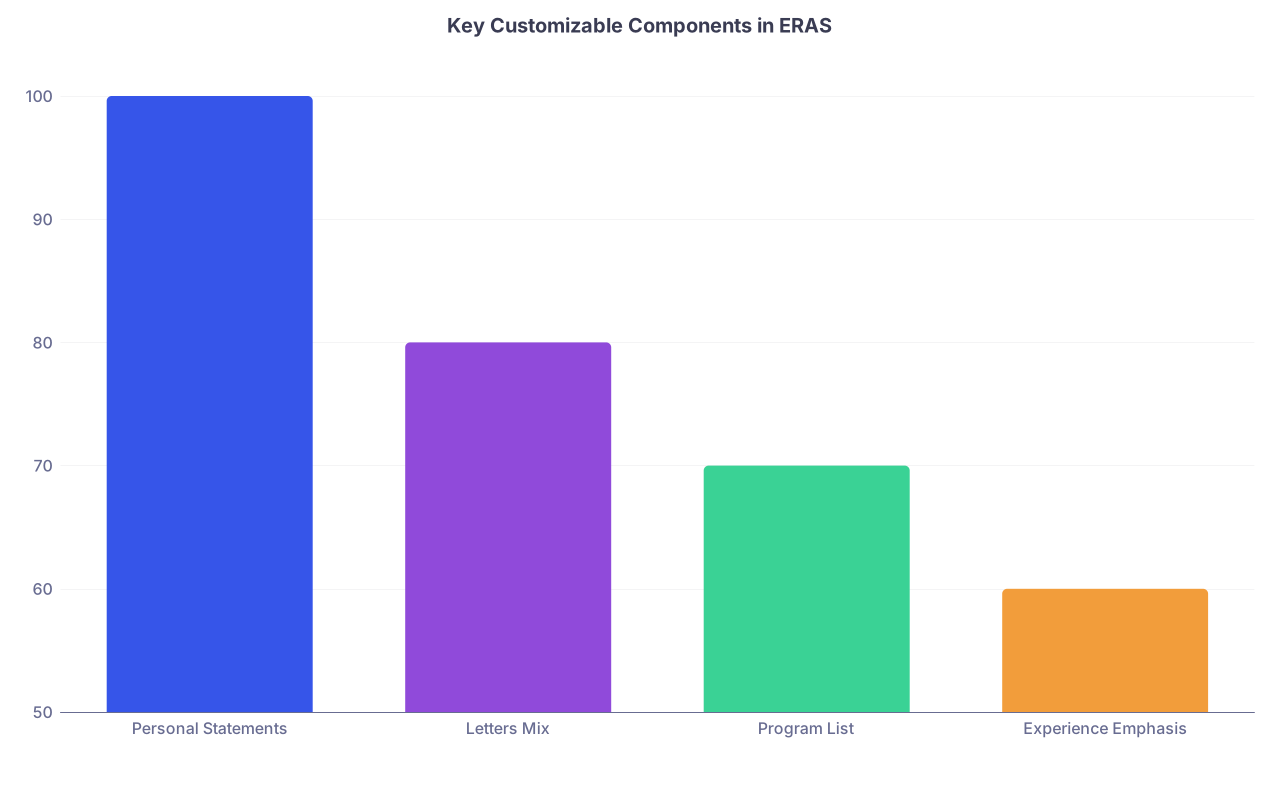
| Category | Value |
|---|---|
| Personal Statements | 100 |
| Letters Mix | 80 |
| Program List | 70 |
| Experience Emphasis | 60 |
What you can customize
-
- One PS per specialty
- Assign appropriately to programs
Letters
- You can choose which letters go to which program
- Build different letter sets:
- Derm set: 3 derm, 1 IM
- IM set: 2 IM, 1 sub-I, 1 research or derm-neutral
-
- Segment into:
- Primary specialty – broad list, including reaches and safeties
- Backup specialty – more realistic list, targeting programs familiar with dual-applicants or with broader intake
- Segment into:
Optional fields / secondary questions (where present)
- Some programs ask “Why this specialty/program?” in a supplemental form
- Tailor very directly; no generic fluff
What you cannot fully customize (and how to handle it)
Activities and experiences
- Same list goes everywhere
- Solution:
- Order and wording should reflect your true interests but not be so hyper-specific that backup specialty cannot interpret them
- Use neutral but accurate phrasing:
- Instead of: “Dermatology research – proving my passion for skin disease”
- Use: “Immunology and chronic inflammatory disease research in psoriasis patients”
Awards / memberships
- If you are in dermatology-specific or ortho-specific interest groups, fine
- Just avoid having literally nothing pointing toward your backup field
7. Numbers: How Many Programs Do You Actually Apply To?
Under- and over-applying are both problems. There is a usable middle.
Use your profile to set application volume
Very roughly:
- If you are a strong applicant for your primary:
- Apply primarily to that field (e.g., 60–80 programs in derm, 20–30 in backup IM)
- If you are borderline for your primary:
- 40–60 primary + 40–60 backup, depending on field
- If you are realistically unlikely to match primary (late realization, low Step, no research):
- Treat backup as near-equal or main: 20–30 primary (for a shot) + 80–120 backup in easier field
For example:
| Profile | Primary Specialty Apps | Backup Specialty Apps |
|---|---|---|
| Borderline Derm Applicant | 40–50 Derm | 60–80 IM |
| Strong Ortho, Mild Red Flags | 60 Ortho | 30 PM&R |
| Late Realization EM is Tough | 30 EM | 80 IM or FM |
This is not gospel. It is a framework. Adjust for geography, DO/IMG status, and school advising.
8. Interviews: How To Talk Without Exposing Plan B
This is where you either seal the deal or reveal that you are hedging.
Rule #1: At each interview, that specialty is your career. Period.
If you walk into a psychiatry interview, you are a future psychiatrist for that room.
You do not:
- Volunteer that you are dual-applying
- Mention your love for another specialty unless asked directly
You do:
- Answer every question as if this is your chosen path
- Show specific knowledge of that field’s issues, patients, and training structure
When they ask if you are dual-applying
Some will. Especially PDs in backup specialties.
You do not panic. You tell a controlled truth:
Example – dual-applying Derm (primary) + IM (backup), at an IM interview:
“Yes, I am also applying to dermatology. My long-standing interests are in complex chronic inflammatory disease and immunology. I found I genuinely enjoyed both inpatient medicine and outpatient subspecialty clinics.
I would be very happy training in internal medicine and see a clear path in this field—whether that is as a hospitalist with a focus on complex medical dermatology patients or as a subspecialist in rheumatology. I am applying here because I can see myself thriving in IM at your program.”
Key elements:
- You name the other specialty calmly.
- You articulate your theme: immunology and chronic disease.
- You make it clear that IM is not a consolation prize, but a path you can fully commit to.
When your primary specialty asks if you are dual-applying
More sensitive.
You have options:
Mild, honest version if you are not forced:
“I am focusing my applications on orthopedic surgery. Given the competitiveness of the field, I have also considered related areas such as PM&R that still center around musculoskeletal function. However, my clear first choice is to train as an orthopedic surgeon.”
If you are deeply worried about honesty vs optics, stick to this principle:
- Never lie.
- You do not need to volunteer unnecessary detail.
- Answer the question that was asked, briefly, then pivot to why you are sitting in that room.
9. Time and Energy Management: Not Burning Out Mid-Application
Dual-applying doubles some of your workload. You need a plan or you will drown in busywork.
Here is the smart order of operations:
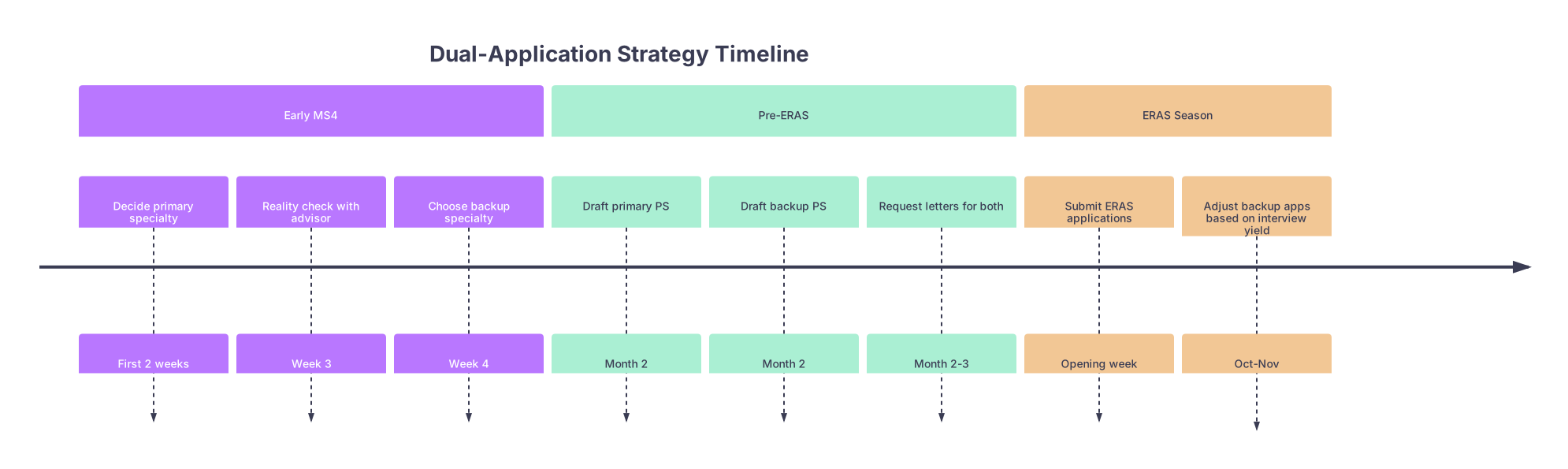
| Period | Event |
|---|---|
| Early MS4 - Decide primary specialty | First 2 weeks |
| Early MS4 - Reality check with advisor | Week 3 |
| Early MS4 - Choose backup specialty | Week 4 |
| Pre-ERAS - Draft primary PS | Month 2 |
| Pre-ERAS - Draft backup PS | Month 2 |
| Pre-ERAS - Request letters for both | Month 2-3 |
| ERAS Season - Submit ERAS applications | Opening week |
| ERAS Season - Adjust backup apps based on interview yield | Oct-Nov |
Practical steps to keep it controlled
Decide on dual-application early
- Ideally months before ERAS
- Late panic decisions are where you see sloppiness and sabotage
Front-load your writing
- Write both personal statements together
- Use the same core experiences so you are not reinventing your life twice
Batch email your letter writers
- Tell each exactly which specialty that letter is for
- Use a short, clear paragraph reminding them of concrete interactions with you
Track program lists with a spreadsheet
- Columns:
- Program name
- Specialty
- Region
- Status (applied / interview / rejection)
- PS version used
- Letter set used
- Columns:
Adjust on the fly based on interview yield
If by late October:
- You have solid traction in primary → do not expand backup list blindly
- You have weak traction in primary but strong in backup → shift focus, add more programs in backup field if still open
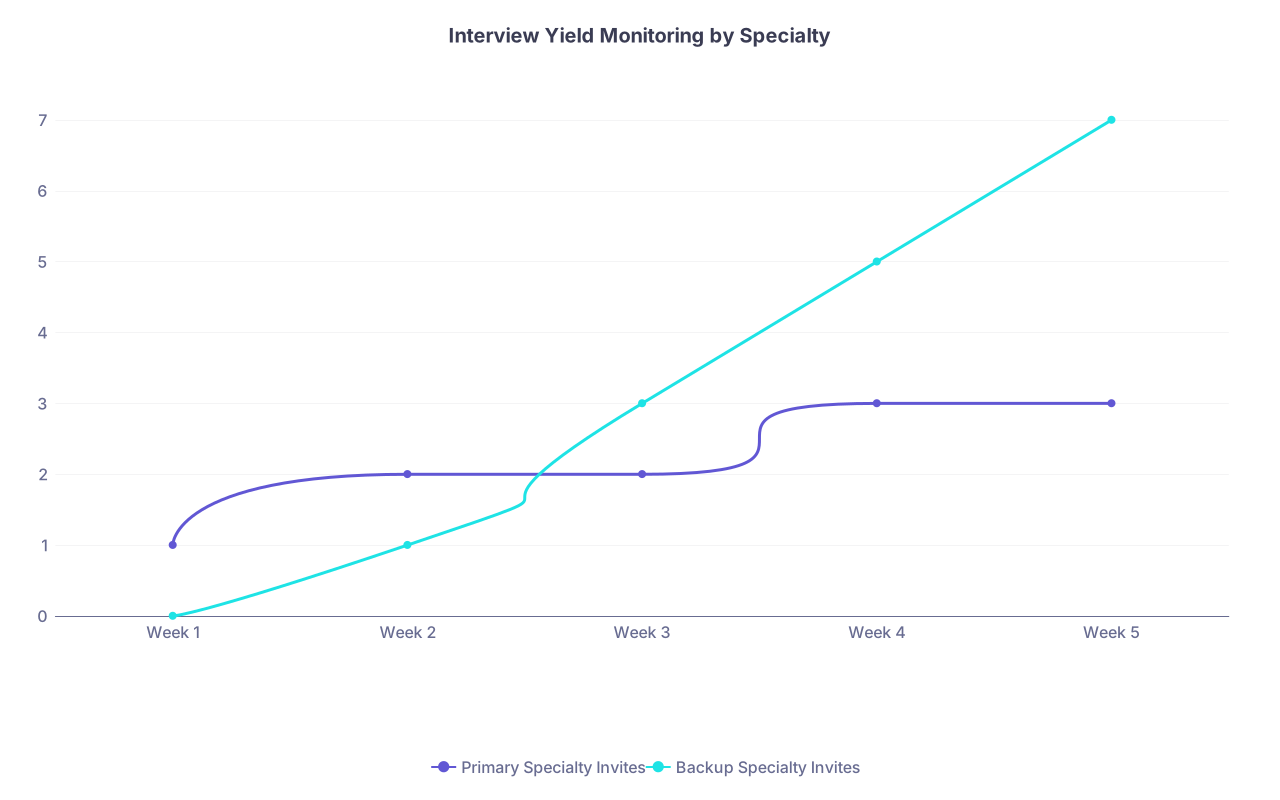
| Category | Primary Specialty Invites | Backup Specialty Invites |
|---|---|---|
| Week 1 | 1 | 0 |
| Week 2 | 2 | 1 |
| Week 3 | 2 | 3 |
| Week 4 | 3 | 5 |
| Week 5 | 3 | 7 |
You are not locked into your initial ratios. Adjusting based on data is smart, not disloyal.
10. Ranking: How Not To Sabotage Yourself at the End
You got through interviews. Now you have two piles of programs across two specialties. Rank time.
Key point: NRMP does not care if you dual-apply. The algorithm is applicant-favorable.
So:
- Rank programs in the true order of where you want to train, regardless of specialty label.
If your honest preference order is:
- Top derm program
- Mid-tier derm program
- Strong IM program
- Lower-tier derm program you disliked
- Community IM program
Then your list should reflect that. Do not:
- Artificially rank all derm programs above any IM out of ego
- Overthink game theory; the algorithm works best when you rank truthfully
However, be realistic:
- If a program seemed clearly uninterested, or you felt you would be miserable there, there is no obligation to rank it.
11. When Dual-Application Is a Red Flag – And How To Fix It
Sometimes, dual-applying does point to a real problem:
- You do not actually know what you want.
- You never got meaningful exposure to either field.
- You are running away from something (hours, procedures, emotion-heavy care) rather than choosing something.
If that is you, the fix is not just strategy. It is intentional exposure:
- Do a focused elective in your backup specialty before ERAS if possible.
- Shadow clinics or call with attendings in that field.
- Talk honestly with fellows and residents.
Even a few weeks of intentional exposure can:
- Sharpen your narrative
- Give you real stories and patient encounters to talk about
- Prevent you from ranking something that will make you hate your career

12. Concrete Example: Doing It Right
Let me walk you through a short, realistic case.
Student A:
- Wants dermatology.
- Step 2 CK: 233.
- One derm research project, one poster.
- From a mid-tier med school, no home derm program.
- Did not do away rotations due to late decision.
Advisor reality check:
- Derm match odds: not zero, but not high.
- Suggests dual-applying with internal medicine.
Strategy:
- Theme: Chronic inflammatory disease and longitudinal care.
- Applications:
- 45 derm programs.
- 70 IM programs (mix of academic and community, wide geography).
- Letters:
- Derm set: 2 derm attendings (research + elective), 1 IM attending from third-year clerkship.
- IM set: 2 IM attendings, 1 derm attending who writes a content-neutral letter emphasizing work ethic and clinical reasoning (no “future dermatologist” line).
Personal statements:
- Derm PS: deep dive into psoriasis clinic, research, love of derm pathology, outpatient continuity.
- IM PS: emphasizes experience on general medicine wards, difficult diagnostic cases, and love for managing comorbidities in patients with inflammatory diseases, one sentence mentioning interest in possibly collaborating closely with dermatology/rheumatology in the future.
Interviews:
- Derm: 4 interviews, acts as if dermatology is her clear path. Does not mention dual-applying unless asked directly (and if asked, states IM is a related area of interest, but derm is primary goal).
- IM: 12 interviews. When asked, she acknowledges derm applications and clearly explains why she would be happy long-term in IM, potentially sub-specializing in rheumatology or allergy/immunology.
Rank list:
- 4 derm programs in true preference order.
- Then IM programs, with academic IM programs she liked best above community programs she liked less.
Outcome:
- Does not match derm.
- Matches at a solid academic IM program on her list.
- Ends up pursuing rheumatology fellowship with a strong immunology focus. Totally coherent career.
Did dual-application hurt her? No. It got her a good match instead of SOAP chaos.

Bottom Line
Three things to keep front and center:
Dual-application is a power tool, not a default. Use it when your primary specialty is truly high-risk for your profile, and pick a backup that logically fits your experiences and long-term interests.
You must build two real stories, not one watered-down narrative. Separate personal statements, targeted letters, and a clear clinical theme that makes both specialties believable for you.
At each interview, you are “all in” for that specialty. Never lie, but do not volunteer chaos. Answer questions cleanly, present each field as a path you can fully commit to, and rank programs in your true order of preference.
Do that, and you can use “easier” specialties as a safety net without cutting your own primary specialty rope in the process.