
The way most students pivot specialties is backwards and sloppy. You are going to do it like a surgeon: deliberate, controlled, and on a clear timeline.
You are late in MS3 or early MS4, your dream specialty is either unrealistic or no longer appealing, and now you are staring down the question: How do I pivot into a less competitive specialty without blowing my chances entirely?
Here is the answer, step by step.
Step 1: Get Real About Your Starting Point
Before you pivot, you need a brutally honest inventory. No fantasies. No “maybe my away rotation will impress them” thinking.
You are answering one question: What doors are actually still open for me?
Do this in three parts.
1.1 Know your hard numbers
Write these down in one place:
- Step 1 result (Pass / Fail, and school quartile if known)
- Step 2 score (or practice scores if not taken yet)
- Core clerkship grades (especially IM, Surgery, FM, Psych)
- Class rank / quartile if your school uses it
Now categorize your competitiveness for top specialties, just to be honest with yourself:
| Category | Step 2 | Clerkships | Class Rank |
|---|---|---|---|
| Strong | ≥ 245 | Mostly H | Top 25% |
| Middle | 230-244 | Mix H/HP | 25–75% |
| At Risk | < 230 | Many P | Bottom 25% |
If you are in “at risk” by any two of those columns, chasing something like ortho, derm, plastics, ENT, or neurosurgery as a last-minute pivot is fantasy.
That is fine. You do not need those to have a good career. But you do need to accept it fast so you can execute a better plan.
1.2 Understand what went “wrong”
You are not doing this for therapy. You are doing it to design a strategy.
Ask:
- Did you:
- Decide late that you hate your original choice?
- Miss the scores for your target specialty?
- Realize lifestyle or personality mismatch?
- Get poor clinical evals in a key clerkship?
Your pivot approach changes depending on which of these is true.
Example:
- You thought you wanted surgery, got mid 220s Step 2, hated the hours, and realized on IM that you love thinking but not operating. That is a perfect candidate for IM, neurology, PM&R, or psych.
- You aimed for dermatology, did no sub-I’s outside medicine, and barely passed some rotations. Now you need a specialty that is more forgiving and values personality and fit heavily: FM, psych, neurology, prelim IM + later pivot, etc.
1.3 Nail down your true constraints
List hard constraints:
- Must stay in a certain region? (partner job, kids, visa, family)
- Need a more controllable lifestyle?
- Must match in one cycle (no interest in SOAP / reapply)?
- Visa status (IMG with no green card vs US citizen)?
These matter. Family medicine may be wide open in many parts of the US but tight in a few big cities. Psych may be “less competitive” overall but absolutely brutal in Manhattan and San Francisco.
Step 2: Pick Target Specialties That Actually Fit Your Profile
Forget Reddit rumors. Look at what programs actually fill with.
Here are common “less competitive” specialties that are realistic pivots for many MS3/MS4s:
| Specialty | Overall Competitiveness | Key Advantages |
|---|---|---|
| Family Medicine | Low–Moderate | Many spots, broad geography |
| Internal Medicine (Community) | Moderate | Hospital-based, good fellowship options |
| Psychiatry | Low–Moderate | Growing need, lifestyle friendly |
| Pediatrics (Community) | Low–Moderate | Predictable hours, kid-focused |
| Neurology | Moderate (rising) | Cognitive specialty, mix of inpatient/outpatient |
Does this mean these specialties are “easy”? No. Good programs in good cities still screen hard. But if you plan correctly, you can go from “I am screwed” to “I matched at a solid place” in one cycle.
2.1 Translate your background into the new specialty
You need a story that makes sense. Programs want to see:
- Your pivot is logical, not random panic.
- You understand what the specialty looks like in real life.
- You have some focused exposure, even if short.
Examples:
- Surgery → IM: “I loved managing post-op patients, the hemodynamics, the complex medicine. I realized I was more drawn to solving the underlying physiology than operating itself.”
- Derm → FM: “I enjoyed longitudinal care, prevention, and managing multiple chronic conditions. I see primary care as the front line where I can still use my derm interest but with broader impact.”
- Radiology → Psych: “I valued the intellectual puzzle, but I missed patient interaction. In psych, I still solve complex diagnostic problems but remain closely connected to patients over time.”
Write down your own 3–4 sentence “pivot story” now. You will re-use it constantly—for your personal statement, interviews, emails.
2.2 Reality-check target specialties against your numbers
Use a simple litmus test:
- Step 2 < 225 and many Pass clerkships:
- Strongly consider: FM, psych, pediatrics, some community IM.
- Step 2 225–240, mixed HP/P:
- Solid shot: Most community IM, psych, FM, peds, many neurology.
- Step 2 > 240, decent evaluations:
- You can aim a bit higher in each of these (university or academic programs) but do not get cocky.
Step 3: Immediate Timeline – What You Must Do in the Next 4–8 Weeks
This is where most people screw it up. They pivot mentally but do not change their schedule, letters, or narrative fast enough.
Here is your immediate 4–8 week action plan.
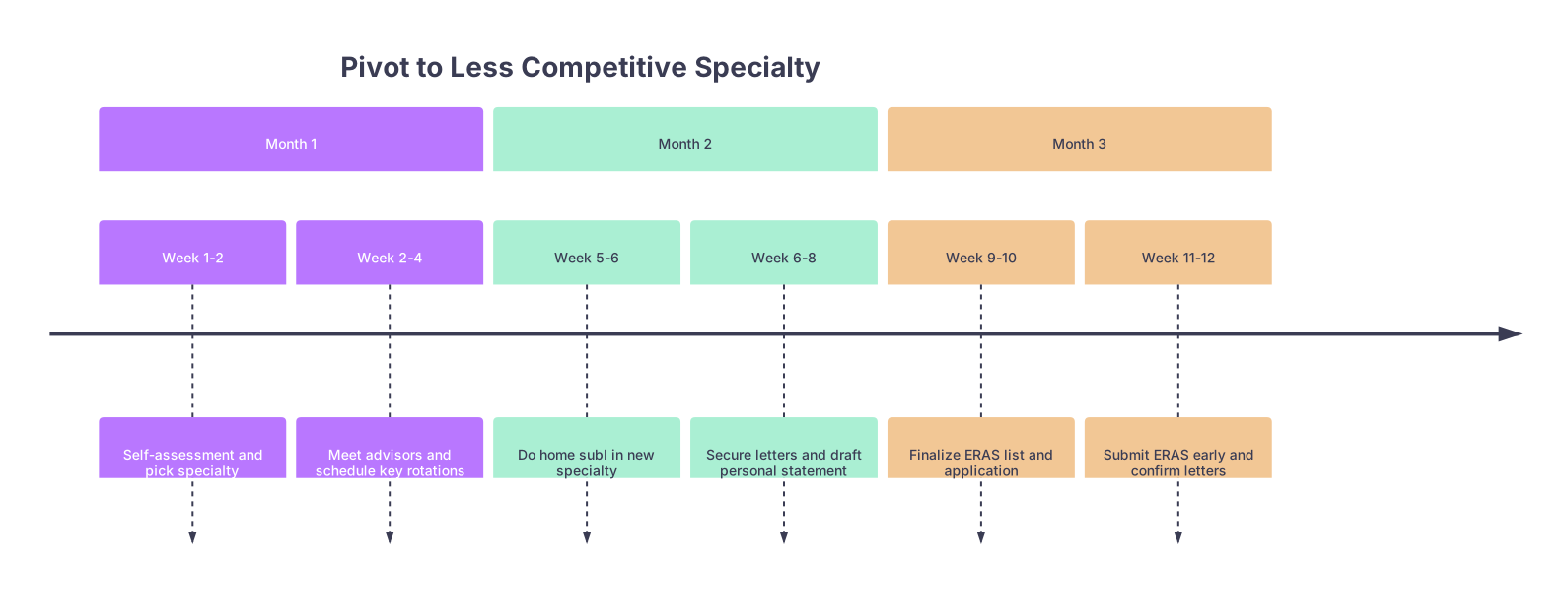
| Period | Event |
|---|---|
| Month 1 - Week 1-2 | Self-assessment and pick specialty |
| Month 1 - Week 2-4 | Meet advisors and schedule key rotations |
| Month 2 - Week 5-6 | Do home subI in new specialty |
| Month 2 - Week 6-8 | Secure letters and draft personal statement |
| Month 3 - Week 9-10 | Finalize ERAS list and application |
| Month 3 - Week 11-12 | Submit ERAS early and confirm letters |
3.1 Lock in rotations that signal commitment
You want at least:
- 1 home sub-internship / acting internship in the target specialty.
- 1 additional elective or inpatient block touching that specialty.
If it is late and your schedule is rigid, then:
- Choose the closest possible option:
- For psych: CL (consult-liaison) psych, inpatient psych, addiction.
- For IM: hospitalist rotation, ICU, cardiology, any strong inpatient block.
- For FM: outpatient primary care clinic, community health center.
- For peds: general peds ward, outpatient peds clinic.
Then you tell programs clearly in your application: “Once I realized X, I rearranged my schedule to prioritize Y.” They want to see you changed course on purpose.
3.2 Identify 3 letter writers fast
Your letters matter more than you think in a pivot. They compensate for limited time in-field.
Your ideal 3:
- One strong letter from the new specialty (home institution attending, preferably from a sub-I).
- One strong letter from a core clerkship in a related field that went well.
- Department chair / program director letter in the new specialty (often required for IM/FM/psych).
If you do not yet have #1: then your current goal on that next rotation is singular—crush it and secure that letter. Be the reliable, prepared, present student. Show early interest, ask for feedback, fix issues quickly.
3.3 Meet with two categories of advisors
Do not skip this. One meeting can shift your entire strategy.
You want:
- An official advisor in your new specialty (clerkship director, APD, PD).
- An unofficial “truth teller” (attending who knows you, recent grad, chief resident).
Ask very specific questions:
- “With my Step 2 of X and these clerkship grades, how many programs should I apply to in this specialty?”
- “What mix of academic vs community programs should I aim for?”
- “Do you think I need a back-up specialty? If so, which one is realistic?”
Write down their numbers and then round them up by 10–20%. You are not optimizing for cost savings. You are optimizing for not spending a year in limbo.
Step 4: Build a Coherent Pivot Narrative in Your Application
You have three main tools: personal statement, experiences section, and letters. Together, they must tell the same story.
4.1 Reframe your prior experiences
You do not need specialty-specific research or a perfect CV. You need consistency.
Take every major experience and ask: “How can I connect this to my new specialty’s core values?”
- Family Medicine:
- Emphasize continuity, prevention, patient education, underserved work, primary care clinics, longitudinal projects.
- Internal Medicine:
- Emphasize complex problem-solving, inpatient care, multi-morbidity management, ICU or wards experiences.
- Psychiatry:
- Emphasize communication skills, empathy, motivational interviewing, addiction work, crisis response, mental health exposure.
- Pediatrics:
- Emphasize work with children, teaching, patience, family dynamics, advocacy.
Example: You did 2 years of basic science research in renal physiology. For IM or FM you present it as: understanding chronic disease at a mechanistic level, persistence, attention to detail.
4.2 Write a personal statement that makes sense
Stop trying to be poetic. You are solving three tasks:
- Explain why you chose this specialty (clear, specific reasons).
- Show that your background logically leads here.
- Demonstrate that you understand the real work of this field.
Structure:
- Opening: Brief clinical moment or realization that triggered the pivot.
- Middle: Concrete experiences that built your interest and skills (rotations, jobs, projects).
- Pivot explanation: 1–2 clear paragraphs about how and why you changed direction.
- Closing: What you want in residency and future goals.
One line you absolutely should include somewhere:
“I am fully committed to a career in [specialty].”
Programs are sick of feeling like your back-up. Say the words.
Step 5: Target Programs Strategically, Not Emotionally
This is where nervous students burn themselves. They throw applications at name-brand programs they have no shot at while under-applying to realistic places.
5.1 Use data and reason, not ego
You can roughly break programs into tiers for your pivot specialty:
| Tier | Type of Program | For a Late Pivot Applicant |
|---|---|---|
| 1 | Top academic, big-name cities | Apply only if numbers are strong |
| 2 | Mid-level university / strong community | Core target for most pivots |
| 3 | Community, smaller cities / rural | Safety net and realistic base |
If you are pivoting into a less competitive specialty with mid scores:
- 20–30% Tier 1–2 (if advised reasonable).
- 40–60% Tier 2.
- 30–40% Tier 3.
If your Step 2 is low (< 225) or you have multiple failures / remediation:
- Majority Tier 3.
- Some Tier 2 if an advisor thinks you have a shot.
- Very limited Tier 1 (and only with strong connections).
5.2 Apply broadly enough
Typical ranges for less competitive specialties (US MD / DO, late pivot, average risk):
- FM: 25–60 programs
- Psych: 30–60 programs
- IM (non-competitive targets): 40–80 programs
- Peds: 25–50 programs
- Neurology: 30–60 programs
Increase the upper end if:
- You are regionally restricted.
- You have visa issues.
- You have academic red flags (failures, remediation, leaves).
Step 6: Fix or Contain Your Red Flags
Most pivoters have at least one: low score, failed exam, poor evals, gap year, change of specialty. Your job is to control the damage.
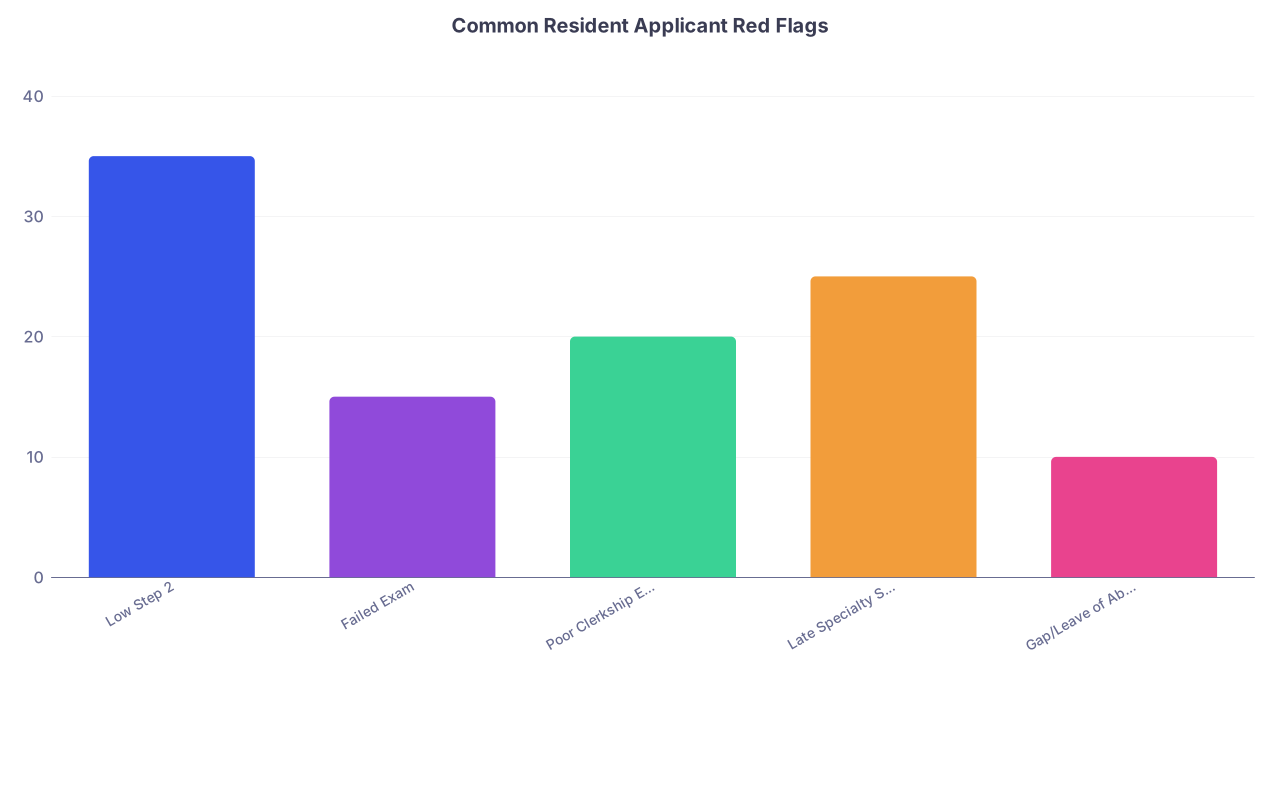
| Category | Value |
|---|---|
| Low Step 2 | 35 |
| Failed Exam | 15 |
| Poor Clerkship Eval | 20 |
| Late Specialty Switch | 25 |
| Gap/Leave of Absence | 10 |
6.1 Low Step 2 or failed exams
Action steps:
- Make sure any later exams or shelf scores trend upward. You need proof of improvement.
- Have an attending mention explicitly in a letter that you are clinically strong and safe.
- Be prepared with a concise explanation: what went wrong, what you changed, and evidence it is now better.
Bad: “I just had a bad day.”
Better: “I underestimated the exam, overscheduled myself clinically, and did not use question banks effectively. Since then I have…” followed by what changed.
6.2 Poor clerkship evaluations
If your bad evals are in your old specialty, that is actually salvageable.
In your MSPE and letters, you want:
- Strong comments from your new specialty rotations.
- A clear pattern of reliability and teamwork going forward.
If you had professionalism issues, you must show a consistent pattern of the opposite over time: no late notes, no missed pages, good feedback from nurses, etc. Programs will call your school informally. You cannot fake this.
6.3 Late specialty change
You do not hide this. You own it.
Tell interviewers:
- What led you to reconsider.
- How you explored other options.
- What experiences sealed your decision.
- What you did after deciding (rotations, meetings, reading, projects).
If you sound panicked or uncertain, they will assume you might try to jump ship later.
Step 7: Behave Like the Strongest Applicant on Every Rotation
Your best leverage point in a pivot is recent clinical performance. You cannot rewrite your Step score. You can absolutely rewrite your clinical reputation.
On your new specialty rotations:
- Show up early, leave late, but more importantly: be useful.
- Know your patients cold. Labs, imaging, meds, overnight events.
- Volunteer for tasks that make residents’ lives easier (calls, notes, tracking consults).
- Ask for feedback in week 1–2: “What can I do differently to function more like an intern on this team?”
Then apply what they tell you. Same rotation, visible improvement. Residents talk. PDs listen.
Step 8: Interview Season – Convince Them You Are Not Just “Settling”
This is where many pivoters sabotage themselves. They act like they are interviewing for their second choice. Programs feel it immediately.
Your goal: walk in talking and acting like this is exactly where you want to be.

8.1 Prepare specific answers to predictable questions
You will be asked:
- “Why [specialty]?”
- “Tell me about your path to choosing this field.”
- “Did you consider any other specialties?”
- “Why did you switch from [previous interest]?”
Bad answer:
“I did not match into X so now I am applying to Y.”
Good answer pattern:
- You were initially attracted to X because of A, B, C.
- On core rotations, you realized parts of X were compelling, but you were missing D/E that you found in Y.
- Concrete examples from Y that energized you or fit your strengths.
- Clear statement of commitment to Y now and long-term.
8.2 Emphasize what you bring because of your past interest
If you are pivoting from a more competitive or different specialty, sell the overlap, not the failure.
Examples:
- Surgery → IM:
- Fast-paced inpatient experience, comfort managing acutely ill patients, understanding perioperative care.
- Radiology → Psych:
- Strong analytic reasoning, pattern recognition, comfort with uncertainty, systematic diagnostics.
- Derm → FM:
- Visual diagnosis skills, comfort managing chronic diseases, patient education about prevention.
You are not damaged goods. You are someone with a broader perspective. Act like it.
8.3 Close interviews clearly
At the end, say something direct:
- “I am very excited about a career in [specialty]. The more exposure I have had, the more certain I have become this is the right field for me.”
- “If I train here, I see myself contributing in [specific way tied to their program strengths].”
Programs remember clarity. They forget vague talk quickly.
Step 9: Decide Whether You Need a Back-Up Plan
Not everyone needs a dual-application or SOAP plan. But some of you absolutely do.
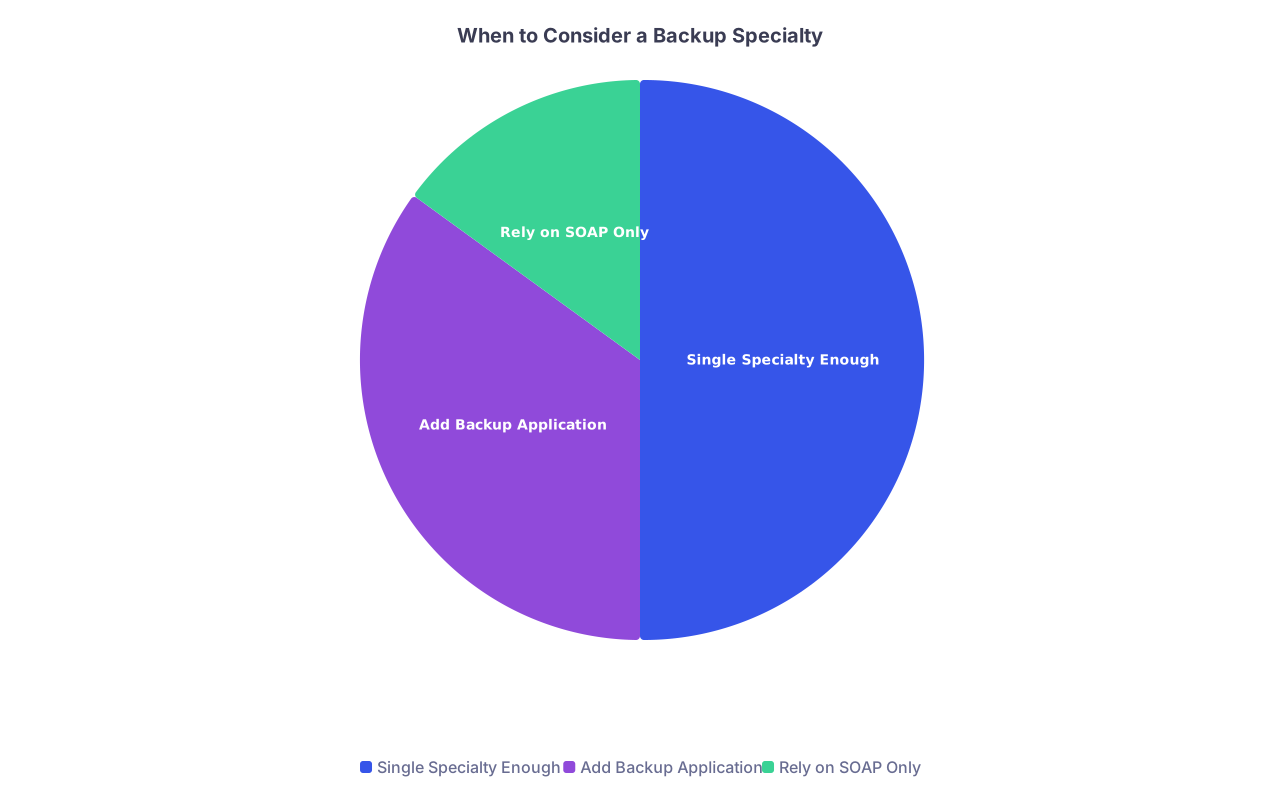
| Category | Value |
|---|---|
| Single Specialty Enough | 50 |
| Add Backup Application | 35 |
| Rely on SOAP Only | 15 |
You should consider a formal backup application if:
- You have multiple exam failures.
- Step 2 is significantly below the mean for even your “less competitive” field.
- You are an IMG with constraints and weak scores.
- Advisors at your school are clearly nervous when you tell them your primary plan.
Options:
- Primary: IM; Backup: FM or Psych.
- Primary: Psych; Backup: FM.
- Primary: Peds; Backup: FM.
Dual applying raises workload but can save your year. The trick is:
- Do not half-commit to both.
- Choose a primary. Choose a realistic backup. Build honest but slightly different narratives for each.
- Work closely with your dean’s office so your MSPE does not look confused or contradictory.
Step 10: Keep Moving Forward Even If It Feels Like You “Missed Out”
A lot of late pivoters carry this quiet grief: “I failed at my dream field.” If you drag that attitude into interviews and residency, it will poison you.
Here is the unvarnished reality: Many residents in high-lifestyle, high-pay specialties are miserable. Many in so-called “less competitive” fields have outstanding careers, autonomy, and frankly better day-to-day lives.

Three practical ways to reframe:
Follow the opportunity within the field.
In IM, that might be cardiology or hospitalist leadership. In FM, it might be sports medicine, procedures, or community leadership. In psych, interventional psychiatry or addictions.Remember your leverage grows over time.
Your specialty choice matters. But your post-residency niche, reputation, and local market matter more for actual quality of life.Control what you can: training quality and your attitude.
A motivated resident in a mid-tier program often comes out better prepared than a checked-out resident in a top-name place.
Quick Visual: Pivot Strategy Overview

| Step | Description |
|---|---|
| Step 1 | Realistic Self Assessment |
| Step 2 | Choose New Specialty |
| Step 3 | Reschedule Rotations |
| Step 4 | Secure Letters |
| Step 5 | Craft Pivot Narrative |
| Step 6 | Apply Broadly |
| Step 7 | Interview With Clear Commitment |
| Step 8 | Match and Build Career |

The Bottom Line
Three points to keep in your head:
- A late pivot is not a death sentence, but it punishes indecision. Decide quickly, then align your rotations, letters, and narrative around the new field.
- Own your story. Programs forgive low scores and late switches more than they forgive vagueness, denial, or obviously half-hearted interest.
- Execute like a professional, not a panicked student. Build a realistic program list, work like an intern on your new specialty rotations, and walk into every interview acting like you belong in that field—because if you follow this plan, you will.