
Most people choose between two backup specialties the wrong way: they obsess over vibes and ignore cold, structural reality.
You cannot afford that mistake.
If you are choosing between two “backup” specialties—especially among the least competitive ones—you need a structured, almost ruthless process. Not another round of late‑night Reddit threads and hand‑waving about “work–life balance.”
Here is the reality:
- Many students pick a backup on feel, then discover late that the job market is saturated.
- Others pick solely on “ease to match,” then hate the day‑to‑day work and burn out.
- Some straddle two specialties so long that both applications end up weak.
You are going to do something different. You are going to treat this like a clinical problem: gather data, apply a framework, decide, and commit.
1. Understand What “Backup Specialty” Really Means
“Backup” does not mean “throwaway.” It means:
A specialty you would genuinely be willing to practice long‑term, which is less competitive than your primary target and more likely to yield a match.
If you cannot honestly say, “I can see myself doing this for 20–30 years,” it is not a backup. It is a future career regret.
Most common backup specialties in the “least competitive” bucket, depending on year and market:
- Family Medicine (FM)
- Internal Medicine (IM) categorical (non‑prestige programs)
- Pediatrics
- Psychiatry (this is getting more competitive in some regions)
- Pathology
- Physical Medicine & Rehabilitation (PM&R)
- Neurology
- Some community Transitional Year / Prelim programs (as routes into something else, though these are not true final specialties)
Let me be blunt. There is no universally “safe” specialty anymore. Even the historically least competitive fields can tighten up in certain cities or cycles. So your backup choice must be strategic, not lazy.
2. The Four‑Pillar Framework: How to Compare Two Backup Specialties
You are choosing between two options. Let’s call them Specialty A and Specialty B. Stop thinking in slogans (“Psych has better lifestyle”) and instead run both through four pillars:
- Fit – Day‑to‑day work, patient population, cognitive vs procedural, your temperament.
- Match Probability – How likely you are to match in that specialty with your profile.
- Training Experience – Residency length, call structure, culture.
- Post‑Residency Reality – Job market, location flexibility, compensation, burnout risk.
You need all four. People often over‑weight Fit and under‑weight Job Market. Or they see Match Probability and ignore that the specialty’s employment prospects are terrible where they want to live.
Use this as the core comparison tool.
| Pillar | Specialty A | Specialty B |
|---|---|---|
| Fit (1–10) | ||
| Match Probability | ||
| Training Experience | ||
| Post-Residency Reality |
You will fill this, but not from your gut. You are going to collect actual data first.
3. Step 1 – Get Brutally Honest About Your Profile
Before looking outward at specialties, you need to know what you are bringing to the table.
Make a one‑page “Applicant Snapshot”:
- USMLE/COMLEX:
- Step 1: Pass / Fail (old score if relevant)
- Step 2 CK / Level 2 score
- Class rank / quartile / AOA status (if applicable)
- Red flags:
- Exam failures
- LOA
- Fails in core clerkships
- Unexplained CV gaps
- Specialty‑relevant experiences:
- Rotations and grades in FM/IM/Peds/Psych/etc.
- Letters of recommendation already secured
- Research in those fields
- Longitudinal clinic or meaningful exposure
Now, be explicit: are you a strong, average, or weak candidate for least competitive specialties?
- Strong: No red flags, solid Step 2 (≥ ~230–235+ for US MD, slightly higher bar for IMGs), good clinical comments, some related experiences.
- Average: Some minor concerns (average scores, not much research, limited exposure) but no major red flags.
- Weak: Exam failure, low Step 2, poor clinical performance, late specialty switch with zero aligned experiences, or IMG with very limited US experience.
This matters because “backup” specialties are not a free pass. I have watched students with 2–3 red flags miss FM and Psych matches in competitive cities, then act shocked because they thought “FM always takes everyone.”
Reality check: it does not.
4. Step 2 – Define Your Non‑Negotiables
Before diving into program lists and compensation tables, you need to decide what you refuse to compromise on. If you skip this, you will chase the “easier match” and then be miserable later.
Take 10–15 minutes and answer, in writing:
Geography
- “I must be within 2 hours of ___” or
- “I am willing to move anywhere for training if the career fits.”
Procedural vs Cognitive
- Do you want your hands on procedures daily (lines, scopes, injections)?
- Or are you happier with mostly talking, thinking, prescribing?
Age & Patient Population
- Kids only? Adults only? Comfortable with geriatrics? Psych-heavy? Complex multi‑comorbidity?
Shift vs Continuity
- Do you want clinic continuity (seeing the same patients for years)?
- Or shift‑based life (ED, hospitalist‑like, night float chunks)?
Lifestyle / Call Tolerance in Training
- Can you handle q4 overnight call?
- Or do you know that level of sleep disruption will wreck you?
Long‑term Identity
- Can you confidently introduce yourself as “a psychiatrist,” “a pediatrician,” “a pathologist” without cringing?
Write your answers. Then rank your top three non‑negotiables. When we evaluate your two backup options, anything that violates those top three is a problem, no matter how “easy” the match looks.
5. Step 3 – Structural Data: Match Chances and Pipeline
Now you look at the specialties themselves with a cold eye. You are comparing two specific fields, so let’s walk through what to check, using an example: FM vs Psychiatry, or IM vs Neurology. The process is identical.
5.1 Use Real Match Data
Pull the latest NRMP “Charting Outcomes” and “Program Director Survey.” You are looking for:
- Median Step 2 scores for matched applicants
- Percentage of independent applicants (IMGs, DOs where relevant) who matched
- Average number of contiguous ranks needed to match in each specialty
- Program director “consideration” factors (USMLE importance, LORs, etc.)
Then ask:
- With your Step 2 score, where do you land relative to the median and 25th percentile for each specialty?
- If you are an IMG or DO, what are the match rates for your category?
If you consistently sit below the 25th percentile in one specialty compared to another, that is a red flag for using it as a “backup.”
5.2 Look at Program Volume
How many positions exist nationally in each specialty?
Family Medicine and Internal Medicine have far more positions than, say, PM&R or Pathology. More positions = slightly more buffer. But program volume does not automatically mean you will match in your preferred city.
Cross‑check where the programs are. Many FM and Psych positions are in smaller cities or rural regions. If you are rigid on large coastal cities only, your real “backup safety” shrinks.
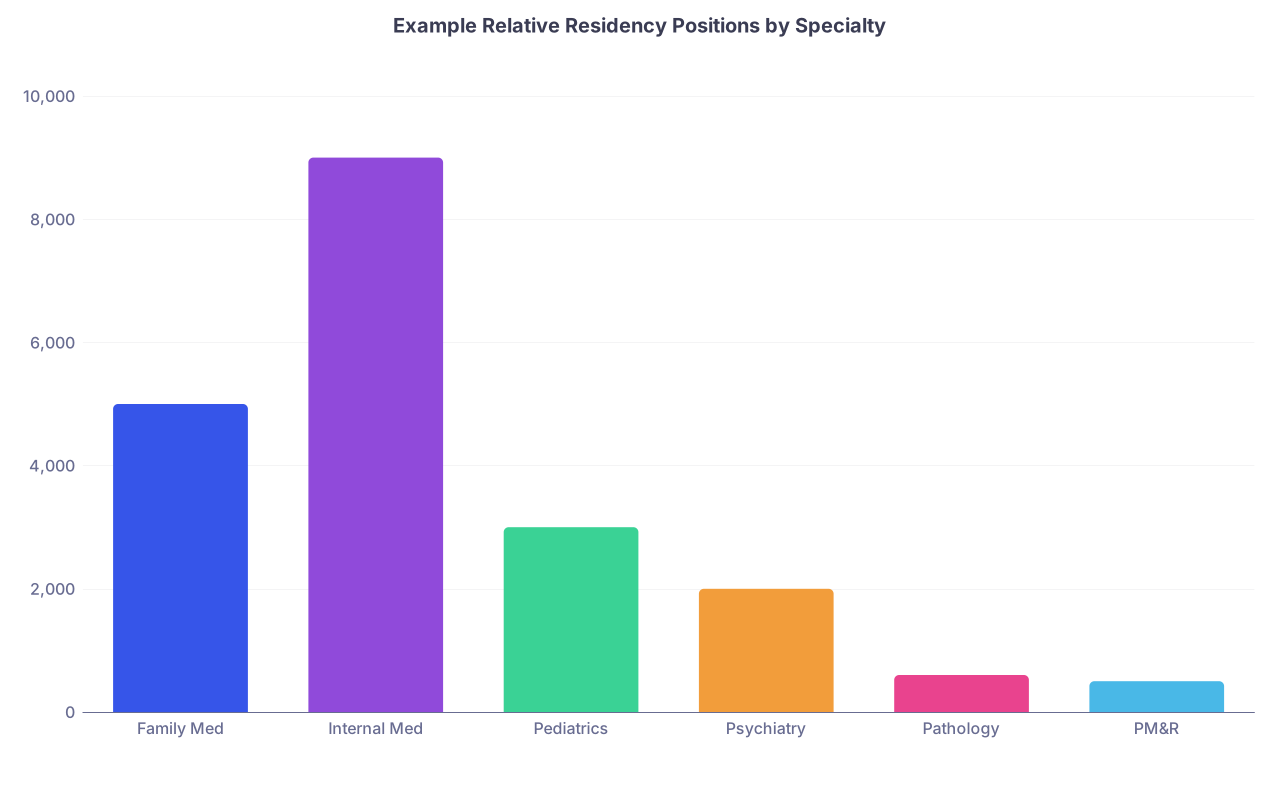
| Category | Value |
|---|---|
| Family Med | 5000 |
| Internal Med | 9000 |
| Pediatrics | 3000 |
| Psychiatry | 2000 |
| Pathology | 600 |
| PM&R | 500 |
(These numbers are illustrative, not exact. You will pull current data for accuracy.)
6. Step 4 – Daily Work Reality: Who Will You Be All Day?
Match is one problem. Waking up for 30 years in a job you hate is a bigger one.
You now zoom in on the fit pillar.
6.1 Shadowing and Honest Reflection
For each of your two specialties:
- Who are the typical patients?
- How much of your day is:
- Face‑to‑face time?
- Documentation?
- Coordination with other services?
- Procedures?
Quick mental snapshots:
- Family Medicine: Bread‑and‑butter primary care, cradle‑to‑grave, heavy outpatient, chronic disease management, lots of brief visits, behavioral health, preventive care, often broad but shallow.
- Internal Medicine (outpatient or hospitalist track): Complex adults, multi‑morbid, more diagnostic puzzles, more inpatient medicine, lots of notes, lots of interdisciplinary work.
- Pediatrics: Kids, families, vaccines, developmental issues, lots of parental anxiety, some acute infections, NICU and PICU if inpatient focus.
- Psychiatry: Long conversations, med management, inpatient psych units, outpatient follow‑ups, emergency consults, strong interpersonal dynamics, chronic severe mental illness.
- Pathology: Zero direct patient contact, microscopes, grossing, tumor boards, lab management.
- PM&R: Neuro and musculoskeletal rehab, functional outcomes, spasticity management, EMGs, injection procedures, interdisciplinary team leadership.
You do not need to love every part. But if you actively dread the core work of a specialty, do not choose it as a backup. You will resent your life.
7. Step 5 – Residency Life and Culture
Two specialties might both be “less competitive,” but their residencies can feel very different.
Questions to research for each:
Residency Length
- 3 years: FM, IM, Peds, Psych (basic tracks)
- 4 years: Neurology, some combined programs
- Pathology and PM&R: often 3–4 years depending on structure (with a PGY‑1 year if advanced)
Call and Nights
- How heavy is inpatient call?
- Does call persist through all years or only early?
- Night float systems vs traditional call?
Culture
- FM and Peds: often more “team‑oriented,” primary care mission, lots of continuity clinic.
- Psych: more discussion‑based, some programs laid‑back, some very heavy on inpatient volume.
- Path: lab culture; you need to be ok with being somewhat in the background, but central for diagnosis.
- PM&R: often very team‑based (PT, OT, SLP), good for those who like functional outcomes.
Talk to actual residents. Not just on interview day. Ask:
- “What are the worst parts of your residency?”
- “If you had to do it over, would you choose this specialty again?”
- “What percent of your class is happy vs trying to exit or switch?”
You will hear patterns. Take them seriously.
8. Step 6 – Post‑Residency Job Market and Lifestyle
This is where many people screw up. They assume “least competitive” means “easy job market forever.” Wrong.
You want to know four things for each backup specialty:
- Job Availability Where You Want to Live
- Typical Compensation (range, not fantasy top 1%)
- Practice Models
- Burnout Trends
8.1 Job Market and Geography
Use:
- Job boards (PracticeLink, HealthECareers, NEJM Career Center)
- Talk to attendings who finished in the last 5–7 years
- Ask PDs and recent grads on interview days
Look for:
- Are FM or Psych jobs plentiful in your target state?
- Are Path or PM&R jobs clustered only in academic centers?
- Are new grads needing to move somewhere they never planned to live?
If Specialty A has broad geographic flexibility and Specialty B forces you into one or two saturated metro areas, that matters.
8.2 Compensation Snapshot
You are not chasing derm money here, but you should know whether long‑term compensation will let you pay off loans and live reasonably where you want to settle.
Rough typical ranges (change over time; verify with current MGMA/Medscape reports):
| Specialty | Typical Range (USD) |
|---|---|
| Family Medicine | $230k–$280k |
| Internal Med (Outpt) | $240k–$300k |
| Hospitalist IM | $280k–$350k |
| Pediatrics | $200k–$250k |
| Psychiatry | $260k–$330k |
| Pathology | $260k–$350k |
| PM&R | $260k–$340k |
Again, these are broad ranges. Local markets may skew higher or lower.
8.3 Burnout and Practice Style
Read beyond glossy brochures. Ask:
- Are FM docs in your region doing 20–25 visits per day with 10‑minute slots?
- Are Psych jobs increasingly telehealth heavy? Do you like that?
- Are Pathologists under pressure with high case volumes and fewer partners?
- Are PM&R physicians increasingly pushed toward pain management clinics vs inpatient rehab?
You are not trying to find a fantasy specialty. You are trying to choose the problems you are most willing to live with.
9. Step 7 – Put It All Together in a Structured Comparison
Now you have data. You stop hand‑waving and you score.
For each specialty, rate the four pillars on a 1–10 scale for you, not in the abstract.
Example (completely hypothetical):
You are choosing between Family Medicine and Psychiatry.
You:
- Want outpatient continuity.
- Are okay with some mental health complexity.
- Have a 225 Step 2, US MD, no red flags.
- Need to be in the Midwest.
You might end up with something like:
| Pillar | Family Med | Psychiatry |
|---|---|---|
| Fit (1–10) | 7 | 8 |
| Match Probability | 9 | 7 |
| Training Experience | 7 | 8 |
| Post-Residency Reality | 8 | 8 |
You can then weight pillars. For example:
- Fit: 35%
- Match Probability: 30%
- Training: 15%
- Post‑Residency: 20%
Multiply and total. The point is not to worship the numbers. The point is to force yourself to be consistent and explicit instead of flipping a coin.
10. The “Split Strategy” Trap: Do Not Half‑Apply
One of the worst errors I see: trying to apply meaningfully to two backup specialties at once without the numbers or bandwidth to do it right.
What that looks like:
- 15 applications to FM
- 15 to Psych
- Generic personal statement that could belong to either
- Mediocre, non‑specific LOR set
- Interview season where you are explaining to each field why you “really” want them
You end up under‑committed to both. And sometimes unmatched in both.
If you are considering two backups, you must decide one primary backup and one emergency fallback, not co‑equals.
- Primary backup: aligned letters, focused personal statement, 80–90% of your applications.
- Emergency: a small, targeted set of programs that might see your interest as genuine (e.g., prelim year or a small number of programs in second specialty where you have ties or exposure).
For most students, especially in the least competitive specialties, the smarter play is:
- Decide one true backup specialty.
- Apply broadly and aggressively within it.
- Use geography flexibility as your safety lever, not a second field.
11. When You Truly Cannot Decide
Sometimes you follow all this and you are still genuinely torn. Both specialties look reasonable. Your scores are fine for both. Your fit scores are similar. So what then?
Two tiebreakers I have seen work well:
11.1 Shadow the “Worst‑Day” Version
Spend a day or two watching:
- The most burned‑out FM doc in a high‑volume clinic.
- The psych inpatient unit on its worst chaotic day.
- The path lab during a crazy frozen section day.
- The PM&R team on a heavy service with complex strokes and spinal cord injuries.
Ask yourself honestly: “Which bad day can I tolerate? Which problems am I more willing to solve every week?”
The specialty whose worst days you can stomach better is usually the safer choice.
11.2 The Ten‑Year Projection
Picture yourself 10 years from now:
- Household situation?
- Likely city size you will live in?
- Financial obligations (loans, family)?
- Energy levels?
Now imagine two parallel lives: you as Specialty A, you as Specialty B.
You are not visualizing prestige or what your parents want. You are asking:
- In which branch do I feel less trapped?
- In which branch do I have more exit options (fellowships, job flexibility, telehealth, locums, academic vs community)?
The specialty that gives you more real options usually wins long‑term, especially for backup choices.
12. A Concrete 7‑Day Decision Protocol
If you are close to application season and need to decide between two backup specialties, here is a tightly structured one‑week plan.
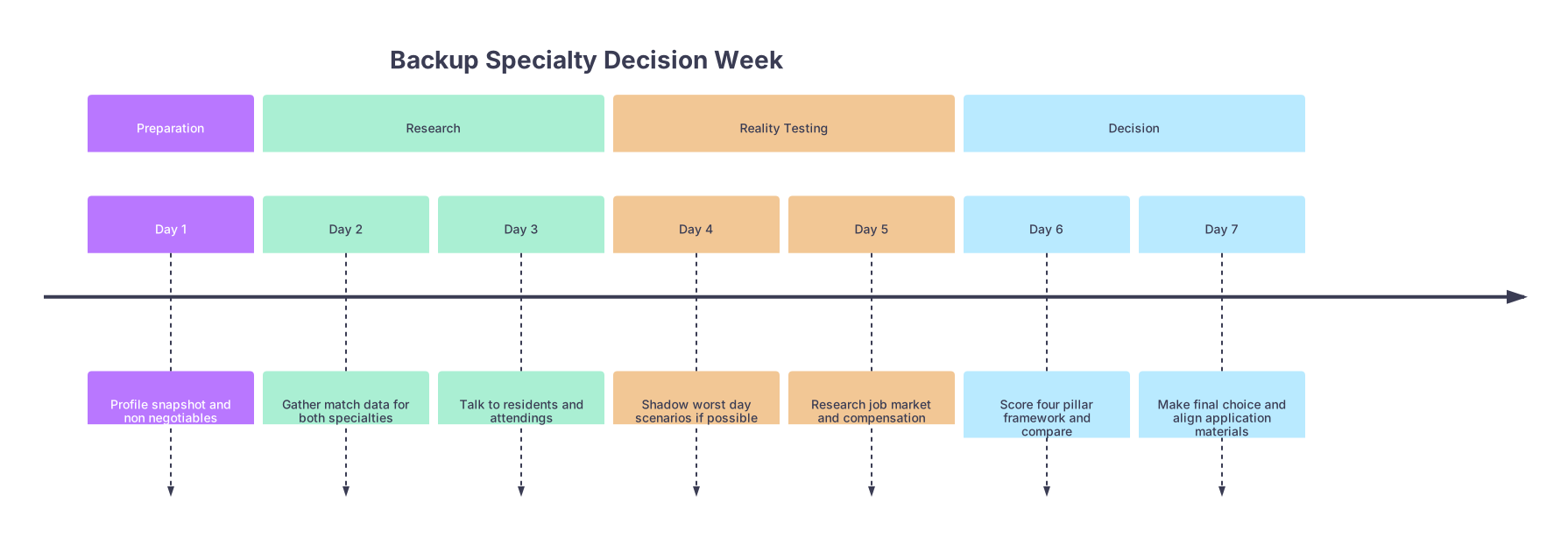
| Period | Event |
|---|---|
| Preparation - Day 1 | Profile snapshot and non negotiables |
| Research - Day 2 | Gather match data for both specialties |
| Research - Day 3 | Talk to residents and attendings |
| Reality Testing - Day 4 | Shadow worst day scenarios if possible |
| Reality Testing - Day 5 | Research job market and compensation |
| Decision - Day 6 | Score four pillar framework and compare |
| Decision - Day 7 | Make final choice and align application materials |
Breakdown:
Day 1 – You Audit Yourself
- Create your one‑page Applicant Snapshot.
- Write your non‑negotiables and rank top three.
Day 2 – Match Numbers
- Pull NRMP data for both specialties.
- Compare where your scores fall.
- Note red‑flag areas (IMG status, exam failures).
Day 3 – Conversations
- Talk to at least:
- One resident or fellow in each specialty.
- One attending in each specialty who finished training less than 7 years ago.
- Ask the three blunt questions:
- “Worst part of your job?”
- “What surprised you negatively?”
- “Would you choose this again?”
Day 4 – Clinical Reality (if logistics allow)
- Shadow or at least informally observe half‑days in each specialty.
- Focus on the worst, not the best.
Day 5 – Job Market and Money
- Check current postings in your desired state/region for each specialty.
- Jot down rough starting salary ranges and common practice environments.
Day 6 – Scoring
- Use the four‑pillar table.
- Assign 1–10 scores and weights.
- Force yourself to choose a winner on paper.
Day 7 – Commit and Align
- Choose your primary backup specialty.
- Draft or revise your personal statement to be clearly tailored.
- Identify which letters of recommendation support this choice and what you still need.
- Create a preliminary program list where you will apply broadly in this chosen backup.
13. Common Mistakes You Are Going to Avoid
Let me spell out some recurring disasters I have seen so you can sidestep them.
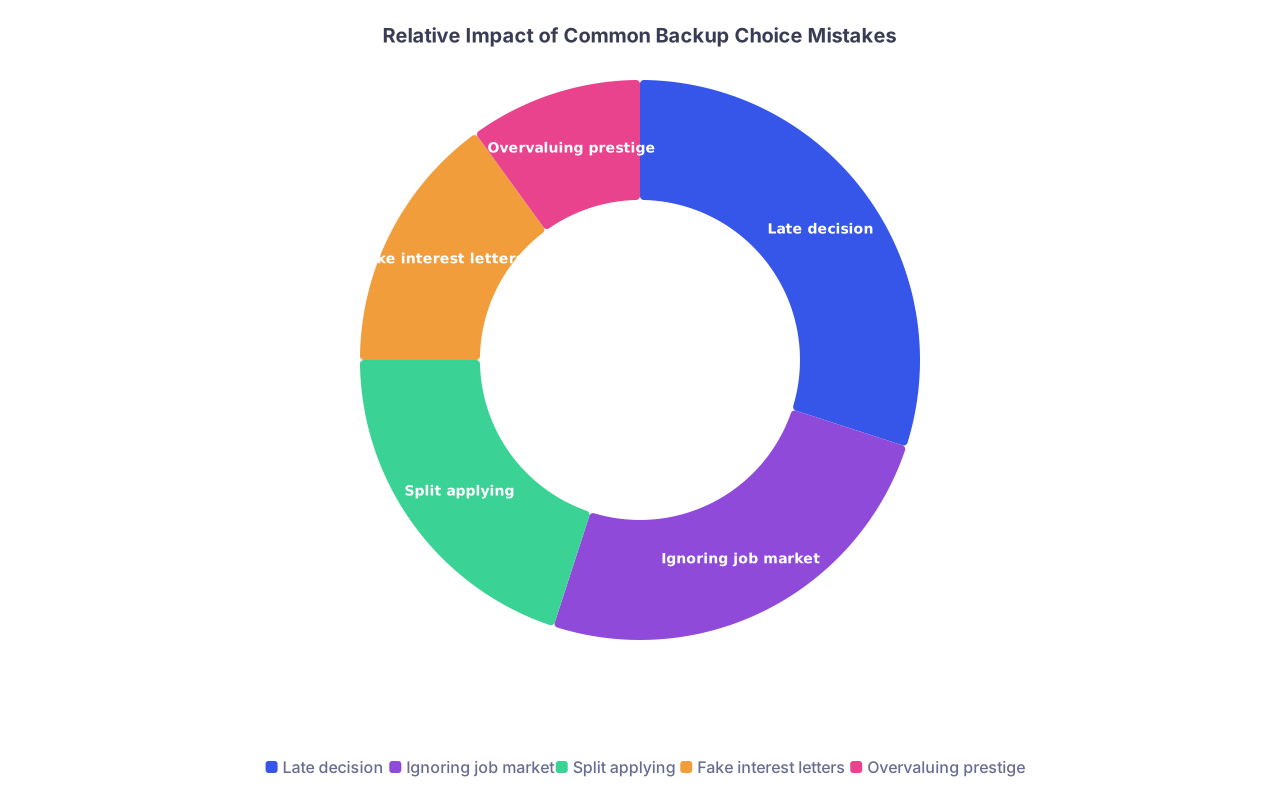
| Category | Value |
|---|---|
| Late decision | 30 |
| Ignoring job market | 25 |
| Split applying | 20 |
| Fake interest letters | 15 |
| Overvaluing prestige | 10 |
Deciding in October of application year.
- You shortchange exposure, letters, and program research.
- Fix: Use the seven‑day protocol months before ERAS opens.
Ignoring long‑term job market realities.
- “I will figure out where to work later” is how you end up stuck.
- Fix: Look at recent grads’ job searches in both specialties.
Split‑applying without enough signal.
- Programs smell hesitation. It hurts you.
- Fix: Pick one field and commit in your essay, letters, and program selection.
Using generic or obviously recycled personal statements.
- Psych PDs know when you reused an IM essay with a few lines tweaked.
- Fix: Write a field‑specific narrative that explains why this specialty.
Chasing perceived prestige instead of real fit.
- Choosing IM because “you can sub‑specialize” when you hate inpatient and only like clinic.
- Fix: Choose the daily work you can tolerate, not the imaginary future you probably will not pursue.
14. Final Check: Does This Feel Like Settling or Choosing?
Backup specialties are emotionally tricky. I have watched students grieve the loss of their first‑choice dream for months. That is normal.
But there is a turning point you must reach: shifting from “I am settling” to “I am choosing.”
If after doing this structured work you still feel only resentment toward your backup option, you have two honest paths:
- Reassess whether you can afford a non‑clinical year or research year to strengthen your profile for your primary specialty, or
- Rework your mindset. Because going into any residency openly hostile to the field is a slow‑motion train wreck—for you and your future patients.
The question you want to be able to answer “yes” to is not “Is this my dream?” It is:
“Can I build a good, sustainable life in this specialty, given who I am and where I am starting from?”
If the answer is yes for one of your two backups, that is your answer.
15. Your Next Action Today
Do this now, not next week:
Open a blank page and write, at the top, the names of the two specialties you are choosing between.
Underneath, create four headings: Fit, Match Probability, Training, Post‑Residency.
For each specialty, jot down three bullet points per heading from what you already know. No data hunting yet—just your current understanding.
Then, circle which specialty currently looks better on that quick pass.
That circled one is your working hypothesis. Over the next 7 days, use the structured protocol above to either confirm that choice or prove yourself wrong with real data.
But stop floating in indecision. Pick a hypothesis specialty today and start testing it. That is how you get unstuck and actually match into a field you can live with.