
It’s April. Your co-residents are locking in hospitalist jobs and your co-chief just signed a contract for cards fellowship. You? You’ve got an expiring resident salary, a pile of loans, and no fellowship spot… but a recruiter keeps emailing you about “flexible, well-paid” locum tenens work.
And your brain immediately goes to:
“If I take a locum gap year, will fellowship directors think I’m lazy? Or washed out? Or that I couldn’t match anywhere?”
Cue 2 a.m. doom-scrolling “locums fellowship gap year red flag???”
Let’s walk straight into all the ugly what-ifs you’re already thinking. Then I’ll tell you what actually matters and how to make a locum year help you, not haunt you.
The Big Fear: “Will They Judge Me for Doing Locums?”
Short answer: They can. But they don’t have to. And you have far more control over the narrative than you think.
Here’s the unfiltered version of how fellowship directors tend to see a locum gap year:
Worst-case interpretation (your nightmare reel):
- “They didn’t match, couldn’t cut it academically, and just went to make money.”
- “They’re drifting. No clear interest in my specialty.”
- “Were they under supervision? Any real teaching? Any scholarly activity? Probably not.”
- “Are they rusty now? Did they coast for a year and forget how to study?”
Neutral interpretation:
- “They took a year, did clinical work, maybe needed time for personal or family reasons.”
- “Let me see what they did with it. Any leadership, teaching, QI, or research?”
- “Is their story coherent or does it sound like they’re making excuses?”
Best-case interpretation (what you want to engineer):
- “They had a clear reason to take a year, stayed clinically sharp, and intentionally used that year to strengthen their application.”
- “This person is mature, self-directed, and grounded. Not someone who panicked and hid.”
- “Their letters from locum sites are excellent and consistent with who they say they are.”
You’re terrified of #1. Most PDs live between #2 and #3—if you make it easy for them.
The red flag isn’t “locum.”
The red flag is “unexplained, unstructured, nothing-to-show-for-it year.”
What Fellowship Directors Actually Care About (Not the Buzzwords)
Forget the forum gossip. Let’s translate what PDs truly scan for when they see a locum gap year on a CV.
| PD Question | What Helps You |
|---|---|
| Why did you take the year? | Clear, honest, concise explanation |
| Did you stay clinically strong? | Consistent work, good references |
| Are you serious about this field? | Specialty-aligned experiences, narrative |
| Any major professionalism issues? | Clean record, positive feedback |
| Can you still do academics? | QI, teaching, research, or CME involvement |
Here’s what runs through their head when they see “2025–2026: Locum Tenens Hospitalist, Multiple Sites”:
“Okay…
• Are they hiding a match failure or probated license?
• Did they just chase money?
• Or were they supporting family, paying down debt, figuring out their specialty fit?
• Did they maintain momentum or totally detach from academic life?”
They’re not monsters. They’re just busy and skeptical.
You don’t need a heroic story. You do need a coherent one.
When a Locum Gap Year Helps You for Fellowship
Let me flip the script for a minute because your brain is currently living on “this will ruin everything.”
There are situations where a locum year is actually a strong asset:
1. When you’re switching directions
Say you finished IM thinking “maybe hospitalist forever” and then realized you really care about pulmonary/critical care. You didn’t apply during PGY-3. Now you’re a year out.
If you do locums in places where you:
- Work in units that actually manage complex patients
- Get face time with intensivists or sub-specialists
- Can honestly say: “Doing X cases made me realize I want deeper training in Y”
…that becomes a believable narrative:
“I tested real-world practice. I saw what I missed from training. I’m choosing fellowship with my eyes open.”
PDs actually like that. A lot. It’s less risky than the intern who “thinks” they like pulm because they liked one rotation.
2. When you need to fix or clarify something
You might be quietly wondering: “My residency wasn’t great. Mediocre name, mid-tier letters. Am I done?”
You’re not.
If your locum year includes:
- A high-functioning site where you impress a respected faculty member
- A new, strong letter—from someone who can say, “I’ve seen many fellows; this person is at that level or better”
- Concrete examples of responsibility (running codes, supervising NPs/PAs, leading teams)
Then you’ve upgraded your story. You’re no longer just “that resident from Mid-State Community Program.” You’re “the doc who stepped into real-world chaos and performed.”
3. When you have a personal or financial reality
PDs understand real life more than you think. I’ve heard them flat-out say:
- “He took a year because his mom had cancer; he still worked part-time and stayed engaged. That tells me a lot about his priorities and resilience.”
- “She paid down loans before locking into three more years of training. That’s arguably responsible, not flaky.”
If the story is:
- Clear (“I needed to support my family / handle my health / deal with immigration / stabilize financially”),
- Short (not a 10-minute monologue),
- And supported by the rest of your application…
…it’s usually fine. The problem is when you either:
- Lie and it doesn’t add up, or
- Overshare and sound chaotic.
When a Locum Gap Year Starts to Look Bad
You’re probably more interested in the horror stories. Fine. Here’s where PDs get nervous.
1. The “Aimless Drifter” vibe
This is where your CV looks like:
- 2 months here, 1 month there, 6 weeks somewhere else, all in totally unrelated settings,
- No continuity practice, no clear pattern, no anchor mentor,
- And in your personal statement you say: “I’ve always been passionate about [insert subspecialty] since medical school.”
PD reaction: “If you were always passionate, why did you scatter yourself across random locum gigs with zero connection to this specialty?”
You don’t need a perfectly linear path, but you do need to avoid looking like you just clicked “accept” on whatever paid the most without a thought.
2. Zero evidence of growth
Red flag pattern:
- No QI, no teaching, no CME, no conferences, no courses
- No meaningful leadership (like leading protocols, improving throughput, etc.)
- No one writing you a strong letter from that year
So your ERAS/CAF file essentially stops at “end of residency.” PDs ask: “What did you actually do this year besides exist?”
Even a simple thing like: “I led a project standardizing sepsis order sets across two facilities” changes that entire picture. And yes, that counts, even as a locum—if you actually did the work and someone can vouch for it.
3. Shaky professionalism or clinical concerns
This is the nightmare scenario you’re secretly spiraling about: “What if I screw up on locums and that follows me forever?”
PDs worry about:
- Gaps within the gap (2 months “unemployed” without explanation)
- Terminated assignments
- Bad whispers from small communities (“Yeah, that doc… we’d pass.”)
Most locum contracts don’t broadcast minor friction to the world, but a pattern of burned bridges can leak through. This is where being a fundamentally reasonable, collegial human matters more than ever.
How to Make Your Locum Year Fellowship-Friendly
You want a checklist. I know. Something you can cling to so your brain doesn’t keep saying “you’re ruining everything.”
Fine. Here’s the practical version.
1. Choose assignments like a future fellow, not a desperate new grad
Instead of “highest pay per shift,” ask:
- Will I work with or near specialists in my target field?
- Is there a realistic chance to get to know someone who can write a real letter?
- Will I see pathology or patient populations that line up with my intended fellowship?
You don’t need a perfect match, but at least go for adjacent.
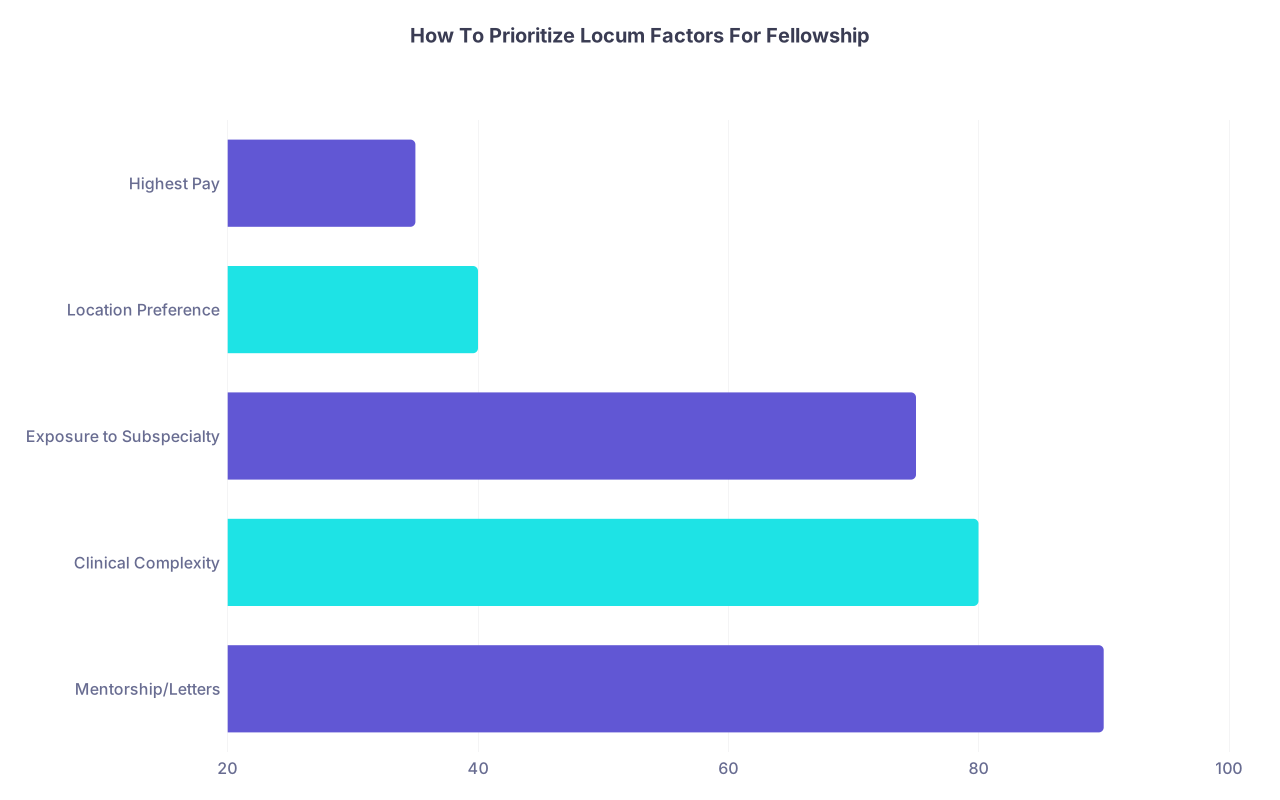
| Category | Value |
|---|---|
| Mentorship/Letters | 90 |
| Clinical Complexity | 80 |
| Exposure to Subspecialty | 75 |
| Location Preference | 40 |
| Highest Pay | 35 |
Pay can’t be the only driver if you care about fellowship. It just can’t.
2. Build one or two real relationships
You don’t need five letters from every hospital you touched. You need 1–2 strong ones.
That means:
- Stay long enough in at least one site for people to know your name and your style
- Ask early: “I’m planning to apply for fellowship next year—are there any QI or teaching opportunities I could help with while I’m here?”
- Identify one attending / medical director / chief who sees your work and can write a granular letter
“Dr. X managed 20+ patients a day with high acuity, took initiative on difficult discharges, and was the go-to for complex cases” is gold. And yes, you can get that letter as a locum.
3. Don’t let your brain atrophy
PD fear: “They haven’t opened a textbook in a year.”
So don’t let that be true. Bare minimum:
- Regular CME (not just to check a licensing box, but actually up-to-date guidelines)
- A board review resource you casually chip away at weekly
- One or two academic things: journal club, conference attendance, or even a short review or case write-up if you can swing it
You don’t have to produce a NEJM paper. You do need to prove you still remember how to think like a trainee, not just a shift worker.
How to Explain a Locum Gap Year in Your Application
This is the part that gives you chest tightness: “What do I say?”
Keep it brutally simple and aligned with your actual life.
In your personal statement or interviews, your explanation should hit three points:
- Why you took the year
- What you actually did and learned
- Why you’re now ready for this fellowship
Example 1 – financial + clarity:
“After residency, I chose to work as a locum hospitalist for a year. I had significant family financial obligations and wanted to stabilize that before committing to additional training. During this year, I worked in two high-acuity community hospitals where I managed complex [relevant] cases independently. This experience confirmed that I want more advanced training in [fellowship field], particularly to better manage [specific patient/population].”
Example 2 – geographic/family + exposure:
“I took a locum year to be closer to my aging grandparents while continuing to practice. Working across three regional hospitals, I led code responses, supervised APPs, and collaborated closely with [subspecialty] teams. Being on the front lines without immediate subspecialty backup highlighted gaps in my skills and strengthened my desire to pursue [fellowship].”
Example 3 – didn’t match + honesty (yes, you can say it):
“I applied for [fellowship] in my PGY-3 year and did not match. Instead of reapplying immediately, I took a locum hospitalist role to continue building my skills and to address feedback I received. Over the past year, I’ve focused on [specific improvements: procedural volume, research, presentations], and I now feel more prepared and more certain that [fellowship] is the right path.”
Notice what’s missing:
No guilt trip. No oversharing. No defensive tone.
You are not confessing a crime. You’re explaining a decision.
Common Myths About Locum Gap Years and Fellowship
Let’s dismantle a few of the lines you keep seeing online that are half-true at best.

“Any gap year kills your chances.”
No. Repeated, chaotic gaps with nothing to show? That’s bad. A single, explainable year with clear work and growth? Very survivable.“Programs only like straight-through trainees.”
Some do prefer it. But plenty have fellows who worked as hospitalists, did chief years, or had kids between residency and fellowship. PDs care more about trajectory and reliability than checking the “no gap” box.“Locums = you couldn’t get a job.”
Everyone in medicine knows that’s nonsense now. In some regions, locums pay better than staff jobs. What PDs actually infer depends on how you frame it and what you did with it.“You’ll be less competitive than current residents automatically.”
Sometimes, yes. Sometimes, no. Older, experienced applicants often interview very well because they’re more grounded and clinically confident. If your letters and story are strong, you’re not automatically behind.
Quick sanity check: Is a locum gap year right for you if you want fellowship?
If you’re still on the fence, here’s a blunt framework.
Locums + Fellowship is more reasonable if:
- You’re burned out and need a different pace before diving back into training
- You have real financial or family constraints
- You’re not 100% sure on specialty and want time to clarify
- You’re willing to strategically choose sites and put in mild extra effort (letters, projects, staying sharp)
It’s less wise if:
- You already have a strong application and just don’t feel like dealing with another application cycle
- You plan to treat the year as a “paid vacation” and never open UpToDate
- You’re allergic to asking for mentorship or letters
- You’re hoping the year will magically fix deep red flags (like major professionalism issues) without specific action
FAQs
1. Will a locum gap year hurt me more than a full-time hospitalist job?
Not automatically. Some PDs slightly prefer a stable, single-site job because it screams “reliable” and often comes with academic/QI opportunities. But a well-structured locum year with continuity at one or two main sites, strong letters, and clear growth looks very similar on paper. The damage comes from chaotic locums, not locums as a concept.
2. Should I hide that it was locum work and just list “Hospitalist, XYZ Hospital”?
Don’t play games. If they ask and it looks like you blurred the truth, trust disappears fast. You can absolutely list the specific hospitals as your primary entries and note in the description that it was via locum tenens. The focus should be on your role and responsibilities, not the contractual mechanism that got you in the door.
3. Do I need research during my locum year to have any shot at fellowship?
Depends on the specialty and your current CV. For something like heme/onc or cards, research helps a lot, but you might already have enough from residency. During a locum year, even small, realistic things help: case reports, QI projects with measurable outcomes, or remote collaboration with old mentors. You don’t have to churn out a randomized trial from a 3-month locum stint in rural nowhere.
4. What’s one thing that absolutely will make my locum gap year look bad?
A year that looks like you disappeared: no clear work pattern, no letters from that time, no explanation, and you get cagey or defensive when asked. That screams “something went wrong.” If you’re up front, have at least one strong reference, and can clearly state why you did it and what you got from it, most PDs will move on and judge you by your entire application.
Open your CV right now and look at the year you’re thinking about filling with locums. Ask yourself: “If a PD saw only these lines, what story would they tell themselves about me?” Then tweak your plans—sites, letters, projects—until that story matches the one you actually want read out loud in a selection meeting.