
You walked out of that last job with your badge in your pocket and your stomach in knots. Part of you felt like you’d just escaped a burning building; another part whispered, “What if I just screwed up my career?” Now someone mentions locums, and it sounds like both a lifeline and a risk.
You’re not trying to “find yourself” for three years. You just need to reset without going from one disaster to another. Done right, locum tenens can be the safest way to rebuild your confidence, your bank account, and your standards. Done wrong, you’ll end up in another toxic mess—just with a hotel key card instead of an apartment lease.
Let’s walk through how to use locums as a career reset, not a holding pattern.
1. First: Stabilize Your Life Before You Chase the Next Contract
If you just left a toxic job, you’re more vulnerable than you think. You’re tired, angry, maybe scared about money. That’s exactly when physicians say yes to terrible locums assignments.
You need three quick stabilizers: time, money, and story.
A. Time: Give yourself 1–4 weeks of decompression
Do not sign a year-long contract the same week you quit.
You do not need a month-long yoga retreat. You do need a deliberate, short reset:
- 3–7 days: Sleep. Finish basic life tasks you’ve been putting off. Notice how burnt out you really are.
- Next 1–3 weeks: Light admin work on your career: CV, licensing, talking to recruiters, talking to your accountant or financial planner.
Set a hard date when “reset time” ends and “execution time” starts. Otherwise you drift and then panic-sign something awful.
B. Money: Know your real runway
Guessing “I think I’m fine for a few months” is how people end up taking unsafe shifts in unsafe places.
Sit down and calculate:
- Monthly essentials: rent/mortgage, loans, food, insurance, baseline utilities.
- Minimum runway: 3 months is ideal; 1 month is the absolute “I must earn something now” threshold.
Then ask: “How many 7-on / 7-off weeks of locums at $X/hr do I need just to buy 6+ months of breathing room?”
That number becomes your minimum target, not your entire career plan.

| Category | Value |
|---|---|
| Essentials | 4500 |
| Loans | 1500 |
| Insurance | 800 |
| Other | 1200 |
| Net Locums (1 week/mo) | 12000 |
C. Story: Decide how you’ll explain your exit once, clearly
You will be asked 100 times: “So why did you leave your last job?”
Craft one clean, non-defensive version now:
- “The culture and expectations were not compatible with safe practice, and leadership was not responsive to concerns. I decided to leave before that environment compromised my standards or my health.”
Practice it until you can say it without your heart rate jumping. That’s your shield with recruiters, credentialing committees, and future employers.
2. Set Clear Rules: What Locums Is (and Isn’t) for You
Locums can be three very different things:
- A financial rehab tool.
- A clinical and emotional reset.
- A structured test-drive of different practice models and locations.
You have to decide which you’re actually doing, otherwise the market will decide for you.
Decide your main goal for the next 6–12 months
Pick one primary goal and one secondary:
- Primary options:
- Pay off high-interest debt / rebuild savings.
- Recover from burnout without leaving medicine.
- Explore different practice settings to choose the next permanent job wisely.
If your last job was toxic, I usually tell people: make recovery and clarity your primary; use money as a strong secondary.
Write this sentence somewhere:
“For the next 12 months, I am using locums primarily to ______ and secondarily to ______.”
You’ll refer back to that when you’re tempted to take a “just okay but soul-crushing” contract.
3. Build the Safety Net: Licenses, Malpractice, and Paper Trail
You want to reset safely. That means no surprises with licensing, malpractice, or contracts.
A. Get your licensing strategy straight
More licenses are not automatically better. They’re just more renewal fees.
For a post-toxic-job reset, I’d do one of two strategies:
- Strategy 1: “Deep in one region”
- Focus on 1–2 states where you’d realistically live long-term.
- Pros: Easier to build reputation, recurring gigs, less travel chaos.
- Strategy 2: “Short-term hit list”
- Pick 2–3 locums-friendly states (e.g., WA, OR, TX, AZ, WI, ME, ND, etc.).
- Use them to maximize options and rate leverage for 1–2 years, then narrow down.
If you’re compact-eligible (for APPs, some specialties), use it, but do not let recruiters push you into 7 states “just because.”
| Approach | # of States | Best For |
|---|---|---|
| Single-State Focus | 1 | Staying near family/home base |
| Regional Focus | 2–3 | Testing a few realistic markets |
| High-Flex Strategy | 3–5 | Maximizing rates/options briefly |
B. Malpractice: What “safe” actually means
Toxic jobs often came with sketchy malpractice coverage. You’re not repeating that.
For each assignment, you need to know:
- Is coverage occurrence or claims-made?
- Who pays for tail if it’s claims-made?
- What are the limits (e.g., $1M / $3M)?
Rule I’d stand by:
If they won’t put malpractice details in writing in the contract, you don’t work there. Period.
Also: keep your own record of every assignment—dates, site names, agency, malpractice carrier and policy #. That list will save you 10 headaches in the next 10 years.
C. Clean paper trail from the toxic job
Before you mentally torch that place, make sure you:
- Download/print your last few years of CME, procedure logs, and case logs.
- Get copies of any formal evaluations that were positive.
- Document your resignation in writing (email), if you have not: short, factual, no insults.
If there were patient safety concerns or harassment, write a short factual memo for yourself now while you remember details. Not to share widely. To protect you if the previous employer decides to be vindictive in references or NPDB reports.
4. Choosing Locums Assignments That Actually Heal, Not Harm
Here’s where people mess up: they leave one toxic job, then let a recruiter talk them into another one because “we really need someone; you’d be a hero.”
You’re not trying to be a hero. You’re trying to not end up in the same psychological ditch.
A. Red-flag vs green-flag assignments
Quick screen when a recruiter calls:
Red flags:
- “We’ve had trouble keeping people” with no specific reason.
- 24–hour in-house call more than 5–6 times a month for hospital-based specialties.
- No clear backup or second provider when things blow up.
- Leadership “too busy” to jump on a 15-minute call with you before signing.
- No orientation or “you’ll figure it out the first day.”
Green-ish flags:
- They’ve had the same locums doc returning for years.
- The permanent docs will actually speak with you before you sign.
- Clear written description of typical census/volume and call structure.
- Defined orientation: at least half a day to a day.
You don’t need perfection. You just need “not obviously abusive.”
B. Ask the right questions—and listen for the squirming
When you talk to the medical director or lead physician, ask:
- “Why are you using locums right now?”
- “What happened with the previous provider in this role?”
- “What does a bad day look like here, in numbers?”
- “What will I be expected to do that is not in the job description?”
- “If I say ‘no’ to something unsafe, who backs me up?”
You’re not looking for poetry. You’re looking for:
- Direct answers.
- No visible dodging.
- Some acknowledgment of system limitations.
If you get “It’s fine, everyone manages, you’ll be okay” after you ask about unsafe volumes—that’s how toxic jobs sound in the sales phase.
5. Designing a Locums Schedule That Actually Feels Like a Reset
The whole point of this is control. You lost that in your last job. You’re buying it back.
A. Decide your “full-time equivalent” on purpose
For many docs, a sane locums reset schedule looks like:
- 7-on / 7-off or 5-on / 9-off
- Aim for 0.6–0.8 FTE equivalent, not 1.2 FTE
That might mean:
- Two weeks per month on assignment
- Two weeks home, where you are not doing clinical work at all
Do the math on income vs your runway first. Then protect the off weeks like they’re part of your job description. Because they are.
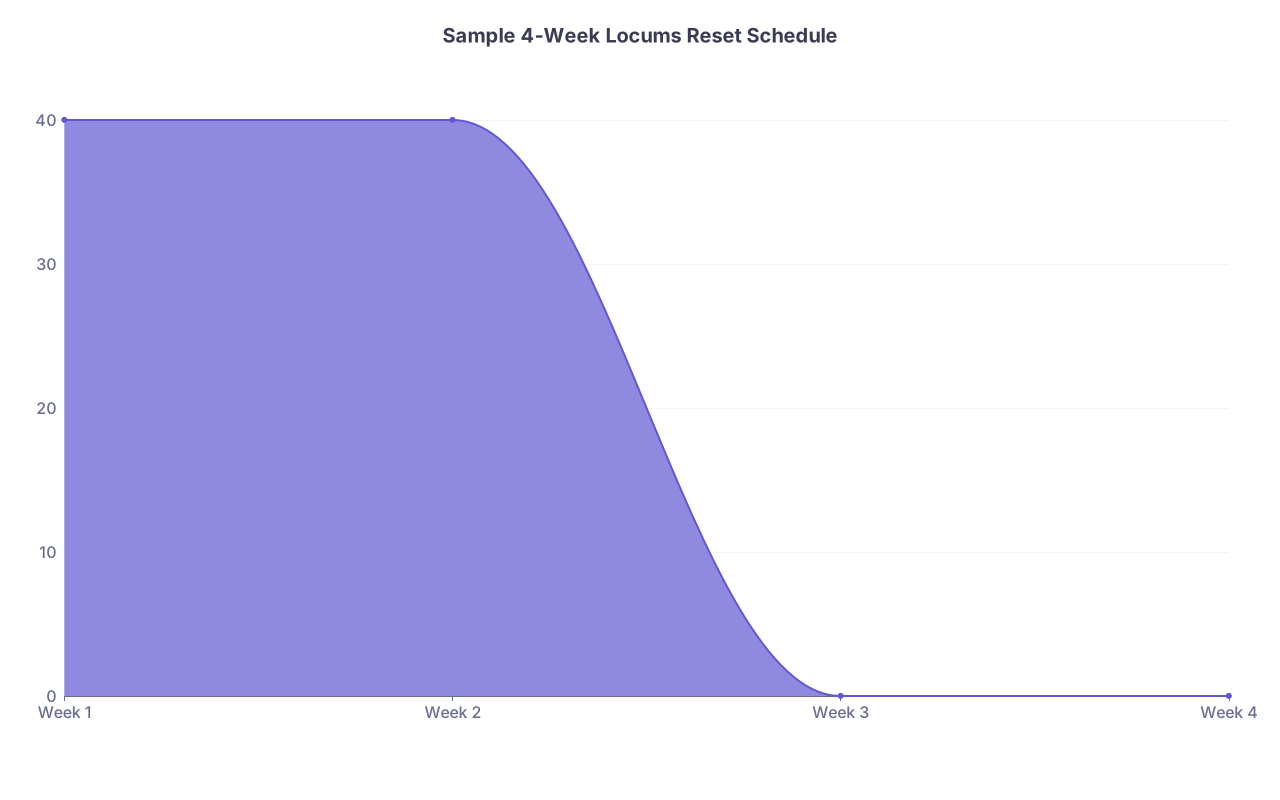
| Category | Value |
|---|---|
| Week 1 | 40 |
| Week 2 | 40 |
| Week 3 | 0 |
| Week 4 | 0 |
B. One site at a time vs multiple sites
For emotional recovery, simpler is usually better.
- Phase 1 (first 3–6 months): One primary site, maybe a backup site you rarely use.
- Phase 2 (after you feel human again): You can add variety if you want it.
Juggling three different EMRs and local cultures while you’re still mentally replaying your last toxic job? That’s how errors happen and anxiety spikes.
6. Using Locums to Rebuild Confidence and Clarify What You Want Next
The reset isn’t just about money and sleep. It’s about data gathering. On yourself and on the system.
A. Track what actually feels good vs what drains you
After each assignment block, ask yourself:
- What parts of this workday felt decent or even good?
- What specifically irritated or exhausted me that is not just “medicine is hard”?
- Did I feel respected? Clear about expectations? Supported when uncertain?
Write it down—two or three lines, nothing long. After 3–4 assignments, patterns show up:
- “I like smaller community hospitals but hate being the only doc at night.”
- “I actually don’t mind high volume if the team is solid and leadership is honest.”
- “I cannot do night-heavy schedules and stay sane.”
That list becomes your non-negotiable filter for your next permanent job.
B. Rebuild your clinical swagger in controlled doses
If the toxic job left you doubting your skills, do not run from complexity forever. Instead:
- In early assignments: take slightly easier, better-supported roles.
- While off: do focused CME or case review in areas where you felt shaky.
- Later: choose one assignment that stretches you in a controlled way (good support, reasonable volume, maybe more complexity).
You want to end this reset year thinking: “I’m good at this. I just will not tolerate nonsense.”
7. Protecting Your Mental Health While You Live “Out of a Suitcase”
Locums can fix one set of problems and create another: isolation, hotel fatigue, lack of routine.
You’ve already been through one grind. Don’t quietly build a new one.
A. Non-negotiables for travel life
You’re not a backpacker. You’re a physician in recovery from a bad environment. Minimum standards:
- Decent lodging: quiet, safe, with a real kitchen or at least a fridge + microwave.
- Travel schedule: avoid overnight flights before clinical days whenever possible.
- One or two personal routines you stick to regardless of location. Example:
- 10-minute walk outside before or after each shift.
- Same simple breakfast you can buy anywhere.
- 5-minute nightly “download” journaling on your phone.
You’re building a sense of continuity. Not a perfect life. Just something that feels like yours.
B. Don’t underestimate the social hit
Toxic jobs often come with toxic colleagues. You leave, and suddenly it’s quiet. Too quiet.
To offset that:
- Pick a home base city where you have at least one real friend or family member.
- Schedule standing calls with 1–2 people weekly, especially post-call on your off weeks.
- Consider a therapist who understands physicians and burnout. Telehealth is fine. Schedule them into your off weeks like you would a mandatory meeting.
You’re not weak for needing this. You’re smart for engineering it now instead of crashing later.

8. Use Locums to Vet Future Permanent Jobs (Quietly and Thoroughly)
The best way to avoid another toxic job? Stop believing the brochure.
Locums lets you “date” systems before you marry one again.
A. Treat each assignment as reconnaissance
While you’re there, quietly notice:
- How do nurses talk about administration when no one important is around?
- When something goes wrong, do they look for solutions or scapegoats?
- What happens to the schedule when someone is out sick? Do they scramble for coverage or guilt-trip people into unsafe loads?
- Do permanent docs ever say, “You should consider coming on full-time”? If so, ask: “What would you change if you could?”
This is real intel. Ten times more valuable than any recruitment dinner.
B. Transition from locums to permanent on your terms
If you find a place that feels right, do not jump at the first “We’d love to have you full-time” comment.
Instead:
- Work there as locums for at least 2–3 separate blocks.
- Talk to at least two physicians who left there in the last 3 years.
- Get the contract reviewed by a physician-side attorney who has seen enough bad ones.
Then negotiate from strength: “I have other locums options; I would take something permanent here only if we can structure X, Y, Z.”
You’re not desperate anymore. You proved that by leaving the last job and surviving. Act like it.
9. Know When the Reset Has Done Its Job
Locums as a reset is a means, not a permanent identity unless you truly want that.
Signs the reset has served its purpose:
- You’re no longer replaying scenes from the old job in your head every night.
- You have a clear list of non-negotiables for any future job.
- You have 3–5 types of practice settings you know are bad fits for you.
- You have some cash cushion and are not saying yes to shifts out of panic.
At that point, you decide:
- Do I want to:
- Stay locums long-term because I genuinely like it?
- Use this clarity to pick a permanent role that I choose, not one I fall into?
Either answer is fine. The wrong answer is drifting without deciding.

| Step | Description |
|---|---|
| Step 1 | Leave Toxic Job |
| Step 2 | Short Decompression 1 to 4 weeks |
| Step 3 | Define Reset Goals |
| Step 4 | Licensing and Malpractice Setup |
| Step 5 | Select Safe Locums Assignments |
| Step 6 | Work 3 to 6 Months with Boundaries |
| Step 7 | Assess Patterns and Preferences |
| Step 8 | Continue Locums Intentionally |
| Step 9 | Targeted Search for Permanent Job |
| Step 10 | Use Locums Intel to Negotiate |
| Step 11 | Stable, Self Directed Career |
| Step 12 | Satisfied with Locums Life |
10. Concrete 30-Day Plan If You Just Walked Out
You like specifics, so here’s a rough 30-day template.
Days 1–7:
- Sleep, move your body, talk to one trusted person about how bad it really was.
- Draft your “why I left” sentence.
- Cancel any automatic commitments that no longer make sense.
Days 8–14:
- Update CV and create a simple log of prior malpractice coverage.
- Speak with 2–3 locums agencies; pick 1–2 to actually work with.
- Decide your target states and type of schedule for the first 6 months.
Days 15–21:
- Start licensing paperwork if needed.
- Have at least one conversation with a therapist or coach who knows physician burnout.
- Start saying “no” to any obviously toxic-sounding offers, even if you feel a money twinge.
Days 22–30:
- Evaluate 2–3 concrete assignment options with your red-flag/green-flag list.
- Tentatively commit to your first block 4–8 weeks out.
- Block your off-weeks in your calendar now and treat them as sacred.
From there, you iterate. One controlled, intentional step at a time. No more jumping into fires.

With locums used this way, you’re not “running away to do temp work.” You’re rebuilding leverage. You’re quietly collecting evidence about what kind of practice and life you’re willing to accept now that you’ve seen the worst of it.
You left a toxic job, which took guts. The next phase is about making sure that courage actually buys you something: money, space, clarity, and better options. Once those are in place, then we can talk about choosing what your long-term career will look like. But that’s the next chapter, not today’s problem.