

The belief that choosing a low-paying specialty locks you into a low-income career is wrong. The problem is not the specialty. The problem is the way most physicians structure their career.
If you picked pediatrics, psychiatry, family medicine, PM&R, or any of the other “bottom-of-the-MGMA-table” specialties and now you are staring at your future salary with a knot in your stomach, you are not stuck. But you do need a portfolio strategy, not a “one-job-for-30-years” strategy.
Here is how you turn a “low-paying” specialty into a high-value, high-option career portfolio.
1. Face the Numbers Without Panicking
First step: stop hand-waving and get concrete about what “low-paying” actually means for your specialty and your situation.
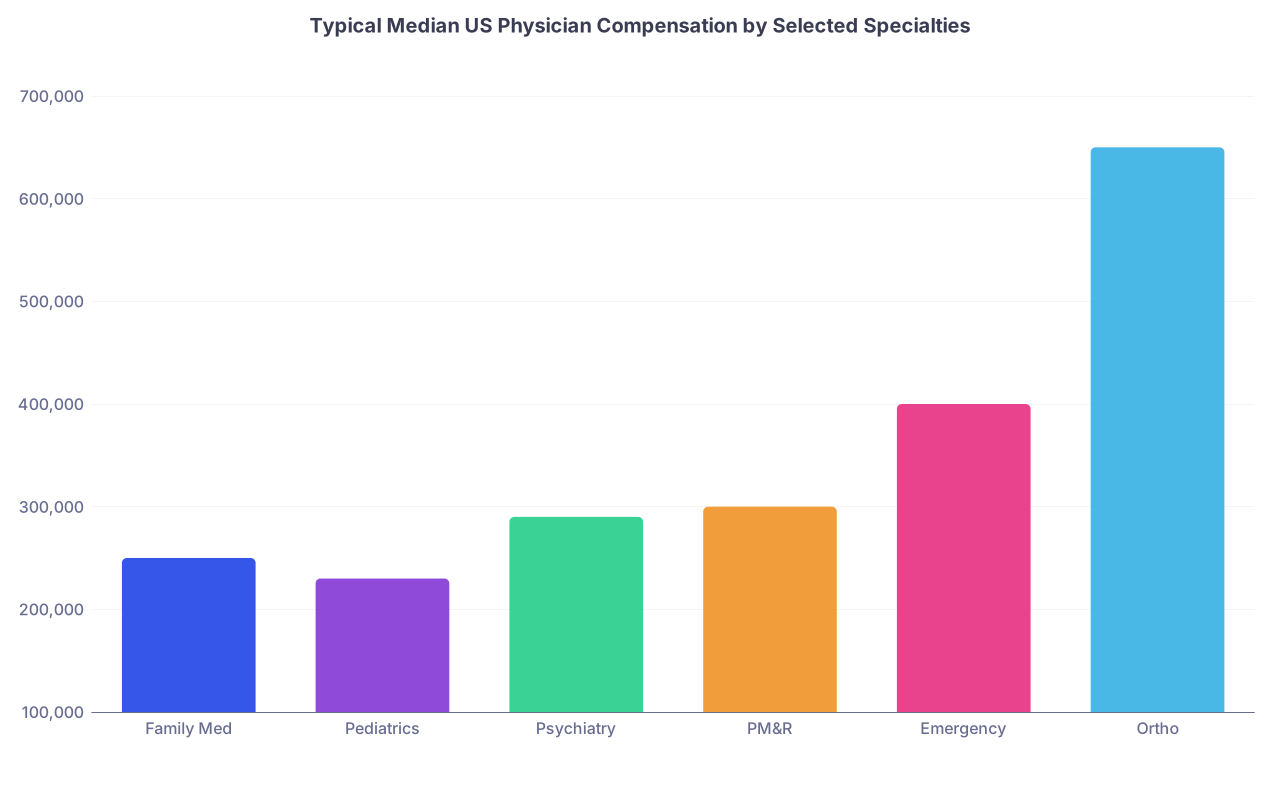
| Category | Value |
|---|---|
| Family Med | 250000 |
| Pediatrics | 230000 |
| Psychiatry | 290000 |
| PM&R | 300000 |
| Emergency | 400000 |
| Ortho | 650000 |
These are ballpark medians; your local market may be higher or lower. But this illustrates the psychological trap:
- You compare yourself to ortho, derm, or radiology.
- You mentally anchor to $500k–$700k as “normal.”
- You assume your only lever is specialty choice.
Wrong. Your levers are:
- Scope of work
- Practice structure
- Revenue mix
- Career portfolio design
You cannot turn pediatrics into neurosurgery. You can absolutely turn a $230k peds job into a $400k+ portfolio over time with the right moves. I have seen it repeatedly: one FQHC pediatrician who added consulting and telehealth hit $420k equivalent within 3 years without working insane hours.
The mindset shift:
- Your specialty is the base asset.
- Your portfolio is how you deploy that asset across:
- Clinical work
- Side practices
- Non-clinical revenue
- Equity / ownership
2. Understand Your Specialty’s Hidden Advantages
Low-paying specialties are not weak. They are misused.
Look at the structural gifts you probably have and are not monetizing properly:
Flexible hours / fewer emergencies
Pediatrics, psychiatry, outpatient PM&R, outpatient FM: fewer nights, fewer middle-of-the-night catastrophes. That is capacity you can re-deploy.Chronic, relationship-based care
Longitudinal patients = stable panel, high trust. That converts beautifully into:- Membership / concierge models
- Group programs
- Behavioral or lifestyle interventions with recurring revenue
Low procedure burden
Yes, procedures pay well. They also lock you into specific settings and equipment. Low-procedure specialties can:- Go virtual
- Scale group formats
- Work across state lines (telepsych, telepeds, tele-FM)
Broad applicability outside traditional healthcare
Psych, FM, peds, PM&R can bolt into:- Digital health startups
- Employer wellness programs
- School systems
- Med-legal work
- Coaching and advisory roles
Your “low-paying” specialty is usually high in:
- Transferability
- Flexibility
- Scalability
If you play it right.
3. Build a Career Portfolio: The 4-Quadrant Model
You need a portfolio, not a single job. Think in quadrants instead of one big blob labeled “my job”.

| Step | Description |
|---|---|
| Step 1 | Core Clinical Job |
| Step 2 | Optimized Compensation |
| Step 3 | Protected Time |
| Step 4 | Clinical Side Work |
| Step 5 | Telehealth |
| Step 6 | Urgent Care or PRN |
| Step 7 | Non Clinical Income |
| Step 8 | Consulting |
| Step 9 | Teaching or Expert Work |
| Step 10 | Equity and Ownership |
| Step 11 | Practice or Real Estate |
| Step 12 | Startup or Digital Health |
The four quadrants:
Core Clinical Role (50–80% of your time)
This is your anchor: W-2 job or main practice. It must:- Pay decently (not necessarily maximally)
- Protect some time and energy
- Offer stability
Clinical Side Work (0–20%)
Short, well-compensated, flexible:- Telehealth shifts
- Urgent care / moonlighting
- Weekend clinics
- Short-term locums
Non-Clinical Income (0–20%)
Directly leveraging your expertise:- Teaching (CME, universities, board review)
- Consulting (employers, startups, schools, insurers)
- Med-legal (IME, expert witness)
- Content / education platforms
Equity / Ownership (5–20%)
Slow build, long-term upside:- Share in a group practice or ASC
- Real estate connected to your practice
- Startup advisory equity
- Building your own small, scalable service line
You do not build this in a year. You build it systematically over 3–7 years.
4. Fix the Core Job Before You Add “Side Hustles”
Most physicians skip this step and end up exhausted. Bad idea. Optimize the foundation first.
Step 1: Audit your current role
List, on paper:
- Clinical FTE and actual hours worked
- Panel size / patient volume
- RVU targets and per-RVU rate (if applicable)
- Call schedule
- Admin time (protected or fake?)
- Non-clinical duties (committees, leadership, teaching)
Then ask three blunt questions:
- Is my compensation in the top 25–50% for my region and specialty?
- Is my schedule leaving me any realistic bandwidth for portfolio building?
- Am I stuck with obligations (call, committees) that pay nothing and block other opportunities?
If you answer “no, no, yes,” you do not need more jobs. You need a better main job.
Step 2: Renegotiate or replace
Options that usually move the needle:
Change structure, not just salary
- Convert some tasks to RVU or stipend (medical directorships, committee work)
- Carve out a 0.1–0.2 FTE “protected time” block to later redeploy into paid work
- Trade an undesirable call schedule for more base pay or vice versa, whichever maximizes net life-and-income value
Shift employer type if needed
Quick comparison:
| Employer Type | Typical Pros | Typical Cons |
|---|---|---|
| Large Health System | Stability, benefits, loan repayment | Bureaucracy, RVU pressure |
| FQHC / Community Clinic | Loan forgiveness, mission, underserved work | Lower base pay, admin overload |
| Private Group | Higher ceiling, partnership track | Business risk, politics |
| Direct Primary Care / Concierge | Control, patient panel size | Income depends on marketing, slower ramp |
If your current environment cannot or will not support a portfolio build (no schedule flexibility, chronically understaffed, hostile to side work), you are better off changing jobs than grinding harder in a broken setup.
5. Clinical Upside: Add Smart, Not Just “More”
You do not want 1.8 FTE of low-margin clinic work. You want high-yield supplemental clinical roles that are:
- Time-bounded
- Well paid per hour
- Low overhead
- Cognitively manageable after your main job
Best options by low-paying specialty:
Family Medicine / Pediatrics
- Urgent care shifts (even 2–4 days per month can add $20–40k/year)
- Newborn nursery coverage if your hospital undervalues this and pays stipends
- Telehealth:
- After-hours pediatric triage
- Direct-to-consumer primary care platforms
- School-based clinics with separate contracts
Psychiatry
- Telepsychiatry (huge demand, geographic arbitrage)
- Collaborative care consulting for PCP groups (panel-based pay)
- Light inpatient or C/L weekend coverage at premium rates
PM&R
- EMG clinics on a per-study basis
- Inpatient rehab weekend rounds
- Spine / MSK teleconsults for employer programs
Strategy rules:
- Cap “extra clinical” at a specific weekly average (for example, one extra 8–10 hour block per week).
- Put all side clinical work on separate contracts if possible so you control exit and renegotiation.
- Avoid permanent second jobs that own your evenings indefinitely.
6. Non-Clinical Lever: Where The Real Asymmetry Lives
Here is where low-paying specialties can completely rewrite the script. This is the quadrant most physicians ignore until burnout forces them to look up.
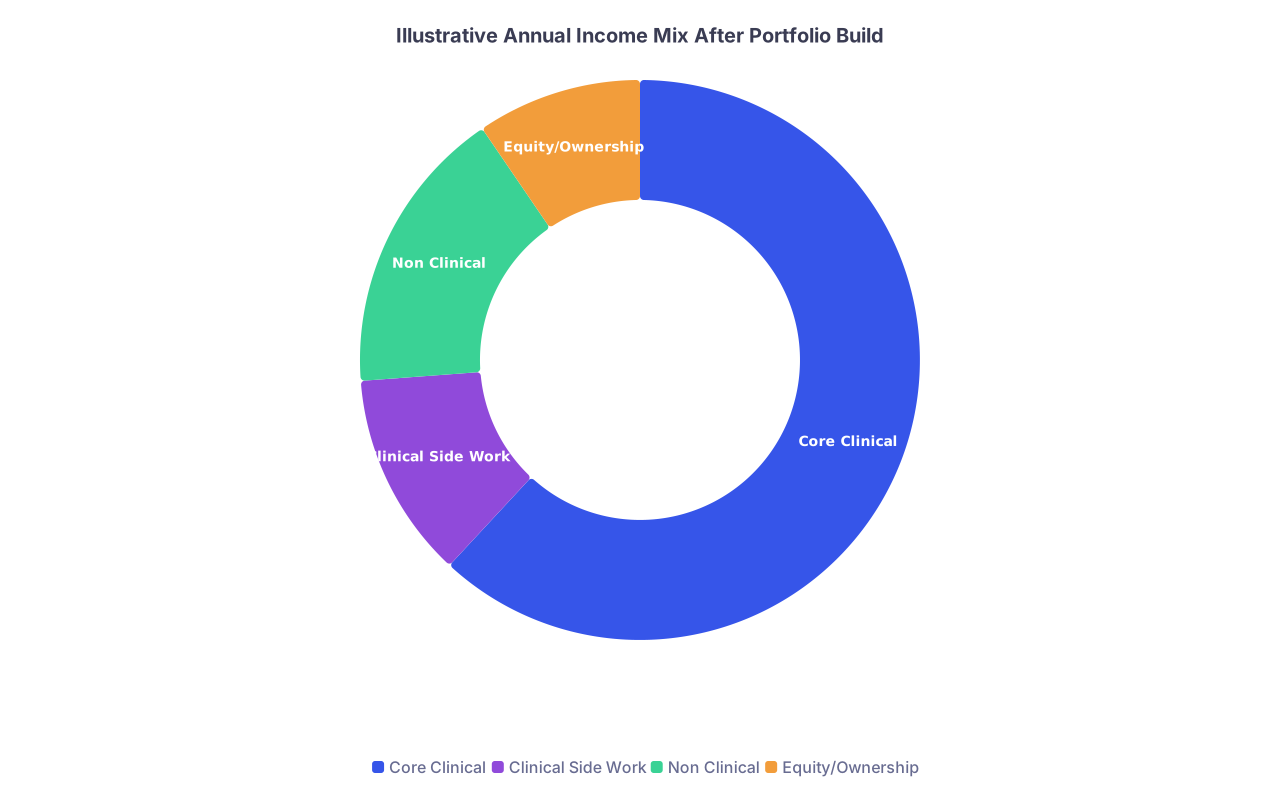
| Category | Value |
|---|---|
| Core Clinical | 260000 |
| Clinical Side Work | 50000 |
| Non Clinical | 70000 |
| Equity/Ownership | 40000 |
This hypothetical pediatrician is sitting near $420k using a very reasonable mix. No 90-hour weeks.
Potential non-clinical lanes:
1. Teaching and Education
- Medical school or residency faculty roles (negotiated stipends, not just “oh by the way”)
- CME speaking and course creation
- Online exam prep (USMLE/COMLEX, specialty boards)
- Developing your own course:
- Behavioral management for pediatric parents
- Sleep training program for infants
- ADHD management course for teachers
Key: own your content and negotiate usage rights. Do not give away your IP casually.
2. Consulting
You have more expertise than you think. Places that pay for it:
Digital health startups
- Product feedback
- Clinical protocol design
- Regulatory / safety input
Employers and payers
- Mental health programs (for psychiatrists)
- MSK / occupational health (for PM&R / FM)
- Pediatric wellness, vaccination policy, school health
Systems and clinics
- Workflow design, panel optimization, quality improvement
If you do not know where to start:
- Set up a simple, clean professional website stating:
- Who you are
- What specialty
- 2–3 specific problem areas you help with
- Start with small, fixed-fee projects. Never “just hop on calls” indefinitely for free.
3. Med-Legal and Expert Work
Particularly ripe for:
- PM&R (functional capacity, disability, injury assessment)
- Psychiatry (capacity, risk, mental status at time of event)
- Pediatrics / FM (standard of care, injury patterns)
Steps:
- Take a basic medico-legal or expert witness course.
- Create a CV geared for legal work.
- Join one or two expert directories; connect with plaintiff and defense firms.
- Charge professionally:
- Set hourly rates that reflect expertise, not clinic pay (think $400–$800/hr depending on niche and experience).
- Strict policies on retainers and payment.
This kind of work is lumpy but high-yield.
7. The Ownership Game: Even Small Slices Matter
You cannot outwork bad hourly pay forever. At some point, your wealth curve depends on owning something:
- Equity in a practice
- Share of an ASC
- Partial ownership in your clinic building
- Equity in a startup you materially help
For low-paying specialties, realistic paths:
Practice-related ownership
- Join a private group with a real partnership track. Ask:
- Buy-in amount and structure
- Historical partner distributions
- How ancillaries are shared (lab, imaging, therapy)
- If employed, explore:
- Shared savings programs
- RVU + bonus structures for quality metrics you can realistically influence
Real estate tie-ins
- Buy into the building your clinic leases. Even a minority share.
- If you are in DPC / concierge or planning it:
- Consider owning a small office condo instead of renting long term.
Startup / advisory equity
- Do not buy random health tech stocks.
- Instead:
- Trade a small, reasonable equity slice for structured advisory work.
- Document your role clearly (meetings, feedback, introductions, design help).
This is speculative. So treat it as a small but intentional slice of your portfolio, not your primary retirement plan.
8. Implementation Timeline: A 3-Year Build
You do not need to guess the sequence. Here is a practical roadmap.
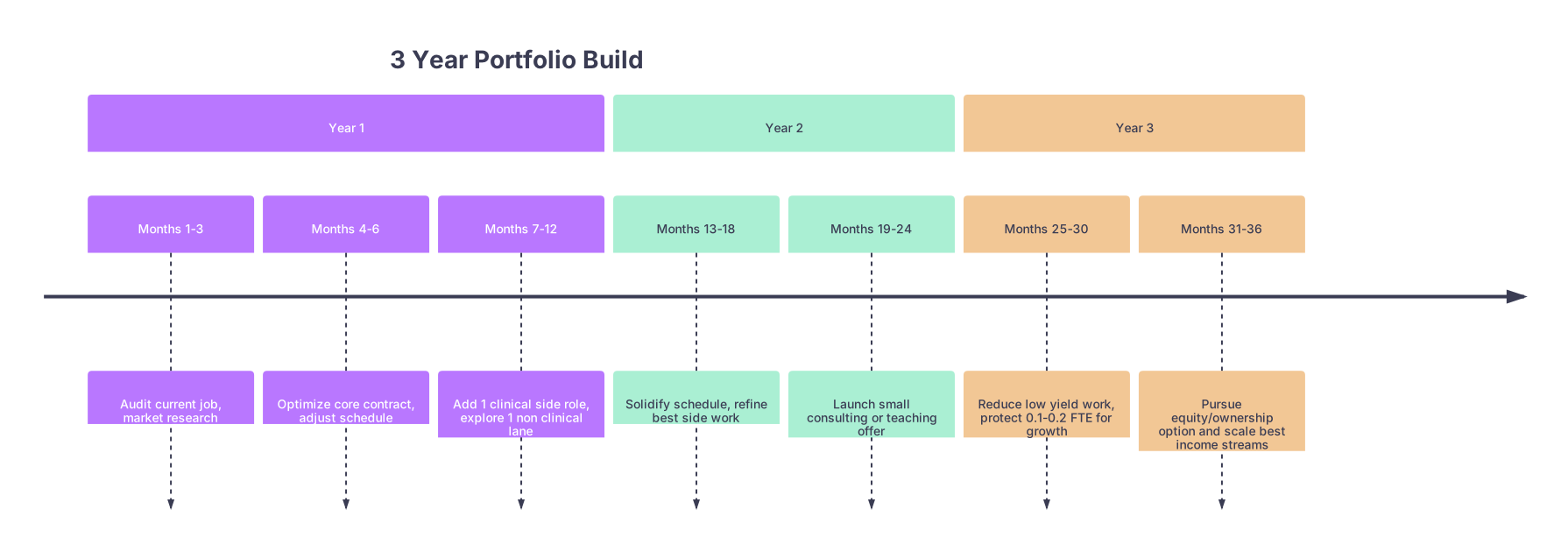
| Period | Event |
|---|---|
| Year 1 - Months 1-3 | Audit current job, market research |
| Year 1 - Months 4-6 | Optimize core contract, adjust schedule |
| Year 1 - Months 7-12 | Add 1 clinical side role, explore 1 non clinical lane |
| Year 2 - Months 13-18 | Solidify schedule, refine best side work |
| Year 2 - Months 19-24 | Launch small consulting or teaching offer |
| Year 3 - Months 25-30 | Reduce low yield work, protect 0.1-0.2 FTE for growth |
| Year 3 - Months 31-36 | Pursue equity/ownership option and scale best income streams |
Year 1: Stabilize and test
- Fix or replace your core job.
- Add one clinical side role. Not five.
- Sample one non-clinical path (guest lecturing, small consulting project, or a tiny digital product).
Year 2: Focus and upgrade
- Drop low-yield experiments.
- Expand what is working:
- More of the specific telehealth that pays well and does not drain you.
- More of the consulting niche where clients actually pay.
Year 3: Shift and own
- Reduce your least efficient core duties (call, unpaid committees) if possible.
- Protect 0.1–0.2 FTE for:
- Non-clinical work
- Ownership opportunities
- Take a deliberate equity step: partnership track, building share, or formal startup advisory role.
9. Guardrails: Avoid the Classic Traps
If you are not careful, you will just recreate the same problem with more moving parts. A few rules that prevent that:
Cap your total weekly work hours
If you regularly live above 60–65 total hours, you will flame out. The point is better pay per unit of time, not endless volume.Say no to “prestige” unpaid work early on
Hospital committees, internal “initiatives,” random “can you just help with this project?”
Until your portfolio is stable, your default is:- “Happy to help if there is a stipend or protected FTE carved out.”
Do not chase 7 different side hustles
You want:- One solid main job
- One reliable clinical side stream
- One growing non-clinical or ownership lane at a time
Separate identity from income experiments
You are still a pediatrician / psychiatrist / PM&R doctor even if one consulting idea fails. So you try another. Failure is data, not a personal indictment.Get real legal and tax help
If you are generating income from multiple sources:- Use an accountant who works with multi-entity physicians.
- Get basic contract review for consulting and side clinical commitments.
- Create a simple LLC for non-W2 income to keep things clean.
10. Example Portfolios by Specialty
You probably want to see what this looks like in real life numbers. So here are simplified but realistic composite examples.
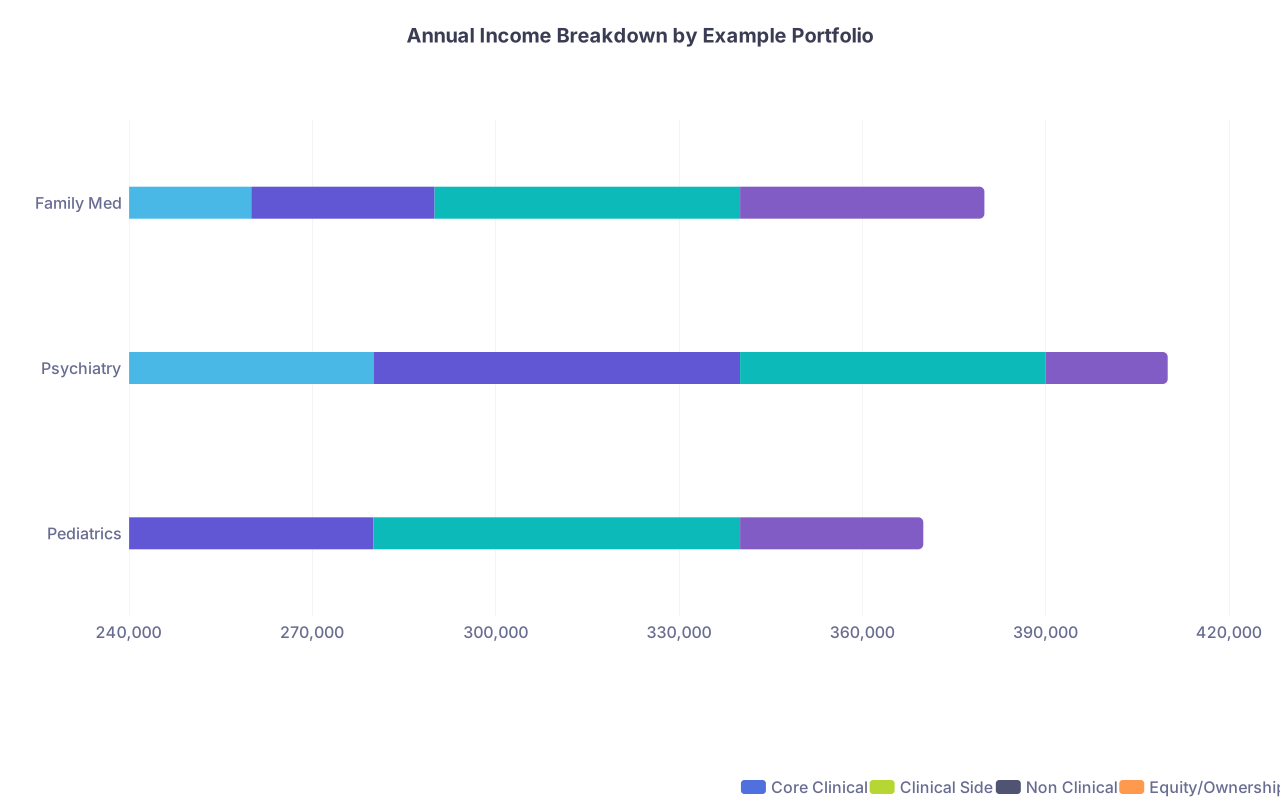
| Category | Core Clinical | Clinical Side | Non Clinical | Equity/Ownership |
|---|---|---|---|---|
| Pediatrics | 240000 | 40000 | 60000 | 30000 |
| Psychiatry | 280000 | 60000 | 50000 | 20000 |
| Family Med | 260000 | 30000 | 50000 | 40000 |
Pediatrics Portfolio (Approx. $370k–$400k)
- Core job: 0.8 FTE employed pediatrician – $240k
- Clinical side: 2 urgent care shifts per month + seasonal telepeds – $40k
- Non-clinical:
- Parent education course + occasional school district consulting – $60k
- Ownership:
- Small share in the clinic building through a physician LLC – $30k in distributions / equity growth
Lifestyle: 45–50 hours/week average, no chronic 80-hour weeks.
Psychiatry Portfolio (Approx. $410k–$450k)
- Core job: 0.7 FTE outpatient psych – $280k
- Clinical side: telepsych shifts across time zones – $60k
- Non-clinical:
- Advisory role with a digital mental health startup + CME talks – $50k
- Ownership:
- Equity grant from startup + small investment in local behavioral health center – estimated $20k equivalent
Lifestyle: Largely remote, high schedule control.
Family Medicine Portfolio (Approx. $380k–$420k)
- Core job: 0.8 FTE employed FM with good RVU structure – $260k
- Clinical side: 1–2 weekend urgent care days/month + occasional locums – $30k
- Non-clinical:
- Employer wellness consulting + corporate health webinars – $50k
- Ownership:
- 10% of a DPC micro-practice they co-founded on the side – $40k between patient membership and enterprise value
Lifestyle: Mix of employed stability with entrepreneurial upside.
FAQ (Exactly 3 Questions)
1. I am a resident in a low-paying specialty. What should I start doing now?
Three things:
- Learn the business side—read about RVUs, compensation models, and contracts.
- Ask attendings who seem “too relaxed for their income” how their work is structured; copy the smart pieces.
- Build one outward-facing skill: teaching, writing, or basic QI/consulting. You will use it later for non-clinical income.
2. How soon after residency can I realistically build a portfolio like this?
You can start in year one, but go slow. Year 1–2 should focus on stabilizing your main job, paying down high-interest debt, and maybe adding one carefully chosen side clinical role. Non-clinical and ownership moves usually start in years 2–5 once you have some stability and a clearer sense of what kind of work you like and are good at.
3. What if my current employer forbids “moonlighting” or outside work?
Then you have a structural problem, not a personal one. You can:
- Clarify exactly what is prohibited—some contracts ban competing clinical work but allow consulting and teaching.
- Renegotiate, especially after you have proved your value.
- Or, if they truly lock you out of any external opportunity with no compensation tradeoff, treat that as a temporary job, not a long-term home, and start planning your exit to an employer or practice that supports a portfolio career.
Key Takeaways:
Use your “low-paying” specialty as a flexible, scalable base, not a cage.
Build a deliberate four-quadrant career portfolio: optimized core job, targeted clinical side work, non-clinical income, and eventual ownership.
Protect your time and energy so you can grow high-value work streams instead of just stacking more low-margin clinic hours.


