

It’s PGY-2. You’re halfway through an IM prelim year, sitting in the call room at 2 a.m., staring at your loan balance: $327,000 at 6.5%. You know you hate wards and you light up in clinic. You’re thinking peds, family med, maybe psych. Then someone says the line every future primary care doc hears:
“Dude, with that much debt, you can’t afford to go into a low-paying specialty.”
Let me answer the actual question you’re asking:
Yes, you can choose a lower-paying specialty with $300K+ in loans and still be financially stable.
No, you cannot do it on autopilot or with sloppy decisions.
If you want primary care, pediatrics, psychiatry, PM&R, or another lower-paying field and you’re carrying mortgage-sized debt, you need a deliberate plan. I’ll walk through what “viable” really means and the concrete levers that matter.
1. What “Financially Viable” Actually Means
Forget vague terms like “comfortable” or “doing fine.” Define viability.
For a low-paying specialty with large loans, I call it viable if you can:
- Pay all essential living expenses without panic.
- Make consistent, on-time student loan payments on a realistic schedule.
- Have a path to being net worth positive (assets > debts) within roughly 10–15 years of starting attending life.
- Maintain some quality of life (you are not eating ramen at 45).
If your specialty lets you do those four things with reasonable guardrails, it’s viable.
Now, what are we talking about when we say “low-paying”?
| Specialty | Typical Range (USD) |
|---|---|
| Pediatrics | $200K–$280K |
| Family Medicine | $220K–$300K |
| Psychiatry | $250K–$350K |
| PM&R | $250K–$350K |
| Geriatrics (IM) | $220K–$280K |
These are national ballparks. Academic or coastal jobs can be at the low end; rural or private practice often higher.
With $300K+ loans, the numbers can still work at these incomes—but not if you pair them with a $1.1M house and two new luxury cars at 32. That’s how people convince themselves their specialty “doesn’t pay enough,” when the real problem is their spending.
2. The Three Big Variables That Make or Break You
With huge loans and a lower salary, a few choices matter more than everything else combined:
- Loan strategy
- Geography and job type
- Lifestyle inflation
If you get those three mostly right, you’re fine. If you botch all three, you’ll feel broke on $280K.
2.1 Loan Strategy: PSLF vs Aggressive Payoff
You’ve got two main lanes:
- Public Service Loan Forgiveness (PSLF) path
- Aggressive payoff (private/fast payoff) path
Let’s put them side by side.
| Factor | PSLF Path | Aggressive Payoff Path |
|---|---|---|
| Employer | Nonprofit / gov | Any (often private) |
| Time to Zero Loans | ~10 years of payments | 5–10 years often |
| Payment Size Early | Lower (income-based) | Higher (standard/refi) |
| Flexibility | Less (must stay qualifying) | More (job/location choice) |
| Total Paid | Often less (for big balances) | Often more, but predictable |
Is PSLF almost mandatory for low-paying specialties with huge debt?
No. Helpful, yes. Mandatory, no.
The crucial question: Do you want to work in a 501(c)(3) or government setting anyway? Many peds, FM, and psych jobs already are.
If yes → PSLF is a very strong tool.
If no → You will just need to be more aggressive on repayment and smarter on lifestyle.
3. Concrete Money Math: A Realistic Scenario
Let’s take a simple, not-optimistic, not-pessimistic pediatrics example.
- Loans: $320,000 at 6.5%
- Specialty: Outpatient pediatrics
- Job: Hospital-employed group in mid-cost city
- Salary: $230,000 starting, rising to $260,000–$280,000
- Status: PSLF-eligible hospital
On Income-Driven Repayment (IDR) + PSLF
Using a modern IDR plan (e.g., SAVE):
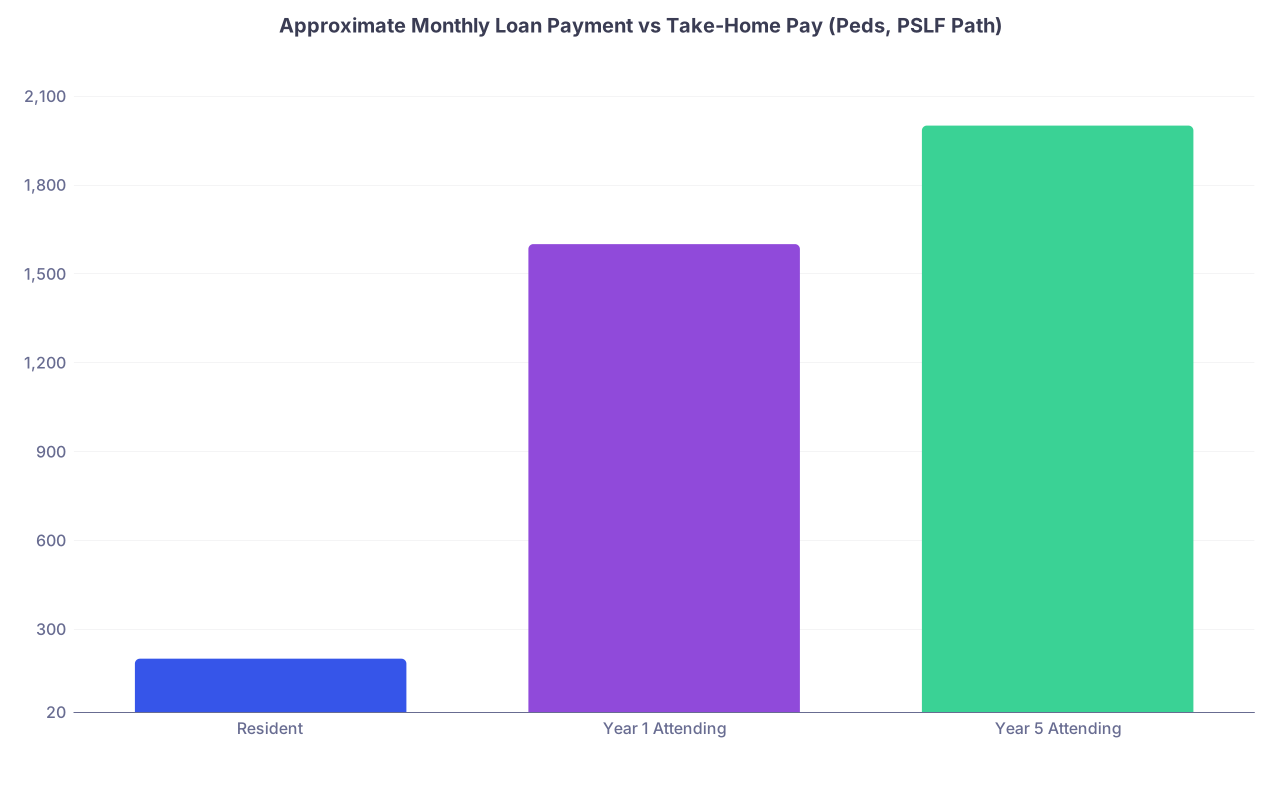
- During residency: very low payments (often <$200/month)
- As attending at $230K, married with one kid, standard deductions: your payment might land around $1,400–$1,800/month initially, then climb with raises.
Let’s look visually at how that might feel versus income:
| Category | Value |
|---|---|
| Resident | 200 |
| Year 1 Attending | 1600 |
| Year 5 Attending | 2000 |
Meanwhile, your monthly take-home at $230K (after taxes, retirement contribution, insurance) might be around $11K–$12K depending on state and deductions.
Is $1,600/month a real number? Yes. Is it miserable on a resident salary? Less fun. As an attending on $230K+, very workable.
Stay 10 total years in qualifying employment (residency counts), keep certifying employment, and the remaining balance is forgiven tax-free under PSLF.
That is absolutely “financially viable.”
On Aggressive Standard/Refi Payoff (No PSLF)
Same doc, but suppose they join a private pediatrics group:
- Salary: $260K–$300K
- Refinance $320K to 4–5% over 10 years
- Payment: roughly $3,200–$3,500/month
Could that work? Yes, but only if:
- Housing cost is kept in check
- No ridiculous car leases
- You don’t max lifestyle to what your peers in dermatology are doing
That payment is heavier, but still fits into a $260K income. You’ll feel the squeeze more, especially if you’re in a high-cost coastal city.
So is pediatrics “impossible” with $320K loans? No. But PSLF or a very intentional payoff plan makes the difference between stress and panic.
4. How Different Low-Paying Specialties Stack Up
Let me be blunt: some “low-paying” specialties actually do just fine for high debt, some are tighter.
| Specialty | With $300K+ Debt? | Comment |
|---|---|---|
| Psychiatry | Very workable | High demand, telehealth, side gigs |
| PM&R | Workable | Mix of inpatient/outpatient options |
| Family Medicine | Workable with discipline | Geography choice matters a lot |
| Pediatrics | Tight but doable | PSLF or lower COL strongly favored |
| Geriatrics | Similar to IM | Often PSLF-friendly institutions |
Fast snapshot:
- Psych: Honestly one of the best “lower-paid” options for high debt. Demand is insane, telepsych lets you add income, and salaries have been climbing.
- FM: Bread and butter primary care. If you’re flexible about rural/suburban and system-employed vs academic, you can easily find $260K–$300K jobs.
- Peds: The thinnest margins. Still viable, but geography and PSLF matter more.
- PM&R: With pain, spine, or interventional skills, you can actually end up mid-to-high income.
- Geriatrics: Often tied to big academic centers = PSLF-friendly.
5. The Two Most Underrated Levers: Location and Lifestyle
This is where people either quietly win or quietly suffer.
5.1 Geography: You Can’t Ignore Cost of Living
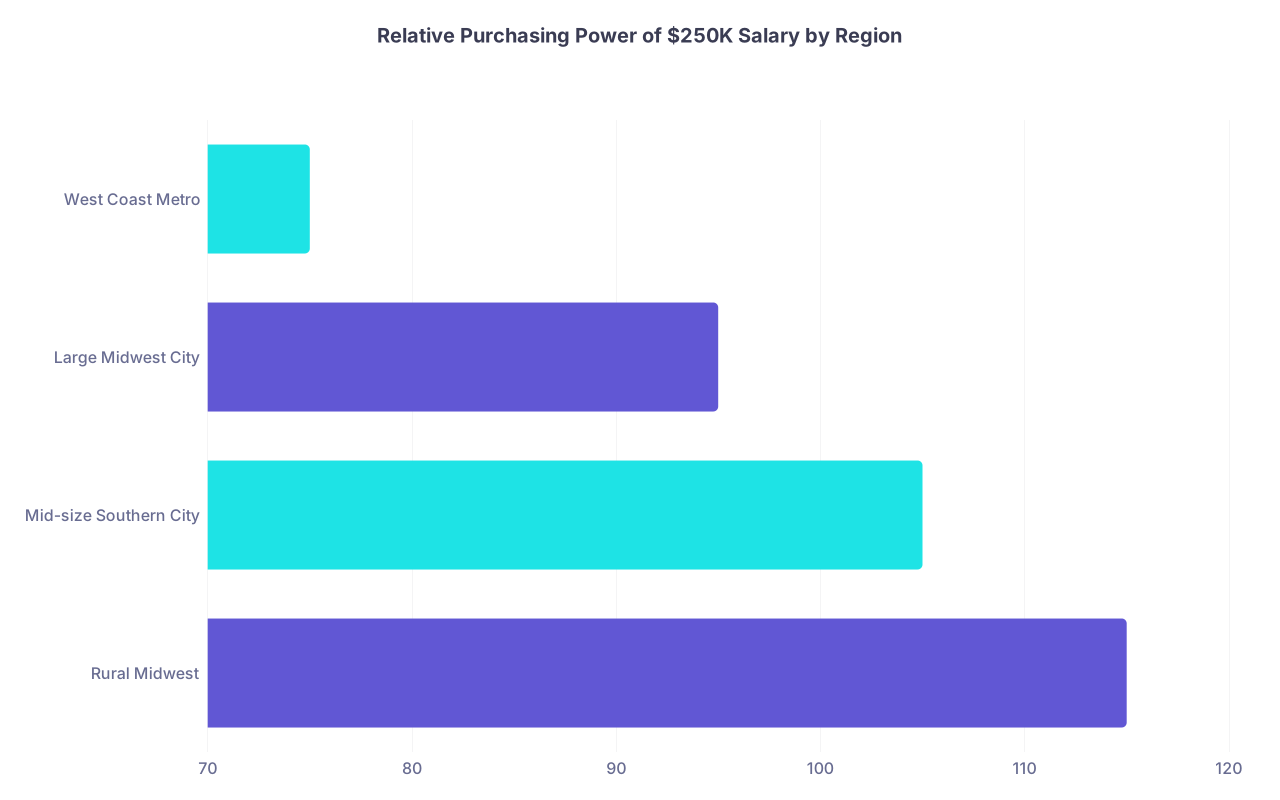
A pediatrician making $240K in Ohio is in better shape than a pediatrician making $260K in San Diego. Housing and childcare will eat you alive on the coasts.
| Category | Value |
|---|---|
| Rural Midwest | 115 |
| Mid-size Southern City | 105 |
| Large Midwest City | 95 |
| West Coast Metro | 75 |
Rough idea: your $250K in a rural Midwest town feels like $300K+ compared to some coastal metros. This matters far more than obsessing over an extra $10K–$20K salary bump.
If you have $300K+ in loans and want a lower-paying specialty, at least start your career in a reasonable cost-of-living area. You can always migrate to a dream city later when your loans are under control.
5.2 Lifestyle: The Unsexy Reality
I’ve seen FM docs at $260K who feel broke. I’ve seen peds docs at $225K who are relatively relaxed financially.
The difference isn’t the specialty. It’s decisions like:
- Do you buy a $400K house or an $850K house?
- Are you driving two paid-off Toyotas or leasing two German cars for $1,500/month?
- Are you trying to “catch up” on lifestyle in your first 3–5 years out?
If you give yourself:
- A 5–7 year “no stupid purchases” rule
- A rough plan to direct 20%+ of take-home to loans and investing combined
You will almost certainly be fine—even in peds or FM—with $300K in loans.
6. How to Decide: Framework for Someone Torn Between Passion and Debt
Here’s a simple way to think it through if you’re still choosing a specialty.
Step 1: Be Honest About What You’ll Hate
If you can’t stand procedures, don’t kid yourself into EM or anesthesia “for the money.” Burnout is expensive too. Switching specialties later can cost you years of income.
Step 2: Check Your Tolerance for Structure vs Flexibility
- If you are totally fine working at a big academic hospital or FQHC, PSLF + low-paying specialty is a very rational path.
- If you want full control, private practice, or niche setups, PSLF may be less compatible. You’ll need either higher-paying niches or stricter budgeting.
Step 3: Rough Out a 10-Year Money Picture
Not detailed spreadsheets, just ballpark:
- Expected attending salary (conservative)
- Chosen repayment strategy (PSLF vs refinance/payoff)
- Likely monthly payment range
- Reasonable housing cost in your target area
You’re not chasing precision. You’re asking: “Does this rough scenario clearly not work, or does it basically fit?”
7. Signs a Low-Paying Specialty Is Not Financially Viable For You
Here’s where I’d say: you’re setting yourself up for chronic stress.
- You’re dead set on living in a top-3 most expensive coastal city.
- You categorically refuse PSLF and prefer the lowest-paying subset of an already low-paying field (e.g., part-time academic peds in ultra-HCOL).
- You know yourself well enough to admit you will not control spending.
If that’s you, then yes—your specialty choice plus your non-negotiables can make things miserable. The loans are the accelerant on that fire.
But blame the whole picture, not just “pediatrics doesn’t pay enough.”
8. Practical Guardrails if You Go Low-Paying with High Debt
Here’s the short, actionable list:
Decide early: PSLF or not.
Stay flexible during residency, keep everything federal, fill out employment certifications, then commit once you see your likely job type.Cap your total housing cost.
As a rule of thumb: keep PITI (mortgage + taxes + insurance) or rent under 20–25% of gross income early on.Commit to a minimum savings/loan rate.
First 5 years out: aim for at least 20% of your gross income going to a mix of loan payoff + retirement.Avoid the luxury arms race.
Your co-resident who matched ortho is not your benchmark.Use any windfalls (bonuses, moonlighting early, signing bonuses) to crush principal or build a real emergency fund, not to upgrade everything.
Do that, and your “low-paying” specialty becomes plenty viable.

FAQ (Exactly 7 Questions)
1. Is it irresponsible to choose pediatrics or family medicine with $300K+ in loans?
No. It’s irresponsible to choose them and then pretend the numbers do not matter. If you use PSLF or a disciplined payoff strategy, control housing and lifestyle, and pick a reasonable cost-of-living area (especially early), pediatrics or FM can absolutely be financially responsible choices.
2. Do I basically have to do PSLF if I have massive debt and want a low-paying field?
You don’t “have” to, but PSLF is extremely helpful for big federal loan balances paired with lower income. If you plan to work at academic centers, VA, county hospitals, or FQHCs anyway, PSLF is almost a no-brainer. If your dream is private practice in a non-qualifying setting, then you’ll skip PSLF and just need a more aggressive payoff approach.
3. How much should I be putting toward loans as a low-paid attending?
As a floor, I like seeing at least 10–15% of gross income going directly toward loans if you’re not doing PSLF, or a similar percentage split between loans and retirement if you are. Many people do more, especially in the first 3–7 years. The idea: your first attending decade is for digging out and compounding, not for maximum consumption.
4. Can moonlighting make a low-paying specialty more feasible?
Yes, in some cases, especially psych, hospitalist FM, or certain PM&R setups. But don’t depend on moonlighting as a permanent crutch. Use it as a temporary accelerator to build an emergency fund, knock down loan principal, or avoid lifestyle creep. Long-term exhaustion from working every weekend is not a plan.
5. Is refinancing my loans smart if I go into a low-paying field?
Refinancing only makes sense if:
- You’re sure you won’t use PSLF or other federal protections.
- You get a significantly lower interest rate.
- You’re committed to a fast payoff timeline.
In a low-paying specialty with job uncertainty or academic/PSLF potential, I’d be very cautious about giving up federal protections permanently.
6. How much does cost of living really matter versus salary?
More than you think. A $230K pediatrics job in a low-to-mid cost city can provide more actual financial breathing room than a $270K job in a coastal metro with $4,000 rent and $2,000 daycare. When you’re carrying $300K+ of loans, geography can be the difference between “tight but okay” and “constant panic.”
7. What are the top 2–3 mistakes I should avoid if I pick a lower-paying specialty with high debt?
Three big ones:
- Buying a too-expensive house in the first 2–3 years as an attending.
- Refinancing out of federal loans too early and killing PSLF options.
- Letting lifestyle inflate to match higher-paid colleagues instead of your actual budget.
Avoid those, and you’ve already solved most of the risk.
Key points to walk away with:
- A “low-paying” specialty can absolutely be financially viable with $300K+ of debt if you treat money decisions as part of your career, not an afterthought.
- PSLF, location choice, and lifestyle control matter more than the difference between pediatrics vs family vs psych salary bands.
- You do not need to sacrifice the specialty you love purely because of loans—but you do need a plan and the discipline to stick to it.


