

The idea that picking a low‑paying specialty ruins your financial future is lazy, loud, and wrong.
If you end up broke as a pediatrician or psychiatrist in 2026 and beyond, it will not be because of your specialty. It will be because of your decisions.
Let’s walk through what the numbers actually say, not what the loudest anesthesiology PGY‑2 in the call room says between cases.
What “Low‑Paying” Actually Means (And What It Doesn’t)
When med students say “low‑paying,” they usually mean primary care and cognitive fields. Think:
- Pediatrics
- Internal medicine (general)
- Family medicine
- Psychiatry
- Geriatrics
- Endocrinology, rheumatology, infectious disease, etc.
You’ve heard the horror lines:
“I love peds, but I don’t want to be poor.”
“FM sounds great, but I can’t pay off $300k that way.”
“Psych is interesting, but I want a life where I’m not stressing every bill.”
Let’s kill the caricature with actual data.
Most recent compensation surveys (MGMA, Medscape 2024, Doximity) put these ballpark medians:
| Category | Approx. Median Income |
|---|---|
| Primary Care (FM, IM) | $260k–$290k |
| Pediatrics | $240k–$260k |
| Psychiatry | $280k–$320k |
| Hospitalist IM | $300k–$350k |
| Surgical Specialties | $450k–$650k+ |
| Radiology/Anesthesia | $450k–$550k |
Are there outliers? Yes. But this is the basic spread.
Now look at that again: “Low‑paying” specialties are still paying 4–5 times the US median household income.
So the right question is not “Will I be broke as a pediatrician?”
The right question is “How does a quarter‑million dollar income interact with debt, taxes, saving, and lifestyle choices over decades?”
That is where people get wrecked. And it has almost nothing to do with picking peds vs ortho.
The Only Three Variables That Actually Decide Your Financial Life
Over a 30‑year career, your financial outcome hinges mostly on three things:
- Your savings rate
- How long you stay in the game (career length and burnout)
- How fast you let your lifestyle inflate
Your specialty affects your ceiling. These three decide everything else.
Let’s anchor this with numbers instead of vibes.
A quick comparison: “low‑paid” vs “high‑paid”
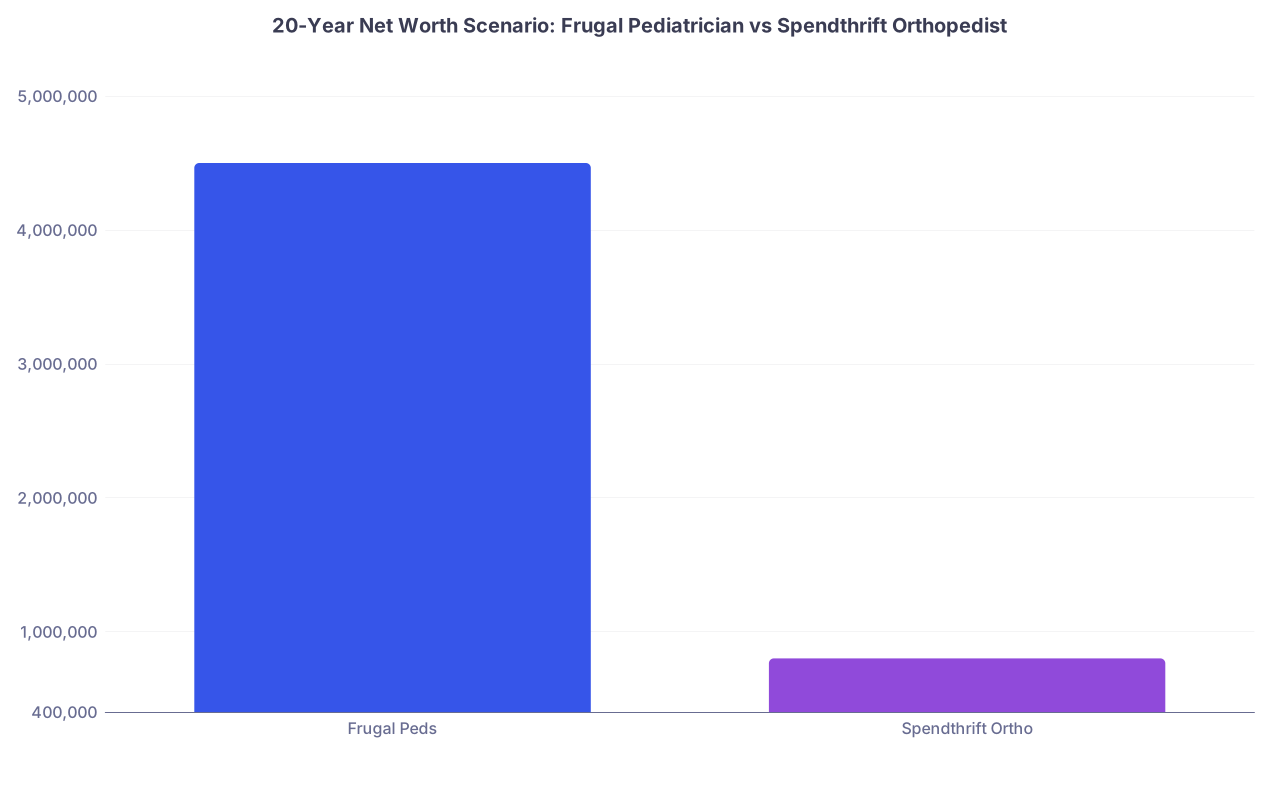
| Category | Value |
|---|---|
| Frugal Peds | 4500000 |
| Spendthrift Ortho | 800000 |
Assumptions (simplified but realistic):
Pediatrician:
- Income: $260k
- Taxes/benefits: $90k
- Living expenses: $90k
- Savings/investing: $80k per year
- Investment return: 5% real (after inflation)
- Time: 20 years
Orthopedic surgeon:
- Income: $600k
- Taxes/benefits: $230k
- Lifestyle: $350k (big house, private school, luxury cars, everything “deserved”)
- Savings: $20k per year (yes, I’ve seen this in real life)
- Same 5% real, 20 years
Do the math:
- Pediatrician saving $80k/year at 5% real for 20 years → roughly $2.6M in investment assets alone. Add home equity and growth after year 20, you’re on track for $4–5M+ net worth by retirement.
- Orthopod saving $20k/year for 20 years → about $680k. Add some home equity, maybe you crack $1M. Maybe.
Higher income just lets you inflate lifestyle faster if you are sloppy. The “broke doctor” cliché is not primary care–specific. It’s behavior‑specific.
The Debt Panic: Why the Med School Scare Stories Are Misleading
Med students fixate on the debt number like it’s a death sentence.
“I’ll have $350k in loans—how can I do family medicine?”
Fine. Let’s stop hand‑waving and run the numbers.
Example: $350k in federal loans
Assume:
- $350,000 principal
- 6.5% interest
- 10‑year standard repayment vs 20‑year extended vs PSLF path
Are these exact for you? No. But they’re close enough to debunk the doom.
10‑year standard repayment
Payment is roughly $3,970/month (~$47,600/year).
On a $260k primary care income:
- After federal/state taxes and benefits, let’s say you keep ~$160k
- Minus $47.6k for loans → ~$112k
- Live on $80k–$90k? You still have $20–30k/year to invest and build an emergency fund.
Is it tight in a HCOL city with daycare? Yes. Is it “I can’t survive in peds” tight? Absolutely not.
20‑year extended repayment
Payment drops to around $2,700/month (~$32k/year). You pay more interest over time, but your early‑career cash flow improves.
That gives you room to:
- Max out a 401(k)/403(b) earlier
- Build a down payment
- Avoid expensive credit card/consumer debt
The “I can’t ever breathe” narrative usually assumes:
- A huge luxury house within 2–3 years of attending income
- Two new cars on loans or leases
- Private school for kids from day one
- No roommates, no delay on “doctor lifestyle”
That’s not a specialty problem. That’s an entitlement problem.
Where PSLF and income‑driven repayment change the calculus
If you work for a qualifying non‑profit hospital or academic center for 10 years:
- You can use an IDR plan (SAVE/REPAYE, IBR, etc.)
- Pay based on 10–15% of discretionary income
- Get tax‑free forgiveness after 120 qualifying payments
The wild part? PSLF is often more valuable for “lower‑paid” specialties because:
- Your income is lower → your payments are lower → more gets forgiven
- You’re more likely to be in academic or non‑profit settings
- A pediatrician at a children’s hospital can walk away with massive forgiven balances
I’ve personally seen general pediatricians get six‑figure balances forgiven in year 10 while maxing retirement for years. They were not suffering. They were…fine.
If you deliberately choose a PSLF‑friendly career path, a low‑paying specialty does not doom you. It might actually be an advantage.
The “Lowest Paid” Specialties Are Not Hopeless—They’re Under‑Optimized
Let’s look at a few of the so‑called “worst” financial specialties and how people in each actually do well.
Pediatrics
The myth: “Peds is the worst paying specialty. You’ll always be struggling.”
Reality:
- Median comp: about $250k, but high‑need regions and hospitalist peds can hit $300k+ with bonuses.
- Many peds jobs qualify for PSLF, NHSC, or state loan repayment programs. I’ve seen $30k–$100k in loan repayment packages for rural or underserved child health jobs.
- Side realities: urgent care shifts, telemedicine, niche clinics (developmental peds, ADHD/behavioral, lactation, etc.) add incremental income.
The pediatricians who struggle usually have two patterns: living as if they were dermatologists, or staying at badly negotiated salaries for years because “it’s awkward to ask.”
Psychiatry
The myth: “Psych is chill but you’ll never make real money.”
Reality:
- Median comp now often ~ $300k and rising; demand is insane.
- Outpatient private practice with cash or hybrid models can easily cross $400k–$500k with far better control of your schedule than most fields.
- Tele‑psych, consultation‑liaison work, and collaborative care models boost earning options.
Psych might be the single best risk‑adjusted combo of lifestyle and earning potential right now. The psychiatrists who are stressed about money often got stuck in low‑paying community mental health setups and never built leverage or a partial private panel.
Family Medicine / General Internal Medicine
The myth: “Primary care is dead. You’re a hamster on the RVU wheel for pennies.”
Reality:
- Traditional employed clinic jobs are often $230k–$280k, but:
- Hospital‑employed FM with inpatient, procedures, or OB can be more
- Direct primary care (DPC) models can reach $300k–$400k at scale with sane schedules
- Urgent care / occupational medicine paths bump comp even higher
I’ve watched FM docs leave a miserable $220k RVU prison and double income while doing less soul‑sucking work by moving to DPC or hybrid urgent care/clinic setups.
Again: the median RVU‑based clinic job is not your destiny unless you sit still and accept it.
Lifestyle Inflation: The Silent Specialty Killer
You know what I don’t see on med Twitter threads about “peds is too low paying”?
Specifics like this:
- “I want a $1.4M house by age 33.”
- “I want two new $80k SUVs on loans.”
- “I want 3 vacations per year, business class, and private school for 3 kids.”
But that is exactly how many attending budgets actually look. I’ve seen the spreadsheets.
Low‑income specialty + high‑income lifestyle = financial stress.
High‑income specialty + high‑income lifestyle = delayed disaster.
The formula that works is boring:
- First 3–5 years as an attending: pretend you make half of what you actually do
- Crush loans or commit to PSLF with a clear written plan
- Max retirement accounts early (time in market dwarfs specialty differences)
- Do not buy the final “doctor house” until your financial footing is solid
I’ve seen a pediatrician couple with $500k in loans hit $1M net worth in under 10 years. They lived like upper‑middle‑class professionals instead of surgeons. That was the entire secret.
Burnout and Career Length: The Part No One Mentions
Let’s talk about orthopedics vs pediatrics from a different angle.
Who do you think is more likely to:
- Work 30+ years without burning out?
- Stay clinically active rather than punching out at 55, bitter and exhausted?
- Find flexible or part‑time work late in career?
If you last 30 years in a “lower paying” specialty vs 20 years in a high‑intensity surgical field before bailing, the lifetime earnings picture shifts.
Rough math:
- Peds at $260k for 30 years → $7.8M gross
- Ortho at $600k for 20 years → $12M gross
Sure, the ortho number is higher. But now subtract:
- Higher taxes
- Higher cost of maintaining a bigger lifestyle
- Earlier retirement with more years to fund
And remember: lots of high‑earning fields also come with more expensive practice insurance, more years in training, and more lifestyle expectations from the social circle they tend to run in.
Meanwhile, a psych doc working 0.7 FTE at age 68, seeing patients they actually like, is quietly stacking wealth in the background with compounding doing the heavy lifting.
Longevity matters. Enjoying your job enough to keep doing it matters more than almost any specialty‑level comp gap.
The Real Financial Risks—And None Are “Picking Pediatrics”
Let me be blunt. Things that genuinely threaten your financial future as a physician:
- Not understanding taxes, retirement accounts, and basic investing until age 45
- Marrying someone who believes “we make $300k so we can afford anything”
- Staying at a lowball salary because negotiating feels uncomfortable
- Buying too much house too fast (this one wrecks more doctors than student loans)
- Never building any non‑clinical income or flexibility (teaching, admin, consulting, niche services, or a practice with equity)
Notice what’s missing?
“Choosing family medicine instead of anesthesia.”
You can choose a low‑paying specialty and wreck your finances. You can choose a high‑paying one and do the same. The constant in both failures is behavior, not board certification.
How to Sanity‑Check Your Own Numbers
Let’s give you a simple litmus test. You do not need a fancy spreadsheet for this.
Within 5 years of finishing residency or fellowship, in any specialty, you want to be able to say:
- I have a written student loan plan (aggressive payoff or PSLF/IDR with real timelines, not vibes).
- I’m saving at least 20% of my gross income (between retirement accounts and taxable investing).
- My fixed expenses (housing, loans, insurance, basic living costs) are low enough that if my income dropped by 25%, my life would be annoying but not catastrophic.
If that’s not true, your problem is not pediatrics. Your problem is financial design.
Stop Blaming the Specialty
The myth that a “low‑paying” specialty dooms you financially is comforting. It shifts responsibility away from you and onto an abstract villain: reimbursement rates, RVUs, “the system.”
The data says otherwise.
Key points:
- Most “low‑paying” specialties still earn 4–5x the US median income. Your savings rate, lifestyle choices, and debt strategy dominate your long‑term outcome, not the last $150k of income gap between fields.
- Debt, even $300k+, is very manageable in pediatrics, family med, psych, and IM with a realistic payoff or PSLF plan and a few years of deliberately restrained lifestyle. The horror stories almost always skip the spending details.
- Picking a specialty you actually like makes you far more likely to work longer, negotiate better, and build flexible income streams. That long-term durability usually beats a reluctantly chosen high-paying field over a 30-year career.
You are not choosing between “rich surgeon” and “poor pediatrician.” You are choosing between “doctor who uses a high income intelligently” and “doctor who lets lifestyle inflate until nothing is left.”
Specialty is just the backdrop. Your decisions write the script.


