

Most physicians in low-paying specialties leave six figures on the table in their first five years. Not because of greed. Because they never learned how to negotiate.
You picked primary care, pediatrics, psychiatry, family medicine, geriatrics, maybe even hospitalist work in a saturated market. Good. Society needs you. But the market does not reward you automatically. You have to pull that money out of the system with leverage and tactics.
This is not another “know your worth” pep talk. You are about to get a practical, stepwise playbook for turning weak-looking offers into strong ones in low-salary fields.
1. Face the Reality: You Are in a Low-Salary Field – Use That, Do Not Fight It
You do not win by pretending your field is cardiothoracic surgery. You win by understanding where your leverage actually comes from.
Low-salary fields typically include:
- Family Medicine
- General Internal Medicine / Outpatient IM
- Pediatrics
- Psychiatry (in some markets)
- Geriatrics / Palliative
- Some academic positions in any specialty
In many of these fields, headline salary is mediocre, but the hidden levers are huge:
- Schedule control
- Call burden
- RVU thresholds and bonuses
- Signing and retention bonuses
- Loan repayment
- Non-clinical time and leadership roles
- Telehealth or hybrid structures
If you walk into negotiation focused only on base salary, you will lose. The employer already knows what the MGMA median is. They also know you do not.
You need a framework.
| Lever Type | Examples |
|---|---|
| Cash up front | Signing bonus, relocation |
| Cash over time | RVU bonus, quality bonus |
| Debt reduction | Loan repayment, PSLF structure |
| Lifestyle | Schedule, call, admin time |
| Growth | CME, leadership, protected projects |
Your mindset: “I know salary is constrained. So we are going to move every other lever as far as it will go.”
2. Do Your Homework: Market Data and Real Numbers
You cannot negotiate from vibes. You need numbers.
Step 1: Get real compensation data
Do this before you ever say what you “expect.”
Sources that actually matter:
- MGMA data (often available via your program leadership or hospital admin)
- AAMC salary data for academic roles
- Doximity Residency Navigator + compensation reports
- Talking to recent grads from your specialty who are 1–3 years out
- Recruiters (yes, they spin, but they still leak numbers)
Ask your seniors:
“Hey, I am starting to look at FM offers in the Midwest. What ranges are you seeing for base + bonus? Any outliers?”
You want concrete packages, not vague impressions.
Example notes from a real FM resident I worked with:
- Rural Midwest FM: 260k base, 25k signing, 30k loan repayment/year x3, 4-day clinic, 1:4 call
- Suburban Southeast FM: 220k base, RVU after 4,500, 15k signing, no loan help, 1:6 call
- Academic IM (Northeast): 190k base, 10% quality bonus possible, 20% protected time, 1:5 call
You do not need perfect data. You need enough to say, “Comparable positions in similar markets are offering X–Y.”
Step 2: Know your own profile
Your leverage is not random. It comes from specific things:
- Are you willing to work rural or underserved?
- Any special skills: addiction, geriatrics, women’s health, bilingual, procedures?
- Visas (J1/H1) – hurts leverage in some ways, helps in underserved areas
- Willing to do inpatient/outpatient mix, nights, or crisis work?
Write a one-line value statement for yourself:
“I am a bilingual outpatient psychiatrist comfortable with high-acuity patients, open to underserved urban settings, and willing to build a full panel.”
That sentence becomes the spine of your negotiation. You repeat it in different forms until they feel how expensive it would be to lose you.
3. Stop Doing the Two Things that Kill Your Leverage
I see residents blow negotiations in the first 60 seconds constantly. Two moves in particular.
Killer #1: Disclosing your number first
When an employer asks, “What are your salary expectations?” they are not making small talk. They are trying to pin you to the floor.
Your goal is to anchor them, not yourself.
Use something like:
“I am looking for a fair, market-competitive offer for a [specialty] physician in this region, with appropriate recognition for call, complexity, and access issues. I would like to see the full package you have in mind.”
If they push:
“From what I have seen, similar positions for [specialty] in [region type] are in the range of [lower-middle range] plus bonuses and loan or sign-on support. But I am more focused on the overall structure—schedule, call, and long-term growth.”
You gave a range, not a single number. You kept the focus on the package, not just base salary.
Killer #2: Accepting “this is standard” without pressure
“This is our standard contract.”
“This is what we offer all our new grads.”
“This is non-negotiable.”
I have seen plenty of residents fold the second they hear these phrases. Big mistake.
Your answer should sound like:
“I understand you have a standard template. My goal is to make sure the details reflect the realities of [specialty] and workload here. Let us go line by line through compensation, call, and productivity expectations and make sure they are aligned.”
You do not have to be combative. You do have to be relentless.
4. Priority Tactics by Low-Salary Specialty
Let us get specific. Different low-paid fields have different pressure points. Here is how to attack them.
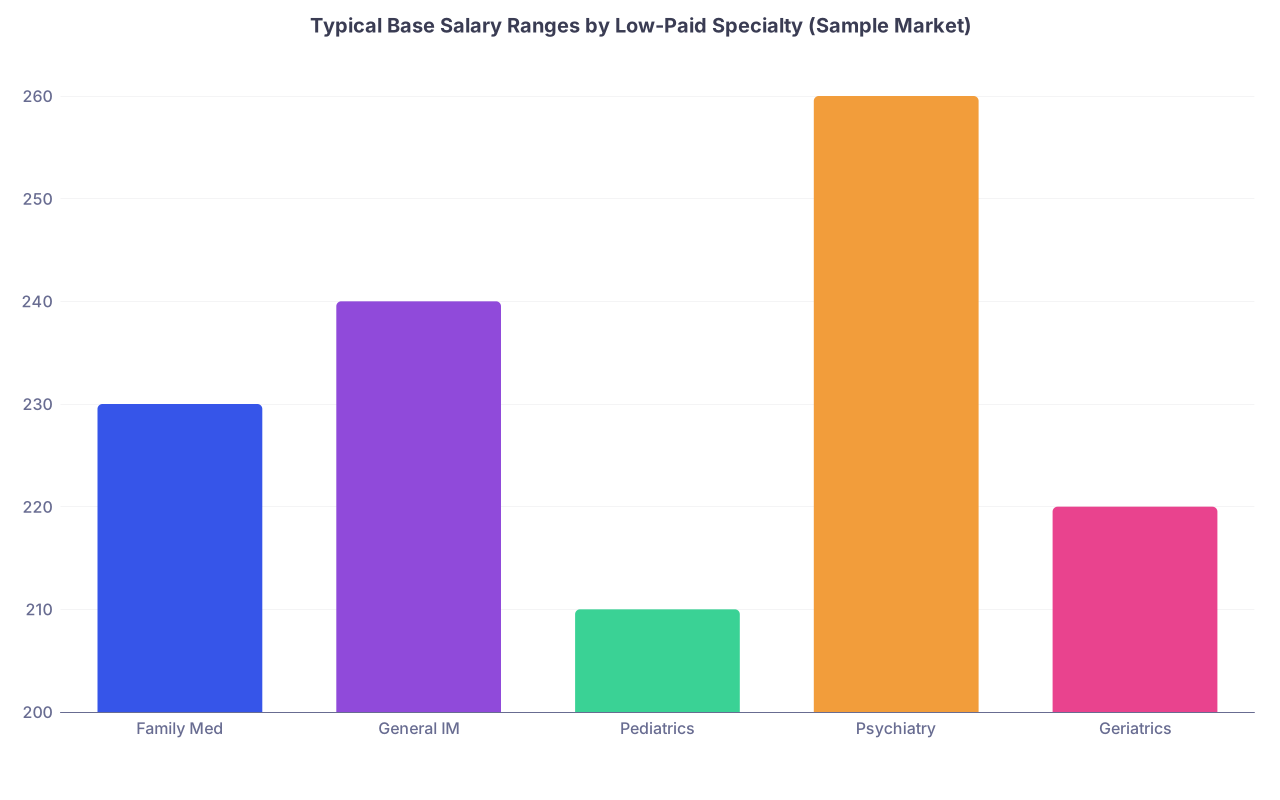
| Category | Value |
|---|---|
| Family Med | 230 |
| General IM | 240 |
| Pediatrics | 210 |
| Psychiatry | 260 |
| Geriatrics | 220 |
Family Medicine / Outpatient IM
Base salary is often capped. Volume and “extras” are where your money comes from.
Tactics:
Guard your RVU thresholds
- Push for: lower thresholds for bonus activation (e.g., bonus after 4,000 RVUs, not 5,000–6,000).
- Clarify the conversion factor: how many dollars per wRVU after threshold?
- Demand RVU transparency monthly.
Attack panel expectations and visit length
You cannot see 28 patients per day with 15-minute slots and maintain quality of life.
Use language like:“To provide safe care and sustain productivity, I want clear expectations. What is the target visits per day? Average complexity? I would like this written into the contract or a signed addendum.”
Use call as currency
- If they need you to take heavy call: trade it directly for money and/or time.
- Concrete ask: “For 1:4 call including weekends, I would expect either a stipend of X per call shift or a post-call half day protected.”
Push for realistic ramp-up guarantees
- New grad FM: demand a guaranteed minimum for 1–2 years while panel builds.
- Ask for: “floor” income plus RVU upside, not pure production from day one.
Pediatrics
Peds gets punished financially. You fix that by maximizing non-base elements.
Key levers:
- Loan repayment (peds is catnip for many loan programs)
- Signing bonus + relocation
- Schedule and call structure
Specific moves:
Loan repayment: make them put real money on it
“Given typical pediatric compensation, loan burden is a major factor in long-term retention. What is the maximum loan repayment support your system has offered in similar roles? I would like that written in with a clear schedule.”
Volume and ancillary support
Peds becomes brutal without good MA/RN support and care coordination.
Ask explicitly:- “How many support staff per provider?”
- “Is there scribe support?”
- “Who handles non-visit tasks (refills, forms, portal messages)?”
Protect your schedule for sanity and side income
If they will not pay more, you may need side work (urgent care shifts, telepeds).
Push for:- 4-day week
- No prohibition on outside work, or at least reasonable limits
Psychiatry
Psych does better than most “low” specialties now, but you still see underpaid hospital-employed psych. Your leverage comes from demand.
Approach:
Do not accept the first number in psych
I have seen psych offers jump 40–60k with one counter.
Use market data aggressively:“Comparable inpatient psych roles in this state are offering in the 300–340k range plus call stipends. Your initial offer of 270k feels below market. What flexibility do you have to move closer to that range?”
Attack how ‘productivity’ is defined
- Are you paid per encounter, per wRVU, or per shift?
- Are involuntary holds, crisis evaluations, group visits valued correctly?
- Push for: predictable shift-based pay over pure RVU whenever possible.
Call and coverage
- Demand specific call terms: “X calls per month, Y inpatient census cap, Z backup coverage.”
- If they will not raise salary, push for a significant call stipend.
Telehealth clauses
- Make sure you can do telepsych on the side if they are underpaying you or, if they insist on exclusivity, they pay for that exclusivity.
Geriatrics / Palliative / Underserved Fields
These roles can be underpaid and emotionally heavy. You have to build guardrails.
Key moves:
Define patient mix and caps
“Given the complexity of a frail geriatric and palliative population, I want explicit caps on daily patient volume and clear expectations for how goals-of-care conversations and family meetings are scheduled and credited.”
Push for extra non-clinical time
- Palliative and geriatrics require documentation, coordination, family meetings.
- Ask for: 20–30% protected time written into the contract.
Tie your work to quality metrics that pay
Many systems get quality bonuses for readmission reduction, advanced care planning, etc.
Negotiate:- A share of quality incentive dollars.
- Specific, achievable metrics and a percentage of pool.
5. Tactics to Improve a Weak Offer Without Saying “No”
You do not have to pick a fight to improve an offer. You have to ask the right sequence of questions.
Use this structure:
Clarify everything
- “Walk me through how total compensation is calculated in a typical year for someone meeting expectations.”
- “What have your last two new hires actually earned in years 1 and 2?”
Find the soft spots
Listen for hesitations around:- Signing bonus size
- Relocation
- Loan repayment
- RVU threshold
- CME, admin time, call pay
Propose a package shift, not just ‘more money’
Example script for a low FM offer:
“I appreciate the 220k base. That feels a little below what I have seen for similar rural FM roles in this region. If base cannot move much, I would like to discuss three areas:
- Increasing signing bonus from 10k to 25k with a 3-year commitment,
- Adding a 20k/year loan repayment for the first 3 years, and
- Lowering the RVU threshold for bonus activation from 5,000 to 4,200.”
You gave them options. You did not just say “pay me more.”
6. Use Timing, Competition, and Silence as Weapons
Negotiation is not only what you say. It is when and how.

| Step | Description |
|---|---|
| Step 1 | Receive Offer |
| Step 2 | Clarify Terms |
| Step 3 | Collect Comparables |
| Step 4 | Request Meeting |
| Step 5 | Present Counter Package |
| Step 6 | Review Again |
| Step 7 | Decide Stay or Walk |
| Step 8 | Employer Response |
Timing
- Best leverage: when they like you but before they have you signed.
- Worst leverage: after you have verbally committed and set a start date.
So you:
- Get the written offer.
- Say: “Thank you, I will review and get back to you in a few days.”
- Gather data, map your counter, then schedule a call (not email only) to discuss.
Competition
Even in low-paying fields, competing offers change everything.
You do not need to threaten. You just show reality:
“I am seriously considering two offers: yours, which I like because of [reasons], and another that is offering [better terms]. If we can adjust [specific items] to more closely align with that range, I would be very comfortable committing here.”
If they know another system is at 260k and they are at 220k, many will quietly move.
Silence
Stop talking after you ask for something.
Bad version:
“I was hoping we could move the base up closer to 240k. I know budgets are tight, and I totally understand if that is not possible, but…”
They heard nothing after “240k.” You negotiated against yourself.
Better:
“Based on my research, I would like to see the base closer to 240k. What can you do on that?”
Then shut up and wait. Let them fill the silence.
7. Do Not Ignore Non-Salary Terms That Make or Break Your Life
The biggest trap in low-salary fields: saying yes to “okay money, terrible structure.”
You must hard-check these items before you sign:

Red-flag areas
Non-compete clause
- How many miles, for how long, for what type of work?
- In primary care, a 20–30 mile non-compete can trap you.
Termination terms
- “Without cause” termination notice period should be mutual and reasonable (60–90 days).
- If they can drop you with 30 days notice and you need 120, that is a problem.
Productivity and “duties as assigned”
- If the contract says you can be moved to “any related duties,” you might become the full-time urgent care doc or inpatient workhorse without extra pay.
- Push for: clear primary role and compensation adjustments for major changes.
Exclusivity and moonlighting
- If base salary is low, you may want side jobs.
- Ask them to either:
- (a) lift strict exclusivity, or
- (b) pay enough to justify exclusivity.
Concrete “fix” language
You can say:
“Given the compensation level, I need flexibility to do occasional external clinical work. Can we adjust the exclusivity clause to allow outside practice with prior approval, as long as it does not conflict with primary duties?”
Or:
“The non-compete radius of 30 miles for all outpatient practice feels too restrictive. I would be comfortable with 10 miles specific to [employer’s main practice area]. Can we update that language?”
Do not sign until you recognize every clause and could explain it to another resident.
8. Short Scripts You Can Actually Use
Residents always ask for this. So here you go—plug-and-play language.

When you first get the offer
“Thank you for putting this together. I appreciate seeing everything in writing. I am going to review the details, compare with other information I have, and I will get back to you within 3–5 days with any questions and my thoughts.”
When you want to push on total comp
“Looking at similar [specialty] positions in this region, total starting compensation—base plus likely bonus—is typically in the [X–Y] range. Right now this offer lands a bit below that. I am very interested in the role, and I would like to explore how we could adjust the package to be more in line with that market range.”
When they say “we cannot change base”
“If base is truly locked, I understand. In that case, I would like to focus on the elements that might be more flexible:
- Signing or relocation support
- Loan repayment
- RVU thresholds and bonus structure
- Call compensation
What room do you have to move in those areas?”
When you want time to think after a counteroffer
“I appreciate you working with me on this package. Let me review these changes in detail tonight and I will get back to you by [specific day] with a final answer.”
Notice the pattern: calm, clear, specific, with deadlines.
9. A Simple Negotiation Checklist for Low-Salary Fields
Print this. Seriously.

Before you talk numbers:
- Get at least 2–3 real-world compensation examples from recent grads
- Learn the MGMA/AAMC range for your specialty and region type
- Define your top 3 priorities (e.g., loan repayment, 4-day week, minimal call)
When you receive an offer:
- Ask for the full package in writing
- Do not commit verbally on the spot
- Map their offer against your data and priorities
When you counter:
- Focus on total compensation and structure, not just base salary
- Bundle your asks (3–4 specific changes)
- Be ready with at least one other ongoing conversation (even if weaker)
Before you sign:
- Non-compete radius and duration are reasonable
- Call expectations and pay are explicit
- RVU thresholds, bonus formulas, and panel/volume expectations are clear
- Termination and exclusivity clauses are understood and acceptable
FAQ (Exactly 4 Questions)
1. I am in a very low-paying region and specialty. Is negotiating even worth it?
Yes. I have seen “hopeless” offers move by 10–30k in total value with one structured counter. In low-salary fields, you often will not move base much, but you can improve signing bonuses, loan repayment, RVU thresholds, schedule, call pay, and non-clinical time. Over 3–5 years, that easily adds up to six figures and a much better life.
2. What if I have only one offer and no other interviews? Do I still have leverage?
You always have some leverage, because hiring a new physician is expensive and slow. Your leverage is lower without competing offers, so you negotiate more gently and focus on multiple small wins instead of one big ask. Use market data (“similar roles in this region are offering…”) and emphasize your long-term commitment to the area to justify adjustments.
3. Should I hire a contract attorney for my first job?
If you can afford it, yes. But pick one who actually reviews physician contracts regularly, not a random lawyer. Their main value: spotting dangerous clauses (non-compete, termination, call expectations, bonuses you will never actually earn) and suggesting specific language changes. They will not magically get you 100k more, but they can prevent you from walking into a trap that costs you far more.
4. How do I know when to walk away from an offer in a low-salary specialty?
Walk if three things line up:
- The total package sits well below clearly documented market ranges,
- They refuse to budge on obvious pressure points (call, RVU thresholds, loan help, non-compete), and
- The culture feels dismissive—rushing you, saying “everyone signs this,” avoiding specifics. In that scenario, the problem is not just the money. It is how they plan to treat you once you are locked in.
Key takeaways:
- In low-salary specialties, leverage lives in structure, not just base pay—attack RVUs, call, bonuses, and loan support.
- Never negotiate from ignorance; get real numbers from peers and use them calmly but directly.
- Treat your first contract like a major procedure: planned, deliberate, and checked line by line before you sign.


