

Your specialty choice does not have to sentence you to 25 years of financial stress.
Most residents in lower-paid fields think, “I will just figure out my loans after residency.” That is a financial disaster in slow motion. The playbook you run during residency is the difference between controlled, predictable debt and a ballooning mess that dictates every career decision you make.
Let me be blunt: psychiatry, pediatrics, family medicine, PM&R, neurology, geriatrics, primary care anything—you cannot copy the repayment strategy of your orthopedics or derm friends. Their income covers sloppy planning. Yours does not.
Here is the structured, practical way to handle student loans as a low-paid resident heading into a low-paid specialty.
1. Know Exactly What You Are Dealing With (Not “About”)
Half the residents I talk to do not actually know:
- Their federal vs private loan split
- Which loans are eligible for Public Service Loan Forgiveness (PSLF)
- Their current interest rates
- Their capitalization status (already capitalized or not)
That is like starting a code without checking the rhythm.
Step 1: Pull the real numbers
Do this once, properly:
Go to studentaid.gov
- Log in.
- Download your “My Aid” data file or at least export your loan summary.
- List:
- Loan type (Direct Unsub, Grad PLUS, Perkins, FFEL, etc.)
- Balance
- Interest rate
- Servicer
Check for private loans
- From your credit report (annualcreditreport.com) or lender portals.
- List lender, balance, rate, fixed vs variable, and any cosigners.
Separate loans into three piles:
- Pile A – Federal Direct Loans (eligible for IDR + PSLF if in qualifying job)
- Pile B – Federal NOT Direct (FFEL, Perkins) that may need consolidation
- Pile C – Private loans (no PSLF, no IDR, different rules)
You now know what you are fighting.
2. Decide Your Big Picture Strategy Up Front
If you are in a lower-paid specialty, your main loan strategies boil down to three:
| Strategy Name | Core Idea | Who It Fits Best |
|---|---|---|
| PSLF + IDR | Pay 10–20 years, forgive balance after 10 years of nonprofit work | Academic / hospital-employed |
| Long-Term IDR (20–25 yrs) | Low payments, taxable forgiveness later | Those not sure about PSLF job path |
| Aggressive Payoff | Attack loans hard after training | Private practice with higher income in lower-paid field |
If you are going into:
- Academic pediatrics
- Hospital-employed psychiatry
- FQHC / community clinic family medicine
- VA, county hospitals, or big nonprofit systems
…then PSLF + IDR is usually the best deal you will ever see in your life. You plan your entire residency + early attending life around that.
If you are heading for:
- Small private psychiatry group, cash-only practice
- Concierge primary care
- Private neurology or PM&R group with strong earning potential
…then PSLF might not be reliable, and you need a different plan.
You must answer this question before you do anything else:
“Do I expect to work for qualifying nonprofit or government employers for at least 10 years total (residency + attending)?”
If the honest answer is “very likely yes,” you build a PSLF-first strategy.
If the answer is “no” or “I truly have no idea,” you build a flexible IDR + optional payoff strategy.
3. PSLF + IDR: The Resident’s Best Weapon (If You Qualify)
If you are in a lower-paid specialty and at a nonprofit hospital, PSLF is absurdly powerful. Most residents underuse it because they start too late or pick the wrong repayment plan.
Here is how to run this correctly.
Step-by-step PSLF setup during residency
Consolidate if needed (only if you have non-Direct loans)
- If you have FFEL or Perkins loans → consolidate into a Direct Consolidation Loan via studentaid.gov.
- Do this before entering an IDR plan so all loans are PSLF-eligible going forward.
- Caution: consolidation resets any PSLF credit those loans had (most residents have 0 or close to it, so not a big sacrifice).
Pick the right IDR plan Today, your likely options:
- SAVE (successor to REPAYE)
- Payment: 10% of discretionary income for grad loans.
- Very generous interest subsidies.
- Great for residents because payments are low and interest growth is suppressed.
- IBR (old/new) if for some reason SAVE does not apply or is worse (in 2024+, SAVE usually wins for residents).
For almost all lower-paid residents: SAVE is the default choice.
- SAVE (successor to REPAYE)
Certify your income smartly
- Use your most recent tax return or pay stubs if that yields lower AGI.
- During intern year, if you filed a prior-year return with $0 or low AGI, ride that: your IDR payment may be $0/month but still count toward PSLF.
File the PSLF form early
- Use the PSLF Help Tool at studentaid.gov.
- Submit an Employment Certification Form (ECF) once you start residency, listing your hospital.
- Repeat every year or when you change employers.
Stay in qualifying employment
- Qualifying = full-time for a 501(c)(3) nonprofit or government employer.
- Most academic centers, large community hospitals, VA, county systems qualify.
- Moonlighting does not matter. The primary W-2 job does.
Make the minimum payment and stop obsessing over the balance
- For PSLF, the payment count matters, not the size of the balance.
- Protect your cash flow, invest in retirement match if offered, and let PSLF do the heavy lifting.
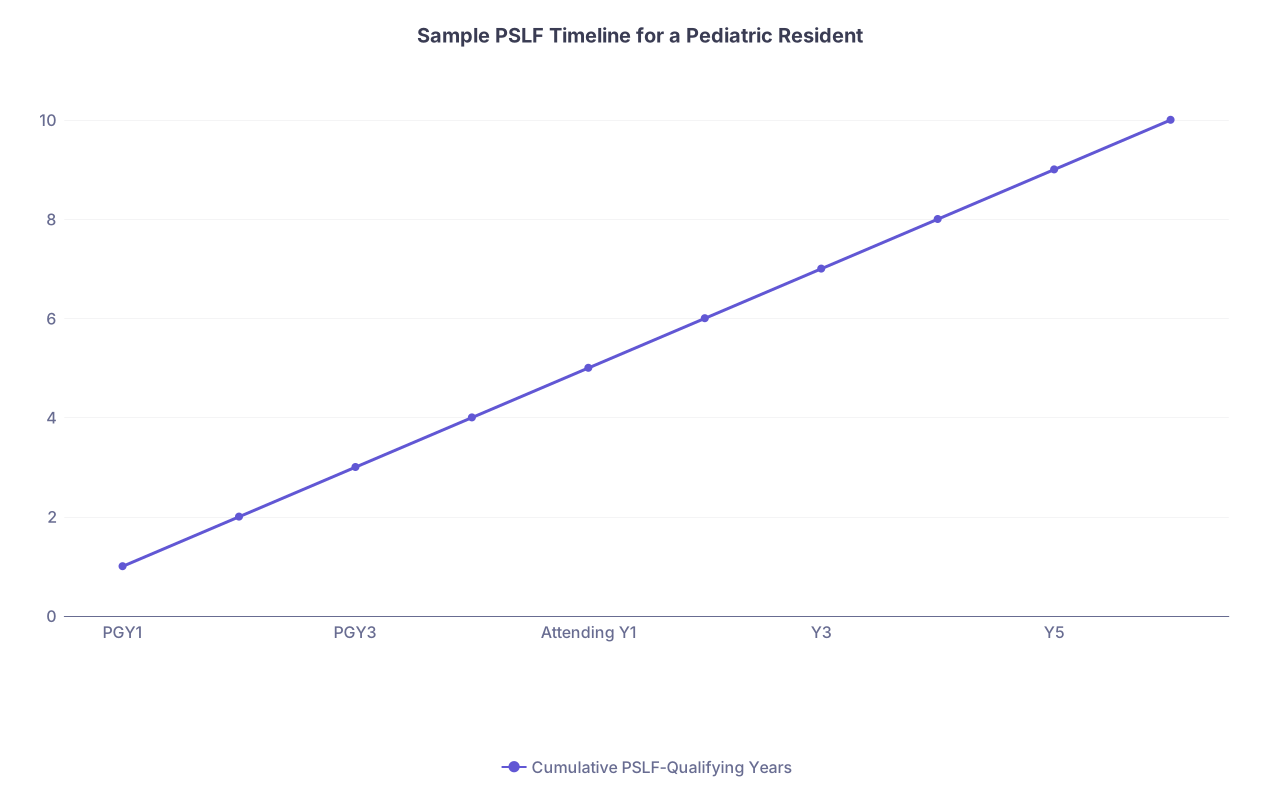
| Category | Cumulative PSLF-Qualifying Years |
|---|---|
| PGY1 | 1 |
| PGY2 | 2 |
| PGY3 | 3 |
| PGY4 | 4 |
| Attending Y1 | 5 |
| Y2 | 6 |
| Y3 | 7 |
| Y4 | 8 |
| Y5 | 9 |
| Y6 | 10 |
By the time you finish a 3-year residency + 1-year chief + 6 years attending at a nonprofit system, you can hit 10 years of PSLF credits with a huge chunk of your original balance wiped tax-free.
4. If PSLF Is Uncertain: Build a Flexible IDR Strategy
Maybe you are a psychiatry resident planning private practice later. Or PM&R with one eye on sports med in a private ortho group. You cannot rely on 10 years of nonprofit work.
Your move: use IDR to survive residency + early years, then reevaluate for either payoff or long-term forgiveness.
The structure here looks like:
Stay in federal loans and pick SAVE (or best IDR available).
- Keep payments low during residency.
- Accept that interest may grow, but SAVE’s interest subsidy will limit the damage.
Do not refinance to private during residency
- Your income is low.
- You would lose IDR and any PSLF option if your career pivots.
- The risk/reward is terrible.
Reassess 6–12 months into attending life
- Once your actual salary, job type, and benefits are clear, run the math:
- Project 20–25 years of IDR payments vs
- Aggressive payoff in 5–10 years with or without refinancing.
- Once your actual salary, job type, and benefits are clear, run the math:
If you clearly will not use PSLF and your income is stable
- Then—and only then—consider refinancing to private at a lower interest rate and attacking the loans.
5. Protect Your Cash Flow in Residency (Without Getting Buried)
You are not going to “win” the loan game during residency. Your objective is to:
- Minimize irreversible mistakes
- Keep cash flow sane
- Maximize PSLF credit if applicable
- Stop insane interest growth where possible
Core cash-flow moves for residents in low-paid specialties
Choose the lowest legitimate IDR payment
- On SAVE, your payment is tied to AGI.
- Use pre-tax retirement contributions (403(b), 457(b)) and HSA where available to reduce AGI and thus payments.
- Yes, that means you are doing retirement savings and cutting your student loan payment at the same time. That is not a bug. That is the point.
Avoid forbearance and deferment like a plague (unless strategic)
- For PSLF, any month in forbearance = a month that does not count.
- Interest often capitalizes when you exit these.
- Use them only in true emergencies (job loss, medical leave) or as a short-term bridge, not a lifestyle.
If you have private loans with very high rates
- Those are the ugly ones in your portfolio.
- Consider:
- Calling the lender for a resident or income-based program.
- Refinancing to a lower-rate private loan only for that high-rate portion, if you are certain these are not PSLF-eligible loans.
Emergency fund before extra loan payments
- 1–2 months of bare-bones expenses in a high-yield savings account.
- You cannot afford a credit card spiral because you were overeager paying extra on loans during PGY-1.

6. How to Use SAVE as a Resident in Lower-Paid Specialties
SAVE is currently the flagship federal IDR plan, and it is particularly friendly to residents.
Why SAVE matters for you
Key features (summarized, not legalese):
- Payment: 10% of discretionary income for graduate loans.
- Discretionary income = AGI minus 225% of federal poverty line. That higher threshold lowers your payment.
- Unpaid interest subsidy: If your payment does not cover monthly interest, the government covers the rest so your balance does not grow due to unpaid interest.
For residents with big loans and small income, that last feature is massive. It keeps your balance from exploding.
How to not screw up SAVE
Enroll as soon as grace/forbearance ends
- Do not sit in standard repayment.
- Do not ignore the email from your servicer after graduation.
Use the lowest reasonable AGI
- If you just started intern year and your prior-year taxes show low or no income → your first SAVE payment could be $0–$50 and still PSLF-qualifying.
- Each year, recertify carefully, timing around any drops in income if applicable.
Married? File taxes strategically
- SAVE may consider your household income.
- If your spouse earns much more, filing Married Filing Separately can lower your IDR payment in some setups.
- Trade-off: higher tax bill vs lower loan payment. You run the math for both.
7. State, Federal, and Employer Loan Repayment Programs: Underused Gold
Lower-paid specialties have one distinct advantage: you are often exactly the type of doctor that loan repayment programs are chasing.
Think:
- Rural family medicine
- Community psychiatry
- FQHC pediatrics
- Underserved neurology or addiction psych
- Geriatrics in shortage areas
Core buckets to look at
National Health Service Corps (NHSC)
- Primary care, psychiatry, some other specialties.
- Works in Health Professional Shortage Areas (HPSAs).
- Offers significant loan repayment (often $50k+ for 2 years of service, sometimes more).
State loan repayment programs
- Run by state health departments, often similar to NHSC.
- Many target family med, peds, OB, psych, and sometimes IM or geriatrics.
-
- Large hospital systems, FQHCs, VA, and academic centers may offer:
- Direct loan repayment contributions
- Signing bonuses specifically tied to loan payoff
- Large hospital systems, FQHCs, VA, and academic centers may offer:
Public Service Loan Forgiveness layering
- The ideal combo:
- PSLF on the federal side
- Plus state or employer loan repayment for added payoff early in attending life.
- The ideal combo:
| Program Type | Example | Typical Benefit Range |
|---|---|---|
| Federal | NHSC Loan Repayment | $50k–$100k+ over 2–3 years |
| State | State LRAP for primary care | $20k–$80k depending on location |
| Employer | Large nonprofit hospital contribution | $10k–$30k per year for several years |
You do not stumble into these. You look for them before you sign an attending contract.
8. What NOT to Do (Common Resident Mistakes)
Let me save you from the greatest hits of loan stupidity I see every year.
Mistake 1: Refinancing to private during residency “for a better rate”
Wrong target. Lower rate but:
- No IDR
- No PSLF
- No pandemic-style pauses or broad relief if Congress ever does something again
You locked yourself into rigid payments with a low salary and removed your best backstops. Do not do this unless you are refinancing only private loans and are 100% fine losing federal protections on that portion.
Mistake 2: Sitting in forbearance for years
“I will just not think about loans until fellowship/attending.”
Translation:
- You accrue interest.
- You rack up zero PSLF credit.
- You may trigger interest capitalization when you re-enter repayment.
Forbearance is an emergency tool, not your default.
Mistake 3: Ignoring your servicer emails
Servicers screw up. They misapply payments, forget PSLF counts, mishandle consolidations. If you are not reading your messages and statements, you will not catch it until it is much harder to fix.
Your protocol:
- Open every email.
- Log in at least every 3–4 months.
- Download and save annual statements and PSLF counts.
Mistake 4: Making big extra payments during residency
I know this sounds counterintuitive. But for most lower-paid residents:
- Your “investment” dollar is far more valuable in:
- Building emergency savings
- Capturing employer retirement match
- Paying off 20% APR credit cards
- If you are on PSLF, extra payments are literally giving money back to the government for no benefit.
Make minimum IDR payments during residency. Save your aggression for when you are an attending with actual surplus income.
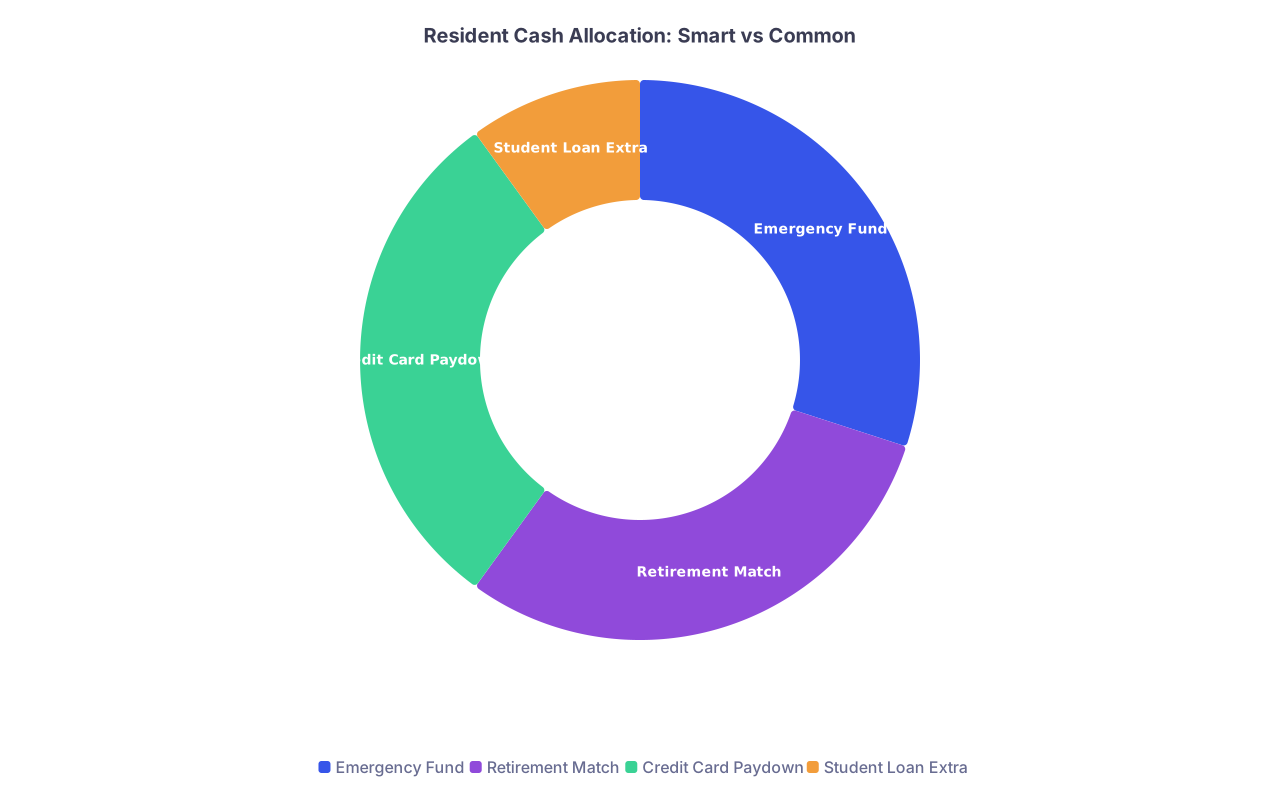
| Category | Value |
|---|---|
| Emergency Fund | 30 |
| Retirement Match | 30 |
| Credit Card Paydown | 30 |
| Student Loan Extra | 10 |
(The “common” version flips that last two. Which is backwards.)
9. Attending Transition: Your First 12 Months Plan
The most expensive mistake I see is residents who never update their loan strategy once they become attendings. They keep autopilot IDR payments for years at an attending salary and never check whether PSLF vs payoff vs refinance is optimal.
Here is a clean protocol for your first attending year.

| Step | Description |
|---|---|
| Step 1 | Start Attending Job |
| Step 2 | Confirm Employer Type |
| Step 3 | PSLF Path |
| Step 4 | Non-PSLF Path |
| Step 5 | Stay in IDR |
| Step 6 | Check PSLF Credit Count |
| Step 7 | Target 10 Years Total Then Forgiveness |
| Step 8 | Project Income and Expenses |
| Step 9 | Consider Refinance and Aggressive Payoff |
| Step 10 | Stay in IDR, Reassess Annually |
| Step 11 | Surplus > 2k/month? |
Concrete steps in that first year
Confirm employer status
- 501(c)(3)? Government? PSLF-qualifying?
- Get HR to confirm in writing if needed.
Update income on your IDR plan
- Recertify based on your actual attending salary.
- Yes, your payment will jump. That is normal.
Run three scenarios using real numbers
Using a solid loan calculator (or professional advisor who actually works with doctors, not some generic planner), estimate:- PSLF: Total 10-year payment vs remaining forgiveness
- Long-term IDR forgiveness (20–25 years) with projected tax bomb
- Aggressive payoff in 5–10 years, with and without refinancing
Pick a lane and commit for 2–3 years
- If PSLF is clearly best, stop thinking about payoff. Optimize retirement, life goals, and just keep making qualifying payments.
- If payoff looks better, especially in private higher-paying positions in a “low-paid” field (think productive outpatient psych with cash pay), then:
- Refinance in chunks if it makes sense
- Set an aggressive but realistic payoff timeline (e.g., 7 years)
- Automate extra principal payments
10. Specialty-Specific Nuances You Should Exploit
Not all low-paid specialties are equal. Some have better incentives and employment structures than others.
Psychiatry
- Strong demand, increasing shift toward outpatient, telepsych, and private practice.
- Realistic path:
- Do residency at nonprofit → pile up PSLF credits.
- Early career at CMHC, VA, or nonprofit → hit 10-year PSLF.
- Then pivot to private or cash-pay if you want.
You can use PSLF to clear the federal loans, then enjoy the flexibility of psych income without that anchor.
Pediatrics / Family Medicine
These are PSLF all-stars.
Tons of jobs at FQHCs, academic centers, children’s hospitals, and nonprofit systems.
Layer NHSC, state LRAP, and PSLF.
You will not be rich, but you can be debt-free and financially stable if you combine:
- SAVE + PSLF
- Employer/state repayment
- Modest lifestyle inflation
PM&R / Neurology
These straddle worlds:
- Many academic and hospital-employed roles (PSLF friendly).
- Real private practice potential if you subspecialize (pain, sports, EMG-heavy neuro).
You need more flexibility:
- During residency/fellowship: PSLF + SAVE if at nonprofit.
- As attending: reassess honestly. If you head into a big private group with higher income, aggressive payoff becomes more compelling.

11. A Simple, Repeatable Annual Checklist
You are busy. You need a short, repeatable system more than you need a perfect spreadsheet.
Once a year (pick a month and stick to it):
Log in to studentaid.gov
- Download updated loan summary.
- Check your servicer and PSLF counts (if applicable).
Log in to your loan servicer
- Confirm IDR plan.
- Make sure automatic payments are correct.
- Download statements for your records.
Review your employment status
- Still at a PSLF-qualifying employer?
- If yes → submit updated PSLF Employment Certification Form.
- If no → note date you left PSLF-qualifying work.
Update your AGI and recertify IDR
- Coordinate with tax filing.
- If you are married, decide filing status intentionally regarding loan impact.
Re-run your big-picture plan
- PSLF on track?
- Payoff still best?
- Time to consider refinance?
Put this as a recurring calendar event. One hour per year beats 10 years of avoidable chaos.
Key Takeaways
- Residents in lower-paid specialties cannot afford sloppy loan decisions. You must pick a coherent strategy early—usually SAVE + PSLF if you work for nonprofits, or flexible IDR with future payoff if you do not.
- Do not refinance federal loans during residency, do not hide in forbearance, and do not throw big extra payments at loans while you are broke. Use IDR to protect cash flow and build PSLF credit or set up future payoff.
- As you transition to attending life, reassess with real numbers, commit to a lane for a few years, and exploit every program—PSLF, NHSC, state and employer repayment—that is biased in favor of exactly the kind of physician you chose to be.


