

The fastest way to make pediatrics, family medicine, psych, or geriatrics feel like a financial punishment is not the salary. It’s the loan mistakes you lock in before you understand how ugly the math gets.
I’ve watched smart people in low-paying specialties dig themselves into holes so deep they were basically stuck: no house, no kids when they wanted them, working extra urgent care shifts just to keep up with interest. Not because of “the system” alone. Because of preventable choices they made with debt.
Let’s walk through the big traps. The ones that make low-paying specialties financially brutal when they didn’t have to be.
1. Pretending Your Specialty Pays Like Ortho
The first deadly mistake: using ortho/anesthesia/derm numbers in your head while you swipe your card and sign promissory notes.
If you’re heading into:
- Family medicine
- Pediatrics
- Psychiatry
- Internal medicine without a high-paying fellowship
- Geriatrics
- PM&R
- Pediatrics subspecialties that don’t pay much better
…you can’t afford to plan like a future $600k attending.
Here’s the mismatch I see all the time:
- MS1–MS4: “I’ll probably do something competitive; I’ll be fine.”
- M3–M4: Falls in love with peds or family. Good choice clinically. Financially? Now the math changes. But lifestyle and borrowing don’t.
- PGY3–PGY5: Realizes “Oh, my attending salary is $210k and I have $350k+ in loans at 7%.” That stomach-drop feeling is real.
You need to align borrowing and spending with realistic income from day one, not with fantasy-income “maybe I’ll subspecialize in cardiology” talk.
Here’s a rough (ballpark) annual attending income comparison that too many people ignore:
| Specialty Type | Typical Range (USD) |
|---|---|
| Family Medicine | 220k–260k |
| Pediatrics | 210k–250k |
| Psychiatry | 260k–320k |
| Geriatrics | 220k–260k |
| Orthopedic Surgery | 600k–900k+ |
| Interventional Cards | 600k–900k+ |
You do not get orthopedics-level forgiveness on your bad loan decisions just because you work hard and do important work.
Mistake to avoid:
Basing lifestyle and loan-size tolerance on “average physician salary” articles that are dominated by high-paying specialties.
Do this instead:
- Use your likely specialty range, not “doctor income.”
- Plan assuming you might stay general (e.g., general peds, general psych), not assuming a unicorn fellowship outcome.
- Run numbers on $230k, not $500k. If it works at $230k, you’re safe. If it only works at $400k+, you’re playing with fire.
2. Ignoring Interest While in Training (This One Hurts the Most)
Let me be blunt: letting interest balloon untouched for 7–10 years and then acting shocked is not a tragedy. It’s a choice. Usually driven by:
- Not understanding income-driven repayment (IDR)
- Believing “I’ll worry about loans after residency”
- Bad or lazy advice from older docs who trained when school was $10k a year
On $300k+ of federal loans at ~7%, your annual interest is easily $20k–25k. Per year. If you’re in a low-paying specialty and you:
- Stay in deferment/forbearance in med school and residency
- Do not enroll in an IDR plan
- Do not go after PSLF aggressively if you’re at qualifying hospitals
You’re quietly lighting tens of thousands of dollars on fire. Money you’ll never dig out of easily with a $230k attending salary.
Here’s what this looks like in practice:
- MS1–M4: No payments, all unsubsidized; interest accrues and capitalizes.
- PGY1–PGY3: Forbearance “because I can’t afford payments.”
- End of training: $300k became $380k–$420k. And you’ve made essentially $0 progress on principal.
Now you’re 32 with a balance higher than your peak med school year and a low-ish salary. That is how low-paying specialties become financially suffocating.
Mistake to avoid:
Forbearance as the default “I’m broke” move during residency.
Better approach:
- Get on an IDR plan immediately in intern year (or even the month you start) – SAVE is usually best right now.
- Even if your payment is small, you’re at least getting credit toward PSLF or toward taxable forgiveness.
- If PSLF is on the table and you’re at a 501(c)(3) hospital, every year in IDR is gold. Throwing it away with forbearance is one of the most expensive choices you can make.
3. Treating PSLF as Optional “Maybe Later” Instead of a Core Strategy
Public Service Loan Forgiveness (PSLF) is not a side quest for low-paying specialties. It’s the main story.
Who benefits the most from PSLF?
- High debt
- Lower incomes
- Long training
- Working at nonprofit hospitals
That’s…you. Exactly you.
But I regularly see:
- Residents who “might do PSLF” but are in the wrong repayment plan
- People who never file annual employment certification forms
- Attendings who have 7 years of qualifying payments but no documentation because “I kept meaning to do it”
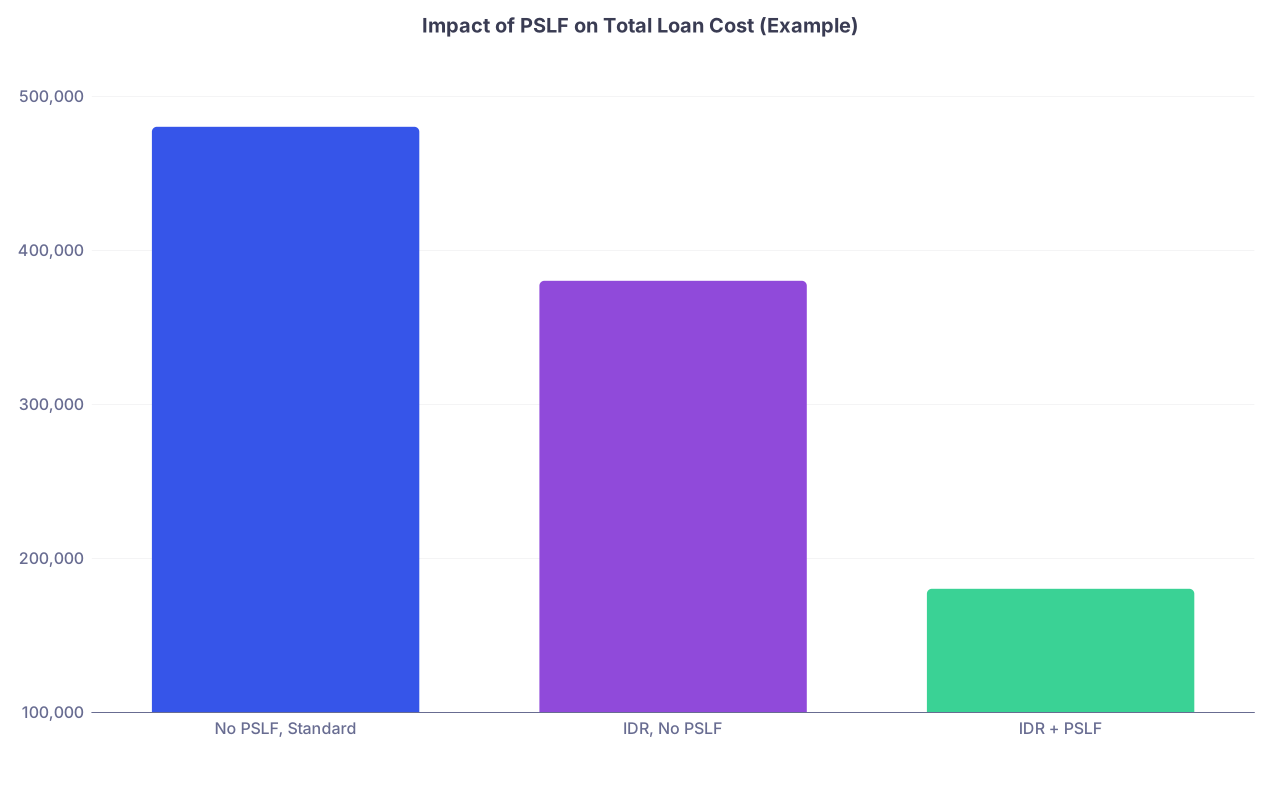
PSLF is fragile. Mess up the details, and you can lose six figures of forgiveness.
| Category | Value |
|---|---|
| No PSLF, Standard | 480000 |
| IDR, No PSLF | 380000 |
| IDR + PSLF | 180000 |
(Those numbers are illustrative – but the spread often really is that dramatic.)
Critical PSLF mistakes that crush low-paying specialties:
Wrong repayment plan
- Using graduated or extended repayment instead of an IDR plan like SAVE, PAYE, etc.
- Those payments don’t count. At all. You can literally work 10 years at a non-profit and get $0 forgiven.
Not consolidating certain loans correctly
- Old FFEL or Perkins loans not consolidated into a Direct Consolidation Loan.
- Result: part of your balance is just not PSLF-eligible.
Sloppy or nonexistent documentation
- Not submitting the Employment Certification Form (ECF) yearly.
- Switching hospitals and never updating.
- Then trying to clean it all up 9–10 years later when HR staff have turned over and records are missing.
Bailing on nonprofit employment in year 6–8 unintentionally
- Jumping to a private group for a small salary bump without realizing you just walked away from $150k–300k of forgiveness.
If you’re in a low-paying specialty at a 501(c)(3) hospital and you’re not playing the PSLF game correctly, you’re choosing the hardest, most expensive path available.
4. Private Refinancing Too Early (Or Ever, When You Shouldn’t)
This one’s brutal because it feels responsible.
You finish residency/fellowship with $300k at 7%. A company offers you 3.8% if you refinance privately. Feels like a no-brainer.
Sometimes it is. But for low-paying specialties, it’s often a huge mistake.
Here’s why:
- Once you refinance federal loans to private, PSLF is gone. Forever.
- Federal IDR options with safety nets are gone.
- Future legislative improvements or emergency programs? You’re out.
If your future income is “modest” by physician standards and your debt is big, federal programs are usually more valuable than shaving a couple percentage points of interest.
Refinancing early is usually a terrible move when:
- You’re still not sure where you’ll work (nonprofit vs private)
- You might end up at an academic/children’s hospital
- Your debt-to-income ratio is high (ex: $350k debt, $230k peds salary)
- You’re even possibly going to pursue PSLF
Refinancing can make sense when:
- You’re 100% sure you’ll work outside PSLF-eligible institutions for your career
- Your debt is relatively small compared to income (e.g., $120k loans, $260k salary)
- You’re committed to aggressive payoff well under 10 years
Where I’ve seen people regret it most:
- Pediatric subspecialists who take academic jobs
- Psych attendings at VA or state hospitals
- Family med docs at community health centers or FQHCs
- IM docs who ended up loving academic hospitalist work
They refinanced at PGY3 or year 1 attending, then realized within a few years that PSLF would have wiped out massive amounts of principal.
Simple rule for low-paying specialties:
If there’s any realistic chance you’ll work at a nonprofit hospital or public system, do not reflex-refinance your federal loans. Run detailed PSLF vs refinance scenarios first.
5. Underestimating How Much Lifestyle Creep Hurts You Specifically
Another mistake: assuming you’ll “just live like a resident” as an attending. Then not doing that. At all.
Here’s what actually happens to a lot of low-paying attendings:
- Finish training, exhausted and burned out.
- Jump salary from $65k resident to $230k peds/family/psych.
- Within 6–12 months:
- New car
- Nicer apartment or house
- Daycare bills
- Travel to “finally live a little”
- Eating out a lot because you’re tired and “deserve it”
None of that makes you a bad person. But combine:
- Big loans
- Mediocre attending income
- No PSLF plan
- Fast lifestyle expansion
…now you’re stuck with a mediocre monthly surplus and a massive debt snowball that never really melts.
High-paying specialties can occasionally grow into a nicer lifestyle and still crush their loans. You do not have that same margin for error.
Warning signs:
- Your student loan payment is less than your monthly car payment.
- You “can’t afford” to increase loan payments but you’re booking $6k vacations.
- You signed a mortgage that leaves almost no slack after loan payments and childcare.
You do not have to live miserably. But if you don’t tame lifestyle creep the first 5 years as an attending, you’ve basically locked in:
- Working extra shifts you don’t want
- Feeling chronically behind
- Delaying retirement savings to your 40s
Low-paying specialties can absolutely be fine financially. But only if you prioritize:
- Housing that’s clearly below your theoretical max
- Cars that are boringly affordable
- A defined, written loan strategy before you splurge
6. Saving Little to Nothing for Retirement While Over-Obsessing About Debt
Here’s the paradox: some of the same people who mismanage loans also swing the other way and over-fixate on “destroying debt,” completely ignoring retirement.
Then you wake up at 45:
- Loans finally gone
- Retirement accounts disturbingly small
- And now you’re trying to play catch-up as a family med doc making $240k
If you’re in a low-paying specialty, time in the market is your friend. You don’t have giant lump sums later to make up for lost years.
The common mistake looks like this:
- No match capture: Not contributing enough to your 401k/403b to receive the full employer match because “I need every dollar for loans.” That’s free money you just burned.
- No Roth IRA while in lower tax brackets early in attending life.
- Blindly sending every spare cent to loans while saving almost nothing.
For many low-paying specialists, the smarter model is:
- IDR + PSLF (or long-term IDR toward taxable forgiveness)
- Aggressive but not insane extra saving for retirement
- Letting the system help you with debt instead of muscling through all of it yourself
Especially if you’re on a PSLF track, overpaying your loans is basically gifting money back to the government. I’ve literally seen pediatricians throw away tens of thousands that way.
7. Not Running Actual Numbers Before Major Life/Job Decisions
A quiet but deadly mistake: making big decisions emotionally, then trying to make the math fit after.
Examples I’ve seen:
- Taking a slightly higher-paying private job that kills PSLF eligibility — but not high enough to actually offset lost forgiveness
- Moving to a high cost-of-living city in a low-paying specialty because “it’s where I want to live” without really seeing what your take-home vs fixed expenses will be
- Adding a non-income-producing grad program (like an MPH you won’t truly leverage) to your debt pile during med school or residency
Let’s say you’re pediatrics with $350k in loans. Two attending job offers:
- Job A: $230k at a nonprofit children’s hospital, PSLF-eligible
- Job B: $260k at a private group, not PSLF-eligible
On paper, $30k more sounds great. In reality? PSLF may be worth $150k–250k in future forgiveness. That extra $30k a year does not come close.
Without a basic spreadsheet or a loan simulator, you will underestimate how bad these decisions are.
Minimum standard before you choose job/region:
- Estimate after-tax income
- Estimate realistic monthly loan payment under your chosen strategy
- Estimate housing + childcare + fixed costs
- See how much slack is actually left
If the numbers look tight before lifestyle extras, you either need:
- Different job
- Different city
- Different loan strategy
Or some combination of the three.
8. Med School Cost Blindness: “Future Me Will Handle It”
The mistake often starts way earlier than residency.
I hear this a lot from premeds and M1s:
- “It doesn’t matter where, I’ll just take loans.”
- “I’ll be a doctor, I’ll be fine.”
That’s how you end up as a $230k-salary pediatrician or family med doc with $450k in debt because:
- You picked the prestige private school over a much cheaper state school
- You borrowed full cost of attendance every year
- You lived like you’d be a surgeon later
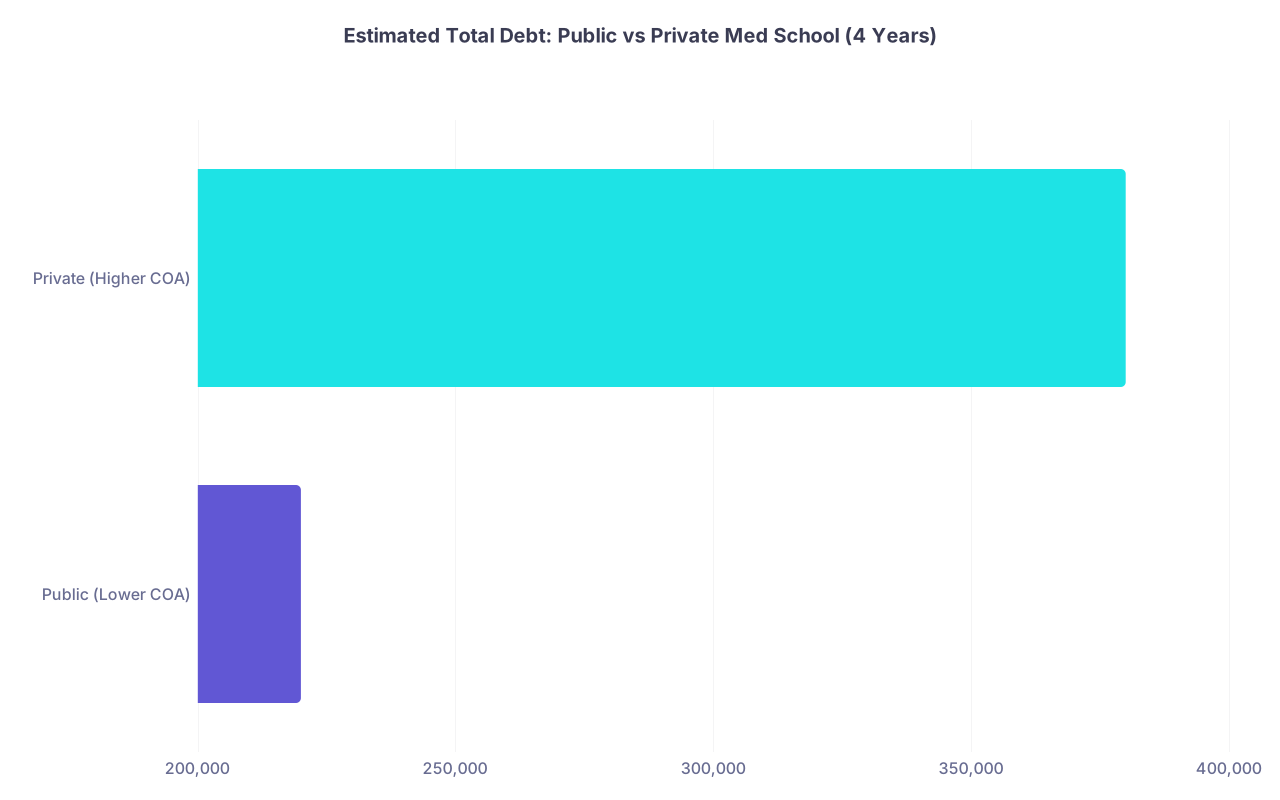
Low-paying specialties can handle reasonable debt. They cannot comfortably handle “I ignored cost differences between a $70k/year private school and a $30k/year public school” levels of debt.
| Category | Value |
|---|---|
| Public (Lower COA) | 220000 |
| Private (Higher COA) | 380000 |
Rough example, yes. But I’ve seen worse.
If you’re already in residency or beyond, you can’t fix this one retroactively. But if you’re advising someone earlier in the pipeline — or considering another expensive degree — this matters.
9. Totally Ignoring Tax Bomb Risk on Long-Term IDR (If Not Doing PSLF)
For those not doing PSLF and planning to ride IDR for 20–25 years until taxable forgiveness kicks in, there’s another mistake: ignoring the “tax bomb.”
Quick version:
- After 20–25 years on certain IDR plans, remaining balance is forgiven.
- Under current law (subject to change, always check), that forgiven amount may be treated as taxable income at the end of the term (except under PSLF).
- If you do not plan for this, you can end up with a giant surprise tax bill right when you thought you were finally free.
Low-paying specialties that stay in community or private settings and don’t qualify for PSLF often rely on this path. That’s fine. But pretending the tax issue doesn’t exist is not.
What you should be doing:
- Running estimates of your projected forgiven amount
- Setting up a separate “tax bomb” investment account and contributing regularly
- Investing that account reasonably aggressively since your time horizon is 20+ years
If you don’t? You just shift the pain from your 30s to your 50s. That’s not a win.
10. Believing “Money Doesn’t Matter, I’m Doing It for the Patients”
I’ll say this carefully: that idealism is how people get exploited.
You can deeply care about patients and still refuse to financially sabotage your own life. These are not mutually exclusive.
The problem is not the sentiment. It’s how that sentiment gets weaponized against you:
- “Take this underpaid job, you’re helping the underserved.”
- “Don’t worry about loans, you’ll manage somehow.”
- “You’re not in it for the money, right?”
No. You’re not in it primarily for the money. But you also need:
- A stable home
- A shot at retirement before 75
- Freedom to say no to toxic jobs
The fastest way to burn out in a low-paying specialty is to add financial anxiety to emotional exhaustion. Loans are a controllable part of that.
Refuse to play the martyr with your money.
Quick Recap: The Big Things Not to Screw Up
To keep low-paying specialties from becoming financially brutal, you need to avoid these:
Planning your loans and lifestyle as if you’ll earn $500k+
Anchor everything to your likely actual income, not a fantasy subspecialty.Letting interest run wild with forbearance and no IDR during training
You cannot afford to ignore interest accrual. Get on IDR early and use PSLF if it fits.Killing PSLF or federal protections too early with private refinancing or sloppy planning
Once you refinance, federal safety nets are gone. Don’t do this casually.
If you dodge just those three mistakes, you’ve already made your financial life as a pediatrician, family doc, psychiatrist, or geriatrician drastically less punishing. The work will still be hard. The pay will still be lower than it should be. But you won’t be crushed by avoidable loan decisions on top of it.


