

The contracts hurting low‑paid specialists are not the obvious bad ones. They are the “standard,” “boilerplate,” “everyone signs this” specials that look harmless and quietly lock you into years of low pay and no leverage.
If you are in one of the lowest paid specialties—pediatrics, psychiatry (non-procedural setups), family medicine, general internal medicine, geriatrics, endocrinology, rheumatology, infectious disease—your margin for contract mistakes is razor thin. A single bad clause can mean the difference between a sustainable career and burnout with no exit.
Let me walk you through the landmines I see residents and new attendings step on again and again.
1. The “Nice Salary” That Is Actually a Trap
The worst contracts for low‑paid specialists do not look abusive on the surface. They look… fine. Especially compared with your PGY salary.
The mistake: confusing “better than residency” with “fair for an attending in this specialty” and ignoring how the clauses around the salary cripple you.
Hidden productivity handcuffs
You will see some version of this for pediatrics, primary care, psych, and IM:
- Base salary: looks okay
- Productivity bonus: wRVU-based or panel-based
- Targets: buried in an appendix or not specified at all
If you are in a low‑RVU specialty, bad relative value unit structures are brutal. Employers know this.

| Category | Value |
|---|---|
| Pediatrics | 40 |
| Family Med | 45 |
| Psych | 42 |
| Cardiology | 70 |
| Ortho | 90 |
| GI | 80 |
What goes wrong:
- Targets are set assuming cardiology‑level visit volume or procedural time, not the complexity and counseling time your patients actually need.
- “Productivity bonus” never materializes because the benchmark is unrealistic for pediatrics, geriatrics, or complex psych.
- The base salary quietly drops after year 1–2 when the “guarantee” expires, and you discover your “total comp potential” was a fiction.
- RVU or panel targets that are not explicitly written with actual numbers.
- Language like “benchmarked to MGMA 75th percentile productivity” without listing the exact wRVUs or panel size.
- “Compensation subject to periodic adjustment at employer discretion.”
In low‑paid specialties, you must assume your bonus will be close to zero unless you see a clear, reasonable formula.
Time-based pay that ignores non-billable work
Another classic: a contract that pays based on “clinical hours” or “clinic sessions” but quietly excludes all the non‑billable work.
Psych, pediatrics, and primary care get hammered here:
- Charting
- Care coordination calls
- Prior authorizations
- School forms, disability paperwork, family conferences
If the contract defines your “full-time” as 36–40 clinic hours per week, and you are also expected to finish all documentation and administrative work on your own time, you have just signed up for 50–60 hours/week at a salary calculated as if you only work 40.
You want definitions, in writing:
- What counts as “full‑time”.
- Whether documentation time is embedded in the schedule.
- Expected average patients per day and average length of visits.
If those are missing, do not kid yourself. They will fill your template to the ceiling and then blame you when charting backs up.
2. Non-Compete Clauses That Are Career Poison for Low‑Paid Specialists
High-earning proceduralists hate non‑competes. Low‑paid specialists are often destroyed by them.
Why? Because your options are often geographically tied—to schools for your kids, partner jobs, extended family, or just the fact that there may only be a few realistic employers in your city for psych, peds, or outpatient IM. A bad non‑compete in ortho is painful. A bad non-compete in community psych can wipe out your entire local job market.
Overbroad non-competes in “low margin” fields
I see this especially with:
- Outpatient psychiatry groups
- Pediatric multi‑specialty clinics
- FQHC or quasi‑FQHC organizations with side practices
- Large hospital‑owned primary care networks
The ugliest patterns:
- 20–50 mile radius from every clinic site where you ever saw a patient.
- Duration of 18–36 months.
- “Any practice of medicine” or “any similar specialty” language instead of something narrow and specific.
You are likely underestimating how bad this can be. A 25‑mile radius in a metro area can easily wipe out the whole city plus its suburbs if they count every satellite clinic. In peds or psych, that might be all realistic employers.

| Step | Description |
|---|---|
| Step 1 | Sign broad noncompete |
| Step 2 | Leave job unhappy |
| Step 3 | Cannot work in specialty |
| Step 4 | Commute 1 hour plus |
| Step 5 | Forced career change or locums |
| Step 6 | Within 25 miles? |
Pay close attention to:
- The exact radius, and from what locations (primary site only vs every site).
- Whether it applies to “primary office” or any place you ever “rendered services.”
- Whether it bans you from “any clinical role” or just competing practice types.
Worst mistake: shrugging and thinking “they don’t really enforce these.” Some do. Or they use it as leverage to force you into a terrible negotiation to buy your way out.
If you are in a low‑paid specialty, you do not have the proceduralist’s cash cushion to survive 18 months out of work or commuting 90 minutes one way.
The fake “mutual” non-compete
Occasionally you will see a contract that gestures toward fairness: “mutual non‑solicitation” or some watered-down mutual restriction. This does not make the non‑compete harmless.
Employers almost never care if you compete with them in the abstract. They care if you open next door and take their patients and referrers. The “mutual” language is PR. You are the one whose entire livelihood can be locked down.
You want:
- Narrow scope: your exact specialty or clinic focus.
- Reasonable radius: 5–10 miles in urban/suburban settings, maybe more in rural areas.
- Short duration: 6–12 months, not 24–36.
If they refuse to budge and you are in primary care, peds, psych, or IM, you should seriously consider walking. Especially if this is not your dream city.
3. Malpractice and Tail: The Clause That Eats Your Net Worth
Low‑paid specialists often ignore malpractice language because they assume coverage is standard. That is how you get stuck with a $40,000 tail bill on a primary care salary.
The major trap: claims‑made coverage where you are responsible for tail coverage when you leave.
Tail coverage in low-comp pay structures
If your employer uses claims‑made policies (very common), when you leave, someone must buy “tail” to cover you for claims filed after your employment ends for work you did while there.
Employers love to pass this cost to you, hidden in a bland sentence:
“Upon termination, Physician shall be responsible for purchasing extended reporting endorsement (tail) coverage.”
For high‑paid procedures? Brutal but survivable. For pediatrics or outpatient psych on a modest salary? Financial disaster.
| Specialty | Typical Tail Cost | Typical New Attending Salary | Tail as % of Salary |
|---|---|---|---|
| Pediatrics | $25,000–$40,000 | $190,000–$230,000 | 11–21% |
| Outpatient Psych | $20,000–$35,000 | $220,000–$260,000 | 8–16% |
| Family Med | $20,000–$30,000 | $210,000–$250,000 | 8–14% |
| Cardiology | $40,000–$60,000 | $550,000–$700,000 | 6–11% |
If you leave after 18–24 months because the job is miserable, you might literally have to write a check that cancels a year of loan payments or your house down payment.
You want one of three things:
- Employer pays 100% of tail, always; or
- Sliding scale: employer pays more based on years of service (e.g., 0% year 1, 50% year 2, 100% year 3+); or
- Occurrence coverage (less common) with no tail required.
Do not sign a contract where you, a pediatrician making $200k, agree to eat a $30k–$40k tail if you leave for any reason. That is not a reasonable risk tradeoff.
Hidden tail triggers
Watch for stealth traps:
- Tail required even if the employer terminates you without cause.
- Tail required if they “choose not to renew” after a fixed term.
- Tail required if you decline to accept a unilateral contract change.
If they can change your schedule, comp model, or practice location at will, then terminate you when you push back, and still make you pay tail? That is a loaded gun pointed at your finances.
4. “Evergreen” Renewal and One-Sided Termination
Low‑paid specialists often feel grateful to have “a stable job.” Employers exploit that by writing contracts that renew automatically forever, while giving themselves broad ways to exit and you almost none.
The common structure:
- Initial term: 1–3 years
- Automatic renewal for successive 1‑year terms unless either party gives X days notice
- Termination by employer: “for cause” (long list of vague reasons) and “without cause” with 60–90 days notice
- Termination by physician: often only with a long notice period, paired with penalties
This looks fair at a glance—“either party can terminate with notice”—but in practice, the power difference is huge.
Long notice periods that trap you
If you, as a family physician or pediatrician, want out of a toxic clinic, and your contract requires 180–365 days notice, your options are:
- Stay in a miserable environment for 6–12 more months.
- Breach the contract and risk damages, repayment of bonuses, and a bad reference.
I routinely see residents sign 180-day notice requirements because “the recruiter said it was standard.”
In a low‑paid field where burnout is already rampant, long notice periods mean one thing: you are stuck.
Reasonable:
- 60–90 days for primary care or psych.
- 90–120 days if you have a unique sub‑specialty panel.
Unreasonable:
- 180+ days for a basic outpatient pediatrics or FM role.
- Any contract where employer can waive notice but you cannot.
You want symmetry: same notice period for both parties, and no extra penalties if you give proper notice.
Vague “for cause” language
“For cause” termination should mean something concrete: loss of license, exclusion from federal programs, gross misconduct. Instead, many contracts include mushy phrases:
- “Material breach of any policy”
- “Failure to maintain satisfactory patient satisfaction scores”
- “Failure to meet productivity standards as determined by employer”
This lets them fire you “for cause” over productivity disputes or subjective metrics and then enforce penalty clauses (like repaying sign‑on bonuses or making you eat tail).
If your revenue per patient is already low, the last thing you need is a clause that weaponizes your metrics against you.
Push back on:
- Any “cause” category tied to subjective internal policies or unlisted metrics.
- Termination “for cause” that does not allow a cure period (e.g., 30 days to fix an alleged breach).
5. Sign-On Bonuses and Loan Repayment That Turn Into Shackles
Low-paid specialties are baited aggressively with upfront money:
- Sign‑on bonuses
- “Forgivable” loans
- Loan repayment promises
The headline number looks amazing to a resident making $65,000. The fine print is where you lose.
Forgiveness periods that exceed sanity
Typical structure:
- $20k–$50k sign‑on or forgiven over 3–5 years.
- If you leave “for any reason” before the end, you owe the “unforgiven” balance, often immediately.
For a pediatrician or psychiatrist, $40k looks like a lifeline. But if you hate the job after 18 months—or the clinic culture is toxic, or leadership changes, or they squeeze your schedule—you are now looking at a giant bill to leave.
Combine that with a tail obligation and you get this scenario:
- You want to leave a bad outpatient psych job.
- You owe $25k in unforgiven bonus.
- You owe $30k in tail.
- You are making $230k and already paying $2k/month in loans.
That is how people stay stuck for years in a job that slowly destroys them.
Reasonable setups:
- Forgiveness over 1–3 years, not 5–6.
- Pro‑rated payback, not “all or nothing.”
- Waiver of repayment if employer terminates you without cause or materially changes your duties.
If they refuse those, understand the trade: you are selling future freedom for a sign‑on check. Sometimes that is necessary. Often it is not worth it.
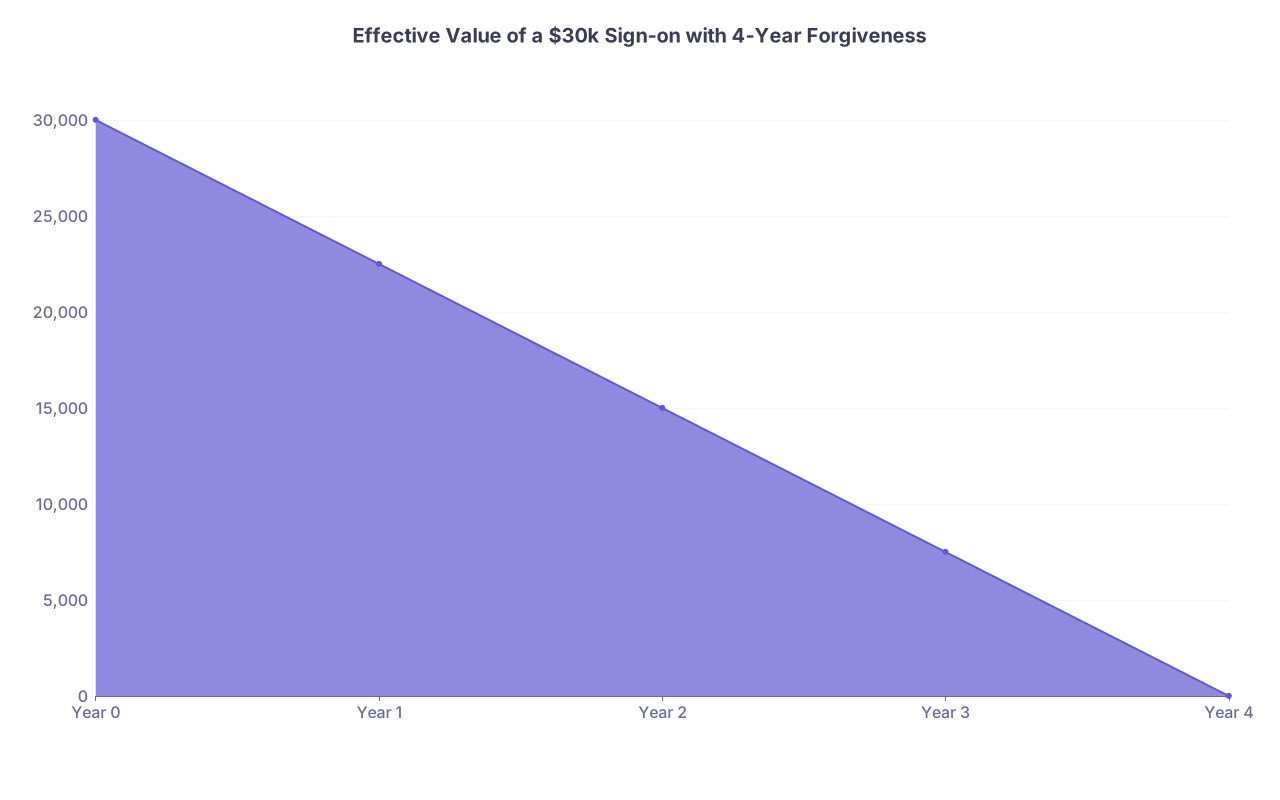
| Category | Value |
|---|---|
| Year 0 | 30000 |
| Year 1 | 22500 |
| Year 2 | 15000 |
| Year 3 | 7500 |
| Year 4 | 0 |
On paper you “got” $30k. In reality, in year 2, you have effectively only “earned” half of it. The rest is a chain.
6. Call, Weekends, and “Other Duties” That Work You for Free
Low‑paid specialties often get abused with “other duties as assigned” clauses that quietly double your workload without adding meaningful pay.
Look especially carefully at:
- Pediatric call / newborn nursery responsibilities.
- Inpatient psych coverage from an outpatient contract.
- Nursing home rounds grafted onto a primary care job.
- “Administrative tasks” for medical directorships with no real protected time.
Common traps:
- Call pay that only kicks in after a threshold that is unrealistic to hit.
- “Call schedule to be determined by employer” with no cap.
- Mandatory weekend clinics or extended hours with no additional compensation.
Pediatrics and primary care get the worst of this. You sign for “4 days clinic + 1 admin day.” Six months later:
- One evening clinic per week.
- One Saturday per month.
- Phone call coverage shared among a large group, but in practice you are covering more than expected for the same pay.
You must force specifics:
- Maximum number of clinic sessions per week.
- Whether evenings/weekends are included in base comp or separately paid.
- How call is divided, and whether it is paid or unpaid.
If the contract is vague, your schedule will not be vague. It will be full.

7. “Ownership Tracks” and Phantom Partnership in Low-Paid Fields
Private practices will sometimes promise “partnership” or “ownership track” to compensate for lower guaranteed salaries. In low‑paid specialties, this is often smoke and mirrors.
Here is the pattern:
- Below‑market starting salary.
- Vague verbal promise: “You will be partner in 2–3 years.”
- No written pathway, numbers, or buy‑in spelled out in the contract.
- No disclosure of current partner compensation.
Two years later, you are told:
- “You are not ready yet.”
- “We are still evaluating fit.”
- Or: “Good news, you can buy in for $300k. Here is the valuation we invented.”
In pediatrics, FM, psych, or IM, the raw revenue of the practice may not justify a massive buy‑in—especially if ancillaries are minimal. But you will not know, because they will not show you real books upfront.
If the partnership track is part of why you accept below‑market pay, you need:
- Written timeline (e.g., eligible after 2 full years).
- Written criteria (not just “subject to unanimous partner approval”).
- Rough estimate of expected buy‑in range and what it includes (hard assets? AR? goodwill? ancillaries?).
And ideally, a clause that obligates them to at least present you with a written offer at that time, even if you can still decline.
Never discount your current working conditions and compensation based on a vague future carrot. In low‑margin specialties, the carrot often never appears.
8. Academic and “Mission-Driven” Jobs: Do-Gooder Discount Clauses
Many low‑paid specialists are drawn to academic centers or community clinics. That is admirable. But you cannot pay loans with gratitude.
Common mission‑masking clauses:
- Lower base salaries “because we offer PSLF eligibility / 403(b) / academic title.”
- Research/teaching or administrative obligations written as part of your FTE with zero protected time or pay.
- “Grant-funded” positions where your job stability evaporates when the grant does.
Do not make these assumptions:
- “Academic” equals stable.
- “Community / FQHC” equals benevolent.
I have watched pediatricians discover that their “0.2 FTE research” is on top of a full 1.0 FTE clinical workload. Or that their “loan repayment program” is contingent on funding that is not guaranteed.
You want explicit:
- How many half‑days of clinic per week.
- How many half‑days of research/teaching/admin, and whether those count toward your FTE.
- Whether any portion of your salary is grant‑dependent and what happens if funding is cut.
Mission matters. So does rent.

9. Information Asymmetry: Benchmark and Negotiation Myths
Low‑paid specialists are often told: “There is not much room to negotiate in your field.” That is only partially true.
What is true:
- Your ceiling is lower than derm or ortho.
- Some big systems use rigid compensation grids.
What is not true:
- That everything in the contract is non‑negotiable.
- That you must accept vague or one‑sided clauses because “we use this for everyone.”
The dedicated mistake here is signing blind. Not knowing:
- What other new attendings in your specialty are actually making in that region.
- Whether your loan repayment or sign‑on is in line with peers.
- Whether the non‑compete term is more aggressive than other local employers.
| Clause | Often Negotiable | Harder but Sometimes | Rarely Negotiable |
|---|---|---|---|
| Non-compete radius/duration | Yes | ||
| Tail coverage responsibility | Yes | ||
| Notice period length | Yes | ||
| Sign-on bonus structure | Yes | ||
| Base salary dollar amount | Yes | ||
| RVU targets or panel size | Yes | ||
| Health/retirement benefits | Yes (system-wide) | ||
| PSLF/loan programs participation | Yes (policy-level) |
Your leverage might not be huge on base salary. But you can frequently:
- Shorten notice periods.
- Soften non‑compete parameters.
- Shift tail responsibility or at least share it.
- Adjust forgiveness terms on sign‑on bonuses.
In low‑paid specialties, those changes matter more than squeezing an extra $5k on base salary.
10. Practical Checklist: Clauses That Deserve a Hard No or Serious Pushback
You do not have to become a contract lawyer. But you do need a short list of “if I see this, I slow down or walk.”
Watch for these, especially as pediatrics, psych, FM, IM, geriatrics, or other low‑RVU specialists:
Non‑compete with:
- Radius >15–20 miles in an urban/suburban area
- Duration >12 months
- Applies to every site you ever worked at
Tail coverage:
- 100% your responsibility regardless of why you leave
- Required even if you are terminated without cause
Notice period:
120 days for basic outpatient roles
- Asymmetrical (e.g., you owe 180 days, they owe 60)
Compensation:
- Productivity targets unspecified or “per employer policy”
- Major pay drop after guarantee without clear, realistic metrics
Bonuses / loan repayment:
- 4–6 year forgiveness periods for modest amounts
- Repayment required even if they fire you without cause
Duties:
- “Other clinical duties as assigned” with no clarity on call, weekends, or inpatient work
- Academic / research / admin time added without FTE credit
Termination “for cause”:
- Includes vague items like “failure to meet quality standards” without definitions
- No cure period for alleged breach

| Step | Description |
|---|---|
| Step 1 | Receive Contract |
| Step 2 | Scan for red flag clauses |
| Step 3 | Request changes or walk |
| Step 4 | Obtain specialist attorney review |
| Step 5 | Negotiate key terms |
| Step 6 | Sign |
| Step 7 | Any major red flags? |
| Step 8 | Reasonable final terms? |
You cannot afford to ignore these. Your future self will not thank you for accepting “standard” language that makes you financially and geographically trapped.
The Bottom Line
Three core points to keep straight:
- For low‑paid specialties, the dangerous clauses are not the ones that scream “unfair.” They are the quiet lines about non‑competes, tail coverage, and notice periods that quietly strip away your options.
- Never trade long‑term freedom for short‑term sugar—oversized sign‑on bonuses, vague partnership promises, or “mission‑based” discounts—without written, specific protections that make the math and risk tolerable.
- Your leverage is not zero. You can often fix the worst clauses. When you cannot, sometimes the smartest move is the hardest one: walk away before you sign, not after you are trapped.


