

What if your “dream specialty” means you can never comfortably pay off your loans, buy a home, or have kids on your timeline—no matter how frugal you are?
That is not dramatic. I have watched it happen. Especially to people walking into the lowest paid specialties with no real numbers, just vibes and “I’ll figure it out later.”
Let me be very clear:
Choosing a low-paying specialty can be absolutely worth it. But doing it blindly? With big loans, expensive life plans, and a fantasy of “money will work itself out”? That is how smart people wreck their future options.
This is the article about when not to choose a low-paying specialty, even if you genuinely like it.
We are talking primarily about:
- Pediatrics (especially general peds, outpatient)
- Psychiatry (non-procedural, community, public-sector)
- Family Medicine
- General Internal Medicine (outpatient, hospitalist in some markets)
- Geriatrics, Adolescent Med, Addiction, Palliative, Academic tracks
- Some outpatient Neurology, PM&R, and non-procedural subspecialties
These fields are crucial. They can be deeply fulfilling. But they are financial landmines if you ignore certain realities.
1. The Biggest, Most Common Mistake: Ignoring the Math
If you remember nothing else, remember this:
Interest does not care how much you love your patients.
I keep seeing the same pattern:
- MS3 falls in love with outpatient pediatrics.
- $350k–$500k in med school debt.
- Dreams of big city, private school for kids, maybe part-time work.
- Shrugs at the salary question: “I’ll do PSLF or something.”
Fast forward 8 years.
They are an attending making $180k in an HCOL (high cost of living) city, PSLF is complicated, and daycare alone is $2–3k/month. Mortgage? Retirement? Helping aging parents? Good luck.
Basic reality check numbers
Let’s compare typical ranges. These are approximate, not promises.
| Specialty Type | Typical Range (USD) |
|---|---|
| Outpatient Pediatrics | $170k–$230k |
| Family Medicine (Clinic) | $190k–$260k |
| Psychiatry (Outpatient) | $220k–$300k |
| Hospitalist IM | $260k–$350k |
| EM / Anesthesia | $350k–$500k+ |
| Ortho / Derm / ENT | $500k–$900k+ |
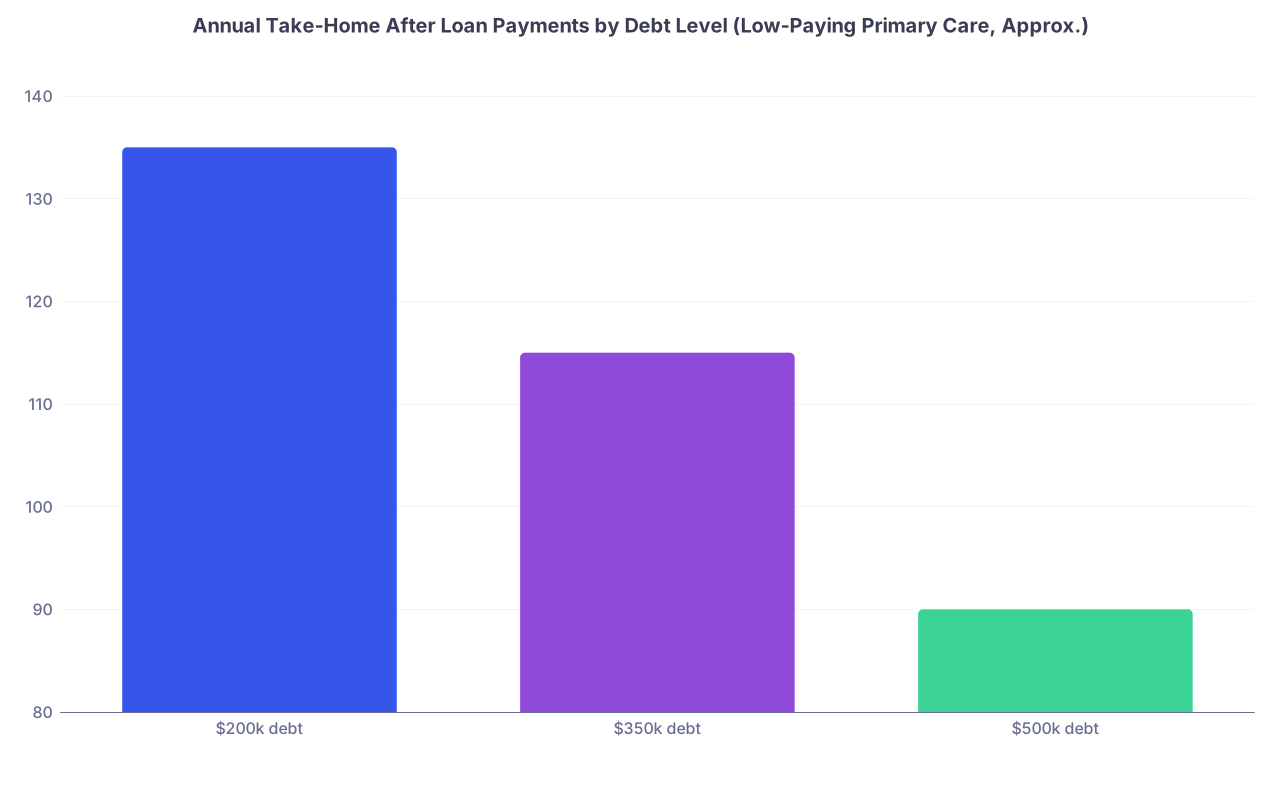
Now layer in debt:
| Category | Value |
|---|---|
| $200k debt | 135 |
| $350k debt | 115 |
| $500k debt | 90 |
(Assuming ~$220k salary, aggressive repayment, and typical taxes. Exact numbers vary, but the direction is right.)
If you:
- Have >$350k debt
- Want to live in a major metro (NYC, SF, LA, DC, Boston, Seattle)
- Do not want to work 60–70 hours or moonlight constantly
Then choosing one of the lowest paying specialties without a repayment/PSLF strategy is a textbook mistake.
Red Flag #1: You have large loans and have never done a concrete, spreadsheet-level 10-year projection of income, taxes, and loan repayment in your target specialty and city.
If your “plan” is just: “I’ll figure out PSLF later,” you are walking straight toward a wall.
2. When Your Lifestyle Goals and the Specialty’s Pay Do Not Match
People underplay this. Then get blindsided.
You cannot have:
- Low-paying specialty
- High cost-of-living city
- Private schools for multiple kids
- Big house
- Minimal call
- Part-time work by age 40
That combination does not exist. Something must give. Usually more than one thing.
Common lifestyle–income mismatches
Here are some combinations that should make you slam the brakes and think hard:
You want part-time early + low pay + high debt
Example:
- Specialty: Outpatient pediatrics
- Goal: 0.7 FTE by early 30s, 3–4 days/week
- Debt: $400k
- Location: Bay Area or NYC
This is almost always a financial trap unless you marry someone with a significantly higher, stable income.
You want expensive urban life + low pay + kids quickly
If your non-negotiables include:
- Living in a high-status neighborhood
- Frequent travel
- Children early in residency or right after
- No interest in moonlighting or side gigs
Then choosing something like academic geriatrics in Manhattan is a bad financial fit.
You want maximum flexibility + are already late to the game
If you started med school at 30+, graduate at 34, finish residency at 37–38, and pick a low-income specialty, you have fewer peak-earning years to course-correct. Not impossible. But much tighter.
Red Flag #2: Your dream life (city, house, family size, work hours) looks like that of a high-earning specialist, but you are choosing one of the lowest paid specialties and assuming “we’ll just budget harder” will close the gap.
No, it will not.
3. When Your Interest Is Real… but Shallow
Liking a rotation ≠ being willing to accept that field’s lifelong trade-offs.
I have seen this sequence dozens of times:
- MS3 loves peds rotation: cute kids, supportive attendings, fun team.
- Thinks: “I like pediatrics more than adults; I will just do peds. Money is not everything.”
- Never actually:
- Talks to mid-career pediatricians about burnout and pay.
- Shadows in community clinics or Medicaid-heavy practices.
- Looks at call schedules and RVU pressures.
- Matches into peds. Excited.
- PGY2: “Wait, so this is the salary ceiling if I stay general? And this call schedule is forever?”
Interest is necessary. It is not sufficient.
You must separate:
- “I enjoyed this rotation as a student in a low-responsibility role”
from - “I understand how this job looks at 10, 20, 30 years, with kids, aging parents, and my actual bills.”
Red Flag #3: Your main exposure to the specialty is one or two “great rotations” and some enthusiastic faculty, but you have not seen: community practice, salary contracts, productivity pressure, or mid-career physicians’ real lives.
If you are going into a low-paying specialty, you need more reality exposure, not less.
4. Debt + Policy Risk: When PSLF or IDR Is Your Only Lifeline
Many students mentally outsource the entire problem to PSLF:
- “I’ll just do 10 years of PSLF.”
- “Income-driven repayment will handle it.”
Maybe. Or maybe not.
The uncomfortable truth:
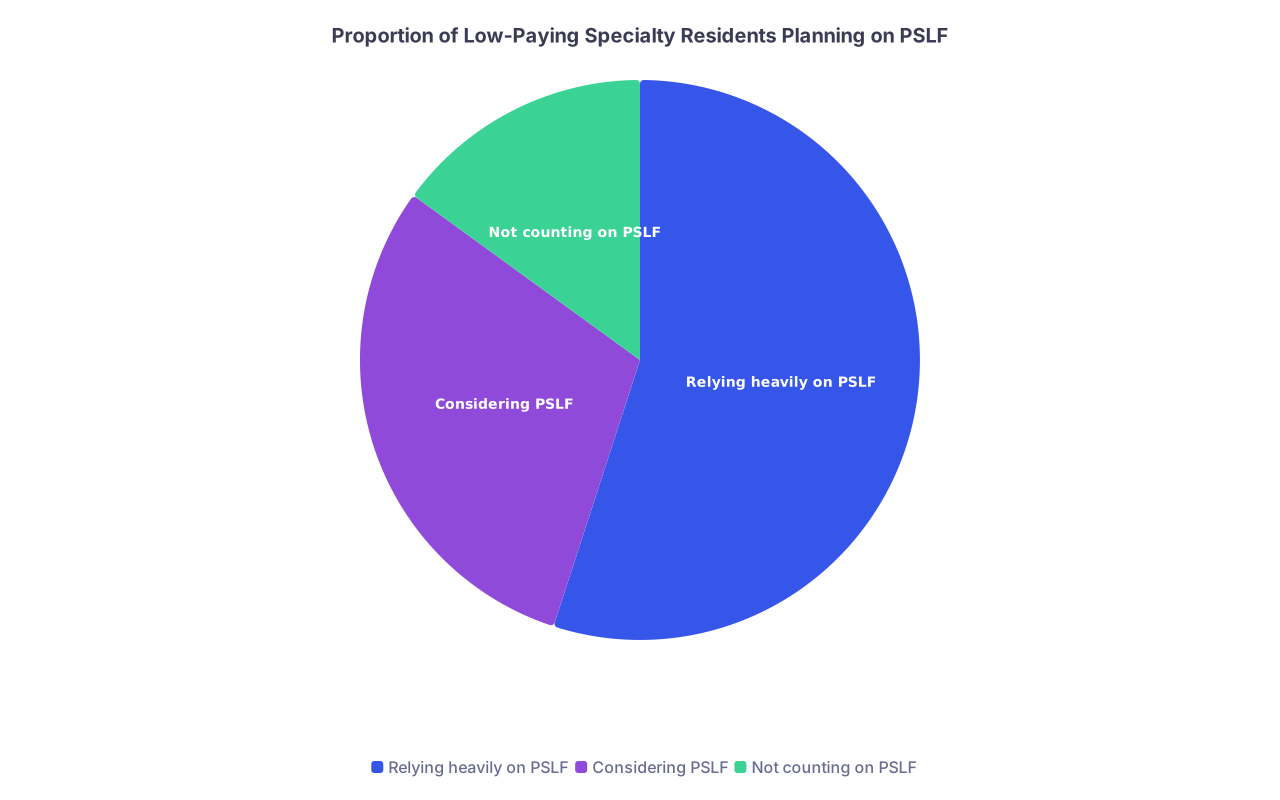
PSLF and income-driven repayment (IDR) are political and policy-dependent. They can change.
| Category | Value |
|---|---|
| Relying heavily on PSLF | 55 |
| Considering PSLF | 30 |
| Not counting on PSLF | 15 |
If your entire financial survivability in a low-paying specialty depends on long-term federal programs staying generous, you are taking a large, unacknowledged risk.
Red Flag #4: Your entire plan is “PSLF will save me,” and if PSLF disappeared tomorrow, your numbers would be catastrophic.
Safer approach if you love a low-paying specialty:
- PSLF = bonus, not life raft
- IDR = tool, not permanent crutch
- Your budget can technically work even without forgiveness, though it might be tight
If that is absolutely impossible with your debt + specialty combo, you need to acknowledge that you are accepting a large, non-medical risk factor.
5. When You Have Zero Interest In Side Income or Negotiation
Some people in low-paying specialties do perfectly fine financially.
Why?
Because they:
- Moonlight strategically in residency and early attending years
- Negotiate contracts hard (yes, even “non-procedural” fields have room)
- Add small procedures or niche services that bump income
- Are willing to live in lower cost-of-living areas for a while
But some of you reading this hate all of that. You want:
- No extra shifts
- No business headaches
- No contract fights
- No picking up tele-psych or moonlighting hospitalist work
That is a personality reality, not a flaw. But it changes what is safe.
Red Flag #5: You have no interest in any of the following: moonlighting, telemedicine, leadership roles, admin stipends, or moving for better-paying jobs—yet you are picking one of the lowest reimbursed specialties with six-figure debt.
If you want a low-paying specialty and a simple, low-hustle career path, you must be even more conservative with:
- Debt load
- Location
- Housing choices
- Private versus public schooling
- Lifestyle creep
You cannot have: low pay + no side income + luxury tastes + big city.
Pick two. Maybe three if your partner earns a lot. But not all of them.
6. Geographic Reality: When Your Preferred City Is a Salary Disaster
Some specialties get absolutely hammered by geography.
Family medicine in rural Midwest?
You might see $260k–$300k+ with loan repayment bonuses.
Same specialty in coastal academic centers?
You may see $180k–$220k in a city where a starter home is $900k.
Outpatient pediatrics in high-cost cities is infamous for this spread.
| Specialty | Location | Salary | Cost of Living Level |
|---|---|---|---|
| Pediatrics | Rural Midwest | $240k | Low |
| Pediatrics | SF Bay Area | $200k | Very High |
| Family Medicine | Texas small city | $260k | Moderate |
| Family Medicine | NYC | $210k | Very High |
If your absolute non-negotiable is:
“I must live in Manhattan / SF / Seattle / DC long term. Full stop.”
Then certain low-paying specialties become extremely risky unless:
- You have minimal debt, or
- You have a high-earning partner, or
- You are willing to accept renting small places long-term, aggressive budgeting, and limited financial margin
Red Flag #6: You will only consider top 5 most expensive metros, yet you are entering a bottom-quartile earning specialty with above-average debt and no side income plans.
You do not fix a geographic mismatch with optimism. You fix it with math or compromise.
7. Personality Misfit: When Your Values Are at War With Your Choice
Some of you tell yourselves:
“I don’t care about money.”
Then 10 years later, you care. A lot. Because money = choices.
Warning signs you should not ignore:
- You already feel resentful watching higher-paid specialties on your rotation (“They do less and get paid more.”)
- You talk frequently about “being valued appropriately” and “systemic disrespect”
- You are very future-focused: you care about timelines for house, kids, retirement
If you are already sensitive to fairness and value, a big pay gap between you and peers may sting more than you think. Especially once:
- You are exhausted
- Your childcare costs more than your monthly loan payment
- Your partner is burned out from carrying more of the financial load
Red Flag #7: You are already angry at the idea of earning much less than your classmates over decades, but you are forcing yourself into a low-paying field because you “should” or because “money is evil.”
Do not martyr yourself to a specialty. You will just burn out faster and leave medicine entirely.
8. When Your Interest Is Real, but Another Specialty Might Serve You Better
Here is an uncomfortable truth:
Many people lock into “low-paid” specialties without ever properly exploring alternative paths that offer similar patient populations or content with better pay or flexibility.
Examples:
- Love working with kids?
- Peds neuro, peds EM, peds anesthesia, or peds hospitalist can pay significantly more than pure outpatient general peds.
- Love longitudinal care and counseling?
- Some outpatient IM, concierge primary care, or combined psych/FM setups can be more lucrative than standard academic primary care.
- Love psychiatry-style work?
- Interventional psych, CL psych at strong systems, or niche private practice can materially boost income.
I am not saying “chase the highest paying variant.” I am saying:
Do not blindly choose the lowest paying version of your interests without checking whether there is a better middle ground.
Red Flag #8: You are basing your entire specialty choice on a very narrow version of the field (often academic) and have not explored private practice, hybrid models, or subspecialties that change the financial picture.
9. A Simple Decision Framework: When You Should Pause or Pivot
If you are seriously considering a low-paying specialty, run yourself through this filter. Be brutally honest.

| Step | Description |
|---|---|
| Step 1 | Interested in low paying specialty |
| Step 2 | Likely OK - proceed with caution |
| Step 3 | Reconsider specialty or location |
| Step 4 | Debt under $250k? |
| Step 5 | Willing to live in moderate COL area? |
| Step 6 | Have high earning partner or strong PSLF plan? |
| Step 7 | Comfortable with side income or moonlighting? |
| Step 8 | Run 10 year projection |
If you land in the “Reconsider” box, that does not mean “never.” It means:
- You need a different location, or
- You need a different debt plan, or
- You might be better in a slightly better-compensated field that you still like
Do not cling to “but I like it” as your only answer. Plenty of residents “liked” EM, then left after 5 years due to lifestyle. Same will happen in primary care and pediatrics if the financial stress is relentless.
FAQ (exactly 4 questions)
1. Is it always a mistake to choose a low-paying specialty with high debt?
No. It becomes a major mistake when you combine: high debt, expensive city, no side-income interest, and unrealistic lifestyle expectations. If you have a clear, conservative repayment plan, are willing to adjust location, and genuinely value the work enough to accept the trade-offs, it can still be a rational, even excellent, choice. The mistake is pretending the numbers do not matter.
2. What level of debt should make me seriously question low-paying specialties?
Once your total educational debt (undergrad + med) passes roughly $300k, you need to be extremely deliberate if you are choosing fields like outpatient pediatrics, family medicine, or academic primary care in big cities. Over $400k, entering the lowest-paid specialties without a strong, specific plan (PSLF strategy, location flexibility, or high-earning partner) is, in my view, reckless.
3. Can PSLF make a low-paying specialty “safe” for me financially?
PSLF can make it workable, but treating it as guaranteed is risky. You must understand the 10-year timeline, employment requirements, tax implications, and political risk. If losing PSLF would completely destroy your financial life, you are putting a lot of trust in policies you do not control. Better to design a plan that functions even if forgiveness programs change, and view PSLF as upside, not the only lifeline.
4. How do I know if my “interest” in a low-paying specialty is deep enough to justify the trade-offs?
Talk to mid- and late-career attendings in that field, outside of academic bubbles. Ask about burnout, scheduling, their actual take-home pay, and what they would do differently. Shadow on “bad days,” not just the fun clinic days. If you still feel drawn to the work after seeing the less glamorous side—and you have run the numbers honestly—that is a good sign your interest is real, not just a temporary rotation crush.
Key points:
- Loving a low-paying specialty does not magically erase the math; do 10-year projections before you commit.
- If your desired lifestyle, location, and debt load do not align with the specialty’s earning potential, that is not “hustle harder” territory; that is “rethink the plan” territory.
- The safest choices come when your personality, values, and financial reality all point in the same direction—do not ignore any of those three.


