

Academic vs Community: Who Really Underpays the Lowest Paid Fields?
Why is a community pediatrician sometimes making more than an academic cardiologist, while an academic psychiatrist can be making less than a community urgent care doc seeing sniffles all day?
You have been sold a cartoon:
Academic = mission-driven, underpaid.
Community = RVU factory, overpaid but “less prestigious.”
Reality is messier. And for the lowest paid specialties, a lot of what you have heard is simply wrong.
Let’s pull the curtain back.
The Myth: “Academic Always Pays Less Than Community”
I hear this constantly from students and residents:
“I love peds and I want to teach, but I can’t afford academic — they pay half of community.”
Not quite. Sometimes. In some markets. But that’s not a law of nature.
The pattern across the lowest paid specialties (think pediatrics, family medicine, psychiatry, geriatrics, infectious disease, endocrinology, rheumatology, nephrology in some markets) is more nuanced:
- Yes, academic base salaries often start lower.
- But community jobs can range from “shockingly generous” to “RVU sweatshop with fake OTE numbers.”
- And the largest underpayment often happens where residents assume they are safe: small academic divisions with no leverage and a culture of “you should be grateful to be here.”
Let’s ground this in actual numbers.
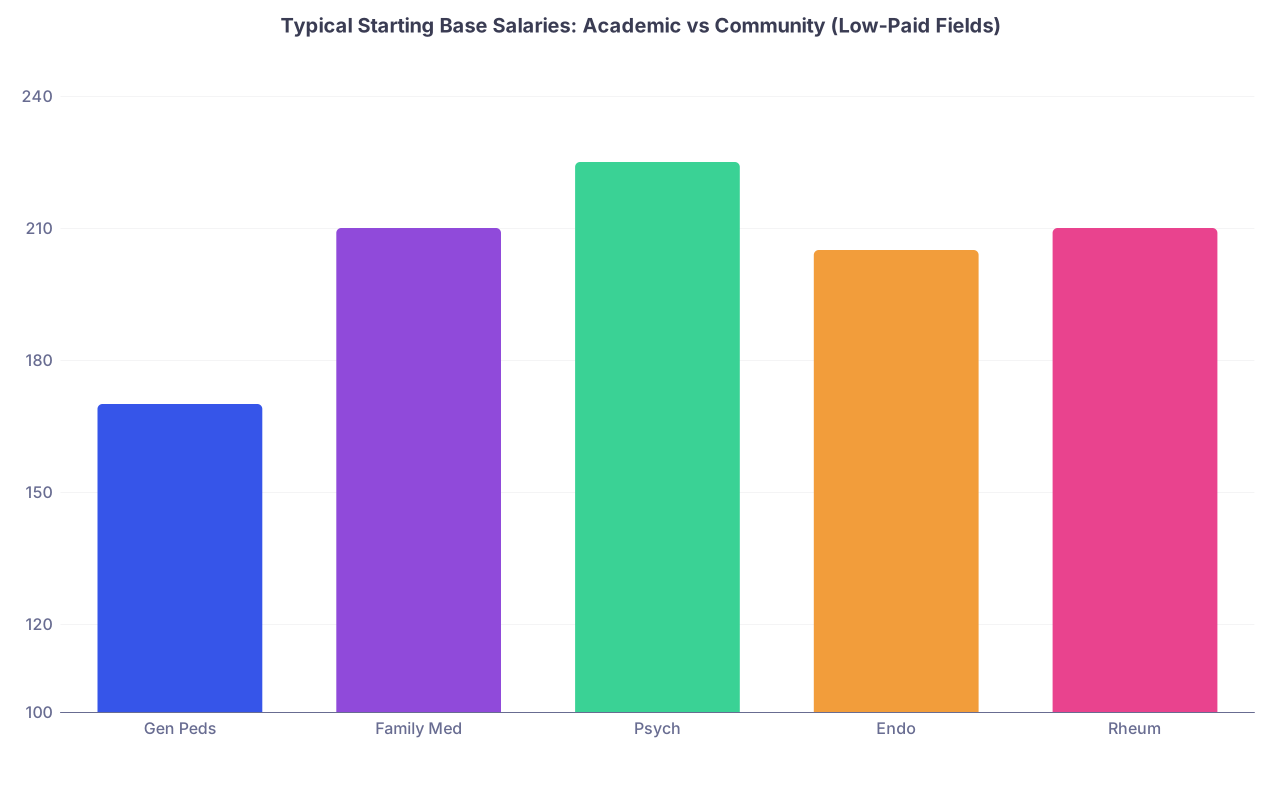
| Category | Value |
|---|---|
| Gen Peds | 170 |
| Family Med | 210 |
| Psych | 225 |
| Endo | 205 |
| Rheum | 210 |
Those are ballpark academic base numbers (in thousands, USD) you’ll see quoted in surveys and real offers for many regions, excluding major HCOL extremes.
Now compare that to realistic community offers in non-manhattan / non-rural-alaska settings:
| Specialty | Academic Base | Community Base |
|---|---|---|
| General Peds | 160–190 | 210–260 |
| Family Med | 200–230 | 240–300 |
| Psychiatry | 220–260 | 260–350 |
| Endocrinology | 190–220 | 220–270 |
| Rheumatology | 200–230 | 230–300 |
Yes, community mean is usually higher. But that gap is not always the 100–150k spread people dramatize on forums. In some areas, the gap compresses to 20–40k once you control for call, RVUs, and benefits.
And there are plenty of community jobs that bait with “up to $350k” and quietly tie that to RVU thresholds that no sane human hits without burning out by year two.
So who is actually underpaying? The answer depends on which low-paid field, which side of the country, and how the job is structured.
Where Academic Really Underpays: Structural Problems, Not Just Altruism
The worst academic compensation for low-paid specialties usually shows up in the same combination:
- High-prestige department name
- Over-subscribed fellowship (peds heme/onc, ID, rheum, endo)
- Heavy teaching / admin that does not generate RVUs
- “But you get to work here” culture
I have seen academic offers in 2024 that look like this (actual structure, details anonymized):
- Pediatric endocrinology, academic center in a major coastal city
- Base: $195k
- “Productivity bonus”: RVU target set at 75th percentile MGMA for peds endo
- Pediatric call 1:4, nights and weekends, “included” in salary
- Clinical FTE: 0.8 “because you’ll do research and QI”
- Research FTE funded: 0.0. Go write grants on your own time.
That’s not “academia pays less because we train and do research.”
That’s bad comp design and exploiting oversupply.
The low-paid academic trap usually has a few consistent markers:
Subspecialty with more fellows than community demand
Think adult ID, some peds subspecialties, endocrine, rheum in saturated metro markets.Name-brand institution using prestige as payment
The pitch is loaded with “We’re top 10 in NIH funding” and light on transparent RVU / salary data.Teaching/admin used as free filler
“0.2 FTE for teaching” that somehow becomes 0.5 FTE in real life. No protected time in your contract. But your RVU target doesn’t change.Misaligned incentive structure
You’re measured with productivity metrics designed for high-revenue specialties. While doing time-intensive, low-RVU clinic work like complex peds or chronic rheum.
Under those conditions, yes, academic absolutely underpays. And not just compared to community. Sometimes it underpays compared to what you could make as a hospitalist moonlighting half-time.
The Community Side: Not Always the Pay Paradise You Think
Flip side: people assume community always “pays better.”
Many times, it does. Sometimes, it really does not.
The ugliest underpayment in community for low-paid fields tends to look like this:
- RVU-only comp with absurdly low conversion factor
- “Guarantee” for 1–2 years at an inflated level, then cliff drop to production
- Narrow-network or Medicaid-heavy payer mix that quietly crushes your collections
- Call, nights, weekends rolled in without extra compensation
- Non-competes that trap you in a 30-mile radius
I have reviewed “community psych” contracts where:
- The headline: “Earn $350–400k!”
- Reality: $40 per RVU, 6-month guarantee at $300k, then full production.
- No-shows and cancellations entirely on you.
- 30-minute med checks scheduled every 15 minutes.
- You are legally an independent contractor, paying your own benefits and malpractice.
Compare that to an academic psych job at $250–270k with real benefits, better hours, and a defined pension or 403(b) match. The raw salary is lower. The underpayment may not be.
The pattern in low-paid fields:
- Good community systems (large multispecialty groups, stable hospitals) pay solid bases and realistic RVU expectations. These are often better than academic by a clear margin.
- Shaky private groups / PE-backed clinics can underpay in a different way: not on base, but by squeezing all your time and risk for a dangling “upside” you never really see.
So the dichotomy “academic underpays, community pays well” is lazy.
Both have traps. Just different flavors.
Specialty by Specialty: Who Gets Hit Hardest?
Some of the lowest paid specialties show very different academic vs community dynamics. Let’s break a few down, since you will not hear this honestly during interviews.
General Pediatrics
- Academic: Often 160–190k base; heavy teaching and inpatient rotations; NICU / PICU coverage sometimes undercompensated; big-city HCOL can destroy effective income.
- Community: Outpatient peds can hit 220–260k with reasonable call, especially in non-coastal, mid-sized cities. Rural can go 280k+ with bonuses and loan repayment.
Who underpays?
Academic, almost always. The exception is the rare academic job with huge loan forgiveness or unusually high state-funded scales.
Family Medicine
- Academic: 200–230k common, with residency teaching and inpatient rounding; often salaried, modest RVU pressure.
- Community: Huge variance. Straight outpatient with some procedures in Midwest / South can easily reach 260–320k. But I’ve also seen fake-optimistic “up to 350k” ads with unreachable RVU thresholds.
Who underpays?
Academic often pays less on paper, but the worst underpayment I see is community RVU-sweatshops with low conversion factors and poor payer mix.
Psychiatry
- Academic: 220–280k, controlled hours, protected teaching time sometimes real, sometimes not.
- Community: 260–350k common, 400k+ possible for in-demand inpatient or C/L roles, especially with call.
But here’s the twist: psych has insane locums and telehealth options. A psych who accepts a 230k academic offer in a tight market might be leaving 100–200k on the table by not mixing in part-time community/tele work.
Who underpays?
Academic, in pure base salary terms. But some community outpatient psych and telepsych setups massively underpay by stuffing panel size, no-show risk, and admin work onto your “off the clock” hours.
Endocrinology and Rheumatology
These are the poster children for “low-paid, time-intensive, cognitively heavy.”
- Academic: 190–230k common; teaching, complex patients, poorly aligned RVUs; lots of clinic and follow-up.
- Community: 220–300k, sometimes more in underserved regions, especially if you are the only rheum or endo in 100 miles.
Who underpays?
Academic, by culture and design. There is a quiet expectation that “these are lifestyle subspecialties” and people will accept low pay to do interesting work. Community can still be underwhelming, but it is usually less insulting.
The Real Variable: Power, Scarcity, and Illusions of Prestige
Compensation in low-paid fields is not primarily about “academic vs community.”
It’s about bargaining power.
You get underpaid when:
- Your specialty is oversupplied locally
- The job is in a place everyone wants (San Diego, Boston, Seattle, SF Bay, NYC)
- The employer has prestige leverage (big-name academic)
- You do not ask hard questions or negotiate
You get paid decently when:
- You are in a specialty or region with scarcity (psych in Midwest, rheum in large exurbs, peds in growing suburbs)
- The employer cares about retention and has to compete with nearby systems
- You treat the job like a business deal, not a calling
The academic vs community label is just decoration on top of those underlying forces.

| Step | Description |
|---|---|
| Step 1 | Your Pay |
| Step 2 | Specialty Supply Demand |
| Step 3 | Local Geography |
| Step 4 | Employer Type |
| Step 5 | Your Willingness To Walk |
| Step 6 | Academic |
| Step 7 | Community |
If you are a general pediatrician in some coastal academic center where there are 20 eager fellows lined up behind you, you have almost no leverage.
If you are the only rheumatologist in a 200-mile radius of a growing metro, academic or community, you suddenly have leverage and your pay reflects it.
How to Tell Who Is Actually Underpaying You
Forget the binary academic vs community for a second. Ask these questions for any offer in a low-paid field:
- What is the base salary after the initial “guarantee” period?
- What is the RVU target and conversion factor, and how does that compare to MGMA median for my specialty and region?
- How many clinic sessions per week? How many patients per session now, and what’s the “goal”?
- Is call paid separately? If not, why not?
- How many FTEs of work are they effectively expecting? Do teaching/research/admin hours reduce clinical expectations, or are those just piled on?
- What do current junior attendings in my specialty actually take home (not just “potential”)?
Then compare academic and community side by side. Strip out the glossy language.
| Domain | Academic Red Flag | Community Red Flag |
|---|---|---|
| RVUs | High target with “protected time” | Low conversion factor, high RVU target |
| Call | Frequent, unpaid, “part of mission” | Mandatory and lumped into base |
| Teaching/Admin | 0.2–0.3 FTE but no workload reduction | Hidden precepting / unpaid supervision |
| Benefits | Weak retirement, minimal match | 1099 with no benefits or malpractice |
What you will often find:
- Some academic offers are clearly exploitative for low-paid specialties, especially where prestige and oversupply intersect.
- Some community offers are disguised underpayment, shifting all business risk to you.
Neither side has a monopoly on underpaying you. They just use different stories to justify it.
So, Who Really Underpays the Lowest Paid Fields?
Short answer: the place that knows you will accept it.
If you force me to generalize:
- Academic centers underpay more frequently in peds, endocrine, rheum, ID, and some general IM roles, using prestige and mission as leverage, especially in popular cities.
- Community practices underpay more brutally in family med and psych when they dangle impossible RVU-based “upside” and offload business risk, especially in oversaturated suburban markets.
- The biggest determinant is not the label on the building. It is your specialty’s local supply-demand balance and your willingness to walk away.
If you are picking a low-paid field, stop asking “academic or community?” like it’s a moral identity. Start asking “Who is pricing my time honestly?”
Key Takeaways
- “Academic always pays less” is lazy and often wrong; some community jobs underpay just as badly once you factor in RVUs, call, and risk.
- The worst underpayment in low-paid specialties shows up where prestige, oversupply, and vague contracts meet — especially in certain academic divisions.
- Your real protection is not the setting; it is understanding the numbers, asking uncomfortable questions, and being willing to say no, even to a shiny name-brand offer.


