

Low-paying specialties do not need business skills. That’s the lie that keeps a lot of smart, altruistic physicians quietly broke, burned out, and boxed in.
If you’re headed into pediatrics, family medicine, psychiatry, geriatrics, infectious disease, or another “lowest paid” specialty, you’ve probably heard some version of this: “We don’t go into this for the money,” or the more toxic cousin, “If you care about business, you picked the wrong field.”
Here’s the problem. The hospital executives negotiating your RVUs? The private equity group buying your practice? The insurer denying your claims? They all use business skills relentlessly. You opting out doesn’t make the system less financial. It just makes you the only one at the table who does not understand the game.
Let’s tear apart this myth properly.
The Data: Low-Paid ≠ Low-Stakes
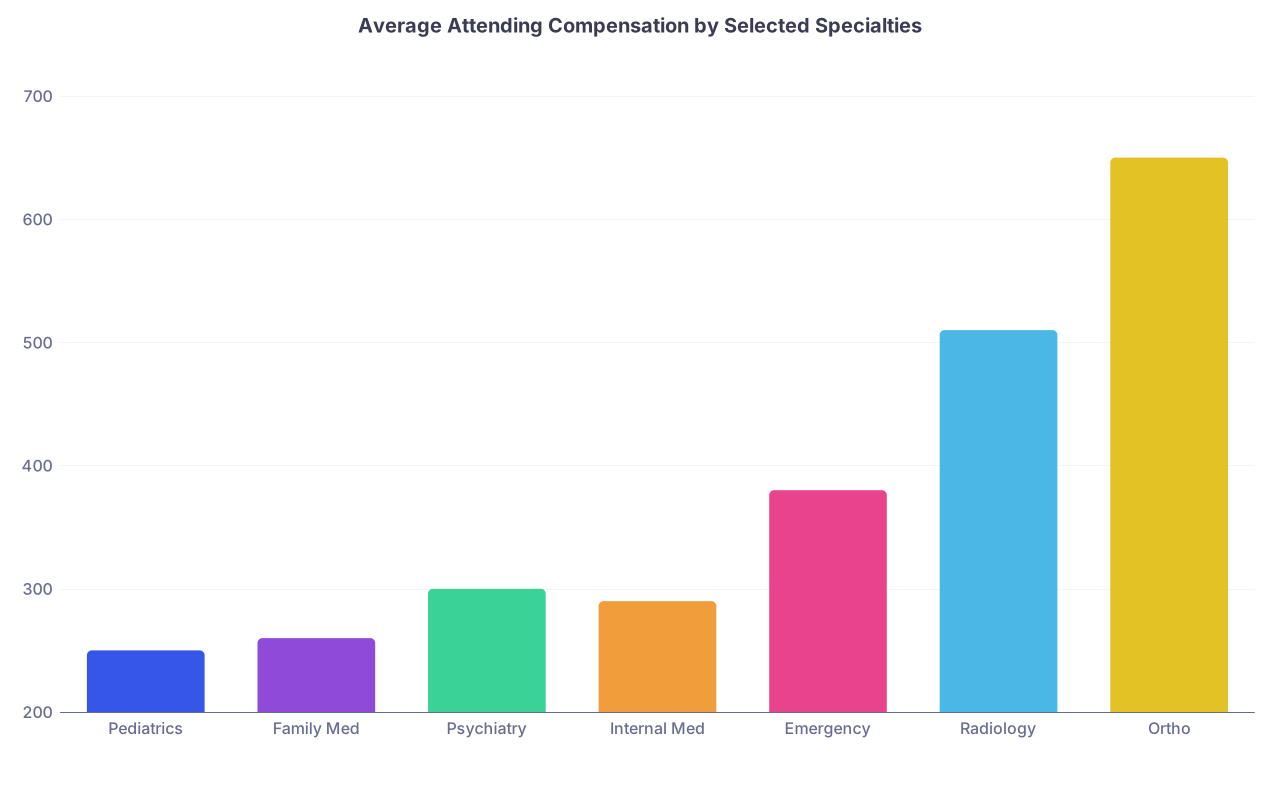
First, let’s anchor this in numbers, not vibes.
| Category | Value |
|---|---|
| Pediatrics | 250 |
| Family Med | 260 |
| Psychiatry | 300 |
| Internal Med | 290 |
| Emergency | 380 |
| Radiology | 510 |
| Ortho | 650 |
These numbers shift slightly year to year depending on which survey you read (Medscape, MGMA, Doximity), but the pattern is stable: your classic “low-paying” cognitive specialties cluster in the mid-200s to low-300s. Surgical and procedural fields can be double that.
Now layer in this reality I’ve watched play out over and over:
A pediatrician making $250k with:
- $300k in med school debt at 6–7%
- Paying 35–45% effective marginal tax on the last dollars
- Living in a medium HCOL city
Has less real financial margin than a radiologist making $500k with the same debt and similar lifestyle creep. The radiologist can screw up financially for years and still land on their feet. The pediatrician gets maybe one or two major financial mistakes before they’re trapped.
So the idea that business skills matter less in lower-paying specialties? Backwards. The less you’re paid, the less room you have for ignorance.
In low-paid specialties, business literacy is a survival skill.
Myth #1: “I’m Just an Employee. Business Doesn’t Affect Me.”
I hear this constantly from residents in primary care and pediatrics. “I’ll just be hospital-employed; they’ll take care of that.”
No. They’ll take care of their margins. Not yours.
Let’s walk through what “just an employee” actually means in practice.
You sign a contract with:
- Base salary
- RVU targets
- Quality or productivity bonuses
- Non-compete clauses
- Tail coverage language
- Termination clauses
Every one of those is a business term. If you do not understand them, you are negotiating blind.

Here’s what I’ve seen repeatedly with low-paid specialties:
A family med doc signs at $230k with a “reasonable” 5,000 RVU target. Sounds fine. The group quietly expects partners to do 7,000–8,000 RVUs to hit bonuses or keep their job. The doc realizes this only after the first year-end review.
A psychiatrist takes what looks like a solid W2 job at $280k but gets hammered by a productivity formula that pays nothing for complex patients that need 60-minute visits. They’re stuck in 15-minute med checks they hate because the business model rewards that.
A pediatrician accepts a contract where “call is shared equally,” not realizing half the partners are near-retirement and informally exempt from call. Suddenly the new hire is carrying 1-in-3 nights instead of 1-in-6.
These are not “medicine problems.” These are business problems disguised as professional culture.
You can call yourself “just an employee” all you want. You’re still bound by a financial agreement, subject to revenue metrics, and replaceable if your margin drops below what administration wants.
If you understand basic business language—P&L, RVU valuation, payer mix, overhead—you can at least see the trap before you walk into it.
Myth #2: “Business Skills Are for High Earners Who Want to Run Groups”
Flip that. The people who need leverage the most are the ones with the least negotiating power: early-career docs in lower-paid fields.
You do not need to become a full-on entrepreneur. But you do need enough business skill to do three things:
- Read and negotiate your own contracts
- Understand what drives your revenue vs your employer’s revenue
- Build at least one additional income or bargaining lever over time
Look at real patterns.
| Profile | Business Skill Level | 10-Year Outcome |
|---|---|---|
| A: Peds, hospital-employed | Minimal | Stagnant pay, high burnout |
| B: Psych, mix of clinic + tele | Moderate | Flexible schedule, higher net income |
| C: FM, joins value-based primary care org | High | Leadership role, equity, schedule control |
I’ve watched nearly this exact table play out in real people.
The pediatrician with “minimal” literacy sees themselves as a pure clinician. Never questions payer mix. Never asks how the hospital bills their work. Ten years in, their real income has dropped after inflation, they’re burning out on volume, and administration hands them pizza on Physician Appreciation Day like that fixes anything.
Meanwhile, the family medicine doc who bothered to learn basic value-based care math? They join or help build a clinic where:
- Preventive care metrics drive shared savings
- They get a slice of upside for lowering hospitalizations
- Schedules are sane because the model is built around panel health, not visit churn
Same specialty “tier.” Totally different outcome. The difference isn’t that one “cares about money” and the other doesn’t. It’s that one understands the business model and positions themselves inside it, instead of under it.
Myth #3: “If I Focus on Business, I’ll Compromise My Ethics”
This one hits hard in pediatrics, psych, geriatrics, ID—fields full of people who actually like their patients.
The hidden assumption is ugly but common: business = exploitation. So if you learn business, you’re joining the dark side.
That’s lazy thinking.
You know who gets ethically compromised fastest? The physician who has zero financial cushion, zero understanding of contracts, and zero say in how their clinic is run. The one who:
- Is pressured to see 26–30 patients a day because “the numbers don’t work otherwise”
- Gets told to shorten complex visits to preserve access metrics
- Has no idea how to push back because “I’m bad with money, I’m just here to help”
That is not moral high ground. That is being easy to manipulate.
Business skills, for a low-paid specialist, are what let you decline bad incentives.
You can say:
“No, I will not do 10-minute ADHD follow-ups for 12-year-olds. Here’s the financial impact of longer visits, and here’s how we can bill appropriately for complexity.”
“Our no-show rate is killing our margin. Give me protected time and authority, and I’ll design a reminder protocol and overbooking strategy that works for our population.”
“I want part of my comp tied to outcomes or quality metrics that matter, not just raw visit count.”
That is ethics in action—using financial literacy to create a practice environment that doesn’t burn you and your patients to the ground.
Where Business Actually Shows Up in Low-Paid Fields
Let’s get concrete by specialty.
Pediatrics / Family Med
You are ground zero for every health system’s value-based care experiment. That means:
- Panel size is a business variable
- Preventive care completion affects shared savings
- Care coordination (which is often invisible) can be billable if coded correctly
If you understand risk adjustment, care gap closure, and the economics of panel management, you can design a clinic where:
- You see fewer patients/day but get paid based on panel health
- You hire or advocate for an RN care manager because you can show ROI
- You negotiate compensation that shares upside from reduced hospitalizations
Without business skills, you’re just told “your panel needs to be bigger.”
Psychiatry
Psych has a giant arbitrage opportunity between system chaos and what patients actually want.
You see:
- Hospitals billing facility fees 3–4x your professional fees
- Clinics forcing 15-minute med checks to “keep the lights on”
- Tech companies overpromising access while quietly underpaying clinicians
Business skills here mean you can:
- Run hybrid models: one W2 job for stability, plus 1099 telepsych or part-time cash practice
- Price a cash visit rationally and ethically instead of guessing
- Understand payer contracts well enough to opt out of the worst offenders
I’ve watched psychiatrists double their take-home in 3–5 years with no change in clinical skill—just by learning how to structure their time and billing in line with demand.
Infectious Disease / Geriatrics / Endocrine
These are specialties where hospital systems frankly underpay you relative to your value because the revenue is indirect.
Your consult prevents:
- ICU stays
- Readmissions
- Complications that cost the system six or seven figures
But the billing for your actual visit is “low RVU.” So admins treat you like a cost center.
If you understand how to measure and articulate your downstream financial impact—reduced length of stay, fewer readmissions, lower antibiotic spend—you have leverage:
- To negotiate protected time
- To justify additional staff
- To push for stipends or leadership roles in antimicrobial stewardship, falls prevention, or chronic care programs
Without that business framing, you’re “the consult doc who doesn’t bring in much.”
The Real Risk: Staying Financially Illiterate
I’ll be blunt. The biggest financial disasters I’ve seen in medicine are not the flashy surgeons blowing money on cars. It’s the low-paid specialists who never learned the basics and trusted “the system” to take care of them.
Common patterns:
- Signing non-competes that effectively lock you into one health system across an entire metro area
- Accepting “partnership tracks” in small groups where the buy-in is a black box and the overhead allocation is opaque by design
- Ignoring student loan strategy and overpaying by six figures because “I’m just doing normal payments” while working at a 501(c)(3) that would have qualified for PSLF
- Working in models where your name is on all the quality metrics, but the system keeps essentially all the upside
| Category | Value |
|---|---|
| Year 1 | 0 |
| Year 5 | 150000 |
| Year 10 | 400000 |
| Year 20 | 900000 |
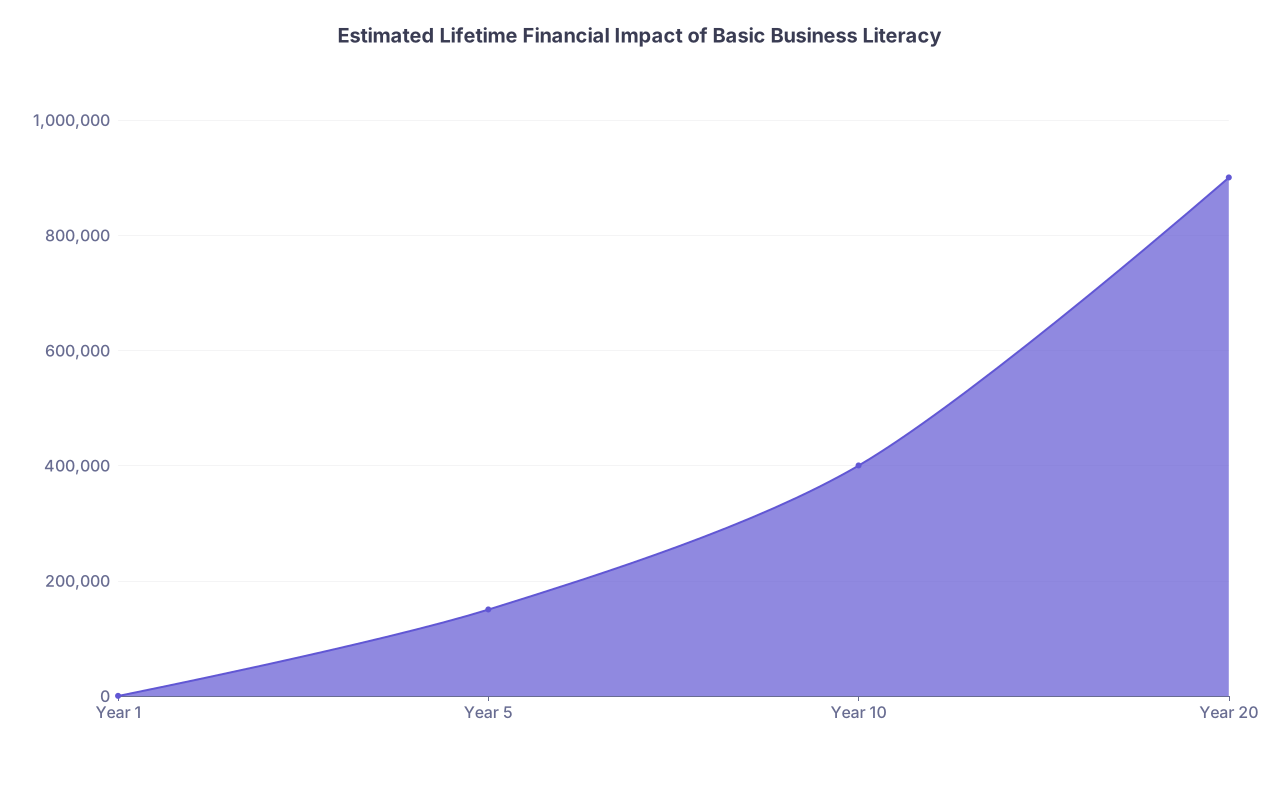
That chart is not hypothetical fluff. If you:
- Negotiate an extra $15–20k/year early on
- Avoid one catastrophic contract mistake
- Optimize loan repayment by even $100–200k over 10–20 years
- Capture modest equity or bonus upside in a better-structured role
You are easily in the high six-figure difference over a career. Especially as a “low-paid” specialist, those numbers move the needle from fragile to stable.
What “Business Skills” Actually Mean for You
I’m not talking about getting an MBA and spouting buzzwords in meetings.
For a resident or early attending in a low-paid specialty, business skills boil down to:
- Being able to read and question an employment contract
- Knowing how your work turns into revenue on a claim form
- Understanding basic financial statements enough to see where the money actually goes
- Recognizing bad incentives before they reshape your workday
- Building one or two leverage points—side clinical work, niche expertise, leadership in a program that truly saves the system money

| Step | Description |
|---|---|
| Step 1 | Residency Year 2-3 |
| Step 2 | Learn contract basics |
| Step 3 | Understand RVUs and billing |
| Step 4 | First job - negotiate key terms |
| Step 5 | Identify revenue and cost drivers |
| Step 6 | Take on project with measurable impact |
| Step 7 | Negotiate role or comp based on results |
| Step 8 | Expand skills into leadership or side work |
That path does not require you to sell your soul. It requires you to stop pretending the money piece is someone else’s job.
The Punchline
Low-paying specialties do not get a pass on business. They get punished the hardest for ignoring it.
Three things to remember:
- The less you earn per hour, the more important it is to understand how every dollar flows—from payer to system to you.
- Business literacy is not greed; it is how you protect your ethics, your time, and your ability to keep practicing without burning out.
- In fields like pediatrics, family medicine, psychiatry, geriatrics, and ID, basic business skills are the difference between being a forever-exploited “cost center” and becoming the person who actually shapes how care is delivered.
You chose a lower-paid specialty. Fine. Just do not also choose to be powerless.


