

The fastest path from “secure professional” to “quietly drowning in money problems” is residency in a low-paid specialty with bad financial decisions layered on top. I have watched smart, capable residents in pediatrics, psychiatry, family medicine, and preventive medicine wreck their future options with choices they thought were harmless or “temporary.”
This is not about skipping lattes. This is about structural mistakes that lock you into decades of stress, limited career flexibility, and a retirement that never quite feels safe.
You are not paid enough in these specialties to shrug this stuff off.
Below are the recurring financial errors I see in low-paid fields—and exactly how to avoid making the same miserable choices.
1. Pretending “Attending Money” Will Fix Everything
The most dangerous thought in residency is simple: “I will pay for it later when I am an attending.”
Residents in derm or ortho sometimes get away with this delusion. You, in pediatrics or family medicine or psychiatry, probably will not.
Here is the trap:
- You underestimate how low your attending salary will be relative to your debt.
- You overestimate how much of that salary you will actually see after taxes, retirement contributions, and malpractice.
- You forget that life gets more expensive, not less, once you finish training.
I have watched a PGY-3 pediatric resident sign a $2,300/month luxury apartment lease, saying, “It’s fine. I’ll be a pediatric hospitalist making $200K soon.” Four years later, he was:
- $320K in student debt
- Trapped in a high cost-of-living city
- Underpaid relative to even his modest expectations
He was “an attending” and still living paycheck to paycheck.
Do not make this mistake: your future attending salary in low-paid specialties is not high enough to bail out unlimited bad choices now.
How to avoid it
- Look up realistic salary ranges for your specialty and geography, not fantasy numbers from recruiters.
- Assume your effective take-home as an attending will be about 55–60% of gross after taxes and retirement if you are responsible.
- Run numbers, not vibes. If your student loan payment, housing, childcare, and retirement do not fit on that future budget, they will not magically fit just because your title changes.
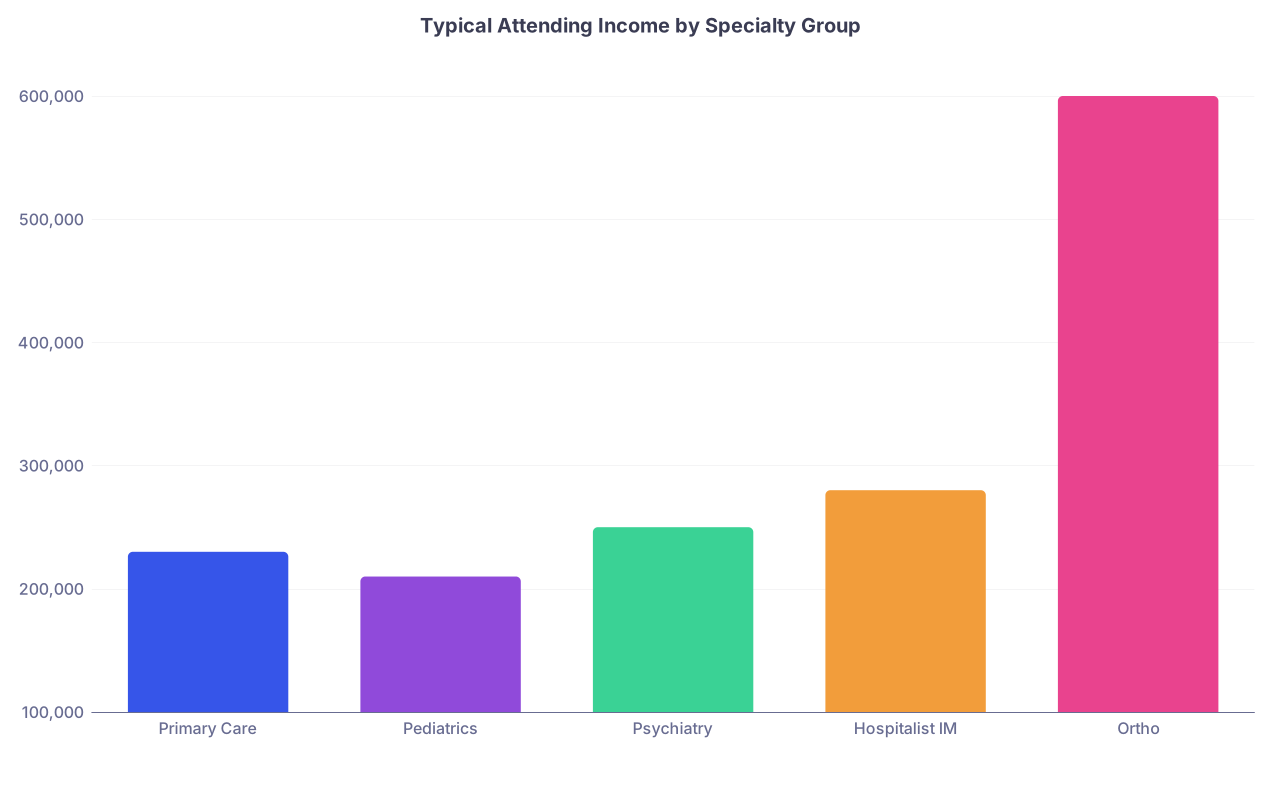
| Category | Value |
|---|---|
| Primary Care | 230000 |
| Pediatrics | 210000 |
| Psychiatry | 250000 |
| Hospitalist IM | 280000 |
| Ortho | 600000 |
Those numbers are not precise for every market, but the gap is real. Pretending you are in the right column when you are actually in the left or middle column is how debt spirals start.
2. Ignoring How Bad High-Interest Debt Really Is
Residents love to say, “It is only a $5,000 balance. I will knock it out later.” The rate? Often 18–24% on credit cards. That is financial arson.
In low-paid specialties, the margin between “okay” and “screwed” is slim. High-interest debt (credit cards, personal loans, Buy Now Pay Later traps, store cards) eats that margin with interest.
I have seen this pattern too many times:
- PGY-1 moves to a new city without an emergency fund.
- Relocation on credit: furniture, deposits, flights, Uber everywhere.
- “I will pay it off during PGY-2 when things calm down.”
- They never calm down. Interest compounds. Balance doubles.
By the time they are attending, they are still dealing with $15K of credit card debt on top of six figures of student loans. And their “low-paid” attending salary does not have enough surplus to wipe it out in a few months.
Do not treat high-interest debt like a background problem. It is the house fire, not the chipped paint.
How to avoid it
- Set one rule now: no carrying month-to-month credit card balances unless it is literal survival.
- Build even a tiny emergency buffer (e.g., $500–$1,000) before you start trying to “optimize” anything else.
- If you are already in the hole, stop pretending. Face the total number, contact the bank or a nonprofit credit counselor, and build a payoff plan. Today, not post-fellowship.
3. Choosing the Wrong Loan Strategy for a Low-Pay Career
Residents in low-paid specialties are uniquely vulnerable to messing up student loan strategy. The most common disasters I see:
- Refinancing federal loans to private during residency for a slightly lower rate, then losing access to income-driven repayment (IDR) and Public Service Loan Forgiveness (PSLF).
- Picking the wrong IDR plan for their situation and paying far more than necessary.
- Failing to certify employment for PSLF annually and then “discovering” ten years of payments do not count.
If you are heading into pediatrics, family med, psych, or preventive medicine and plan to work for a nonprofit hospital, FQHC, or academic center, PSLF is not a side perk. It can be the difference between paying your loans for 10 years vs 25+.
I have seen a child psychiatry fellow refinance $300K in federal loans to a private lender during PGY-4 because “the rep said it would save me thousands.” She planned to work at a children’s hospital. That single decision likely cost her well over $150,000 in lost forgiveness. There is no undo button.
Basic guardrails
- If you are even mildly likely to work for a nonprofit or government employer long term, keep federal loans federal until you are 100% certain PSLF is off the table.
- Learn the difference between REPAYE/SAVE, PAYE, and IBR and how they treat your spouse’s income, family size, and interest subsidies.
- File the PSLF Employment Certification Form every year you are at a qualifying institution. Not “later.” Now.
| Feature | Federal Loans | Private Loans |
|---|---|---|
| PSLF Eligible | Yes | No |
| Income-Driven Plans | Yes (SAVE, PAYE, IBR, etc.) | Rare / Limited |
| Forbearance Options | Strong, flexible | Lender-dependent, stricter |
| Interest Rates | Often higher initially | Sometimes lower initially |
| Best For | Low-paid, PSLF candidates | High-paid, sure non-PSLF path |
If you earn $210K as a pediatrician and qualify for PSLF, you might reasonably have six figures forgiven. If you throw that away for a 1–2% better rate during residency, that is not optimization. That is self-sabotage.
4. Overestimating How Much House You Can Afford
The “doctor mortgage” is marketed like a gift. Low down payment, no PMI, special terms. For many residents and new attendings in low-paid fields, it is a loaded gun.
I have watched young family physicians and pediatricians get crushed by housing costs because they anchored on “the bank approved me” instead of “what can I easily afford on a low-attending salary with daycare, loans, and retirement to fund.”
Here is what goes wrong:
- You accept a primary care or peds job at $210–240K in a mid- or high-cost city.
- A lender pre-approves you for a $700K+ house because of your “doctor profile.”
- You buy at the top of that range, assuming dual-income stability and rising pay.
- Reality: daycare is $1,500–2,000/month, loan payments climb, raises are small, and you feel squeezed every month.
If your specialty is low-paid, housing inflation hits differently. You do not have huge bonuses or side gig procedures to plug the gap. You just feel tense every time the mortgage auto-draft hits.
Safe approach
- Ignore the pre-approval number. Decide your own cap based on a conservative rule: total housing (mortgage, taxes, insurance, HOA) ideally ≤ 25–28% of your GROSS attending income in a low-paid field.
- Do not buy during residency unless the math is extremely compelling, the market is very stable, and you are likely to stay at least 5–7 years post-training. Almost no one checks all those boxes.
- Assume you or your partner might step back from work at some point—especially if you enter a lifestyle specialty like psych or peds partly for flexibility. Buy a house that still works on one reasonable income, not both.
Residents who got burned in 2021–2022 with peak-price houses in HCOL cities are now stuck: they want to move to cheaper locations or different jobs but cannot sell without pain. That is how financial handcuffs work.
5. Living Like Your High-Earning Co-Residents
Mixed programs are dangerous: psychiatry residents watching anesthesia co-residents lease Teslas, pediatric residents comparing themselves to surgical colleagues, family medicine living with radiology friends.
You are exposed to the same culture, the same insecurity, the same pressure to “treat yourself.” But your long-term earning trajectory is very different.
I watched a psych resident in a joint IM/psych program slowly creep her spending to match her IM buddies:
- $1,900/month solo apartment instead of a shared place
- Frequent DoorDash and Postmates because “we are all too busy to cook”
- Multiple weekend trips stacked on a credit card
- New car instead of a reliable used one
On paper, her choices did not look insane. But with $280K in loans and a planned outpatient psych career at $240K, she did not have the margin to carry those habits into attending life. Her medicine co-residents going hospitalist or subspecialty had much more room for mistakes. She did not.
Do not anchor your lifestyle to your highest-earning peer. Or even your average peer if they are in a more lucrative field.
Simple rule
- Compare yourself only to people in your own specialty or other low-paid fields.
- Better yet, compare yourself to who you want to be at 45: reasonably free, not burned out, not chained to a toxic job because of a mortgage and car payments.
If you start residency living like a modest middle-class adult and never fully “buy into” doctor lifestyle inflation, you will be decades ahead of your peers who constantly chase the next expense tier.
6. Ignoring Taxes, Retirement, and “Future You”
Residents in low-paid specialties sometimes overcompensate for low pay by either:
- Totally ignoring retirement and taxes because “I will do all that later when I earn more,” or
- Trying to overcontribute to everything without understanding cash flow, then swinging back to high-interest debt and chaos.
Neither extreme works well.
The worst pattern I see:
- No retirement contributions in residency.
- No idea how taxes work.
- Hit attending life with large increases in income but no habit of saving.
- Lifestyle expands to fill the new salary.
- At 40, they realize they are behind and panic.
Low-paid specialties do not give you infinite time to “catch up.” Your peak-earning years are often not as high or as flexible as surgical subspecialties. If you delay building any retirement for 10–15 years, compound growth cannot bail you out as effectively.
Avoid this by doing the boring minimums early
- Learn your marginal tax rate and what your paycheck really is after federal, state, Social Security, and Medicare. No more guessing.
- In residency, if your loans are on IDR and you are serviceable on basic living expenses, at least try to capture an employer match if one exists. Free money is rare in medicine.
- When you become an attending in a low-paid field, make yourself prioritize retirement before upgrading cars or housing. Aim for at least 15–20% of income toward retirement across all accounts. Not optional. Structural.
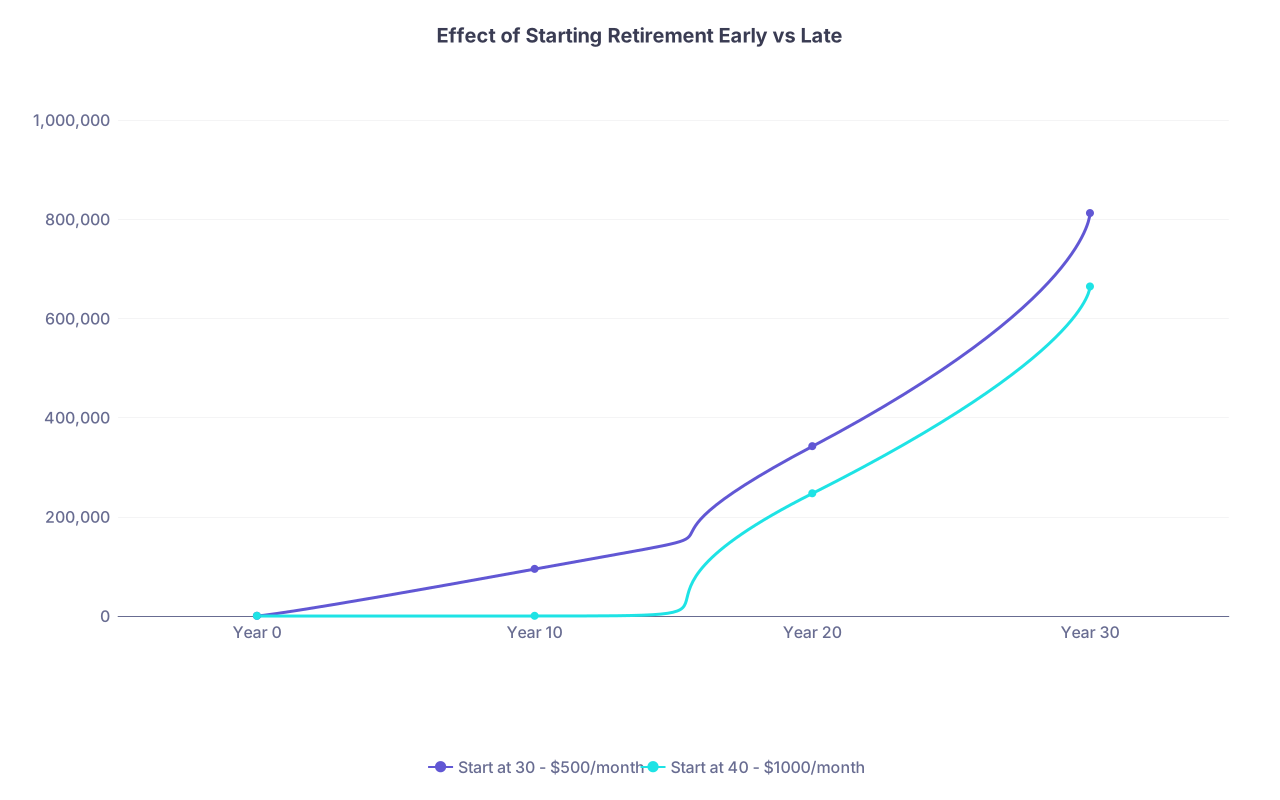
| Category | Start at 30 - $500/month | Start at 40 - $1000/month |
|---|---|---|
| Year 0 | 0 | 0 |
| Year 10 | 94600 | 0 |
| Year 20 | 342000 | 247000 |
| Year 30 | 812000 | 664000 |
Same total contribution. Very different result. Low-paid specialties cannot afford to ignore this.
7. Locking Yourself into Toxic Jobs Because of Money
This is the subtle, long-term damage that no one talks about during orientation.
Here is how it happens:
- You take on oversized housing, car payments, and private school commitments as a new pediatrician or psychiatrist.
- You do minimal retirement and minimal debt reduction because “things are tight right now.”
- You get a job with a corporate group or large system that underpays and overworks you, but it covers your current overhead.
- Five years later, burnout hits hard. You want to switch to academic, part-time, or a lower-paying but healthier role.
- You cannot. The pay cut would break everything.
I have watched a family medicine attending in an RVU-obsessed clinic cry in a call room because their student loans, giant mortgage, and two car payments made it financially impossible to take a 25% pay cut for a job with saner expectations. They were clinically trapped.
If you are in a low-paid field, you must protect optionality. Your future freedom to move to a different practice environment is your safety valve against burnout. Do not spend that away in your early 30s.
Guardrails to preserve freedom
- Avoid fixed costs (mortgage, car loans, private school) that require your absolute top-end income to function.
- Keep housing and car choices modest enough that you could comfortably survive a 20–30% pay cut if you needed to.
- Treat every long-term financial decision as if you might want part-time or lower-paying work in ten years. Because many of you will.

| Step | Description |
|---|---|
| Step 1 | Residency in Low Paid Specialty |
| Step 2 | Limited Savings |
| Step 3 | High Debt Burden |
| Step 4 | Trapped in High Stress Job |
| Step 5 | Regular Savings |
| Step 6 | Manageable Debt |
| Step 7 | Flexible Job Options |
| Step 8 | Spending Choices |
8. Underestimating How Much Location Matters for Low-Paid Fields
For high-earning procedural specialties, you sometimes can brute-force a high cost-of-living area with massive income. For pediatrics or family medicine, that does not work as cleanly.
I have seen this play out:
- A pediatric resident loves their big coastal city and “cannot imagine leaving.”
- They take an attending job at $205K in that market, thinking it is fine.
- After tax, loans, and expensive housing, their net life is frighteningly close to residency—with more responsibility and no time.
- They feel stuck because all their social ties are there.
Meanwhile, a co-resident moves to a mid-sized city or reasonably priced suburb and earns $230–260K with half the rent or mortgage cost. In 10 years, that difference compounds into:
- Dramatically higher net worth
- More savings options
- Ability to go part-time or change jobs without panic
For low-paid specialties, geography is not a lifestyle choice. It is a major financial lever.
Avoid this mental mistake
Do not compare offers by salary alone. Base your comparison on:
- After-tax pay
- Housing costs
- Student loan strategy (PSLF eligibility)
- Commute and time costs
- Total benefits (retirement match, loan repayment, CME, etc.)
If you ignore cost-of-living because “I just really like this city,” you are effectively choosing to pay a large tax on your already modest income.
9. Letting Shame or Confusion Stop You from Getting Help
The quiet disaster I see again and again: residents in low-paid specialties who are clearly overwhelmed financially, but too embarrassed or too busy to ask for real help.
They:
- Ignore unopened mail from loan servicers.
- Guess about IDR vs PSLF vs refinancing based on Reddit threads.
- Avoid looking at their net worth because “I know it is bad.”
Fast-forward a few years and they have:
- Chosen the wrong loan path
- Missed years of qualifying PSLF payments
- Paid tens of thousands in extra interest
And for what—because they did not want to admit they were confused?
You are trained to manage sepsis and suicidal ideation, not federal loan policy. There is no virtue in pretending to understand this stuff while you quietly bleed.
How to not make this your story
- Schedule one serious financial sit-down with yourself (and partner if relevant): gather loan info, debt totals, income, and contracts.
- If your situation is complex—and in low-paid, PSLF-eligible fields, it usually is—consider paying for a one-time session with a fee-only financial planner who understands physicians and federal loans.
- Use written plans, not vibes. A written 1–2 page plan beats a vague sense of “I will figure it out someday.”
Final Warnings: What Actually Matters
You chose a low-paid specialty. That was probably the right move for your personality and sanity. But that choice comes with rules.
Break these and you will regret it:
- Do not assume future attending income will erase today’s mistakes. In pediatrics, family med, psych, and similar fields, it will not.
- Do not sacrifice PSLF and federal protections lightly. Once you refinance to private, you are done.
- Do not inflate your fixed lifestyle (housing, cars, schools) to a level that requires top-dollar work forever. You will want options later. Protect them now.


