

You are post-call, eating cold leftovers at your kitchen table. Your loan balance is north of $300,000. Your co-interns keep talking about anesthesia, derm, and ortho offers they are hearing about from seniors. You? You love pediatrics. Or psych. Or family med. One of the “lowest paid specialties.”
And now you are doing math on the back of a napkin and thinking:
“Am I being irresponsible? Can I even afford this?”
Let me be blunt: yes, you can choose a low-paying specialty and not financially wreck your life. But you cannot drift into it. You need a concrete plan. Numbers, timelines, and specific moves.
This is that plan.
Step 1: Get Clear on the Money Reality (Not the Hype)
First fix: replace vague fear with actual numbers.
Here is the basic landscape (ballpark, attending level, U.S., pre-tax). These vary by region and practice model, but the hierarchy is consistent.
| Specialty | Typical Range (Attending) |
|---|---|
| Family Medicine | $220k–$260k |
| Pediatrics | $210k–$250k |
| Psychiatry | $260k–$320k |
| Internal Med (Outpt) | $230k–$280k |
| Emergency Med | $350k–$450k |
| Anesthesiology | $400k–$500k+ |
You already know the high earners. The emotional trap is comparing your dream specialty to the very top. That is the wrong benchmark. Your benchmark is:
- Your after-tax income in that field
- Your monthly loan payment under the right repayment strategy
- Your non-negotiable life goals (kids, city vs. rural, house vs. rent, etc.)
Let us put some numbers to it. Suppose:
- Loans: $350,000 at ~6.5%
- Specialty: Pediatrics, expected starting salary ~$220k
- Filing: Single, standard W2 job, moderate tax state
Rough, simplified math (not perfect, but directionally right):
- Gross: $220,000
- Taxes + payroll (federal, state, SS/Medicare): roughly 30–35% → say $70,000
- Take-home: about $150,000/year → $12,500/month
Now layer loan payments:
- Aggressive standard 10-year refinance payment on $350k: ~$3,900–$4,100/month
- IDR payment (e.g., SAVE) based on income: maybe ~$800–$1,200/month initially, rising with income
So your real question is not “Can I live on $220k?” It is:
Do I want a lifestyle where $4,000/month goes to loans for 10 years? Or do I want to stretch them out with IDR or PSLF and free up cash flow?
That is a solvable problem, not a disaster.
To make this less abstract, here is what typical attending budgets look like:
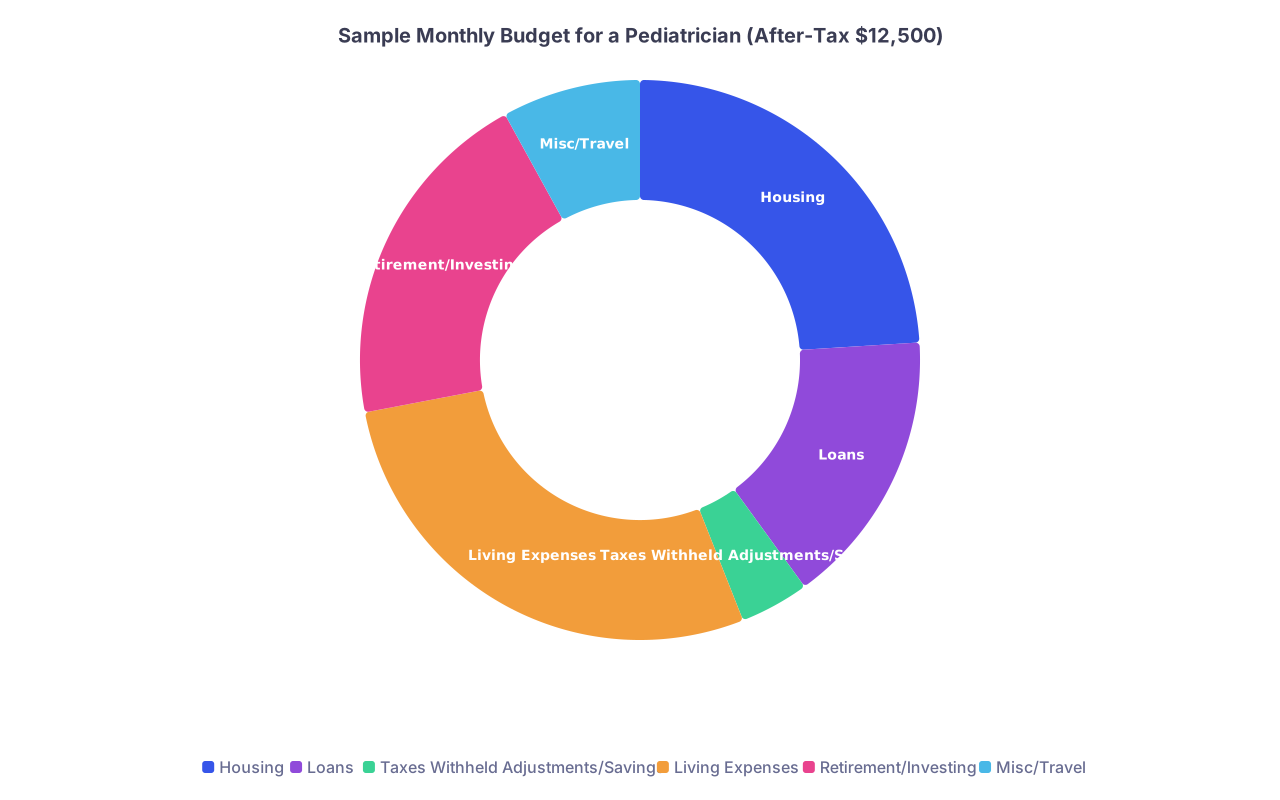
| Category | Value |
|---|---|
| Housing | 3000 |
| Loans | 2000 |
| Taxes Withheld Adjustments/Savings | 500 |
| Living Expenses | 3500 |
| Retirement/Investing | 2500 |
| Misc/Travel | 1000 |
You do not need to guess. You run the math, then you design your path around it.
Step 2: Decide Your Loan Strategy Before You Lock Your Path
Low-paying specialty + big loans means you do not have the luxury of “I’ll figure out repayment later.” You pick a lane now.
There are three main lanes:
- Aggressive Payoff (Private Refinance, 5–10 Years)
- Federal IDR + PSLF (10 Years of Qualifying Work)
- Federal IDR Without Forgiveness (20–25 Years, Then Taxable Forgiveness)
Here is how to choose like an adult, not a panicked PGY-1.
Lane 1: Aggressive Payoff (Refinance, 5–10 Year Plan)
You do this if:
- You are certain you will work in private practice or non-qualifying jobs (e.g., many private psych groups, certain urgent cares)
- Your debt-to-income ratio is at most around 1.5:1 after training (e.g., $300k debt and $220k+ income), and
- You can psychologically tolerate high fixed payments for a decade
Typical moves:
- Stay in federal loans during residency on SAVE or PAYE to keep payments low and cash flow manageable
- In final year of residency or early attending, refinance to a lower interest rate with a 5–10 year term
- Make this your “second rent”: immutable, non-negotiable, auto-drafted
Who this works best for in low-paying specialties:
- Psychiatrists (often with higher earning potential via part-time telepsych, cash practices)
- Hospitalists or outpatient IM in higher-paying markets
- Family medicine docs who add a side hustle or shift work
If your monthly payment after refinance would be more than ~30% of your net pay, this lane starts to feel like a choke collar. Use the math, not pride.
Lane 2: PSLF + IDR (The Underrated Weapon for Low-Paid Fields)
If you like low-paying specialties, PSLF was practically designed for you.
You want PSLF if:
- You are willing to work at a qualifying nonprofit or government employer for 10 years (residency counts)
- You are carrying $250k+ in federal loans
- Your specialty is one where nonprofit or academic work is common (peds, psych, FM, IM, heme/onc, etc.)
The move set:
- Keep loans federal. Do not refinance.
- Get on an IDR plan as early as possible (ideally PGY-1).
- Recertify income on time every year.
- Keep religious track of employment certification forms.
- Aim to stay in qualifying jobs until reaching 120 qualifying payments.
Typical result for a pediatrician with $350k in loans:
- 3–6 years of residency/fellowship: very low payments based on low income
- 4–7 years as an attending at a children’s hospital or academic center: higher but controlled IDR payments
- At 10 years of total qualifying payments: remaining balance forgiven, tax-free
I have seen pediatric attendings who paid less total cash out of pocket on $350k loans than their anesthesia peers with $200k loans who refinanced and paid aggressively. Because structure beats raw income.
If you like academic work, children’s hospitals, community mental health centers, or FQHCs, PSLF is almost always the right default.
Lane 3: Long-Term IDR Without PSLF
This is your “I want maximum freedom, and I’ll manage the tax bomb” route.
Applies when:
- You expect to hop between qualifying and non-qualifying employers
- You are not committed to 10 years of nonprofit/government
- Your debt is very high (e.g., $400k+) relative to your salary, and PSLF is not realistic
You:
- Stay on an IDR plan long term (e.g., SAVE)
- Accept higher total interest but lower monthly strain
- Plan for a potential tax bill at 20–25 years when remaining loans are forgiven
This is most common in fields like psychiatry (lots of private options) or family medicine docs who want maximum geographic and practice flexibility.
You build a “tax bomb fund” on the side — just an investment account earmarked to cover the eventual bill.
Step 3: Choose the Right Practice Environment for Low-Paid Fields
Same specialty. Very different money.
In “low-paying” specialties, the pay spread between environments can easily hit $60k–$150k per year. That dwarfs the salary difference between derm vs peds if you make smart choices inside your field.
Here is a quick comparison:
| Setting | Typical Pay Impact | Notes |
|---|---|---|
| Academic/University | Lower | Good for PSLF, prestige, lighter RVU pressure |
| Large Hospital / System | Moderate | Stable salary, benefits, PSLF eligible often |
| FQHC / Community Clinic | Moderate + Bonuses | PSLF, loan repayment programs, underserved focus |
| Private Group Practice | Higher | More RVU/productivity-based, autonomy varies |
| Locums / Contract Work | Often Higher | Less stability, more flexibility, travel |
Specific examples:
Pediatrics
- Academic pediatrician in a major city: maybe $210k–$230k
- Community hospital-employed general peds: $230k–$260k
- Rural peds with call + loan repayment: $250k+ plus state/federal incentives
Psychiatry
- Academic psych: $240k–$280k
- Community mental health: $260k–$300k, PSLF eligible
- Telepsychiatry / cash pay outpatient: $300k–$400k+ if you work hard and handle business logistics
Family Medicine
- Academic FM: $210k–$230k
- Hospital-employed outpatient in a small city: $240k–$280k
- Rural FM with procedures and OB: $280k–$350k plus loan paydown perks
Point: You can love pediatrics and still earn at the high end of pediatrics by choosing your environment strategically.
Step 4: Build a Concrete 10-Year Career–Loan Plan
Here is where people mess up. They think specialty choice = destiny. It does not. Your sequence of jobs and decisions matters more than your specialty label.
Let me give you a skeleton you can customize.
Example: Pediatrics, $350k Loans, Interested in Academic / PSLF
Years 1–3: Pediatric Residency
- Keep federal loans, enroll in IDR (SAVE)
- Certify employer annually for PSLF
- Make minimum payments; save little but set up basic Roth IRA if possible
Years 4–6: Pediatric Hospitalist at Children’s Hospital (Nonprofit)
- Salary: ~$230k–$260k
- Maintain IDR + PSLF, now 40–70 qualifying payments already done
- Increase retirement contributions (401k/403b and maybe 457b)
- Keep lifestyle reasonable: no $1.3M house yet
Years 7–10: Same or similar nonprofit role, maybe promotion
- By year 10, you hit 120 qualifying payments
- Remaining loans are forgiven tax-free
- Now free cash flow jumps by $1–3k/month
At that point, you can:
- Move to private practice if you want
- Buy the house
- Scale back hours if burnout looms
Example: Psychiatry, $280k Loans, Wants Flexibility / Private Practice
Years 1–4: Residency
- IDR on federal loans
- Consider moonlighting PGY-3/4 and start learning private-practice operations
Years 5–7: Hospital Employed Psych (Nonprofit or For-profit)
- Salary: $260k–$320k
- Decide: PSLF path or not?
- If PSLF: choose nonprofit, certify employment, stay IDR
- If not: refinance after first attending year, 10-year term, pay ~$3k/month
Years 8–10: Mix Model
- Maintain 0.8 FTE employed gig for stability/benefits or PSLF
- Add 0.2–0.4 FTE private patients, telepsych, or group practice work
- Direct extra income toward either:
- Accelerating payoff (if refinanced)
- Building a taxable portfolio (if staying IDR/PSLF)
Point: the combination of a “safe” base job and an “optional” side stream massively changes the financial equation, even in psych or peds.
Step 5: Use Side Income Strategically (Not Desperately)
I am not telling you to hustle forever. I am saying you can front-load some extra work for a few years to buy peace later.
What works well for low-paying specialties:
Telemedicine / Telepsych
- Psych: obvious winner; high hourly rates, flexible
- FM/IM: urgent care telemed, chronic disease management, etc.
Urgent Care / ED Fast Track Shifts
- FM/IM can pick up shifts at urgent care or low-acuity ED sections
- Higher per-hour pay than clinic, usually
Procedural Add-ons
- FM or IM adding basic procedures: joint injections, skin procedures, IUDs, etc.
- In some systems, this bumps RVU-based compensation noticeably
Teaching / Admin
- Academic roles with small stipends: program director, clerkship director, committee roles
- Not huge money, but often +$10-20k with career benefits
Use these with a defined mission:
- “I will do 2 extra shifts/month for 4 years to either:
- kill $100k of principal early, or
- fully fund a down payment and emergency fund.”
You are not signing up to grind forever. You are trading a little extra sweat now for much lower baseline stress later.
Step 6: Lock Down Your Personal Burn Rate
The hard truth: many doctors in high-paying specialties feel poorer than smart pediatricians. Because lifestyle.
Your specialty income matters. Your burn rate matters more.
Here is the simple, un-glamorous framework:
Cap fixed housing at ~20–25% of take-home pay
- If your net is $12,500/month, aim for housing (rent + utilities) under ~$3,000/month initially
- Do this for at least the first 3–5 attending years
Automate your “future self” payments
- Retirement contributions (aim for at least 15–20% of gross eventually)
- Loan payments
- Emergency fund auto-deposit until you have 3–6 months’ expenses
Make big purchases follow big milestones, not feelings
- House after: stable job + clear loan plan + 6–12 months of expenses
- Car: buy used or reasonable new until loans are tamed
- Kids + daycare: plan their cost like you plan loan payments
Once those rails are set, you can relax. You know you are not sabotaging your future just because you chose pediatrics.
Step 7: Exploit All the “Small” Loan Advantages Available to You
The system actually throws more help at lower-paying specialties. If you are smart, these stack up fast.
Look for:
NHSC Loan Repayment (National Health Service Corps)
- For primary care (FM, peds, IM, psych) in underserved settings
- Often $50k+ loan repayment for 2 years’ service, renewable
State-specific loan repayment programs
- Many states pay $20k–$100k over a few years for working in rural or shortage areas
- Common for FM, peds, psych, OB, sometimes IM
Hospital / Employer loan assistance
- Some hospital systems offer $10k–$25k/year for 3–5 years as part of recruitment
- Negotiable — ask explicitly during contract talks
Signing bonuses + relocation
- Do not blow these on lifestyle
- Use them as instant principal pay-down or to fund your emergency + moving cushion
If you stack:
- PSLF
- State loan repayment
- Employer loan assistance
You can walk away from $300k+ of loans while your peers in competitive high-paying fields are white-knuckling their private refinance.
Step 8: Contract and Location Strategy: Make Your Specialty Pay “Above Average”
Same low-paying specialty. Divergent outcomes.
A few levers that move the needle:
Geography
- Big coastal cities often pay less in raw dollars and effectively much less after housing costs
- Smaller cities, Midwest, South: often $30k–$80k more per year for the same job, lower cost of living
- Rational trade: 5–7 years in a “boring but lucrative” location early in career to crush loans and build savings, then relocate if you want
RVU vs. Straight Salary
- Early on, a guaranteed salary + modest RVU bonus is safer
- Once you know your practice volume, RVU-heavy comp can reward efficient clinicians in FM, IM, psych
- Read the fine print: RVU thresholds, what counts, what does not
Non-competes
- In some states, still enforceable and can trap you in low-paying setups
- Try to negotiate radius and duration down, especially in saturated markets
Benefits
- 401k/403b match, 457b access, health insurance costs, disability insurance
- In a lower-paid field, benefits can be a huge share of total comp — do not ignore them
Do not get hypnotized by just the base salary number. Evaluate the whole structure.
Step 9: Mental Framework – You Are Not Failing by Choosing the Work You Actually Like
There is a toxic idea floating around that if you do not chase the top comp specialties, you are financially naive or morally obligated to maximize income.
No.
You are obligated to:
- Understand your numbers
- Use the available tools (PSLF, IDR, location arbitrage, side opportunities)
- Not lie to yourself about what future you will tolerate
If the thought of doing anesthesia or ortho for 30 years makes you miserable, but you light up on a peds ward…ignoring that for an extra $150k/year is not “responsible.” It is short-term fear dressed up as prudence.
Let me sketch a concrete contrasting scenario.
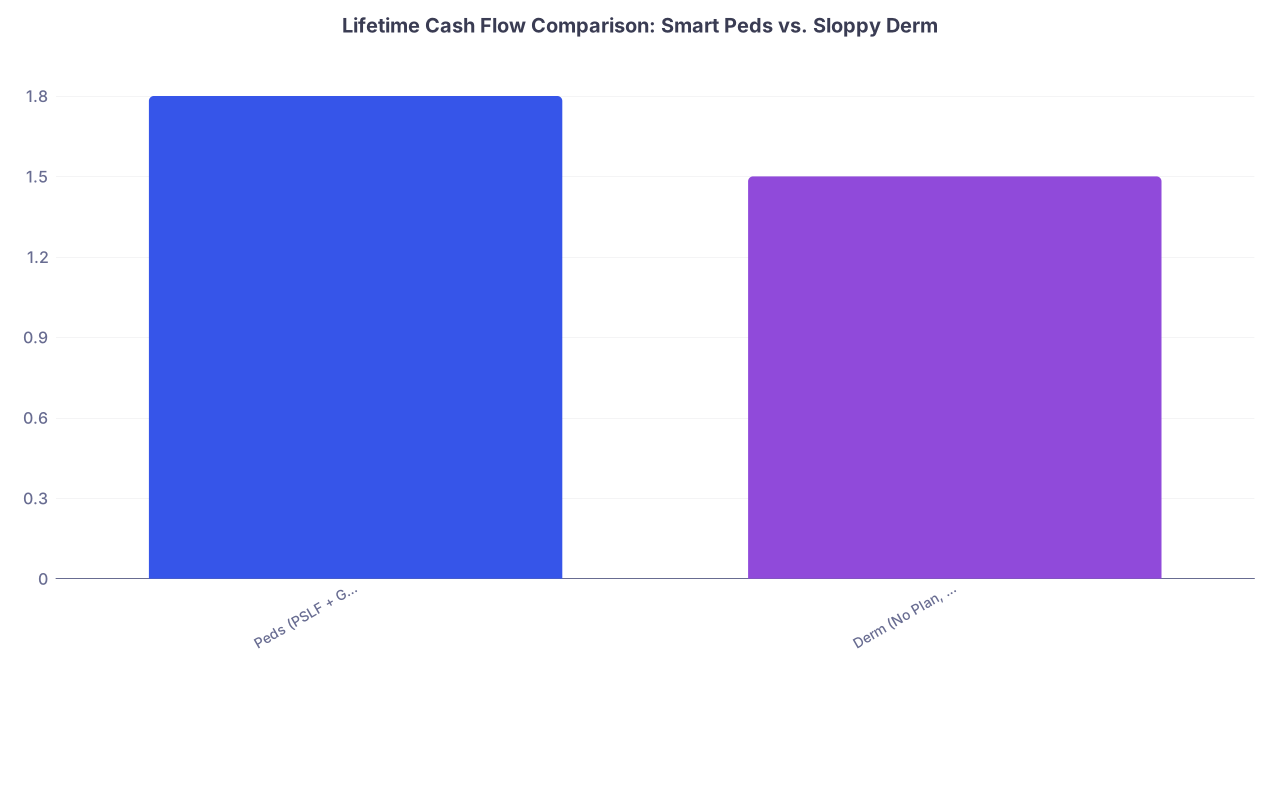
| Category | Value |
|---|---|
| Peds (PSLF + Good Habits) | 1.8 |
| Derm (No Plan, Lifestyle Inflation) | 1.5 |
Think of those values as “millions of net worth at 20 years out.” Not exact, but you get the point. A pediatrician who:
- Uses PSLF,
- Lives reasonably,
- Invests consistently,
Will almost certainly end up wealthier than a dermatologist who:
- Over-buys house and car,
- Pays high-interest loans slowly,
- Barely saves.
You are not doomed by your specialty. You are only doomed by drifting.
Step 10: Your 30-Minute Action Checklist
Here is what you do this week:
List your top 2–3 specialty choices.
- Next to each, write realistic starting salary ranges in the cities you are willing to live in. Use MGMA data, Doximity, or talking to recent grads, not Reddit rumors.
Pull your current loan total from studentaid.gov and servicers.
- Get the real number. Principal + interest.
Run two repayment scenarios for your dream specialty:
- PSLF path (use a reputable online calculator)
- Private refinance 10-year standard payoff
Decide your likely lane: PSLF vs aggressive payoff vs long-term IDR.
- Write it down. You are allowed to revise later, but you need a working plan.
Identify one practice environment that fits your loan lane.
- PSLF lane → nonprofit hospital, FQHC, academic
- Aggressive payoff → higher-paying private or hospital-employed gig in moderate/low cost-of-living area
Set a lifestyle rule for PGY-1 through first 3 attending years.
- Example: “No housing >25% of take-home and no new car payments >$400/month.”
If you are in training now:
- Make sure you are on an IDR plan (likely SAVE)
- Submit PSLF employment certification if at a qualifying hospital
Do just these. You will be miles ahead of most of your peers, regardless of specialty.
Key Takeaways
- You can absolutely choose a low-paying specialty and still have a solid financial life, but you must pick a deliberate loan strategy early (PSLF, aggressive payoff, or long-term IDR).
- Inside every “low-paying” specialty, there is a wide earnings band determined by practice setting, geography, and side opportunities. You can aim for the upper end without abandoning what you love.
- Your long-term security will come less from your specialty label and more from consistent, boring decisions: controlled housing costs, smart job selection, and automatic saving/loan-repayment systems.


