

The idea that “all primary care jobs pay the same” is flat-out wrong. It is not even close.
If you think choosing “primary care” locks you into one generic, low-paid career track, you’re about to miss some enormous differences that can change your lifetime earnings by seven figures.
Let’s pull this apart properly.
The Myth: “Primary Care = Low Pay, All About the Same”
You’ve heard versions of this:
- “FM, IM, peds, they all top out around the same.”
- “If you go into primary care, you’re choosing lifestyle over money.”
- “Hospitalist vs outpatient IM? Eh, basically the same.”
No. No. And still no.
Primary care is not a single job. It’s an umbrella. Inside that umbrella you have:
- Family medicine (FM) – outpatient, inpatient, urgent care, OB, rural, direct primary care, academic, hospital-employed, FQHC, locums.
- Internal medicine (IM) – outpatient primary care, hospitalist, nocturnist, SNFist, academic, concierge, hybrid hospital/outpatient.
- Pediatrics – outpatient, hospitalist peds, urgent care peds, academic, subspecialty-lite roles.
- Med-peds – hybrids that can look like IM, FM, or something stranger.
You can’t make sense of the money until you accept this: site, structure, and scope matter more than specialty label.
Reality #1: There’s a Huge Pay Spread Within “Low-Paid” Primary Care
Let’s look at typical full-time attending compensation ranges, drawn from MGMA, Medscape, and major recruiter data (Merritt Hawkins, Jackson Physician Search, etc.) over the last few years. Numbers vary by region and bonus structure, but the spread is real.
| Role | Typical Range (USD) |
|---|---|
| Outpatient Pediatrics | $180k – $260k |
| Academic FM/IM/Peds | $170k – $240k |
| Outpatient FM (employed) | $220k – $320k |
| Outpatient IM (employed) | $230k – $340k |
| Hospitalist (IM/FM) | $260k – $400k+ |
| Nocturnist (IM/FM) | $320k – $450k+ |
Those are not rounding errors. That’s a difference of:
- $150k+ per year between a low-paying academic pediatrics job and a busy nocturnist role.
- $70–100k between a middling outpatient gig and a hospitalist job in the same city.
Over 20 years, a $100k annual difference is $2,000,000 before taxes. That is the consequence of treating “primary care” like one bucket.
Now layer geography on top and the range widens further.
Reality #2: Geography and Practice Type Change Everything
Where you practice and who signs your paycheck matter as much as your specialty.
Urban academic vs rural employed
Scenario I’ve seen multiple times:
- Urban academic IM job:
- Salary: $190k
- 1.0 FTE, high teaching load, research optional, low RVU pressure
- HCOL city (San Francisco, Boston, NYC)
- Rural hospital-employed FM job:
- Salary: $280–320k guaranteed + RVU bonus
- 1.0 FTE, busy clinic, maybe some inpatient
- LCOL town in the Midwest or South
Same broad category (“primary care”). $100k+ difference in pay. And after cost of living, the gap grows even more.
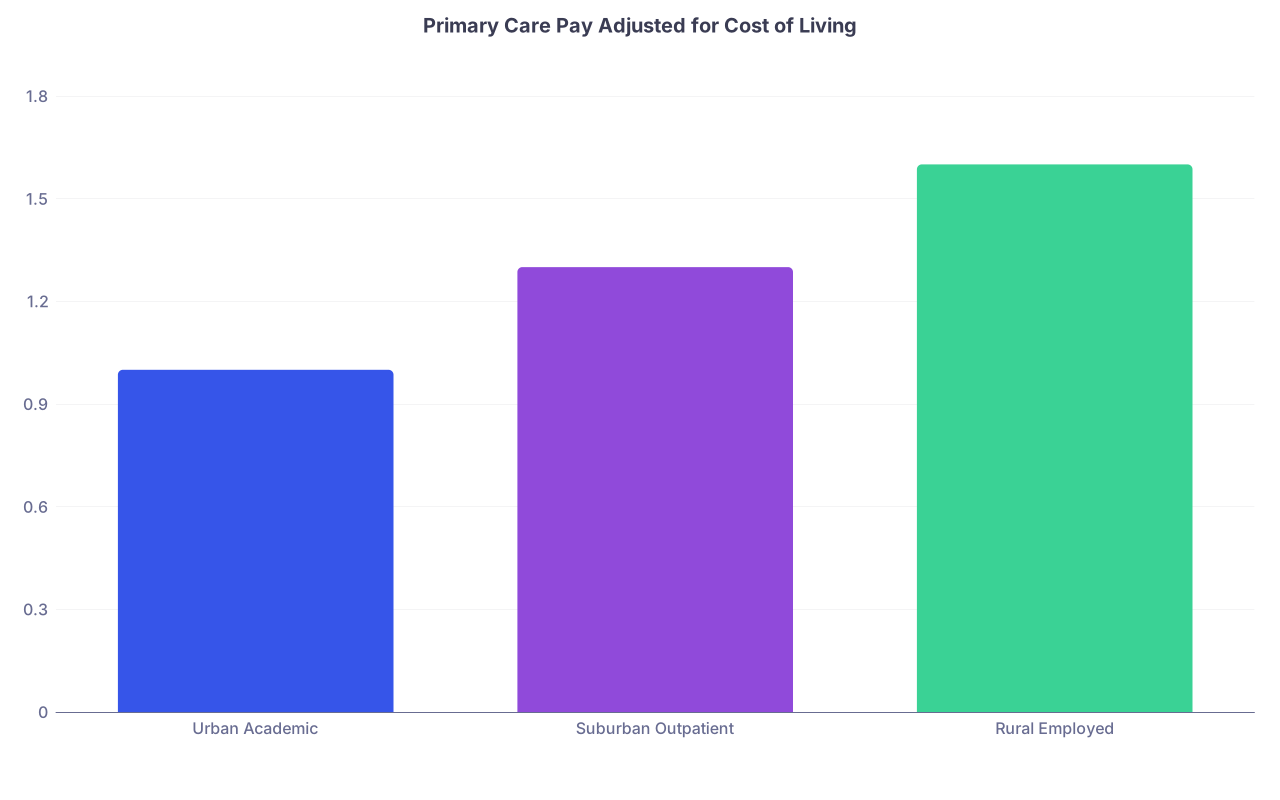
| Category | Value |
|---|---|
| Urban Academic | 1 |
| Suburban Outpatient | 1.3 |
| Rural Employed | 1.6 |
That chart is conceptual: urban academic primary care often gets you the lowest real purchasing power, rural employed the highest.
Practice ownership vs “just show up”
There’s also the ownership question:
- Employed by a hospital or large system: predictable, often lower upside, less control.
- Employed by a private group: more variation, partnership track, sometimes buy-in, more upside if the group is well run.
- Owner of your own practice: high risk, high potential, steep learning curve, variable income early on, potentially very lucrative long term.
- Direct primary care (DPC)/concierge: lower panel, membership fees, higher per-patient revenue, but huge range depending on how you set it up.
I’ve seen small-town FM docs with modest overhead clearing $500k+ once their panels mature and they stop accepting garbage payer contracts. I’ve also seen burned-out solo docs scraping by at $160k in oversaturated suburban markets.
Different worlds. Same “specialty” label.
Reality #3: Hospitalist vs Outpatient – Same Specialty, Different Economy
This is the first big internal split in primary care money that students underestimate.
Hospitalist and nocturnist: primary care in disguise
Hospitalists are mostly internal medicine or family medicine. They’re still primary care physicians by training, but hospitals pay them like they matter (because they do).
Typical structure:
- 7-on/7-off schedule
- 12-hour shifts, days or nights
- RVU-based or per-shift compensation
- Often extra pay for nights, ICU, or higher census
Numbers you see again and again:
- Community hospitalist: $280–350k
- Nocturnist: $330–430k
- Rural or hard-to-staff sites: offers pushing $400–450k+ with sign-on bonuses
Compare that to:
- Outpatient IM in the same metro: $230–300k, more predictable hours but relentless inbox and admin.
Physically and psychologically they are totally different jobs. Lumping them together because they share an IM degree is how people end up saying stupid things like “all primary care pays around 250.”
Why hospitals pay more
Hospitals have a straightforward financial incentive: hospitalists directly influence length of stay, throughput, and coding. That impacts revenue immediately.
In outpatient primary care, your impact is enormous in human terms, but economically your contribution is obscured and fragmented across payers, systems, and years. So you get paid less, even if you’re doing more holistic work.
It’s not just about “patient care.” It is about where the money flows and who captures it. The hospital captures it directly. The outpatient doc generates it mostly for everyone else.
Reality #4: Pediatrics Really Is Paid Less (And Why)
Yes, pediatrics is generally the lowest-paid of the primary care trio.
Across most surveys:
- Outpatient peds: $180–240k typical starting, maybe hitting $260–280k with experience and a strong practice.
- Pediatric hospitalist: better, often $230–300k, sometimes more in tough locations.
Why the gap?
- Kids don’t generate the same intensity of billable services as adults with multiple comorbidities.
- Fewer high-RVU procedures.
- Medicaid-heavy payer mix, which reimburses at lower rates than Medicare or commercial insurance.
- Systems historically undervalue pediatric care because children don’t rack up the same immediate billable revenue as sick adults.
Is it fair? No. Is it real? Yes.
Could you, as a pediatrician, still do well financially? Absolutely. But if your only question is “highest earning: FM vs IM vs peds?” then peds usually loses.
Reality #5: RVUs, Payer Mix, and Panel Size Quietly Drive Your Income
Another myth: “Salary is salary. The offer says $240k, so that’s what I’ll make.”
Look at the structure.
Most primary care compensation boils down to some mix of:
- Base salary or guarantee
- RVU-based productivity bonuses
- Quality metrics or value-based incentives (HEDIS, patient satisfaction, panel risk adjustment)
- Call pay, admin stipends, teaching stipends
The RVU part is key. Two IM docs both “making 260” can have wildly different experiences:
- Doc A:
- Base $220k + RVU bonus
- Reasonable panel, 16–18 patients/day, decent support staff, mostly commercial/Medicare
- Hits 4,500–5,000 RVUs, actually earns $260–280k
- Doc B:
- Base $240k, but high expectations
- 22–24 patients/day, poor support, heavy Medicaid, lots of no-shows
- RVUs hard to hit, endless burnout, feels underpaid
The structure and environment turn the same “salary range” into either a fair deal or highway robbery.
Reality #6: Loan Forgiveness and Benefits Quietly Tilt the Scales
On paper, two jobs might both say $220k. They are not equal.
Here’s what can massively change the real financial picture:
- Public Service Loan Forgiveness (PSLF) eligibility
- NHSC/HRSA loan repayment (common in FQHCs and rural clinics)
- Sign-on bonus and relocation (compare NPVs, not just sticker numbers)
- Retirement match (3% vs 8% is thousands per year compounded)
- Health insurance premiums and coverage for family
- CME funds, licensing, malpractice tail coverage
Example I watched play out:
- Job 1: $240k in a private practice, no PSLF, modest 3% 401(k) match.
- Job 2: $210k at an FQHC, full PSLF eligibility, $50k loan repayment in first 2 years, 8% retirement contribution, cheap health benefits.
On a spreadsheet, once you model 10 years of loan forgiveness and compounding, Job 2 easily beats Job 1 financially for a heavily indebted new grad. Yet people call it “lower paid” because they only see the base salary.
Reality #7: Direct Primary Care and Concierge – Not Magic, But Not Fantasy Either
There’s a growing myth on the other side now: “Just do DPC/concierge and make $400k seeing 8 patients a day.” That’s the new fantasy.
Reality:
- Direct primary care (DPC): membership model, often $60–150/month per patient, no insurance billing, small panel (400–800 patients).
- Concierge: higher membership fees, usually still bills insurance, panel maybe 400–600.
Can they be very lucrative? Yes, with:
- The right market (middle/upper-income, under-served for high-touch care).
- Good business sense.
- Time to build your panel.
- Willingness to do actual marketing and operations work.
I’ve seen DPC FM docs in mid-sized cities earning $250–350k working 4 days a week once mature. Also seen others stuck at $140k with a half-filled panel because they overestimated demand or priced wrong.
The point: these aren’t salary jobs where you plug in your specialty and collect a check. They are small businesses. Potentially powerful. Definitely not automatic.
Reality #8: Lifestyle and Income Are Not Cleanly Traded
Another lazy assumption: “Higher pay always means worse lifestyle.” Not automatically.
You can absolutely find:
- Low-paying jobs with bad lifestyle (overbooked clinics, no control, endless inbox).
- High-paying jobs with tolerable hours (rural employed primary care, some hospitalist roles).
- Medium-paying jobs with great flexibility (0.7 FTE outpatient, telemedicine blends, hybrid models).
Simple example: A rural IM outpatient doc working 4 days a week at $280k and low COL vs an urban academic doc at $190k working 5+ days with research demands and a brutal commute. Which has the “better lifestyle”? It depends on what you value, but it’s not as simple as “academic = cushy” and “rural = grind.”
Reality #9: Specialty Choice Is Less Important Than Job Choice
This is the big one most residents miss.
The specific job you take will matter more, financially, than whether you picked FM vs IM vs peds.
To illustrate:
- Highest-paid FM/IM primary care roles (rural, hospitalist, nocturnist, ownership, successful DPC) can equal or surpass lower-tier procedural subspecialties in real take-home money especially after you account for:
- No extra 2–3 years of fellowship (you’re earning instead of training).
- Lower malpractice in many primary care settings.
- Lower cost of living options.
- Lowest-paid roles in any primary care field (urban academic, under-funded FQHCs without loan programs, oversaturated markets) will underperform financially no matter your training.
If you want income, stop asking “which primary care specialty pays the most?” and start asking:
- What kind of practice model am I willing to work in?
- Where am I willing to live?
- How much control do I want over my schedule and my business?
- Which compensation structures do I actually understand?
A Quick Side-by-Side: Not All “Primary Care” Jobs Are Created Equal
| Feature | Urban Academic IM | Rural FM Employed | IM Hospitalist |
|---|---|---|---|
| Base Salary | ~$190–220k | ~$260–320k | ~$280–350k+ |
| Schedule | M–F, clinic + admin | 4–5 days clinic | 7-on/7-off |
| COL Typical | High | Low/Moderate | Varies |
| RVU Pressure | Low–Moderate | Moderate–High | High |
| Teaching | High | Variable | Low–Moderate |
| Loan Forgiveness | Possible (PSLF) | Possible (rural/NHSC) | Rare |
Those are three totally different lives. All “primary care.”
Visualizing the Spread Inside Primary Care
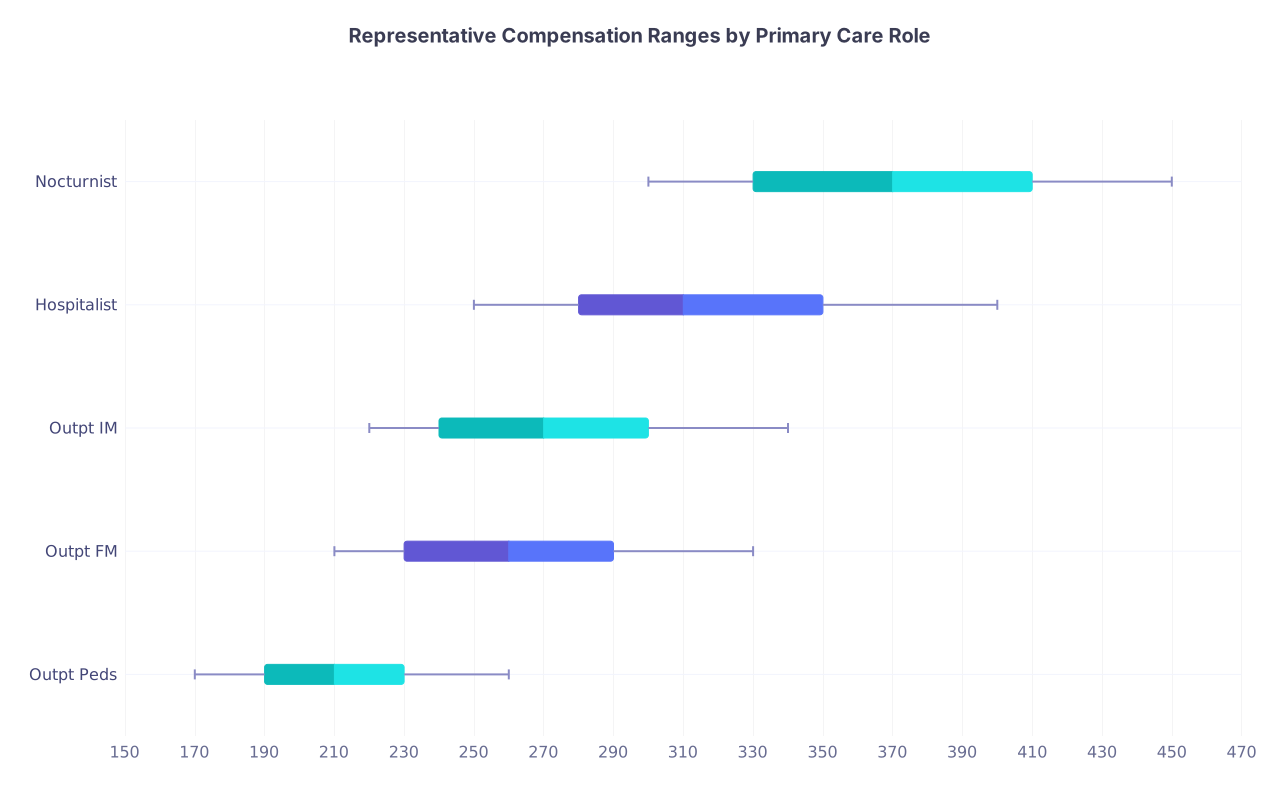
| Category | Min | Q1 | Median | Q3 | Max |
|---|---|---|---|---|---|
| Outpt Peds | 170 | 190 | 210 | 230 | 260 |
| Outpt FM | 210 | 230 | 260 | 290 | 330 |
| Outpt IM | 220 | 240 | 270 | 300 | 340 |
| Hospitalist | 250 | 280 | 310 | 350 | 400 |
| Nocturnist | 300 | 330 | 370 | 410 | 450 |
How Residents Actually End Up Underpaid
I’ve watched this happen:
PGY-3 FM resident. Tired. Overwhelmed. Has heard “primary care pays 200–220” a thousand times. Gets a $215k offer in a mid-sized city, 18–20 patients/day, decent benefits. They sign it quickly because they think “this is just what FM pays.”
They never:
- Compare it to rural employed offers at $260–280k.
- Ask about RVU structure.
- Check PSLF or loan repayment options.
- Look at cost of living or real estate.
- Consider hospitalist work at $280–320k as a bridge or long-term plan.
Five years later, they discover colleagues in the same specialty earning $80–120k more for similar or better lifestyles. Same board certification. Completely different financial lives.
That gap didn’t come from choosing the “wrong specialty.” It came from treating primary care as if it were flat.
A Few Non-Obvious Levers You Actually Control
To end on something actionable, here are levers that move the needle far more than your exact primary care label:
- Willingness to work in rural or underserved areas (at least for 3–5 years).
- Comfort with inpatient care (hospitalist/nocturnist paths).
- Openness to ownership/entrepreneurial models (small group, DPC, concierge).
- Aggressiveness in negotiating offers and understanding RVU tables.
- Strategic use of loan forgiveness and repayment programs.
- Saying no to obviously bad deals, even if they’re in your dream city.

| Step | Description |
|---|---|
| Step 1 | Choose FM IM or Peds |
| Step 2 | Consider rural employed high salary |
| Step 3 | Hospitalist or nocturnist |
| Step 4 | Outpatient focus |
| Step 5 | DPC concierge or small group |
| Step 6 | Hospital employed outpatient |
| Step 7 | Willing to work rural |
| Step 8 | Comfort with inpatient |
| Step 9 | Ownership interest |
So, Are All Primary Care Jobs Financially the Same?
No. Not remotely.
If you remember nothing else, keep these three points:
- Primary care is not one job. FM, IM, and peds each contain multiple practice models with pay that can differ by $150k+ per year.
- Where and how you work matters more than the letters on your board certificate. Geography, practice type, RVU structure, and loan programs drive real-world income far more than “FM vs IM vs peds.”
- You can be in a “low-paying specialty” and still do very well – or very poorly. The myth that all primary care jobs are financially the same is how people sleepwalk into underpaid, burnout-prone roles while better options sit wide open.
Stop asking, “Is primary care low paid?” Start asking, “Which version of primary care am I actually signing up for?”


