

What if I told you that choosing pediatrics over orthopedic surgery doesn’t always doom you to lifelong financial second class—but that most people who say “you can always catch up” have never actually run the numbers?
Let’s do what almost nobody in med school or residency bothers to do: model the gap with real assumptions, not vibes.
You are not choosing between “rich” and “poor.” You are choosing between different curves over time: when you start earning, how fast income ramps, what your lifestyle does in response, and how long you actually practice. Plus taxes. Plus debt. Plus burnout.
Most advice stops at: “Surgeons earn more, end of story.” That’s lazy. The reality is more nuanced—and in a few specific scenarios, some “low-paying” specialties can narrow the gap more than people expect. But you need to be brutally honest about what has to be true for that to happen.
Let’s walk through it like an attending with a whiteboard and no patience for fairy tales.
The Baseline Reality: The Gap Is Real, Large, and Starts Early
Before we get clever with models, you need a sober baseline: the average attending compensation difference between low-paid and high-paid specialties is not a rounding error.
Rough order of magnitude from recent physician compensation surveys in the US:
- Pediatrics, family med, internal med (primary care): roughly $230k–$280k median
- Hospitalist, outpatient IM subs: often $280k–$350k
- General surgery, EM, anesthesia: roughly $380k–$500k
- Ortho, neurosurg, cardiology, GI, derm, rad onc: commonly $550k–$800k+
You do not need the exact dollar to see the point: some specialties earn twice what the lowest earners do. Every single year.
Here’s a simplified snapshot to keep the rest of this honest:
| Tier | Example Specialties | Approx Median Income |
|---|---|---|
| Lowest paid | Pediatrics, Family Med | $240k–$260k |
| Lower-middle | Outpatient IM, Psychiatry | $280k–320k |
| Upper-middle | EM, General Surgery, Anesthesia | $380k–480k |
| Highest paid | Ortho, Cards, GI, Derm, Neurosurg | $600k–800k+ |
So if you’re comparing, say, pediatrics ($250k) to orthopedic surgery ($650k), that’s a $400k annual gross gap.
If you think “I’ll make it up with smart investing,” understand what you’re saying: you intend to beat a colleague who is investing an extra attending salary per year on top of what you invest.
Can the gap narrow? Under certain conditions, yes. Completely close? Rare. But there are a few specific situations where the difference isn’t as catastrophic as people assume.
The Part Everyone Ignores: Timing, Residency Length, and Burnout
The advice you usually get is static: “This specialty pays X, that one pays Y.” That’s not how real life works.
Time to attending matters. Residency length matters. Fellowships matter. Burnout and early retirement matter.
Let’s compare two very real archetypes:
Dr. Peds: Pediatrics
- 3-year residency
- Starts attending at 30
- Earns $250k starting, modest growth
- Practices until 65
Dr. Ortho: Orthopedic Surgery
- 5-year residency
- Starts attending at 32
- Earns $650k starting, modest growth
- But there’s a real chance of earlier exit—say, 58–60—due to burnout, physical wear, lifestyle
People like quoting lifetime earnings charts that assume both people start the same year and retire at the same age. Real careers don’t look like that. Spine surgeons blow out shoulders. EM docs get tired of nights at 52 and bail to urgent care at half pay. Not few. Many.
Now look at timing visually:
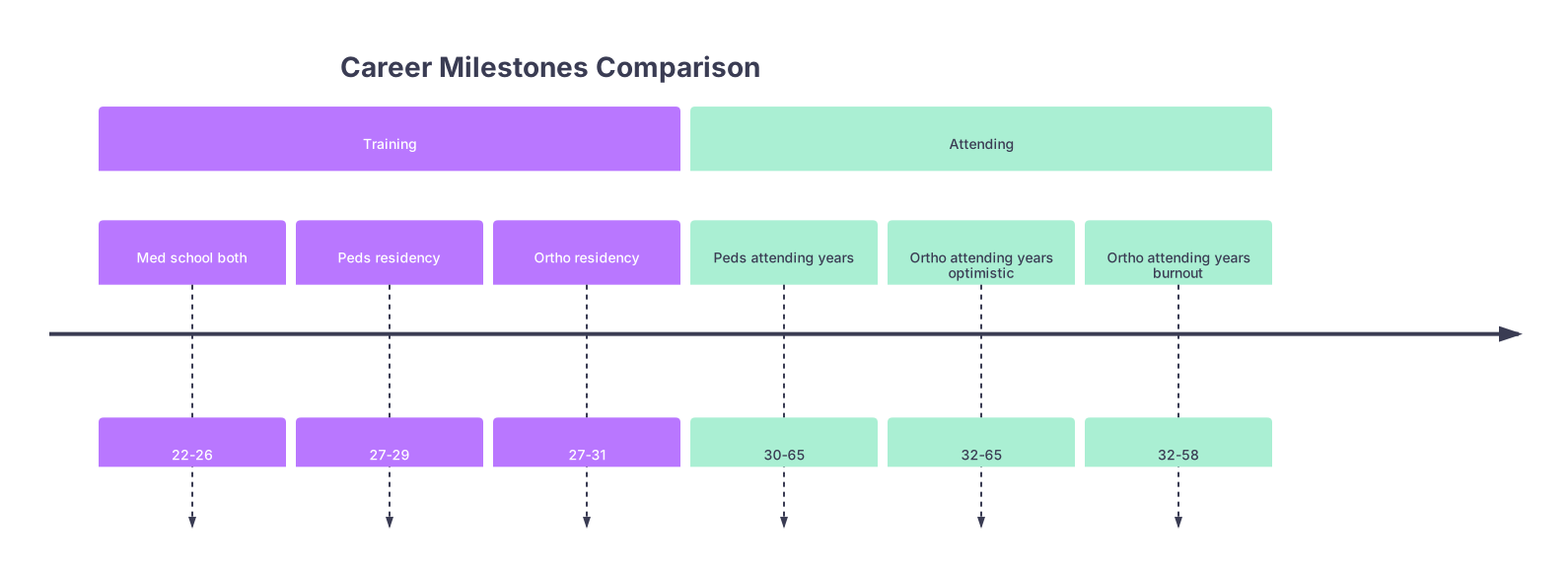
| Period | Event |
|---|---|
| Training - Med school both | 22-26 |
| Training - Peds residency | 27-29 |
| Training - Ortho residency | 27-31 |
| Attending - Peds attending years | 30-65 |
| Attending - Ortho attending years optimistic | 32-65 |
| Attending - Ortho attending years burnout | 32-58 |
Two key points that most students ignore:
Shorter residency = more attending years. A peds or FM doc can easily have 3–5 extra attending years at the front end compared to some highly specialized surgical path that includes long fellowships.
High-burnout specialties often have shorter true careers. If you exit early or downshift at 55, those last 10 peak-earning years everyone assumes in the models vanish.
You still will not “win” financially in most comparisons against high-paying fields. But in a peds vs ortho scenario where the ortho doc cuts back to part-time at 55 and retires by 60, and the peds doc quietly works full-time to 67? The “infinite gap” myth starts to show cracks.
Debt, Lifestyle Creep, and the One Thing Low-Paying Docs Can Actually Control
You cannot control market compensation for pediatrics. You can absolutely control lifestyle, savings rate, and how fast you dig out of debt.
The dumbest myth in this space is: “As long as you pick a high-paying specialty, you’ll be fine.” I’ve watched a $700k surgeon be more financially stressed than a $260k pediatrician. Why? Because money in is not the same as money kept.
Let me be concrete.
Scenario A: The “Smart” Pediatrician
- $250k starting income
- Lives on $110k after tax (modest but very comfortable in many regions)
- Saves and invests $40k per year (pre-tax and post-tax combined) starting PGY-3
- Aggressively pays off loans in 7–10 years
- Keeps lifestyle inflation mild—house but not mansion, one decent car, day care but no $70k/year private school
Scenario B: The “Rich but Bleeding Cash” Orthopod
- $650k starting income
- Lives on $370k+ after tax (huge house, private school, two luxury leases, etc.)
- Saves $60k/year (sounds impressive until you look at the percentage: under 15% of gross)
- Delays real investing until loans “feel small,” around year 8–10
- Regular backdoor Roth, some 401(k), but no intentional strategy
Now layer in compounding.
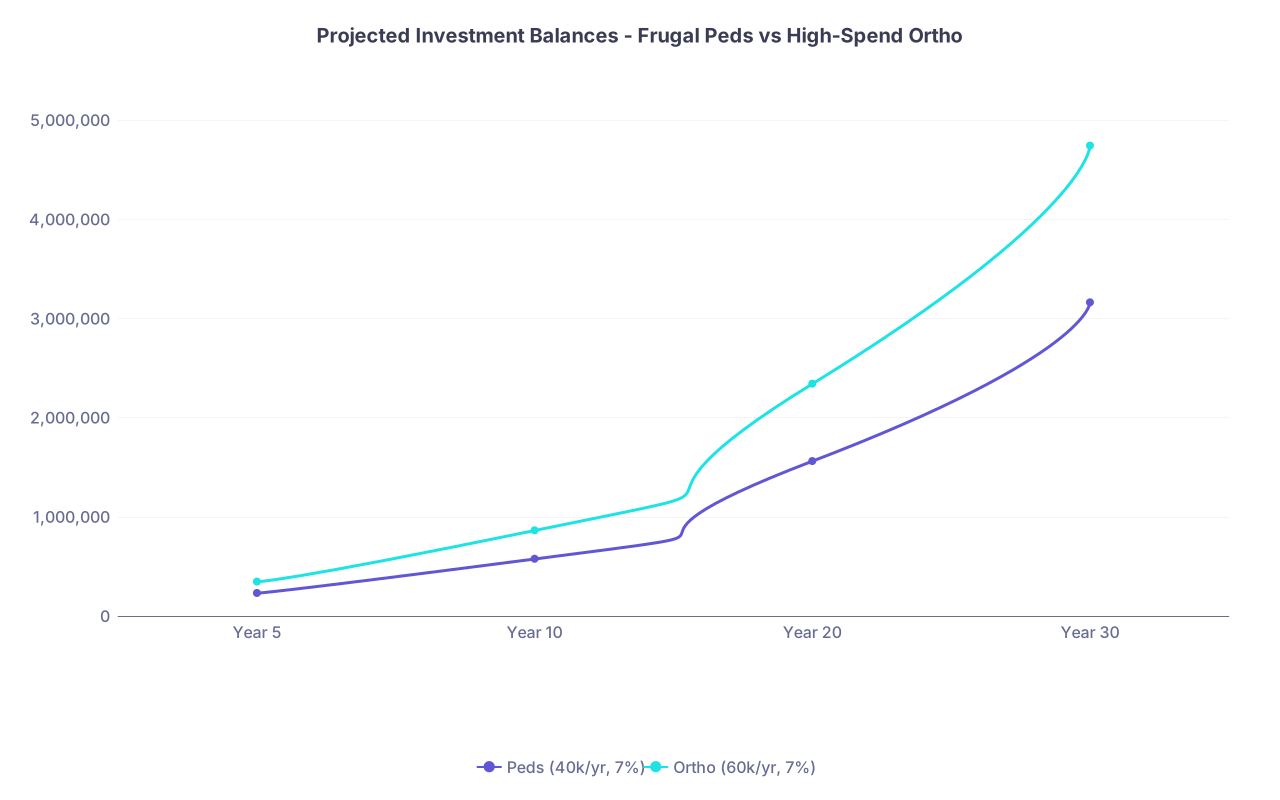
| Category | Peds (40k/yr, 7%) | Ortho (60k/yr, 7%) |
|---|---|---|
| Year 5 | 230000 | 345000 |
| Year 10 | 575000 | 862000 |
| Year 20 | 1560000 | 2340000 |
| Year 30 | 3160000 | 4740000 |
Even saving only $40k vs $60k, by year 30 the ortho doc “wins” on assets—no surprise, they just put more in. But notice what had to happen for the gap to be this narrow relative to the income spread:
- The peds doc is saving a much higher percentage of income (~16% of gross)
- The ortho doc is saving a pretty pathetic share (<10% early, maybe 15% later)
If that ortho doc decided to be only slightly more disciplined—say, save $120k/year instead of $60k? The gap becomes obliterating. That extra $60k/year compounded over 25–30 years is millions of dollars. No reasonable low-paying specialty pathway can touch that.
So here’s the truth that people don’t like because it kills the “I can pick anything and just invest smart” fantasy:
- A disciplined pediatrician can out-wealth an undisciplined orthopedist.
- A disciplined orthopedist will financially crush almost any disciplined pediatrician.
You are not just choosing specialty. You are choosing your future savings rate and how badly lifestyle creep will amputate your earning power.
Where Low-Paying Specialties Can Narrow the Gap
There are a few specific, repeatable situations where a “low-paying” specialty doesn’t end up as financially hopeless as Twitter warriors like to claim.
Not equal. But not hopelessly behind.
1. Shorter Training + Longer Career
Think of a straightforward path:
- Peds/Family/General IM: 3 years residency, no fellowship, start at 30, practice to 67
- Neurosurg/Ortho/Cards with fellowship: 7–8 years residency/fellowship, start at 34–35, burnout or scale back at 58–60
You’ve just given the primary care doc 7–10 extra attending years on the front and maybe 5–7 extra on the back. That’s 12–17 extra years of earnings.
Even at “only” $250k–275k/year, that’s $3–4.5 million in additional gross income spread across a life. Does this make up for the bigger checks in the middle? Not fully, but it narrows things a lot compared to the naive “both work the same 30 years at their peak salary” fantasy graph.
2. Geographic Arbitrage
Low-paying specialties tend to be more geographically flexible. Community hospital in the Midwest? Rural region hungry for primary care? You can see:
- Peds/FM/IM offers at $280k–320k instead of $230k
- Loan repayment programs stacking $20k–50k/year
- Lower cost-of-living, so a higher real savings rate
A pediatrician making $300k in Iowa with a 30% savings rate will end up far ahead of a pediatrician making $230k in coastal California saving 10%. That’s not subtle.
And in some high-paying rural gigs, “low-paid” isn’t even that low.
3. Lean Lifestyle, High Savings Rate
This one is simple and brutal:
- A doc who saves 25–30% of gross income from age 30–40 and then chills to 15–20% later crushes almost any doc saving 10–12% forever, no matter what specialty.
Because compounding does not care that you were “underpaid.” It only cares what hit the market, and how early.
The Myths That Need to Die
Let me hit some of the popular lines I hear on wards and in resident lounges and tell you, bluntly, which ones are garbage.
Myth: “If You Love a Low-Paying Specialty, Just Do It—Money Will Work Out”
Half true, half dangerous.
If you genuinely love peds or FM and can see yourself working into your 60s without burning out, you are structurally better off than someone forcing themselves into a high-burnout specialty they hate and can’t sustain. That’s real.
But “money will work out” is fantasy unless you:
- Avoid insane lifestyle inflation
- Commit to a real savings/investing plan
- Take geography and practice setting seriously
Loving your job does not protect you from math.
Myth: “You Can’t Be Wealthy in Peds/Primary Care”
Bluntly false.
I have seen pediatricians and family docs hit $3–5 million net worths by their late 50s. How?
- Reasonable house; no trading up 3 times
- Driving cars into the ground rather than leasing status
- Maxing all tax-advantaged accounts every year
- Often a spouse with some income, but not always
- Practicing in moderate cost-of-living areas
Low-paying specialty just means the margin for foolishness is thinner. Not that wealth is off the table.
Myth: “High-Paying Specialties Are Always the Rational Financial Choice”
Only if you assume perfect behavior and long-term durability.
If you:
- Hate the field
- Have a body that’s not built for lugging lead aprons or doing 3 am ex-laps at 58
- Plan to cut back heavily at 50
…then that top-line salary projection is a lie.
The rational choice is the specialty you can see yourself doing long enough, consistently enough, to let compounding and steady savings do their thing. For some people, that is ortho. For others, it’s psych or peds.
So, Can Low-Paying Specialties Ever Catch Up?
Sometimes they can meaningfully narrow the gap. Very rarely can they fully erase it.
To summarize the reality, not the fantasy:
| Factor | Helps Low-Paying Catch Up? | Comment |
|---|---|---|
| Shorter training | Yes | More attending years earlier |
| Longer working career | Yes | Compounds modest income |
| Higher savings rate | Yes | Can beat sloppy high earners |
| Geographic arbitrage | Yes | Higher pay + lower COL |
| Lifestyle inflation | No | Kills low earners fastest |

So here’s the stripped-down answer you probably wanted from the start:
- If you choose a low-paying specialty and live like many doctors do—big house early, new luxury cars, private school everything, low savings rate—you will not catch up. Not remotely.
- If you choose a low-paying specialty, keep lifestyle rational, save aggressively from early on, and work a full career, you can absolutely become wealthy and, in some cases, out-wealth high earners who live like clowns.
- If you choose a high-paying specialty and pair it with even modest financial discipline, the gap is so large that “catching up” from the low-paying side is almost impossible.
Your specialty choice is not your entire financial destiny. But it sets the slope of the line. Your behavior sets whether that line compounds or bleeds out through the walls of a 5,000-square-foot house.
Pick the specialty you can stand living with for decades. Then act like the income—whatever it is—is a tool, not a scorecard.
Key takeaways:
- The pay gap between lowest- and highest-paid specialties is structurally large; only extreme discipline can narrow it from the low-paying side.
- Shorter training, longer careers, geographic arbitrage, and high savings rates can let low-paid specialists become genuinely wealthy—even if they never fully “catch up.”
- Specialty matters, but your savings rate and lifestyle choices matter more than most physicians are willing to admit.


