

Does choosing pediatrics over radiology actually protect you from burning out—or are you just signing up to be underpaid and exhausted?
Let me be direct: the “low-paid = low burnout” idea is mostly fantasy. It survives because it’s comforting, not because it’s true.
You’ve probably heard it from advisors, residents, maybe even attendings:
“Primary care has less burnout because the patients are so rewarding.”
“Derm and radiology burn out more—it’s all money-driven.”
“If you pick a ‘lifestyle’ specialty you’ll be happier, even if it pays less.”
Nice story. The data do not back it.
What the Big Burnout Studies Actually Show
Let’s start with what we can measure. The most cited data: the Medscape Physician Burnout & Depression Reports (annual) and large surveys from organizations like the AMA, National Academy of Medicine, and specialty societies. They are not perfect, but they’re the best we’ve got.
The pattern across years is remarkably consistent: higher-paying does not equal higher burnout, and lower-paying does not equal lower burnout.
| Category | Value |
|---|---|
| Emergency Med | 55 |
| Family Med | 50 |
| Internal Med | 48 |
| Pediatrics | 42 |
| Psychiatry | 47 |
| Radiology | 45 |
| Dermatology | 33 |
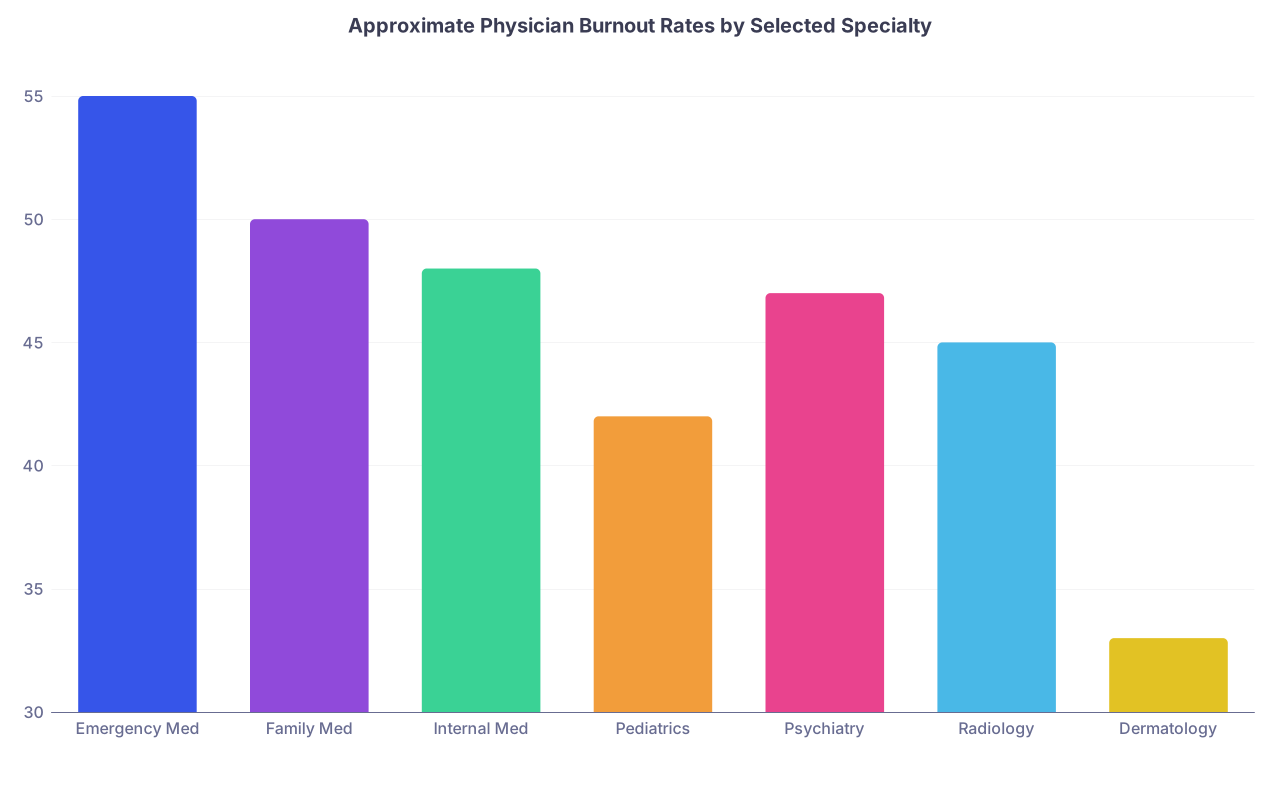
These are ballpark numbers pulled from recent Medscape reports (they bounce a bit year to year, but the ranking is similar):
- Emergency medicine: repeatedly near the top for burnout. Pay is solid but not the highest.
- Family medicine & internal medicine: high burnout, relatively low pay.
- Pediatrics: typically mid-pack on burnout, bottom of the barrel for pay.
- Psychiatry: mid-to-high burnout, mid pay.
- Radiology: mid-pack burnout, upper pay tier.
- Dermatology: consistently among the lowest burnout, and among the highest pay.
So if the mantra “low-paid specialties are safer from burnout” were true, dermatology should be a disaster zone and pediatrics should be a burnout oasis. It’s not.
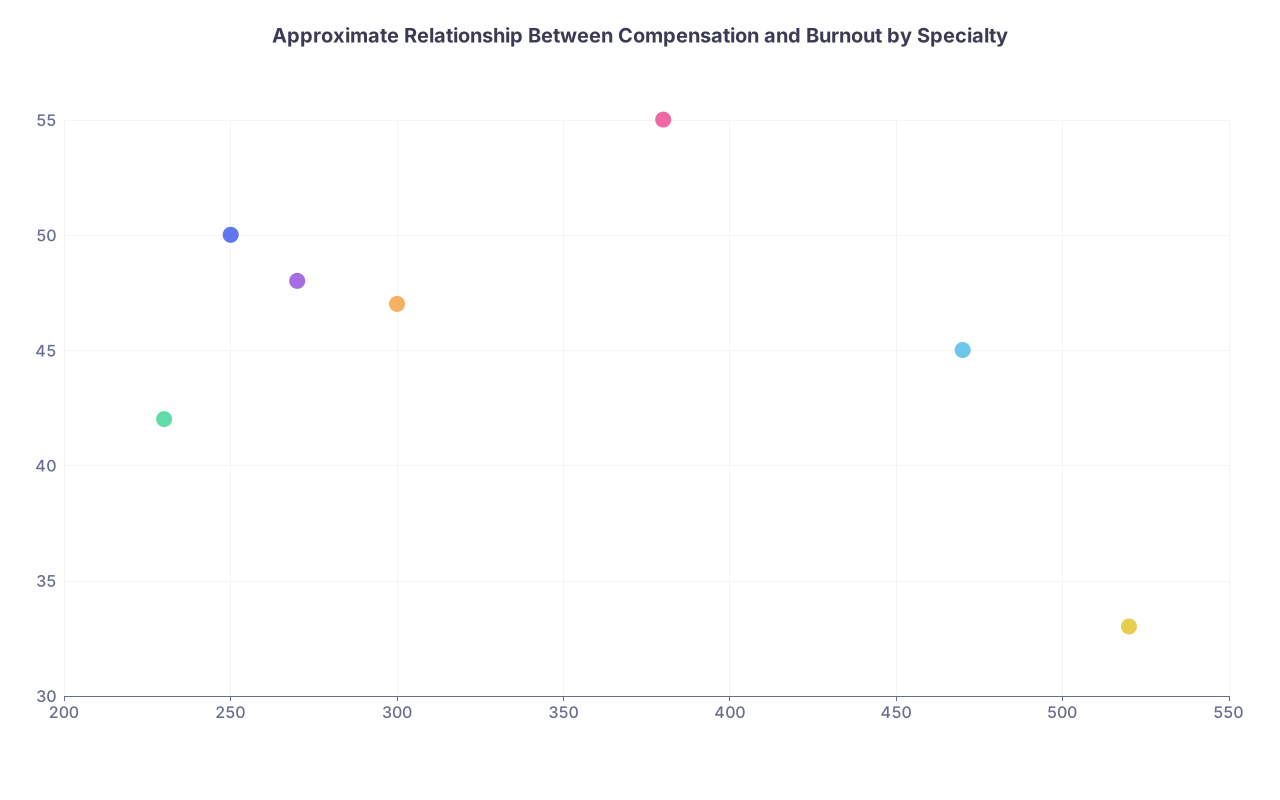
The more honest statement is uglier: compensation explains very little of the variance in burnout across specialties.
I’ve watched med students talk themselves into primary care they do not want, on the assumption it’s the emotionally healthier choice. Then I’ve watched some of them crash two years into residency.
The problem was never that they didn’t believe in the mission. The problem was all the other stuff no one bothered to quantify for them.
The Real Drivers: Control, Workload, and Chaos
If you strip away the mythology and look at the actual predictors of burnout, the same themes show up in study after study:
- Autonomy (control over schedule, patient load, and clinical decisions)
- Work hours and intensity (including nights/weekends)
- Documentation and administrative burden
- Workplace culture and support
- Degree of chaos and acuity in daily work
Money shows up in some models, but it is rarely the main effect once these factors are in.

| Step | Description |
|---|---|
| Step 1 | Specialty Choice |
| Step 2 | Workload and Hours |
| Step 3 | Autonomy Level |
| Step 4 | Admin Burden |
| Step 5 | Clinical Intensity |
| Step 6 | Compensation |
| Step 7 | Burnout Risk |
Now, map that onto “low-paid” specialties.
Family medicine, general internal medicine, pediatrics—these fields often combine:
- High patient volume per day
- Short visit slots
- Heavy documentation
- Insurance fights, prior auths, refill requests
- Pressure to “do everything” with very limited time
The pay is lower, sure. But the workload, chaos, and sense of powerlessness? Off the charts in many settings.
Contrast that with something like outpatient dermatology:
- Fewer true emergencies
- More control over schedule
- More predictable days
- Less life-or-death acuity
- Often physician-owned or smaller group practices
Is derm stressful at times? Of course. But it is not hard to understand why many derm attendings are less burned out than an underpaid PCP doing 23 visits a day with a 20-click EHR per encounter.
So when you say “low-paid specialties,” what you’re really smuggling in is: “high-meaning, low-intensity, relationship-based fields.” That sounds nice. The reality in 2026 American healthcare: the “relationship-based” clinicians are often buried under metrics, inbox messages, and productivity RVU quotas.
Meaningful work doesn’t protect you from a system that grinds you.
Specialty-by-Specialty: Where the Myth Cracks
Let’s walk through a few concrete examples.
Pediatrics: Noble, Underpaid… and Mixed on Burnout
Pediatrics is the poster child for “rewarding but low-paid.” The narrative is that pediatricians are less burned out because kids are cute, parents are grateful, and the stakes are different.
That’s partially true. Many pediatricians genuinely love their patients. But the data are blunt: pediatricians do not have the lowest burnout rates. They sit in the middle.
Why? Same structural issues:
- Lower reimbursement → high volume expectations
- Sick-season chaos
- Parents as secondary “patients” who email, call, message constantly
- Resource constraints, especially in underserved areas
I’ve heard pediatric residents say verbatim: “I knew I’d get paid less; I didn’t realize it would feel this unsustainable.”
Family Medicine & General Internal Medicine: Idealism vs Reality
These are the specialties most often sold to students as “meaning-driven, great for balance.”
In reality, they reliably appear at or near the top of burnout rankings. In multiple national surveys.
The rationale from hospital admin is simple: you’re the front door of the system. You’re cheap. So they pile volume, forms, and care coordination on you, then hand you a modest salary and a quality bonus tied to metrics you do not fully control.
You can absolutely build a good life in FM or IM—especially if you choose your practice setting carefully. But the average FM doc is not LESS burned out than an orthopedist just because they make half as much.
Psychiatry: Better Than It Used To Be, Still Not Protected
Psych has historically had high burnout, especially in public and inpatient settings. Recently it has improved somewhat in surveys, but here’s the catch: demand has exploded, and many psychiatrists are drowning in volume, prior auths for meds, and under-resourced systems.
This is a “moderate pay, moderate-to-high burnout” field. Again, not a clean story of “less money, less burnout.”
Emergency Medicine: Good Pay, Terrible Burnout
This one breaks the myth from the other direction. EM is reasonably well compensated, absolutely. And yet it’s at or near the top for burnout and intent to leave clinical practice.
Why? 24/7 shift work, high acuity, high violence risk, zero continuity, relentless boarding. You get paid reasonably well to stand at the sharpest end of a broken system. Extra money doesn’t cancel that out.
If pay were protective, EM docs would be thriving. Many are not.
The Outliers: Dermatology and Some Radiology
On the happy side of the graph, you see derm—and often radiology—showing lower burnout.
Both are relatively high-paying specialties.
Derm: lots of outpatient work, control over pace, lower proportion of middle-of-the-night emergencies. Radiology: increasing telerad options, some remote work, fewer direct confrontations with angry families or chaotic wards (though workload and isolation have their own costs).
These fields disprove any simple “money causes burnout” argument. Or “low pay is spiritually purer and safer.”
You can absolutely still be miserable in derm or radiology if your group is toxic, your call pool is tiny, or your leadership is dysfunctional. But structurally, they’re not doomed the way the myth suggests.
The Salary–Burnout Relationship: Weak and Indirect
Let’s tackle the core belief: “If I earn less, I’ll feel less pressure, and that will reduce burnout.”
That’s not how it actually plays out.
| Category | Value |
|---|---|
| FM | 250,50 |
| IM | 270,48 |
| Peds | 230,42 |
| Psych | 300,47 |
| EM | 380,55 |
| Radiology | 470,45 |
| Derm | 520,33 |
Values: rough median compensation (in $K) on x-axis vs burnout (%) on y-axis. It’s noisy. There is no clean “higher pay → higher burnout” or “lower pay → lower burnout” line.
Where compensation does matter:
- Crushing educational debt magnifies dissatisfaction in low-paying fields.
- Feeling underpaid relative to work and training level stings.
- Money can buy time: childcare, house help, saying no to extra shifts.
But there’s a point of diminishing returns. Multiple studies on professionals (not just physicians) show that once basic financial security and a decent lifestyle are covered, happiness and burnout are driven more by daily experience than raw income.
You don’t walk out of a 14-hour clinic day with your inbox still full thinking, “Well, at least I make $50K less than a radiologist—this feels great.”
The Big Confounder: Self-Selection and Personality
Another reason people cling to the myth: they notice that some folks in fields like pediatrics or FM seem more “content” on average.
That part is partially real—but not for the reason people think.
Certain personality types and values self-select into certain specialties. People who choose peds are, on average, more agreeable, more relationship-focused, more motivated by altruism than prestige. That doesn’t make them saints. It just means the baseline culture and expectations look different from, say, neurosurgery.
That cultural difference can blunt some aspects of burnout. Supportive colleagues buffer stress. Feeling aligned with your mission helps.
But self-selection doesn’t magically remove systemic abuse. A kind clinic manager does not cut your inbox messages in half. A collegial peds team does not triple Medicaid reimbursement.
And crucially: if you are not that personality type and you force yourself into a lower-paid field you don’t actually like “for balance,” you’re not getting that self-selection protection. You’re simply mismatched and underpaid.
Where Low-Paid Specialties Can Win on Burnout
So is the whole thing a lie? Not entirely. There are situations where a lower-paying specialty ends up being the better burnout play. But it’s not automatic. It’s conditional.
Patterns I’ve seen (and the surveys hint at) where low-paid fields can be lower burnout:
- Smaller group or independent practice with sane volume caps.
- Integrated team models where admin burden is shared (scribes, RNs, behavioral health).
- Less hospital-owned productivity pressure.
- Regions where cost of living is modest and debt manageable.
- Intentional scope (e.g., outpatient-only IM with no inpatient call).
In other words, it’s not “pediatrics vs radiology.” It’s “this specific pediatrics job in this setting vs that specific radiology job in that setting.”
The specialty is a rough frame. The job is the reality.
| Setting | Typical Burnout Risk |
|---|---|
| Hospital-owned FM, high RVU | High |
| Small independent FM, lower volume | Moderate/Lower |
| Academic peds with heavy admin | High |
| Community peds, good support | Moderate |
| Teleradiology with isolation | Moderate/High |
How You Should Actually Think About This as a Trainee
Here’s the part no one tells you bluntly enough: you can burn out in any specialty if you land in the wrong environment. You can also build a sustainable life in most specialties if you play your cards carefully.
Chasing “low pay = low burnout” is the wrong axis. A better set of questions:
- Do I like the day-to-day tasks of this field when I’m tired, not just when it’s interesting?
- Can this specialty be practiced in settings with real control over schedule and volume?
- What does burnout look like in attendings 10–20 years out where I’m rotating?
- How flexible is this field if I need to pivot (outpatient vs inpatient, academic vs private, administrative roles, etc.)?
And the painful one:
- If I end up making the median income for this specialty, with my debt and my desired lifestyle, will resentment build over time?
You do not solve burnout by under-earning in a miserable job. You solve a piece of it by aligning what you enjoy with a practice style that is structurally sustainable and financially adequate for your life.

Where the Myth Comes From—and Why It Persists
A quick reality check on why so many people still repeat this:
- Cognitive dissonance. People in low-paying fields need to believe the trade-off protects them somehow. Saying “I get paid less AND my burnout risk is similar” is a tough pill to swallow.
- Survivor bias. The folks you see in outpatient peds or FM clinics who are still there 15 years later are, by definition, the ones who tolerated it. The ones who quietly left, cut back drastically, or switched careers are not giving lunchtime talks.
- Marketing. Health systems need primary care. They have every incentive to frame it as the noble, balanced choice. They’re not going to lead with RVU spreadsheets and inbox screenshots.
I’ve watched more than one MS3 absorb that messaging uncritically and then feel blindsided as an intern. You do not need to be that person.
| Category | Value |
|---|---|
| Low-paid = low burnout | 80 |
| High-paid = always high burnout | 70 |
| Meaningful work prevents burnout | 60 |
| Specialty alone determines burnout | 90 |
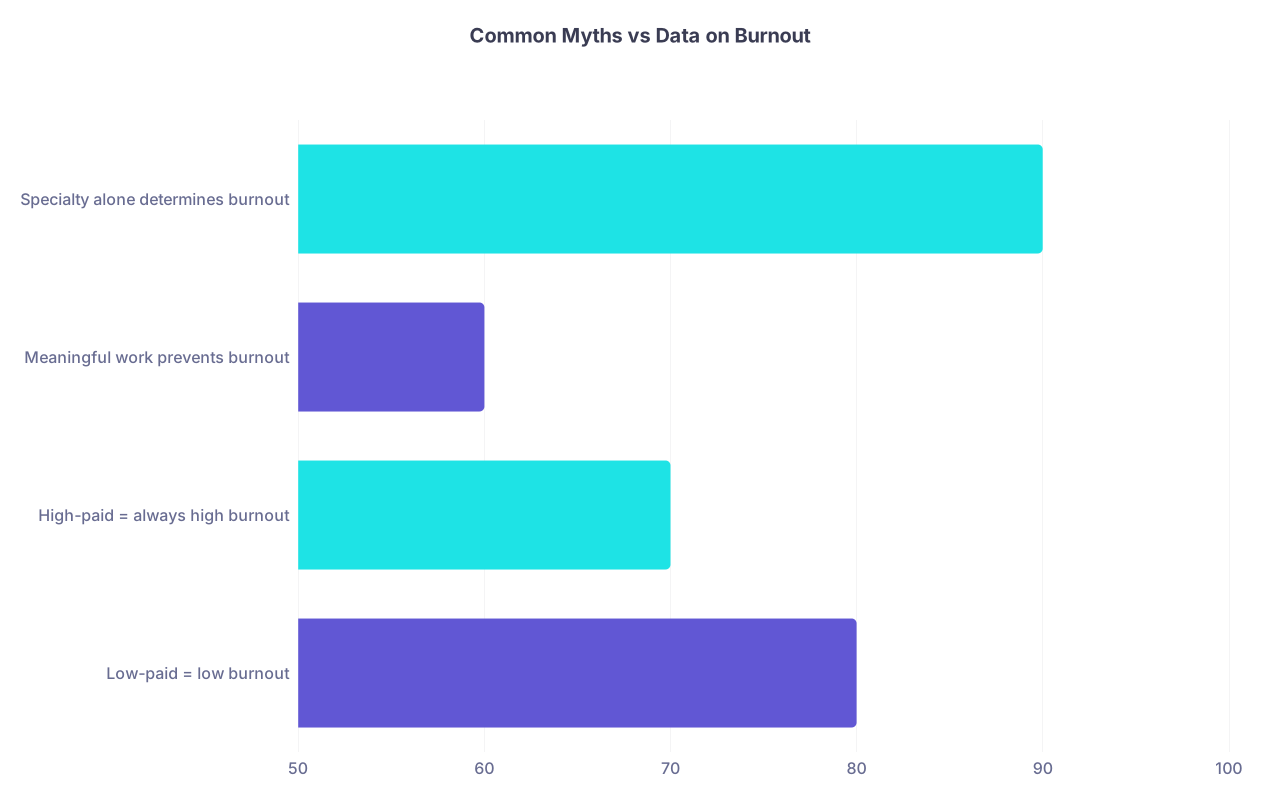
(Values here represent how common the myth is, not truth. The point: these beliefs are everywhere; their evidence support is weak.)

The Bottom Line: What the Studies Actually Say
Let’s cut to it.
Low-paid specialties do not reliably have less burnout. If anything, many of them have more burnout than some of the highly paid fields.
Burnout tracks far more with:
- How much control you have.
- How chaotic and intense your work is.
- How much pointless administrative nonsense you’re forced to do.
- Whether your compensation feels fair for the beating you take.
You won’t “out-virtue” a broken system by accepting less money. Pick a specialty whose work you can tolerate and often enjoy. Then, inside that specialty, fight hard for a practice setting that protects your time, your autonomy, and yes—pays you enough that you don’t feel used.
That—not the comforting myth about low-paid fields—is what actually lowers burnout risk.

Key points:
- Low compensation does not protect against burnout; many low-paid fields have high burnout in national surveys.
- Burnout is driven more by workload, autonomy, chaos, and admin burden than by raw income.
- Your real leverage is not “high vs low pay specialty,” but picking work you like in a setting that gives you control, reasonable volume, and fair compensation.


