

It’s 4:45 a.m. You’re walking into a dim, half-renovated hospital for your early ward round. You passed two shiny OR suites with giant company logos on the way in last week when you rotated at the big-name surgical center. That place had catered lunches and a “residents’ wellness lounge.” Here, the resident room has a broken chair, a slow computer, and a coffee pot that looks older than you.
You chose – or are about to choose – a lower-paying specialty. Pediatrics, psychiatry, family medicine, geriatrics, preventive medicine, maybe pediatric neurology or child psych. You’ve heard the lines: “It’s so rewarding.” “The lifestyle is good.” “You’ll have great job security.”
Let me tell you what really happens.
Program directors in these fields absolutely know they are not offering you derm or ortho money. They know the lifetime earning curve is flatter. So they expect something in return. From you. Unspoken, but very real tradeoffs. And the residents who do not understand those tradeoffs are the ones who get quietly sidelined, labeled “not a team player,” or just burned out and bitter.
We’re going to talk about what PDs actually expect from you when you sign up for a lower-paying field – not the glossy AMA-version, but the behind-the-scenes reality I’ve heard in PD meetings and hallway conversations.
The Money Reality PDs Assume You Already Know
Program directors rarely talk numbers out loud in interview rooms, but they all know the rough math. They assume you’ve either done it or chosen not to.
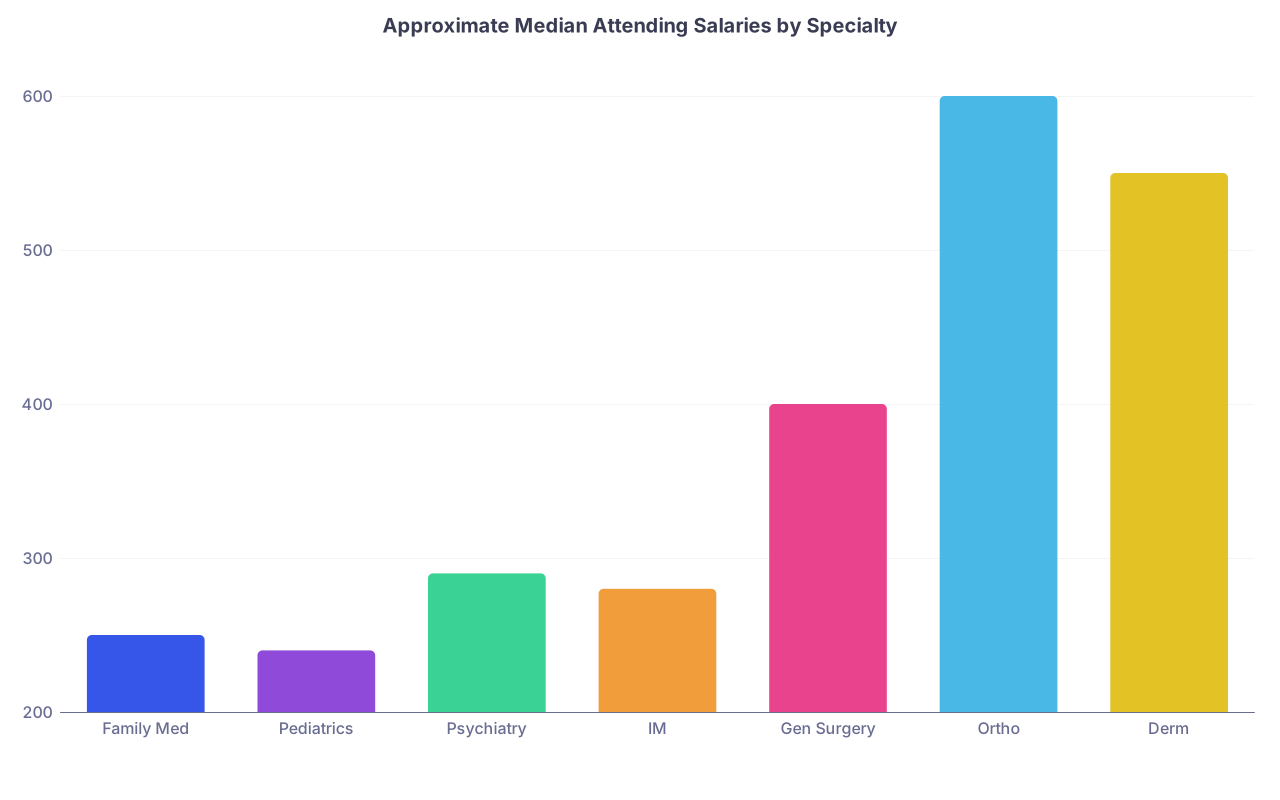
| Category | Value |
|---|---|
| Family Med | 250 |
| Pediatrics | 240 |
| Psychiatry | 290 |
| IM | 280 |
| Gen Surgery | 400 |
| Ortho | 600 |
| Derm | 550 |
Here’s the insider part: How they interpret your choice.
When you rank a low-paying specialty high, most PDs make at least three assumptions about you:
- You’re willing to trade money for meaning or lifestyle.
- You won’t be constantly comparing yourself (out loud, at least) to your ortho and anesthesia classmates.
- You’re prepared to compensate in other ways: scope, location, side gigs, or academic track.
They’ll never say this in the interview, but I’ve heard variations of this in closed-door PD meetings:
- “If he’s already complaining about debt at the interview stage, he will be miserable in family med. Hard pass.”
- “She keeps bringing up salary. I worry she’s going to bail to hospital administration as soon as she finishes.”
They expect you to understand the financial downside. And if you act surprised in PGY-2 that urgent care pays more than your academic pediatric attending, they lose patience fast.
So let’s be direct: You’re stepping onto a track where your ceiling is lower. PDs already know this. They expect you to come in pre-accepted to that reality, not fighting it every month.
Tradeoff #1: Emotional Labor for Fewer Dollars
This is the ugliest hidden exchange in lower-paying residencies: you’re trading money for emotional labor. Everyone in leadership knows it. They just rebrand it as “mission-driven work.”
Pediatrics, family med, psych, geriatrics – these are the specialties where:
- Patients often cannot advocate for themselves.
- Families are anxious, demanding, or flat-out hostile.
- Systems are underfunded, especially in safety-net or county hospitals.
- Social determinants of health hit you in the face on every clinic day.
And here’s the part nobody says out loud: PDs in these programs select residents they believe can absorb more emotional chaos without exploding.
Not because it’s fair. Because that’s how the system survives.
I have sat in rank meetings where someone says:
“Look, she’s brilliant, but she looked exhausted talking about her underserved work. I’m not sure she’ll last here.”
Translation: This specialty drains you. PDs want residents who seem to have emotional reserves and coping mechanisms already, because they know they cannot “fix” this during training.
If you’re aiming at a low-paying specialty, PDs are looking for signs that:
- You’ve worked with tough populations before and still chose this.
- You understand long-term, chronic, system-level frustration and haven’t become cynical or cruel.
- You are not going to implode the first time a parent calls you a “baby killer” for recommending vaccines, or a psych patient screams obscenities at you.
They are trading salary for mission. And they expect you to buy into that mission with your emotional bandwidth.
Tradeoff #2: More Documentation, Less Glamour
You know those fields with clean procedural checklists and beautiful, finite consult notes? That’s not most low-paying specialties.
Primary care, pediatrics, psych, geriatrics – these are documentation-heavy, ambiguity-heavy worlds. You’re not just writing “lap chole POD1, doing well” notes. You’re doing social work, risk documentation, disability forms, school letters, guardianship paperwork, safety plans.
Program directors know exactly how much of your time this will consume as an attending. So as a resident, they expect a few things:
- You will not be allergic to charting and forms.
- You’ll tolerate EMR bloat without having a meltdown every week.
- You’ll learn to be efficient because there is no alternative.
I once heard a psych PD say this about an applicant:
“He wants to ‘just do therapy and med management.’ This is county psych. It’s 60% documentation and 20% chasing collateral. He’s going to hate it.”
In other words, in low-paying specialties, you’re trading status and “cool factor” for continuity, session notes, and multi-page forms. PDs expect you to understand that this is not a mistake; it’s baked into the job.
Tradeoff #3: Work Hours vs. Headspace (The Lifestyle Myth)
The myth goes: “Lower-paying fields have better lifestyle.” Yes and no. The hours might be more humane on paper. The mental carryover is not.
A pediatric hospitalist might “only” work 14 shifts a month, but she takes every catastrophic outcome home. Family med might end at 5 p.m., but you’ll be worrying about whether your uninsured COPD patient can actually afford their inhaler.
Here’s the insider reality:
- PDs in these specialties sell “lifestyle” to applicants because they know they can’t sell money.
- Privately, they know the cognitive and emotional load is high.
- They pick residents who seem able to psychologically separate when needed.
I’ve heard PDs say things like:
“He’s too enmeshed. Every tough patient story wrecks him for days. I’m worried he’ll burn out.”
So what’s the tradeoff? You get fewer 28-hour call shifts but more long-term emotional residue. And PDs expect you to have, or develop, some form of emotional boundary – not because they care about your feelings in some abstract sense, but because that’s what keeps you functional in year three.
Lifestyle is not just hours. It’s whether you can leave clinic without replaying the worst room of the day all night.
Tradeoff #4: Prestige vs. Autonomy and Scope
Lower-paying specialties carry less institutional prestige. That’s not me being harsh – that’s how hospital politics work.
Ortho, cardiology, neurosurgery – they drive revenue. They sit at the big table. When they ask for an MRI slot, they get it.
Family med, peds, psych, geriatrics – they are often:
- Fighting for clinic space.
- Justifying their RVUs.
- Begging admin not to cut another social worker position.
So what do you get in return?
You often get much more autonomy and broad scope, especially in rural or community settings. A family med doc in a small town can do OB, minor procedures, addiction medicine, sports, inpatient, nursing home. A child psych in a shortage area basically sets their own rulebook.
Program directors know this. They assume you’re the kind of person who:
- Is okay not being the “star” service in the hospital.
- Values broad generalist impact over niche prestige.
- Will not sulk because your consults are not considered “stat” by anyone.
In selection meetings, I’ve heard comments like:
“She keeps talking about wanting to do ‘cutting-edge’ stuff. This is bread-and-butter peds in a safety-net system. I don’t think she’ll be happy here.”
That’s the unspoken tradeoff: less prestige, more grassroots control. If you radiate resentment about “just doing clinic,” PDs will smell it and move on.
Tradeoff #5: Academic vs. Community – The Salary Compression Trap
There’s another money trap PDs are fully aware of but don’t like talking about: the academic penalty.
In low-paying fields, academic salaries can be brutally low compared to community or locums. A pediatric hospitalist at a big-name academic center may be making not much more than a well-run urgent care doc, while carrying teaching, QI projects, and night coverage.
| Specialty | Academic Attending | Community/Private Attending |
|---|---|---|
| Pediatrics | $190k–$230k | $230k–$300k |
| Family Med | $200k–$230k | $230k–$280k |
| Psychiatry | $230k–$260k | $280k–$350k |
| Geriatrics | $190k–$220k | $220k–$260k |
| Child Psych | $240k–$270k | $300k–$380k |
PDs in academic programs expect you to “accept” that penalty in exchange for:
- Teaching and mentorship.
- Protected research or QI time (on paper at least).
- Institutional resources and titles.
Here’s the quiet part: Many PDs know their own residents will leave academics to chase money once loans come due, kids arrive, or burnout hits. They’re not shocked by this. But when they’re recruiting, they’re hunting for people who at least look like they might tolerate the academic penalty for a few years.
So if you tell an academic psych PD, “I want the highest salary possible right after residency,” you’re signaling misalignment with their entire ecosystem. They will rank someone else higher. Not because you’re wrong, but because they know they can’t give you what you say you want.
Tradeoff #6: “Mission Fit” = Will You Work Where No One Else Wants To?
In low-paying specialties, especially primary care and psych, PDs are under huge pressure to produce graduates who will work in:
- Rural communities
- FQHCs and community health centers
- County and state facilities
- Underserved urban areas
They are judged informally, and sometimes formally, on placement into shortage areas. I have heard PDs brag or complain in exactly those terms at national meetings.
So when they assess you, they’re quietly asking:
- Will this person take a job in the middle of nowhere if that’s where the need is?
- Will this person stay in safety-net settings instead of fleeing to concierge?
- Is this applicant “mission-aligned” or just using this specialty as a fallback?
If your entire application screams big-city, private-school, boutique interests, and you say nothing concrete about underserved or public-sector work, the PD may see you as a flight risk.
Does that mean you must sentence yourself to rural medicine forever? No. But if you want a competitive residency in a low-paying field, showing credible commitment to high-need populations is almost mandatory. That’s the tradeoff: they train you; they expect some of you to go where no one else wants to go.
Tradeoff #7: Being “Nice” Is Not Optional – It’s Currency
In the lower-paying specialties, collegiality is not just a buzzword. It’s a survival trait. You’re often in under-resourced settings. The only thing between you and chaos is whether your team actually likes each other.
Program directors know this very well. They overvalue “fit,” sometimes to an almost ridiculous degree, because a single malignant resident can poison an already-fragile culture.
I’ve heard this line so many times it’s practically a script:
“I would rather take the 225 Step applicant who everyone loved than the 255 who seemed arrogant. We live with them for three years.”
These PDs expect you to:
- Be teachable. Not performatively humble. Actually receptive.
- Treat nurses, social workers, and MAs as colleagues, not furniture.
- Show up when your co-resident is drowning, even if “it’s not your patient.”
In high-prestige, high-paying specialties, sometimes pure technical brilliance can offset a bad personality. In pediatrics, psych, family, geri – less so. Being unpleasant is a bigger liability, because the work itself is already hard and under-rewarded. PDs will not knowingly inject toxicity into that mix if they can avoid it.
So yes, “being nice” is a tradeoff. You’re trading some of the leverage you might have in a more revenue-heavy specialty for the expectation that you will help hold the culture together.
What PDs Won’t Say Out Loud, But Operate On Anyway
Let me put some of the real PD thought-process into plain language. Behind closed doors, the questions sound like this:
- “Will this person quit when they see their friend’s derm paycheck?”
- “Can they handle soul-crushing social situations without becoming cruel?”
- “Will they implode in a safety-net clinic with five languages and zero resources?”
- “Does this applicant understand what lower-paying actually means, or are they romanticizing it?”
- “Is this someone I would trust caring for my own family in a broken system?”
They’re balancing risk. Emotional risk, institutional risk, and yes, financial risk (because turnover is expensive).
If you want to match into these fields and not be miserable once you’re in, you need to be brutally honest with yourself:
- Are you truly okay with the money differential, or are you hoping it won’t matter?
- Do you actually like complexity without neat fixes, or do you just like saying you do?
- Can you see yourself working with high-need, low-resource populations day in and day out?
If the answer is yes, program directors can feel that. And they will go out of their way to support you, because you are what keeps their specialty alive.

| Step | Description |
|---|---|
| Step 1 | Interest in low paying specialty |
| Step 2 | Constant resentment and burnout |
| Step 3 | Focus on mission and lifestyle |
| Step 4 | High risk for early burnout |
| Step 5 | Better long term fit |
| Step 6 | Chronic dissatisfaction |
| Step 7 | Autonomy and scope satisfaction |
| Step 8 | Accept lower income reality |
| Step 9 | Tolerate emotional labor? |
| Step 10 | Comfort with low prestige? |
How To Signal You Understand These Tradeoffs (Without Sounding Fake)
You do not need to recite any of this explicitly. But you should signal, in your personal statement, interviews, and behavior on rotations, that you “get it.”
Concrete ways this shows up:
- You talk about a specific, hard patient story and what you learned about your own limits.
- You acknowledge systemic barriers without collapsing into helplessness or rage.
- You describe debt and money concerns honestly, but you do not center them in every conversation.
- You express interest in underserved settings that matches your CV, not just lip service.
- On rotations, you help with the unglamorous work – discharge summaries, family calls, clinic overflow – without theatrics.
When a PD sees that, the mental translation is: “Okay. This one understands the unspoken contract. I can work with this.”
FAQ: The Unspoken Tradeoffs in Lower-Paying Residencies
1. If I care a lot about money, should I avoid low-paying specialties altogether?
If money is a major driver for you – not just a concern, but a primary value – then yes, you’re probably going to be chronically frustrated in these fields. That doesn’t mean you need to chase the absolute highest-paying specialty, but you do need to be realistic. You can somewhat offset income gaps with location (rural often pays more), side gigs (urgent care, telepsych, consulting), or higher-volume practice models. But you will not fully close the gap with ortho or derm. PDs can usually tell who is going to be bitter about this and who has made peace with it.
2. Can I start in a low-paying specialty and later switch to a higher-paying one?
Technically, yes. People do it. But switching specialties is messy, politically awkward, and not guaranteed. When PDs sense you’re “using” their field as a stepping stone, they’re less inclined to invest heavily in you. If you’re thinking of psych only as a bridge to neurology, or family med as a backup while aiming for EM, you need to own the risk: you might get stuck in a specialty you never fully committed to. And that’s a rough way to spend a career.
3. How honest can I be about burnout risk and emotional strain in interviews?
You can be very honest, as long as you’re not asking the PD to reassure you that everything will be fine. Saying, “I’ve taken care of a lot of high-need patients and I’ve seen how draining it can be. I’ve built X and Y coping strategies, and I’m still committed to this population,” signals insight and maturity. Saying, “I’m worried this will burn me out; convince me it won’t,” makes you look fragile and misaligned with reality.
4. Is it a red flag to say I want a good work-life balance in a low-paying field?
Not inherently. These specialties often attract people explicitly seeking balance. The red flag is when “work-life balance” sounds like “I want to avoid hard cases, weekends, or any emotional discomfort.” If you frame it as, “I want a sustainable career where I can be present for my patients and my family, and I know that means developing boundaries and efficient work habits,” most PDs will nod along. They are trying to do the same thing.
5. How do I know if a specific program is exploiting the ‘mission’ angle to justify bad conditions?
Watch what current residents say when faculty aren’t in the room. Do they talk about meaningful work plus solid support, or do they use “mission” as a coping slogan for chronic understaffing and unsafe workloads? Look at the schedule, turnover, and where grads go. If every graduate flees to private practice or locums as fast as possible, that’s a bad sign. There’s a difference between hard, under-resourced work that people still believe in, and a program quietly burning residents down while quoting “service to the underserved” as a shield.
Years from now, you won’t remember the exact RVU numbers, or the salary graphs you obsessed over on anonymous forums. You’ll remember whether you can walk into clinic most days without hating who you’ve become. The tradeoffs are real. PDs already expect you to make them. The only real question is whether you’re making them with your eyes open.


