

Last February, I sat in a rank meeting where a resident applicant had Family Medicine first, followed by Radiology and Anesthesiology. One of the senior attendings looked at the list, raised an eyebrow, and said, “Either this kid really loves primary care… or they have no idea what they’re doing.”
If you think program directors are blind to what your rank list says about you, you’re wrong. We talk about it. We make assumptions from it. And when you put a lower-paid specialty at the top, it triggers very specific reactions—some good, some quietly brutal.
Let me walk you through what actually happens on our side of the table when we see you choosing primary care, pediatrics, psych, or other “lower income” fields as your first choice.
First Reality Check: PDs Do See Patterns in Your Choices
You submit your rank list in confidence. But the pattern of what you apply to and where you interview is obvious long before February. We see it during interview season.
We notice when:
- You only applied to one specialty, and it’s low-paying.
- You applied to two or three very different specialties, with wildly different lifestyles and incomes.
- You “backed up” into a lower-paying field.
Program directors talk. IM PDs know what FM PDs are seeing. Psych PDs talk to Neurology PDs. Same hospital? We literally share the same call rooms and committee rooms.
Here’s the uncomfortable truth: your specialty choices create a narrative about you, whether you like it or not.
What Low-Paying Specialties Actually Are (From Our Side)
Let’s name them, roughly, so we’re on the same page. These are broad strokes, but this is how PDs mentally sort things in the hallway conversations:
| Income Tier | Example Specialties |
|---|---|
| Lowest | Pediatrics, Family Medicine, Psychiatry |
| Lower-Mid | Internal Medicine, Neurology, PM&R |
| Mid | OB/GYN, Emergency Medicine, Hospitalist tracks |
| Higher | Anesthesiology, Radiology, General Surgery |
| Highest | Ortho, Derm, ENT, Plastics, Cards, GI |
Are there exceptions? Of course. Outpatient psych private practice can print money. Some FM docs in rural locums make more than hospitalists. But PDs still think in these categories.
So when you rank a “lowest paid” field first—peds, FM, psych—here’s what goes through a lot of minds.
Reaction #1: “Is This Genuine Mission or Just Desperation?”
Let me be blunt: low-paying specialties are used as “backup plans” more often than any applicant wants to admit.
We see:
- Derm applicants backing into FM.
- Ortho applicants switching to PM&R.
- Radiology hopefuls ending up in IM or psych.
When a PD looks at an applicant clearly capable of landing a higher-paying specialty—strong scores, research in Ortho, letters from Derm—and that applicant then applies to FM or peds, the first unfiltered question is:
“Do they actually want this, or did they just run out of options?”
The cynical part of faculty (and every department has a few) will say things like:
- “They’ll leave as soon as they can get a fellowship in something better paying.”
- “They’re just here until they can lateral into something else.”
- “They couldn’t cut it in Ortho, so now they’re trying to smile their way into FM.”
But here’s the twist: most program directors are not actually put off by you being “below your original target,” as long as you can clearly articulate:
- Why you understand the downside of the lower-paying field.
- Why you still chose it.
The worst thing you can do is pretend money never crossed your mind. That comes off as naive at best and dishonest at worst. The smart applicants say something more like:
“I know peds is one of the lower compensated fields. I thought seriously about that. But I realized I prefer continuity of care and complex developmental stuff over procedural work and a bigger paycheck.”
That lands well. We know you’ve thought about salary—everyone has. We just want to see that you still chose the specialty despite the economics, not in ignorance of them.
Reaction #2: “Are They Financially Clueless or Financially Secure?”
There’s another whispered layer to this.
When you rank a low-paying specialty first, PDs will quietly infer things about your financial life. They shouldn’t, but they do. I’ve sat through these comments:
- “Do they have loans? They want peds with 400k debt?”
- “Their dad is a cardiologist; they’ll be fine.”
- “They did Teach for America and worked before med school—probably used to living lean.”
Here’s how the mental math goes:
- Applicant with massive debt, no prior career, choosing FM with no clear plan → “Risk of future burnout when reality hits.”
- Applicant with a previous high-paying career who’s switching into psych or peds → “Probably thought through the trade-offs.”
- Applicant acknowledging loans and talking about lifestyle/side gigs/long-term flexibility → “Financially literate, less likely to be blindsided.”
We’re not your financial planners. But we’ve seen enough 3rd-year residents in low-paying fields crying in conference rooms because their loan payments are choking them. PDs are wary of building a class of residents who are going to wake up miserable when their first attending paycheck arrives.
Whether you like it or not, your clarity about money becomes part of your “risk of burning out and quitting” calculation.
Reaction #3: “Does Their Application Match a Low-Paying Specialty?”
This is where most applicants get exposed.
PDs compare your declared interest with your actual track record. If you rank a lower-paid field first and your entire file screams something else, red flags go up.
Here’s what I mean.
You say: “I’m passionate about primary care.”
But:
- All your research is in interventional cardiology.
- Your away rotation was in ortho.
- Your personal statement uses the word “procedure” every other paragraph.
- No longitudinal clinic experience, no underserved work, no continuity clinics beyond what was mandatory.
In rank meetings, those applicants get shredded.
Someone will say, “This is not a primary care personality. They’re checking a box.” And suddenly your chances drop.
On the other hand, when someone with a 250+ Step 2, AOA, and shiny research still has:
- Community clinic volunteering
- Long-term mentoring or school outreach
- Letters from FM or peds attendings who clearly know them well
- A statement that reads like it was written for real patients, not journals
Then the conversation flips:
- “They could have gone into anything and still chose us.”
- “This is the kind of resident who doesn’t bolt after PGY-2.”
- “They’ll be a rock star and a future leader in the field.”
You want that reaction.
What Happens When You Rank Only a Low-Paying Specialty
Let me tell you how PDs interpret applicants who go all-in on a lower income field and don’t apply anywhere else.
We usually think one of three things:
- “They’re either incredibly committed…”
- “…or incredibly naive…”
- “…or they had no realistic shot anywhere else and finally accepted it.”
Your job in interviews is to push us toward #1.
The ones who get full respect usually do a few things:
They talk about specific aspects of the work that are unappealing to others but attractive to them. For example:
- A psych applicant who says: “I actually like chronic complex patients; I don’t want quick procedures or quick fixes.”
- A peds applicant saying: “I’m fine with parents being anxious and demanding. I like educating families.”
- An FM applicant saying: “I don’t want to give up continuity. I want cradle-to-grave medicine.”
They also show they’ve reality-tested the career:
- “I shadowed community pediatricians, not just academic subspecialists.”
- “I’ve talked with attendings about their RVU pressures and still felt this is my lane.”
- “I understand the income distribution in psych and have a plan for my loans.”
When you speak like that, PDs stop pitying or doubting you and start thinking, “Ok. This one knows exactly what they’re signing up for.”
What If You Rank a Low-Paying Field First, Higher-Paying Second?
This is where things get psychologically interesting.
Say your rank list starts with:
- Psychiatry
- Neurology
- Anesthesiology
Or:
- Family Medicine
- Internal Medicine
- Radiology
We do not see your actual NRMP rank list, but your application choices, interview signals, and hallway comments give us the shape of it. And if you talk too freely, we find out more than you think.
That kind of pattern creates questions like:
- “If they don’t match into psych, are they going to be happy in neurology?”
- “Are they ranking FM first because they think it’s easier to match, but really still want radiology?”
Most PDs care about one thing above all: They want people who want to be there. Not refugees from a different specialty.
So when your choices cross income and lifestyle lines, you must be able to explain a coherent through-line.
Something like:
“Across all the specialties I considered, what I liked most were long-term doctor–patient relationships and complex decision-making, not procedures. That’s why my final decision landed on psych as my first choice, with neuro as something I could also see myself happy in.”
That tells us you’re not just chasing a life raft. You have a theme.
The worst thing you can say is some mealy-mouthed “I liked everything, I could be happy anywhere” line. That just signals you don’t know yourself yet.
Match Outcomes by Specialty: PDs Know the Numbers
Here’s the other side: most PDs are students of the Match data. We know who is choosing what and how competitive each field is year to year.
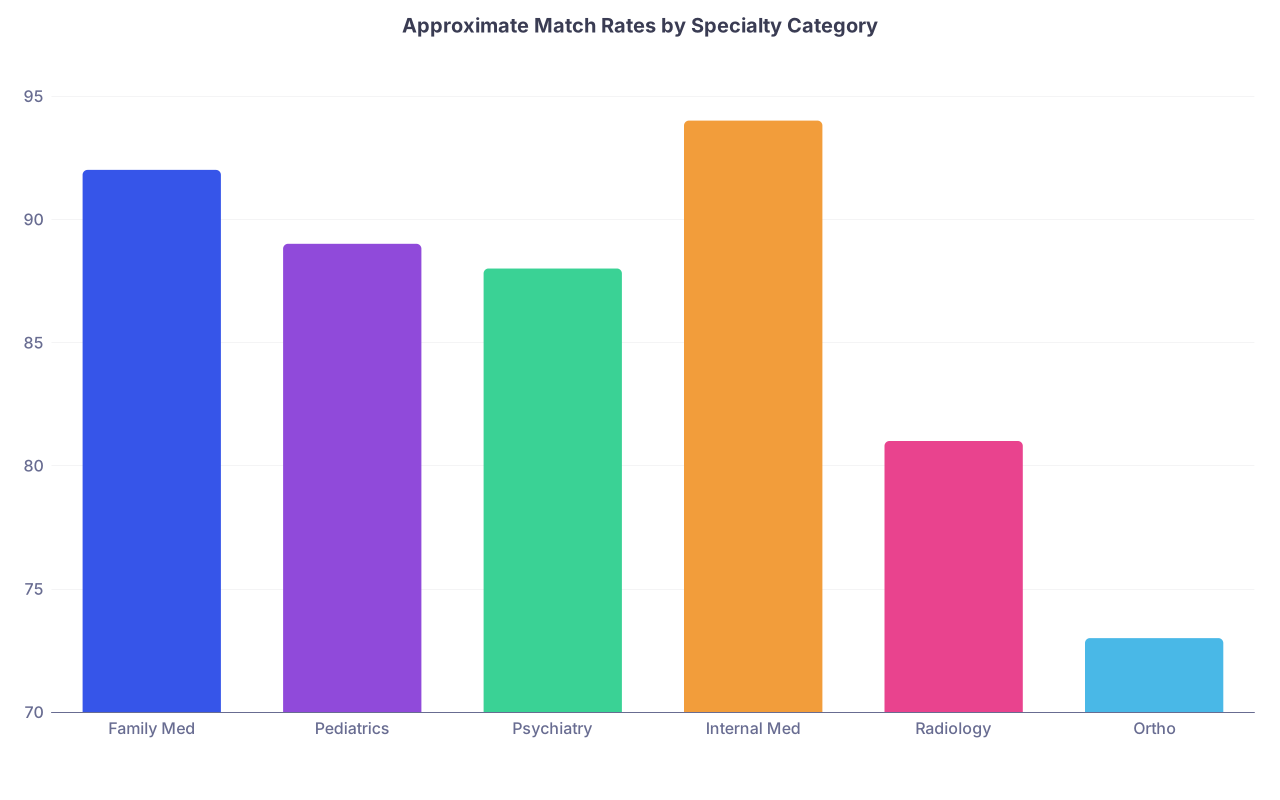
| Category | Value |
|---|---|
| Family Med | 92 |
| Pediatrics | 89 |
| Psychiatry | 88 |
| Internal Med | 94 |
| Radiology | 81 |
| Ortho | 73 |
Family Med, peds, and psych usually fill, but with a meaningful slice of positions going to IMGs or less traditionally competitive applicants. So when a very strong US MD student with high scores and research chooses these fields first, PDs notice. They’re often pleasantly surprised.
A strong applicant voluntarily going into a low-paying field raises their value in our eyes. They’re less likely to be there purely because they got squeezed out of the “prestige” lanes.
When I see a 250+ applicant say, “I want FM,” the room usually shifts:
- “This is someone who could drive academic change.”
- “Let’s prioritize them near the top of the list.”
- “They’ll be a great ambassador for our program.”
You’re not penalized for “over-qualifying” for a low-paying field. Quite the opposite. As long as your story makes sense.
How PDs Quietly Sort Applicants by Risk
Here’s the part not printed in any handbook.
Every PD and core faculty member carries an internal rubric:
- Risk of quitting the specialty
- Risk of burning out dramatically
- Risk of being chronically dissatisfied and toxic to the program
When you pick a low-paying specialty first, you can either increase or decrease that perceived risk depending on how your story lands.
Higher risk patterns we see:
- Heavy procedures research + suddenly applying psych with no psych mentors.
- Failed to match into a competitive specialty last year + now applying FM with zero FM engagement prior.
- Visible fixation on lifestyle or money + choosing a field where both are tight.
Lower risk patterns:
- Longitudinal, clearly documented interest in that field.
- Multiple mentors in the specialty who vouch for your insight and maturity.
- Clear-eyed statements about loan repayment, salary, and long-term career structure.
You do not need to write a financial analysis in your personal statement. But in interviews, if a PD asks, “Have you thought about the income side?” and you freeze or hand-wave it away, your risk score goes up.
The Trick: Showing You Chose Toward Something, Not Just Away From Money
The smartest applicants frame their decision not as “I don’t care about money” (no one believes that) but as “I prioritized other things higher.”
They say things like:
- “I realized I care more about seeing the same patients every year than about procedures.”
- “Psych gives me more day-to-day meaning than chasing an extra couple hundred thousand a year.”
- “Even though FM pays less, I like the flexibility—rural, academic, urgent care, admin—that lets me shape my career over time.”
That’s compelling. It shows intention, not surrender.
What PDs hate is the accidental martyr narrative. The ones who speak as if they’re sacrificing themselves to “do what’s right,” with an unspoken expectation that everyone must admire them. Those residents burn out hard because reality doesn’t reward martyrdom. It rewards sustainability.
We want people grounded enough to say, “Yeah, money matters. But what I’m trading for it is worth it to me.”
How Your Rank List Affects You After You Match
One more thing people do not tell you: your specialty choice colors how attendings perceive your career trajectory for years.
In lower-paid fields, the attendings will start asking you early:
- “Are you thinking of fellowship?”
- “Private practice vs academic?”
- “Do you want to do admin or leadership?”
Why? Because they know if you stay general in a lower-paying field without a plan, you’re at higher risk of long-term dissatisfaction. Not because the work isn’t meaningful, but because the system pays poorly for some of the hardest jobs.
Your PD will quietly categorize you:
- The one happy to be a generalist long-term.
- The one we need to push into a fellowship for career viability.
- The one who will leave clinical work for administration, industry, or nonclinical roles.
That categorization often starts from the story you told when you ranked and interviewed. The residents who came in with honest, coherent reasons for their choices get much better mentorship.
A Quick Reality Snapshot: Lifestyle vs Salary
Some of you are bargain-hunting specialties. You know the pay is lower but the lifestyle can be strong. PDs know that game too.
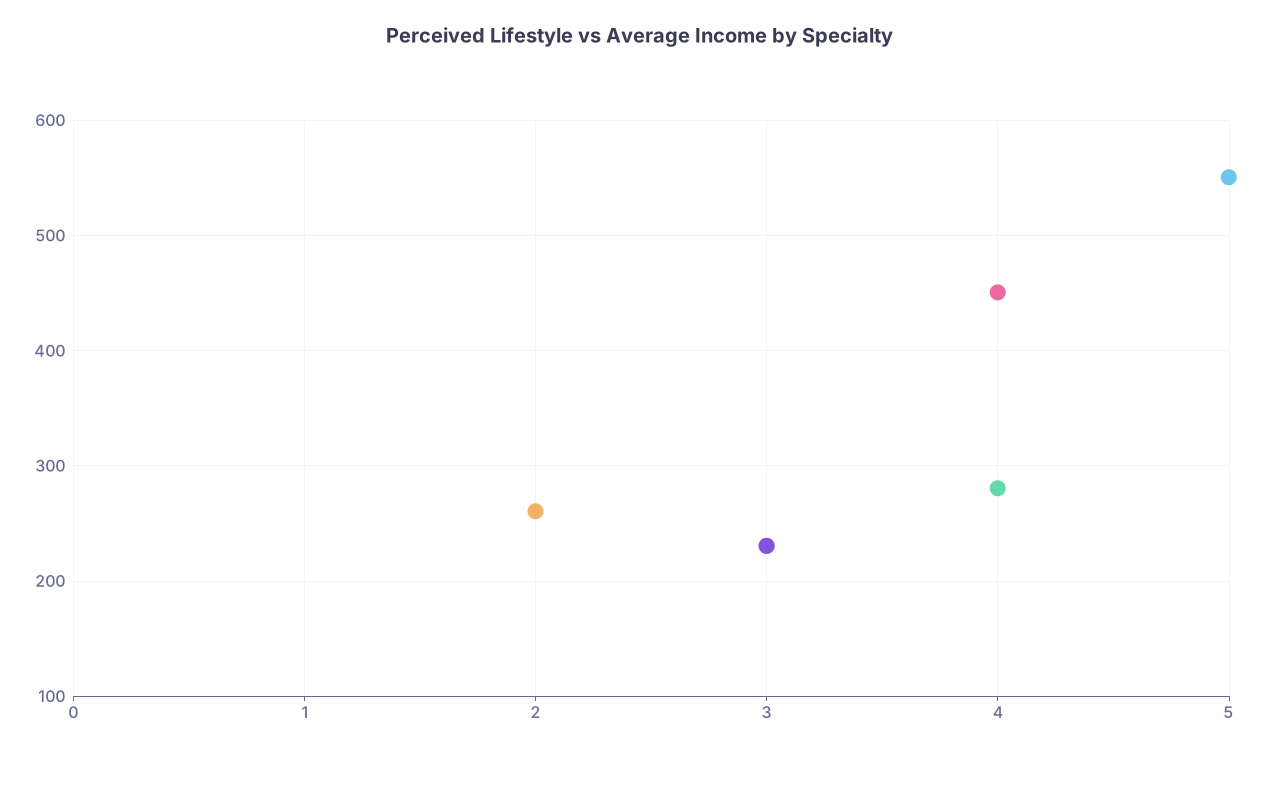
| Category | Value |
|---|---|
| FM | 3,230 |
| Peds | 3,230 |
| Psych | 4,280 |
| IM | 2,260 |
| Radiology | 4,450 |
| Derm | 5,550 |
(Vertical axis: approximate average income in thousands; horizontal: lifestyle score 1–5.)
Psych and FM especially get a lot of applicants who are really optimizing lifestyle, not mission. You’re not fooling anyone when you emphasize “mental health is so important” if your entire demeanor screams “I want 4-day weeks and telehealth.”
If you’re lifestyle-driven, you don’t have to pretend you aren’t. Just don’t make that your whole personality. Pair it with something substantive in the work itself that you clearly enjoy.
How to Not Sound Like a Walking Red Flag
So what should you actually do if you’re ranking a low-paying specialty first?
Three concrete moves that change how PDs read you:
Acknowledge reality once, clearly.
When asked, you can say: “Yes, I know this specialty is not the highest paid. I looked at the numbers. I still chose it because…” and then pivot to your real reasons. One sentence about money, not a monologue.Show your track record matches your choice.
Have at least a year or two of activities, mentors, or projects that align with the specialty. Not something slapped on in the last 3 months.Connect your personality to the work, not the paycheck.
Talk about what in your temperament matches the problems and patients of that field—patience with chronic disease, love of behavior and communication, tolerance for uncertainty, whatever is actually true.
Do that, and PDs stop whispering “backup plan” and start saying “good fit.”

| Step | Description |
|---|---|
| Step 1 | Applicant ranks low paying specialty first |
| Step 2 | Seen as backup or desperation |
| Step 3 | Viewed as intentional and grounded |
| Step 4 | Viewed as naive or idealistic |
| Step 5 | Low perceived burnout risk |
| Step 6 | Moderate burnout risk |
| Step 7 | High risk - may not rank highly |
| Step 8 | Application aligned? |
| Step 9 | Acknowledges money reality? |

FAQ (Exactly 4 Questions)
1. Will ranking a low-paying specialty first hurt me if my scores are very high?
No. High scores do not hurt you in low-paying specialties. If anything, they impress PDs—if your story is consistent. You only run into trouble if your entire application screams “surgical/procedural prestige” and you suddenly claim you’ve always loved primary care without anything in your file to back that up. High metrics plus coherent interest is a huge asset.
2. Should I bring up salary or loans in my personal statement?
Usually no. The personal statement should focus on why the work itself fits you. Money talk belongs, if at all, in the interview—briefly, when directly relevant or if the PD asks whether you’ve thought about finances. One clean, honest acknowledgment is enough. Turning your personal statement into a financial reflection makes you sound anxious and misfocused.
3. If I failed to match a competitive specialty and I’m reapplying to a lower-paying field, how do I not look like a failed applicant?
You own the narrative directly. Something like: “I initially applied to X because of Y, but during that process I realized Z about what I actually value in daily work, which aligns much more with [new specialty]. Since then, I’ve done A, B, and C in this field to test that and confirm the fit.” Then your recent actions—rotations, letters, projects—must clearly support that pivot. PDs will respect an honest, well-documented correction more than a vague, evasive story.
4. Do PDs actually find out my exact rank list order?
No, they do not get your NRMP rank list. But they see what you applied to, what interviews you accepted, what you say on the trail, and sometimes what you accidentally reveal in conversation. They infer patterns. They know if you’re dual-applying. They know if half your interviews are in a different specialty. You should behave as if your overall strategy is semi-transparent and make sure your explanation of “why this field” stands up even under that scrutiny.
Key takeaways:
- Ranking a low-paying specialty first doesn’t make you look weak; it makes you look exposed. PDs will judge whether your choice is intentional or desperate.
- You win respect when your application history, your words, and your understanding of the financial reality all line up behind the same story.
- Don’t pretend money doesn’t matter. Show that you understand the trade-off—and are still choosing the work, with your eyes open.


