

The blunt truth: fellowship directors talk about “low ROI” residents all the time—just never in front of you.
If you think “ROI” only lives in finance, you have not heard what’s said in the conference room after you log off Zoom. In less lucrative specialties—peds, psych, family med, PM&R, geriatrics—the phrase “low return on investment” comes out of directors’ mouths way more than you’d guess. Because the money is tight, the margins are thin, and they’re brutally careful about who they invest in.
Let me walk you into that room for a minute and show you what really gets said—and who is getting quietly blacklisted.
The “ROI” Problem In The Lowest‑Paid Specialties
If you’re in pediatrics, family medicine, psychiatry, PM&R, geriatrics, or even heme-onc at a safety‑net hospital, you already feel it: clinical volume is high, reimbursement is mediocre, and everyone is stretched.
Here’s the part you do not see: fellowship directors in these specialties think about trainees the way administrators think about service lines. Not just “are they good?” but “do they pay off?”
Not financially. Professionally.
They’re asking three quiet questions about every resident who comes across their radar:
- Will this person make my fellowship look better or worse?
- Will this person make my life and my faculty’s lives easier or harder?
- Will this person bring something back to the field—or just take from it?
When the answer to those three questions is “no, harder, and take,” that resident gets labeled—often explicitly—as “low ROI.”
And once that phrase attaches to your name, things start happening that you’ll chalk up to “bad luck.”
How Directors Actually Talk When You’re Not in the Room
Let me give you some verbatim things I’ve heard from fellowship selection meetings in low‑pay specialties:
- “He’s fine clinically, but there’s no upside. Total low ROI.”
- “We poured so much into her on that away month and she never followed up. Why would we do that again?”
- “If I’m going to fight for a funding line, it’s not going to be for someone who just wants a cush lifestyle job.”
- “She’ll be a solid community doc. Great. But that’s not what these few spots are for.”
Notice something? No one is talking about “is this a nice person” or even “are they safe.” The bar for fellowship-level selection is way above “safe.”
The unspoken rule: in low‑paid specialties, fellowship is a luxury. Programs justify it by outcomes—papers, reputation, referrals, subspecialty niche. If you look like someone who will just take a fellowship spot and then quietly disappear into a generic outpatient job with no ongoing contribution, directors privately label you as “low ROI.”
The kicker? Your metrics might be good. Your comments might be positive. You can still be low ROI in their eyes.
What “Low ROI Resident” Actually Means to Them
Let me decode the term as directors use it.
They’re not literally calculating revenue per RVU per FTE from you. They are thinking in four currencies: reputation, output, teaching, and pipeline.
A “low ROI” resident is someone who:
- Consumes a lot of mentorship, time, letters, and political capital
- Produces very little lasting benefit for the program, division, or specialty
Here’s how that gets operationalized.
| Dimension | High ROI Resident | Low ROI Resident |
|---|---|---|
| Reputation | Enhances program name | Neutral or quietly embarrassing |
| Output | Papers, QI, talks, curriculum | Nothing beyond required work |
| Teaching | Actively teaches juniors | Bare minimum, passive on rounds |
| Engagement | Shows up, volunteers, follows up | Uses resources, then disappears |
| Trajectory | Niche, leadership, or academic | Generic job, no clear value‑add |
If you consistently fall in the right column, you’re the person they mean when they say, “We can’t keep training low ROI residents. It’s killing us.”
Specialty by Specialty: How “Low ROI” Plays Out
Pediatrics: The “Nice But Nowhere” Resident
Peds program and fellowship directors are some of the most conflict‑avoidant people in medicine. They will praise you to your face, write you a “solid” letter, and then quietly never rank you.
What they privately call low ROI:
- The resident who is adored by families and nurses but never finishes a project, never writes a case report, never gives a real talk beyond required noon conference.
- The one who constantly says, “I just want to be happy and have balance,” in every career conversation. Translated as: “I will not do extras once this residency box is checked.”
- The resident who rotates on heme-onc or NICU, gets tons of teaching, then ghosts the faculty afterward.
On a peds heme-onc fellowship committee, I heard:
“Look, she’s sweet. Everyone likes her. But that’s where it ends. We’ve got three spots. I can’t justify one on someone who’s going to do zero scholarly work the minute she leaves.”
In a low‑paid field like peds heme-onc, that’s brutal reality. They want people who will crank out protocols, QI projects, multicenter work. If you present as “nice but nowhere,” you’re low ROI.
Family Medicine: The “Service Line Black Hole”
Family medicine fellowships—sports, OB, geri, palliative—are deeply sensitive to ROI because departments are under relentless financial pressure.
Who gets labeled low ROI?
- The resident who wants sports medicine “for the lifestyle” but has never helped with research, team coverage, or curriculum. Just shows up, sees patients, goes home.
- The person who uses fellowship time to do what they’d do in a regular FM job: clinic, some procedures, no broader impact.
- The resident who constantly complains about call and says out loud, “I’m not doing anything academic once I graduate.”
Directors sit in a room and say things like:
“We trained him, we set up cases, we got him coverage with ortho, and he’s now in a private clinic doing nothing with it. Why am I chasing funding for more fellows like that?”
They don’t forget that feeling. Next time a resident with a similar vibe applies, the memory of that “black hole” colors the whole conversation.
Psychiatry: The “Therapist Only” Trajectory
Psych has become more competitive, but the field still pays less than the “big money” specialties. Subspecialty psych fellowships—child, addiction, CL, forensics—are thinking ROI all the time.
Low ROI in their language:
- Residents who treat every rotation like personal therapy. Endless talk about “fit” and “burnout,” very little talk about patient volumes, clinic logistics, or systems problems.
- The resident who wants child psych “because I like kids” but hasn’t touched research, advocacy, or systems work. No letters from subspecialists, no evidence they’ll ever build a program or lead anything.
- Someone who is clinically fine but never reads, never attends journal club seriously, never pushes themselves beyond what’s needed to pass.
I’ve heard a CL psych fellowship director say:
“He’s going to be a solid outpatient prescriber somewhere. Nothing wrong with that. But that’s not CL material. We need people who understand hospitals, systems, and can publish. Otherwise, what are we doing?”
If you present as “I just want a chill outpatient life,” you’re telling them, very clearly: low ROI.
PM&R: The Quiet Calculators
PM&R is classic “low pay, high niche value.” Pain, sports, brain injury, spinal cord—these fellowships survive on reputation and referral patterns, not fat salaries.
Low ROI here looks like:
- Residents who want a sports or pain fellowship purely as a ticket to procedural income later, but never contribute while they’re in training. They show zero interest in team coverage, protocol development, or long‑term departmental projects.
- The person who barely passes EMGs, avoids consult-heavy services, and then applies for neurorehab. Faculty know they’ll be dangerous without supervision and bring nothing back to the division.
- Someone who never teaches medical students or PT/OT students, never volunteers to present at grand rounds, never collaborates on studies.
A PM&R sports director put it bluntly in one meeting:
“If all he wants is to do injections in a strip mall clinic in three years, why am I giving him our name? He’s not building anything for us. Low ROI.”
That’s the mindset.
Behaviors That Quietly Put You on the “Low ROI” List
Here’s the uncomfortable part: residents almost never realize they’re giving off low ROI signals. They think they’re being “chill” or “balanced” or “humble.”
Directors read it differently.
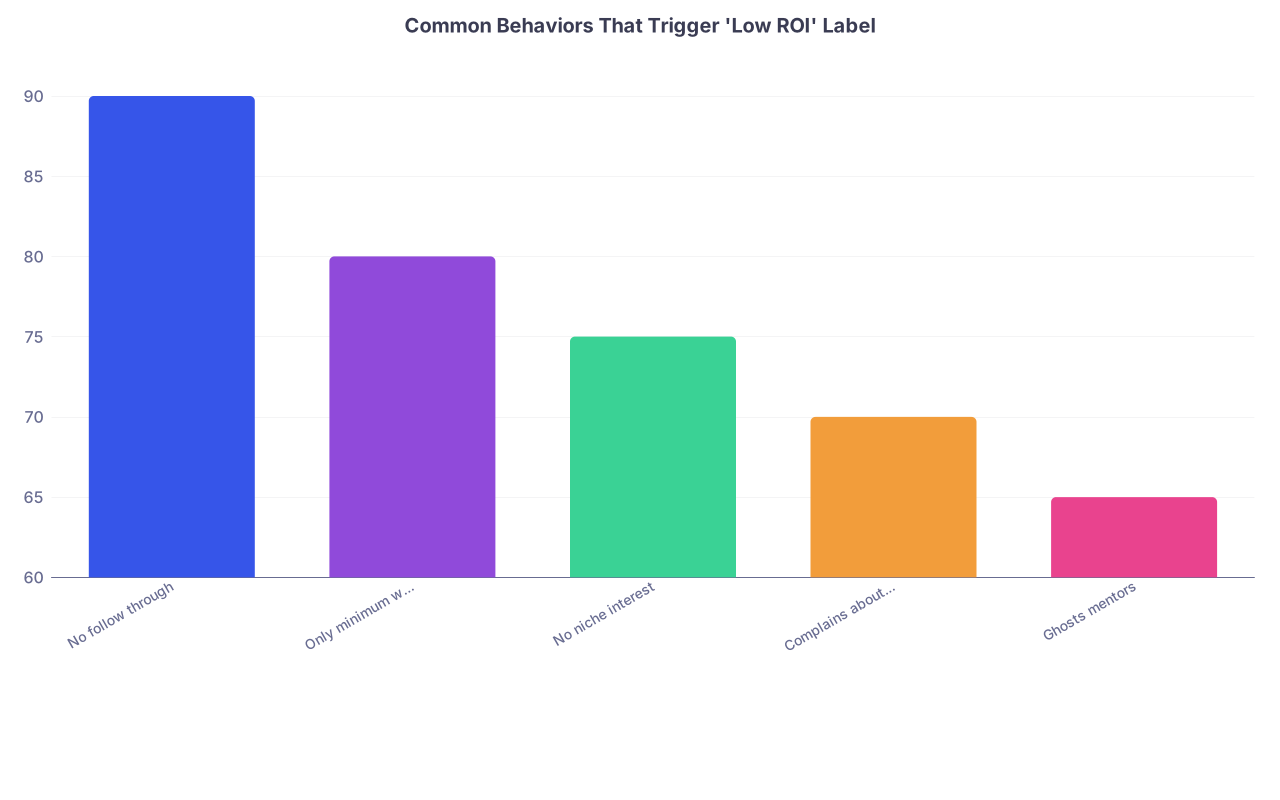
| Category | Value |
|---|---|
| No follow through | 90 |
| Only minimum work | 80 |
| No niche interest | 75 |
| Complains about extras | 70 |
| Ghosts mentors | 65 |
The top red flags I see:
You never follow through
You express interest in a project, rotation, committee. Faculty spend time explaining, sending resources, looping you in. Then you vanish. No explanation, no update, no “I’m overcommitted, can we scale this down?” Just… gone.
Directors remember this in one sentence: “We invested. We got nothing.”
You never produce anything visible
Not everything needs to be in JAMA. But in three years of residency, if you’ve produced:
- Zero posters
- Zero M&M or grand rounds that people remember
- Zero QI with visible change
You look like someone who uses the system but doesn’t feed it at all.
You talk a lot about what you won’t do
“I don’t want to be academic.”
“I’m not trying to be a superstar.”
“I just want to be a regular doctor.”
You think you’re being honest. Directors hear: “I will not provide any long‑term ROI on your investment in me.”
You’re invisible to subspecialty faculty
You’re applying to a fellowship, yet the people in that field barely know you. You did the rotation, yes. But you didn’t stay late a few times voluntarily, didn’t email afterward about a paper you read, didn’t show your face at their conferences.
On paper you’re “fine.” In their gut, you’re low ROI.
You’re passive with juniors and students
You never pull interns aside to teach. You let med students flounder. You’re not mean; you’re just absent. Directors are thinking about: who will train the next wave? If you show no instinct to teach now, they doubt you’ll magically develop it later.
What High‑ROI Residents Do Differently (Without Killing Themselves)
This is where people panic and think, “So I have to be a 30‑paper machine and a chief resident and a saint?”
No. Directors are more pragmatic than that. They’re looking for signs, not sainthood.

| Step | Description |
|---|---|
| Step 1 | Decide Your Niche |
| Step 2 | Find 1-2 Key Mentors |
| Step 3 | Take On One Visible Project |
| Step 4 | Show Up and Follow Through |
| Step 5 | Teach Juniors When Possible |
| Step 6 | Signal Long Term Interest |
Here’s what high‑ROI residents in low‑paid specialties actually do:
They pick a lane
Child psych. Peds heme-onc. Geriatrics in FM. Cancer rehab in PM&R. They do not need a 10‑year plan. They just need a believable story: “Here’s the population I care about. Here’s what I’ve done with that so far.”
They complete one real thing
Not five half‑baked projects. One complete arc: idea → work → product. Poster, local talk, QI project with measurable change. Directors look at that and think, “We invest in them, we’ll get something finished.”
They show face—reliably
Journal club, division conferences, teaching sessions. They’re not always the loudest person in the room, but faculty notice: “He keeps showing up. She keeps leaning in.”
They communicate when they can’t do more
Everyone is overworked. Directors respect residents who say, “I’m at capacity on clinical weeks. If we do this, can we structure it with lighter demands at first?” That’s mature. That’s partnership. Very different from ghosting.
They are explicitly grateful—and specific
“I really appreciated you letting me come to those clinics. I’m planning to build my career in X, and this really helped clarify Y.” That line, said once or twice sincerely, goes a long way to reframe you as ROI positive.
How This Plays Out in Fellowship Selection Meetings
You need to understand what your file looks like when it hits that table.
There’s you, and then there are 60–200 other residents, many from places that produce trainees who already “pay off” quickly—big academic centers, powerhouse programs.
In the meeting, it’s not just, “Are they good enough?” It’s, “Given we only have 3 spots, where do we get the biggest return?”
Here’s the internal logic:
- “We take this peds resident from a community program with no clear academic interest: low upside, low institutional gain.”
- “We take this FM resident who did a small QI project that improved vaccination rates and actually wrote it up—that’s someone who gets things done.”
- “This psych resident is quiet, but they’ve stuck with a mentor for two years and presented twice at regional meetings. That’s a safe bet.”
The resident who gets cut is almost never “bad.” They are simply offering too little in return for a very scarce resource.
Directors will say things like:
- “I like her, but we’d be doing charity here. We need someone who helps the program grow.”
- “He’s not going to embarrass us, but he’s not going to move the needle either. Pass.”
That’s what “low ROI” sounds like when translated into polite committee language.
How To Know If They Already See You As Low ROI
No one will say this to your face, but there are clues.
You rarely get unsolicited opportunities
High‑ROI residents get invited: “Hey, want to be on this abstract?” “Can you help with this curriculum?” “We’re building a clinic—want in?” If no one is doing that with you, they either don’t know you… or they don’t see the payoff.
Your emails to big names go unanswered
If you reach out thoughtfully a few times and keep getting ignored, sometimes it’s just busyness. But sometimes your reputation has quietly preceded you: “nice but no follow‑through.” Faculty are triaging their own ROI too.
Your letters feel generic when you read them
If you get to see drafts of your letters (some mentors share them), low‑ROI letters are soft: “a pleasure to work with,” “reliable,” “solid,” with no specifics, no superlatives, no strong closing line. That’s a sign they don’t want to spend capital selling you.
You’re always “fine” but never “go talk to…”
High‑ROI residents get personally introduced: “You need to meet Dr. X, they’re the person in that field.” If no one has ever walked you over or CC’d you to a key contact, you’re not a priority asset.
How To Pivot If You Think You’re Already on That List
You can recover. I’ve watched residents turn this around in less than a year.
You do it by forcing one undeniable, high‑signal piece of value into existence. Not by begging for “support.”
Concrete playbook:
- Pick a micro‑project that solves a pain point your faculty already complain about. Missed follow‑ups. Discharge summaries. Clinic no‑shows.
- Propose a tiny, realistic fix. Not a 20‑page protocol. A two‑week pilot.
- Ask one faculty member: “If I do this and we get X data, would you be willing to help me present it?”
- Execute the hell out of that pilot. Make sure it works, or at least produces clean data.
- Present it at a local or regional conference. Put your program name on the slide.
Now when your name comes up, someone can say: “They actually got something done.”
That one sentence moves you out of the “low ROI” trash bin.
FAQ – What Residents Keep Asking (And What I Actually Tell Them)
1. “If I don’t want an academic career, am I automatically low ROI?”
No. But you need to show some kind of ongoing contribution—community leadership, building a service line, meaningful QI. Directors are fine with non‑academic careers; they’re tired of people who treat training as a one‑way transfer of value with zero intention to give anything back.
2. “I’m in a small community program with no research. Am I doomed?”
Not if you demonstrate you can create value in your environment. Small QI projects, regional presentations, even local teaching initiatives count. Directors look very favorably on residents who did something meaningful where it was harder, not easier.
3. “My evaluations are all good. Doesn’t that prove I’m high ROI?”
No. Good evals mean you’re safe and competent. The ROI conversation happens on a different level: letters, hallway chats, selection meetings. You can be “excellent clinically” and still be seen as offering little return beyond that baseline.
4. “Isn’t it toxic to think of trainees as ‘investments’?”
Probably. But they do. Especially in lower‑paid specialties where every fellow spot is a fight with hospital leadership. Directors who don’t show impact—on papers, programs, outcomes—risk losing their lines. That pressure flows straight down to how they see you.
5. “What’s the single fastest way to escape the ‘low ROI’ label?”
Finish one visible, concrete thing that someone on the faculty actually cares about. A poster, a QI project, a curriculum, a useful tool. Then make sure the right people know you did it and why. One finished, valuable thing is more powerful than a dozen vague “interests.”
Key points, stripped of the fluff:
Directors in low‑paid specialties are ruthless about ROI because they have to be. “Nice, solid, reliable” is not enough to earn a fellowship spot when funding is thin and outcomes are scrutinized. If you do not want to be quietly filed under “low ROI,” you need to show, in some tangible way, that investing in you gives something back—to the program, the field, or the next generation.


