

Low-paying specialties are not the problem. Your lack of a system is.
If you want to do pediatrics, family med, psych, PM&R, or any “non-sexy, non-ortho” field, the math can absolutely work. I have watched people with $350k+ in loans build solid net worth in low-paying specialties. I have also watched people making $400k+ in procedural fields feel broke and panic at 45.
The difference is not the specialty. It is the plan.
You chose (or are considering) a lower-paying specialty. Good. Those fields need competent people who actually like the work. Now your job is to remove money as the reason you someday regret that choice.
Let us build a concrete, step-by-step strategy that makes a $190k–$260k attending salary work despite six-figure loans and late start.
1. Get Real About the Numbers For “Low-Paying” Specialties
Vague fear is useless. You need precise numbers.
Here is the reality for typical “lowest paid” specialties in the U.S. (attending level, not academics at the lowest-paying institution on earth):
| Specialty | Conservative Range (USD) |
|---|---|
| Pediatrics | $190k–$260k |
| Family Medicine | $210k–$260k |
| Psychiatry | $240k–$320k |
| Internal Med (non-hosp) | $220k–$280k |
| PM&R | $240k–$320k |
None of those are poverty-level incomes. The problem is:
- You start late (30s).
- You often carry $200k–$400k in loans.
- Lifestyle inflation nukes what could have been a strong savings rate.
So we design a system that:
- Controls fixed expenses brutally early on.
- Uses student loan rules strategically.
- Front-loads net worth growth in the first 5–10 attending years.
- Keeps optionality (geography, side gigs, practice type).
2. Residency: Set the Financial Foundation Before You Make “Real” Money
If you screw up residency financially, you will bleed for a decade. Residency is where you lock in systems, not where you “wait until I am an attending.”
Step 2.1 – Decide Your Loan Path In Residency, Not After
You have three real paths:
- Aggressive payoff (private, high income, short path to high pay)
- Long-term lower payment / forgiveness (IDR + SAVE/PSLF)
- Status quo / random decisions / deferments – this is the disaster path
For low-paying specialties, PSLF or IDR forgiveness usually wins unless:
- Your loans are relatively low (<$120k).
- You are 100% sure you are going private with high pay in a low COL area.
Here is a simplified decision snapshot:
| Situation | Likely Best Path |
|---|---|
| $300k+ loans, want academic/VA | PSLF (IDR + 10 yrs) |
| $250k loans, open to FQHC/501(c)3 | PSLF |
| $150k loans, private group, rural | Aggressive payoff |
| $400k loans, not sure yet | Start IDR, preserve PSLF option |
Key actions in residency:
- Get on an IDR plan (SAVE) immediately; never go into forbearance without a strategy.
- Certify employment annually if at a 501(c)(3) hospital for PSLF credit.
- Track every year of qualifying employment from PGY-1.
Step 2.2 – Hard Cap Your Lifestyle as a Resident
You do not “deserve” a luxury apartment on a resident salary. You deserve options later.
Concrete resident rules:
- Housing: max 25–30% of net pay. House hack if you can (roommate, spouse income).
- Car: If you are financing more than $15k as a resident, you are lighting money on fire.
- Subscriptions: Cut aggressively. One streaming service, not six.
- Credit cards: Never carry a balance. If you already do, set a 24-month payoff plan.
Your target as a resident is not building massive wealth. It is:
- Avoiding high-interest debt.
- Building 1–2 months of emergency cushion.
- Learning to live comfortably below what a future attending income will provide.
3. The First 5 Years as an Attending: This Is Where You Win or Lose
You match into pediatrics, FM, psych, whatever. You sign that first $220k–$250k contract. Feel good for one night. Then sit down and run the numbers.
Step 3.1 – Start With After-Tax, After-Loan Reality
A typical new attending in a low-paying specialty:
- Salary: $230,000
- Federal + state tax (ballpark): ~30–33%
- Net after tax: ~ $155,000
- Net monthly: ~ $12,900
Then layer in loans under IDR (SAVE):
- IDR payment: usually 5–10% of discretionary income
For many, it is $700–$1,500/month initially.
You are not living on $230k. You are living on more like $10–11k a month after taxes and loans. Which is still plenty if you are not trying to live like a cardiologist.
Step 3.2 – Build a “Reverse Budget” Based on Goals, Not Lifestyle
Do not start with “what apartment can I get?” Start with “what must my future self have?”
Simple framework:
Savings & investing (non-negotiable):
- 15–20% of gross income for retirement (solo or combined with employer match).
- Additional 5–10% of gross toward other goals (house, kids, etc.).
Loan strategy:
- If PSLF: pay required IDR minimum, invest the difference elsewhere.
- If no PSLF: target a clear payoff horizon (e.g., 10 years) and set a fixed monthly overpayment.
Everything else is what is left. That is your true lifestyle budget.
Example on $230k salary:
- 20% to retirement = $46,000/year (~$3,830/month)
- IDR loan payment = ~$1,000/month
- Left for everything else ≈ $8,000/month
That $8k must cover:
- Housing
- Food
- Transportation
- Insurance
- Travel / fun
- Kids / childcare if relevant
If you choose a $4,500/month mortgage in a coastal city, you have just torpedoed your flexibility. That is how “low-paying specialty” becomes “I feel poor.”
4. Housing, Geography, and Practice Type: Your Biggest Levers
Your specialty is not the main financial determinant. Where you live and how you practice is.
Step 4.1 – Geographic Arbitrage For “Low” Income
Same family medicine doc:
- In SF Bay Area: $240k, rent $3,800/month, daycare $2,500/month.
- In mid-size Midwest city: $260k, mortgage $2,000/month, daycare $1,200/month.
The second one will be financially fine. The first might constantly feel squeezed.
If you insist on:
- High cost of living (HCOL) coastal city
- Private school
- Large house right away
Then yes, your “low-paying” specialty will feel low. That is not a math problem. It is a choice problem.
Step 4.2 – Practice Type: Not All Family Med Jobs Pay $210k
You have meaningful levers even in low-paying specialties:
- Academic center in HCOL city: lower salary, better PSLF.
- Community hospital in mid-COL city: higher salary, often PSLF as well.
- Rural community clinic or FQHC: sign-on bonuses, loan repayment, PSLF.
- Telehealth psychiatry: often high hourly rates + location flexibility.
- Private groups: potential for partnership and profit sharing.
Example I have seen repeatedly:
- Academic pediatrics, HCOL, PSLF track: $185k–$210k but full PSLF after 10 years.
- Community peds in moderate COL city: $230k–$260k with RVU bonus, slower loan payoff but more cash now.
There is no universal “right” answer. But you need to intentionally pick your trade-offs, not stumble into them.
5. Make Student Loans Obey You, Not the Other Way Around
If you are in a lower-paying specialty, student loans either become:
- A predictable monthly line item, integrated into your plan.
or - A fog of dread that quietly controls every decision you make.
Choose the first.
Step 5.1 – PSLF Playbook for Low-Paying Specialties
If you:
- Work for a 501(c)(3), government hospital, or FQHC.
- Have $200k+ federal loans.
Then PSLF is often the mathematically dominant play.
Your protocol:
- Confirm your employer qualifies (HR + PSLF employer form).
- Get on SAVE or other IDR plan as early as residency.
- Recertify income and employment annually.
- Make 120 qualifying payments (10 years), not necessarily consecutive at the same job.
- Resist the temptation to refinance to private loans unless PSLF is absolutely off the table.
Do not mentally “plan” for PSLF and then fail to submit forms or track payments. That is how people end up with 7–8 fake PSLF years because nothing was ever certified.
Step 5.2 – When PSLF Is Not in Play
If you are heading private or working at non-qualifying employers:
- Stick with federal loans + IDR if your debt is huge relative to income.
- If your projected debt-to-income ratio is favorable (e.g., $150k debt, $260k income), refinancing to a lower rate and paying off in 5–10 years makes sense.
The rule of thumb I use:
- Debt > 1.5x your expected income: lean toward PSLF or long-term IDR forgiveness.
- Debt < 1x your expected income: aggressive payoff can work well, especially outside PSLF environments.
6. Build a Simple, Aggressive Investment Plan (Without Turning Into a Finance Nerd)
You do not need to become a part-time financial advisor. You need a boring, consistent system.
Step 6.1 – Your Core Investment Stack
Priority order for most low-paying specialists:
- Employer retirement plan (401k/403b) up to match – free money.
- Max Roth IRA or backdoor Roth IRA (if income too high for direct).
- Go back and max 401k/403b to the annual limit.
- Taxable brokerage account for extra savings.
Target:
- 20% of gross income into retirement-focused accounts.
- Extra 5–10% toward “medium-term” goals (house down payment, etc.) in a taxable account.
Step 6.2 – Keep the Portfolio Dirt Simple
You can do this with 1–3 funds:
- A total U.S. stock market index fund.
- A total international stock index fund.
- Optional: a bond fund if you want lower volatility.
Or pick a target-date index fund with a reasonable year and let it run. Do not jump in and out of random hot funds because “my co-resident said this one is better.”
Your skill is medicine, not day trading. Treat investing like hygiene, not a hobby.
7. Side Gigs and Niche Skills: Optional, Not Rescue Missions
Side income in low-paying specialties is leverage, not a requirement. But it helps.
Realistic ways physicians in low-paying fields add $20k–$60k/year:
- Telehealth (esp. psych, FM, IM): night/weekend sessions.
- Urgent care shifts: high hourly, flexible.
- Locums in rural areas: short stints, strong pay.
- Consulting: guideline panels, industry advisory boards, expert witness work.
- Teaching: adjunct clinical roles, though pay is often modest.
The key is not to burn yourself out for pennies.
Test every side opportunity against:
- Hourly effective rate (after taxes and prep time).
- Burnout risk.
- Impact on your primary job performance.
If you are adding 15–20 hours a week on top of full-time clinical work, you are borrowing from your future health. That will cost more than it earns.
8. Lifestyle Design: Live Like a Well-Paid Professional, Not a YouTube Influencer
The silent killer for low-paying specialties is not salary. It is expectation creep.
You are not competing with your procedure-heavy classmates. You are designing a life that fits your numbers.
Core guardrails that I have seen work repeatedly:
- Housing: Total housing cost (mortgage + taxes + insurance) ≤ 2–2.5x your gross annual income. On $230k, that means house price in the $400–$575k range, not $900k.
- Car: Pay cash or keep payment + insurance < 10% of take-home pay.
- Vacations: 1 larger trip + 1–2 smaller trips per year is reasonable. If you are flying business class everywhere on a $230k salary with six-figure loans, you are borrowing from your future.
- Kids: Private school for three kids in an HCOL city will financially crush many low-paying specialists. If you are going that route, you must compensate somewhere else (cheaper housing, more side income, etc.).
The target is comfort + margin, not constant flexing.
9. Timeline: What “Winning” Actually Looks Like
Let me lay out a realistic trajectory for a pediatrician or family doc with $300k in federal loans, pursuing PSLF, earning around $230k–$260k over time, living in a moderate COL area.
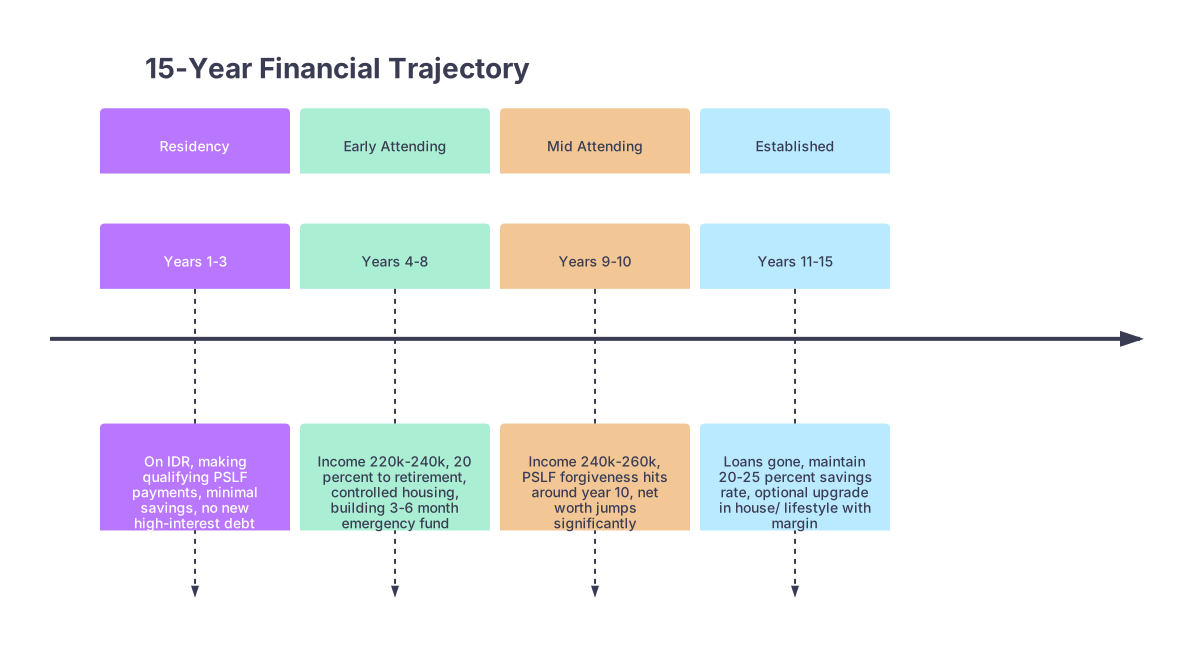
| Period | Event |
|---|---|
| Residency - Years 1-3 | On IDR, making qualifying PSLF payments, minimal savings, no new high-interest debt |
| Early Attending - Years 4-8 | Income 220k-240k, 20 percent to retirement, controlled housing, building 3-6 month emergency fund |
| Mid Attending - Years 9-10 | Income 240k-260k, PSLF forgiveness hits around year 10, net worth jumps significantly |
| Established - Years 11-15 | Loans gone, maintain 20-25 percent savings rate, optional upgrade in house/ lifestyle with margin |
By year 10:
- Loans: wiped out via PSLF.
- Retirement accounts: several hundred thousand dollars.
- Net worth: strongly positive, trending upward fast.
All on a “low-paying” specialty income, without a tech startup or crypto miracle.
That is the game. Boring, consistent, deliberate.
10. A Concrete Checklist: From “I Am Scared” to “I Have a Plan”
You want a step-by-step path? Here is your protocol.
Step A – Clarify Your Situation (This Week)
- List all loans:
- Federal vs private
- Balances
- Interest rates
- Estimate your realistic attending income range for your specialty and region.
- Confirm whether your current or future employers are PSLF-eligible.
Step B – Pick a Loan Strategy (Next 2–4 Weeks)
- If likely PSLF:
- Get on SAVE/IDR now.
- Submit PSLF employer certification.
- Set calendar reminder to recertify every year.
- If not PSLF:
- Run numbers for refinancing vs keeping federal.
- Choose payoff horizon (e.g., 7 or 10 years).
- Set automatic monthly payment to hit that horizon.
Step C – Set Guardrails for Lifestyle (Before Signing a Lease or Mortgage)
- Decide:
- Max housing payment (rent or mortgage).
- Max car payment (if any).
- Minimum saving rate (percent of gross income).
- Write it down. Share it with your partner if you have one.
Step D – Automate the Important Stuff (First 3 Months as Attending)
- Set automatic transfers:
- Retirement contributions from paycheck.
- Automatic investment into Roth IRA / taxable brokerage.
- Automatic loan payment.
- Build an emergency fund:
- Start with 1 month of expenses.
- Grow to 3–6 months over 1–2 years.
Step E – Reassess Annually, Not Every Week
Once a year:
- Review:
- Net worth (assets – debts).
- Savings rate.
- Loan payoff progress or PSLF timeline.
- Adjust:
- Contributions upward with raises.
- Lifestyle very cautiously (always trailing income growth).
If you are checking your portfolio daily and changing funds every election cycle, you are doing it wrong.
11. Common Mistakes That Break Low-Paying Specialties
I have seen the same errors repeatedly:
Moving to a glamorous HCOL city with a mediocre salary and no PSLF
Result: permanently tight cash flow.Buying a “doctor house” in year one
Result: house rich, cash poor, zero margin.Ignoring PSLF rules and assuming you will “figure it out later”
Result: lost qualifying years, extra decade of payments.Financing two luxury cars early
Result: $1,200+/month that could have gone to investments or loans.Random side gigs that pay poorly
Result: burnout without significant financial gain.Never learning basic personal finance
Result: dependence on whatever salesperson or colleague is loudest.
Avoid these and you are already ahead of 70% of your peers.
12. Putting It All Together
Being in one of the “lowest paid specialties” is not a financial death sentence. It is a constraint. And constraints force discipline.
Your specialty choice can absolutely coexist with:
- Six-figure net worth in your 30s.
- Seven-figure portfolio in your 40s–50s.
- Reasonable house, decent car, vacations, kids.
If you treat money as a system to design, not an emotional mess to avoid.
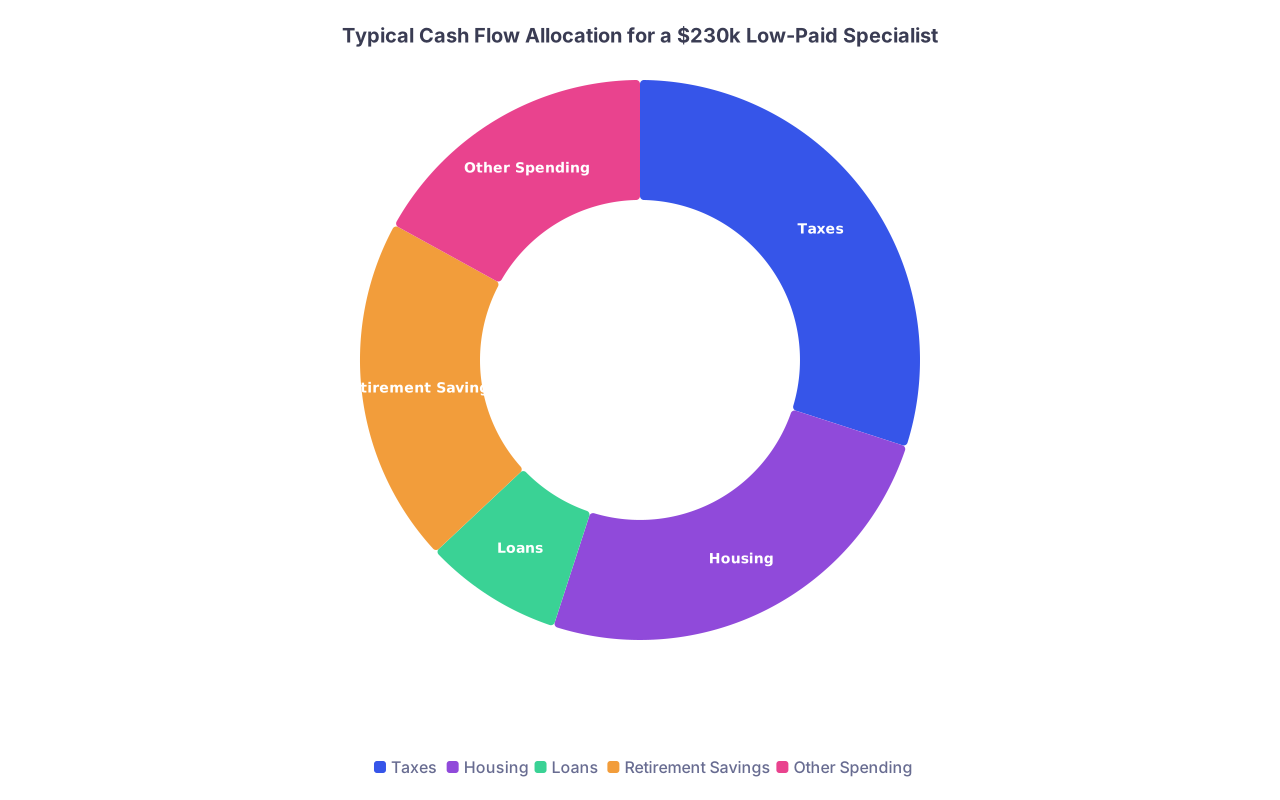
| Category | Value |
|---|---|
| Taxes | 30 |
| Housing | 25 |
| Loans | 8 |
| Retirement Savings | 20 |
| Other Spending | 17 |


Key Takeaways
- Your specialty is not your financial destiny. Housing choices, geography, loan strategy, and savings rate matter far more than “FM vs ortho.”
- The first 5–10 attending years are critical. Cap lifestyle, automate savings, and deliberately manage loans (PSLF or aggressive payoff).
- If you set clear guardrails and stick to a boring, consistent plan, a “low-paying” specialty can still fund a comfortable, secure, and even generous life.


