

The hierarchy of specialties is not about money. It is about power. And academic centers quietly extract a lot of power from the lowest paid specialties while giving them a fraction of the credit.
You already know which fields get paid less: pediatrics, psychiatry (outside super-subspecialty private practice), family medicine, general internal medicine, geriatrics, hospitalist medicine, PM&R, sometimes neurology. What you probably do not know is how academic hospitals actually think about them behind closed doors. In dean’s offices. In RVU committees. In fellowship selection meetings.
Let me pull back that curtain.
The cold math: who prints money and who prints prestige
Here’s the first uncomfortable truth: academic centers rarely talk about specialties in terms of “low pay” or “high pay.” They talk in three currencies:
- Clinical margin (who brings in cash)
- Strategic value (who feeds referrals and protects key service lines)
- Academic capital (who wins grants, publishes, boosts rankings)
Low-paid specialties sit in a weird spot. Many don’t directly bring in huge margins. But they enable everything.
The CFO does not care whether outpatient pediatrics pays less than interventional cardiology. The CFO cares that:
- Pediatrics fills the beds with complex kids who then need surgery, imaging, subspecialty consults
- Family medicine and general internal medicine create the pipeline for procedures, admissions, and “downstream revenue”
- Psychiatry keeps the ED functional and reduces length of stay for medically complex patients who would otherwise sit for days
Nobody will say this on a recruitment brochure, but inside the conference room, the language is blunt: “Downstream capture,” “access,” “ED offload,” “primary care footprint,” “admission feeders.”
Let me show you the way they quietly quantify this.
| Category | High-Paid Procedural (e.g., Ortho) | Low-Paid Cognitive (e.g., IM, Peds) |
|---|---|---|
| Direct margin per case | High | Low to moderate |
| Downstream referrals | Moderate | Very high |
| Bed utilization | Moderate | High |
| Research potential | Moderate | High in population/health services |
The mistake students make is thinking: “If a specialty is low paid, the institution must not value it.” Wrong. The institution values it differently, and not always in ways that benefit you as a resident or faculty.
Primary care and general IM: the backbone they underpay and overuse
Let’s start with general internal medicine and family medicine. The lowest glamour, the highest dependency.
Here’s what really happens at big academic centers:
They pitch primary care as “mission-critical,” “community-oriented,” “cornerstone of value-based care.” Then, in the same week, an internal spreadsheet goes around showing that general IM clinic visits generate poor margin compared with an afternoon of cath lab cases or joint replacements.
So why do they keep pumping money into primary care and hospitalist services?
Because without them, everything else collapses.
- The surgical services need hospitalists to clear pre-op, manage post-op, and take transfers
- Subspecialty clinics need someone to handle the “simple” stuff and refill meds
- The ED needs someone who will actually admit and manage the flood of undifferentiated patients
- Value-based contracts (ACO, risk arrangements) require strong primary care panels to keep readmissions and ED visits down
Inside leadership meetings, I’ve seen this exact sentiment:
“Margin is in the procedures; control is in primary care.”
Translation: they know primary care doesn’t cash-print per visit, but the people who control the patients control the system. So the hospital invests in primary care access, then recoups the money when those patients flow to their ORs, cath labs, and imaging suites.
The ugly piece? The institution benefits financially from your labor as a low-paid, cognitive specialist more than your personal paycheck ever reflects. Residents and junior faculty in primary care are working inside a system that is quietly making a lot of non-clinic revenue off their panels and admissions.
You feel underpaid. The hospital does not see you as low value. It sees you as a slightly underpriced asset with massive indirect returns.
Pediatrics: prestige, pipeline, and cheap complexity
Pediatrics is a perfect example of misaligned value. Pediatricians are disastrously underpaid relative to their complexity. But academic centers love having a big-name children’s hospital on the website. They will build the tower, paint the murals, sponsor the NICU “miracle” stories on local news.
What they say: “Pediatrics is central to our academic mission and community service.”
What they mean:
- Pediatrics brings in donations. Huge ones. People give to sick kids.
- Pediatrics attracts complex cases that drive ICU days, surgeries, and advanced imaging
- Pediatrics boosts reputation; families will travel across states for a branded children’s hospital
On a margin-per-RVU basis, pediatrics is often painful. Medicaid-heavy. Complex care with low reimbursement.
Yet, behind closed doors, it’s strategically golden because:
- It creates a pipeline of patients with chronic conditions transitioning to adult services
- It drives market capture: once the family is locked into the system for their kid, they usually stay for themselves
- It anchors research: NICU outcomes, congenital heart disease, oncology trials
So how do they “value” pediatric residents and fellows?
This is where the disconnect hits.
Residents hear: “You’re the heart of the institution.”
But when budget season comes, pediatric services get pressure to increase patient throughput, add clinic sessions, and accept more complex transfers with the same (or fewer) FTEs. You’re working harder in a department that the hospital will not let fail—because the brand hit would be enormous—but they won’t pay like ortho, either.
Pediatrics is both priceless and cheap at the same time. The center will fight to keep the service line robust; it just won’t translate into your paycheck.
Psychiatry: dumping ground or strategic lever, depending on who is in charge
Psychiatry lives on a knife edge in academic centers. I’ve watched it exist in two totally different realities.
Scenario A: Weak psychiatry leadership
Psych becomes the institutional dumping ground.
- Boarding psych patients in the ED for days
- Endless consults for “capacity” and “SI” on every medical floor
- Minimal investment in outpatient services
- Constant pressure to “take more” from ED, jails, surrounding hospitals
Behind those doors, the message is: “We just need psych to keep the ED moving and reduce length of stay.” Value is judged almost entirely by how fast they can absorb acute cases and offload pressure points.
Scenario B: Strong, politically savvy psychiatry chair
Now psychiatry is suddenly “strategic.”
- Integrated behavioral health in primary care
- Collaborative care models that tick all the boxes for value-based contracts
- Grants for addiction, depression, SMI tied to public health and population outcomes
- Research dollars and national reputation from high-profile trials and policy work
The chair walks into leadership meetings with data: decreased ED recidivism, improved ACO metrics, lower readmission rates. And magically, psych is no longer just the field that “doesn’t bring RVUs.” It’s the one that lets the institution win big contracts and justify shiny “innovation” centers.
Residency-level impact? In a weak department, you feel like service staff. In a strong one, you’re at the nexus of collaboration with IM, ED, neurology, peds, addiction medicine—and leadership suddenly courts you for system-wide roles.
Either way, the base salary is still lower than procedural fields. But inside the room, when you’re not there, psychiatry can be framed as either a liability or an institutional lever. The difference is leadership, not intrinsic field value.
Hospitalists and low-paid inpatient services: the workhorses of throughput
Hospital medicine is a case study in how academic centers think.
Hospitalists rarely make surgeon money, but they’re treated as absolutely essential to the financial machine because of one key word: throughput.
Leadership doesn’t ask, “How much does a hospitalist bill per day?” They ask:
- How many patients can we safely manage per team?
- What’s our average length of stay by DRG?
- How many ICU transfers, how fast are discharges, how quickly do we turn over beds?
If ORs are sitting on cases because there are no beds upstairs, the surgical chair calls the CMO. And the CMO calls… the hospitalist chief.
So while you’re relatively low on the income scale, your specialty is sitting in the middle of the institution’s main financial artery: bed turnover.
I’ve literally sat in meetings where:
- Radiology and surgery argued for more block time
- Finance pointed out that OR days were being wasted because medicine could not discharge fast enough
- The “solution” was to increase hospitalist census targets and pressure residents to pre-round and discharge earlier
Do they value you? Yes—operationally. You are the system’s lubricant. Without you, the proceduralists cannot fully monetize their skills.
Do they reward you proportionally? Not really. The value accrues to the service lines that bill the big procedures and the execs who demonstrate year-over-year efficiency gains.
PM&R, geriatrics, neurology: the quiet “system glue” specialties
Physical medicine and rehabilitation (PM&R), geriatrics, and often neurology live in the weird middle. Not glamorous, not paid like surgery, but critical in ways students don’t see on a quick rotation.
PM&R: Academic centers view PM&R as the field that solves expensive problems—long stays, readmissions, and functional decline. Rehab units absorb complex trauma, stroke, and surgical patients who would otherwise clog acute beds.
Geriatrics: Geriatricians make the system look good in every quality metric that matters—falls, delirium, polypharmacy, readmissions, advanced care planning. In leadership meetings, their impact is discussed in terms of “avoided costs” more than direct revenue.
Neurology: General neurology is not paid like neuro-interventional, but academic centers need it to feed stroke programs, epilepsy surgery, MS infusions, movement disorder programs. General neurology gets treated as the front door to high-yield subspecialty lines.
So inside planning sessions, it’s things like:
- “We need more geri for our ACO structure”
- “We can’t grow our stroke center without general neurology capacity”
- “We’re losing rehab volume to the community; that’s leakage”
You, as a resident, will not hear this language on rounds. But your field is being talked about as infrastructure. Not showpiece. Not cash cow. Infrastructure.
That matters for how much they will fight to recruit and retain you, versus how much they will actually pay.
The academic bargain: low-paid specialties as RVU shields and grant engines
Now let’s talk about the academic side. Because academic centers don’t just think in RVUs. They think in grants, publications, and “protected time.”
Here’s a secret most students don’t understand until it’s too late:
Low-paid specialties subsidize academic careers in a way high-paid procedural fields often cannot.
A cardiothoracic surgeon doing 8-hour cases doesn’t easily get 60% protected research time without someone getting very angry about lost margin. But a general internist can build a career on:
- Implementation science
- Population health
- Medical education
- Healthcare delivery research
- Quality improvement
Same for pediatrics, geriatrics, psychiatry, PM&R. These fields are fertile ground for NIH, PCORI, CDC, and foundation funding that academic centers love. The salary they have to cover from departmental clinical work is lower, so it’s “cheaper” to create a 0.5 or 0.7 FTE research faculty.
Look at where many vice deans for education, quality, and population health come from. It’s not a coincidence that so many trained in IM, peds, psych, or family medicine.
Inside the promotion committee, these specialties are often framed as “academic engines”:
- Lots of clinical volume for trials
- Populations that line up with public health priorities
- Lower opportunity cost to pull people out of clinic
The flip side: residents and junior attendings in these fields often feel crushed by service needs. Because the department still has to run mountains of clinic and ward coverage while supporting a chunk of faculty who have large protected time.
So the residents feel: “We’re short-staffed and burned out.”
Leadership feels: “This department is a bargain—we get clinical coverage, quality metrics, and lots of grants for relatively low salary outlay.”
Both are true.
How this all affects you when you choose a low-paid specialty
Enough theory. Let’s translate this into your actual life.
Here’s what happens, on the ground, if you go into one of these lower-paid but institutionally critical fields at an academic center.
First: you will not be seen as “less than” by the people who actually run the system. Chairs, CMOs, chief quality officers—they know exactly how dependent the hospital is on IM, peds, psych, FM, geri, PM&R, neurology.
Second: you will feel underpaid, especially if your close friends match into ortho, ENT, or derm. Because on an absolute level, you are underpaid relative to training length and responsibility.
Third: if you’re smart and pay attention, your field gives you leverage that isn’t obvious on a salary sheet:
- You have outsized opportunity to step into system-level roles: quality, safety, education, leadership
- You can more credibly negotiate for protected time, academic tracks, and non-RVU-based roles
- Your skill set is portable and in-demand in nearly every health system, especially in the value-based era
Where you can get burned is this: thinking mission language equals personal advocacy.
“Primary care is our foundation.”
“We are committed to behavioral health.”
“Children are our top priority.”
I’ve heard all of these in town halls. The question you should always ask is: “How is that reflected in FTE support, call schedules, and protected time?” If the answer is vague—run. The rhetoric is disguising the fact that your field is being overused and under-resourced.
To make this practical, here’s how academic centers quietly treat a few specialties you might be considering:
| Specialty | How Leadership Really Sees It | Typical Resident Experience |
|---|---|---|
| General IM | Operational core and admission engine | High volume, high service, broad scope |
| Family Medicine | Market capture and value-based care anchor | Undervalued, often under-resourced |
| Pediatrics | Brand, donations, complex care hub | Intense workload, high complexity |
| Psychiatry | ED pressure valve or strategic lever | Variable: from dumping ground to star |
| Geriatrics | Quality metric and cost-control powerhouse | Niche, respected but underpaid |
| PM&R | Post-acute and functional recovery enabler | Quietly essential, under the radar |
How to use this insider knowledge to your advantage
You can’t change the macroeconomics. But you can absolutely stack the deck for yourself if you go into one of these fields.
A few blunt strategies:
Anchor yourself where your field is treated as strategic, not decorative.
Ask brutally specific questions on interview day:
- “How many FTEs are fully clinical vs. with protected time?”
- “Who in your department holds system-level roles—CMO, quality, population health, GME leadership?”
- “What happened the last time you were short-staffed—did you hire locums, reduce clinics, or just increase everyone’s load?”
Watch how they answer. Vague answers mean trouble.
Leverage your hidden power.
If you’re in IM, peds, psych, geri, FM, PM&R, neurology—you sit on top of data and patient flow everyone else needs. Use that.
- Get involved early in QI projects that touch multiple departments
- Volunteer for system committees strategically—readmissions, sepsis, length of stay, behavioral health integration
- Build relationships with finance and operations people, not just clinicians. They know exactly how valuable your service line is.
And do not be shy about asking for what actually reflects that value:
- Protected time that’s real, not theoretical
- Reasonable panel sizes or capped census with documented support
- Academic titles and leadership roles that align with the invisible work you’re already doing
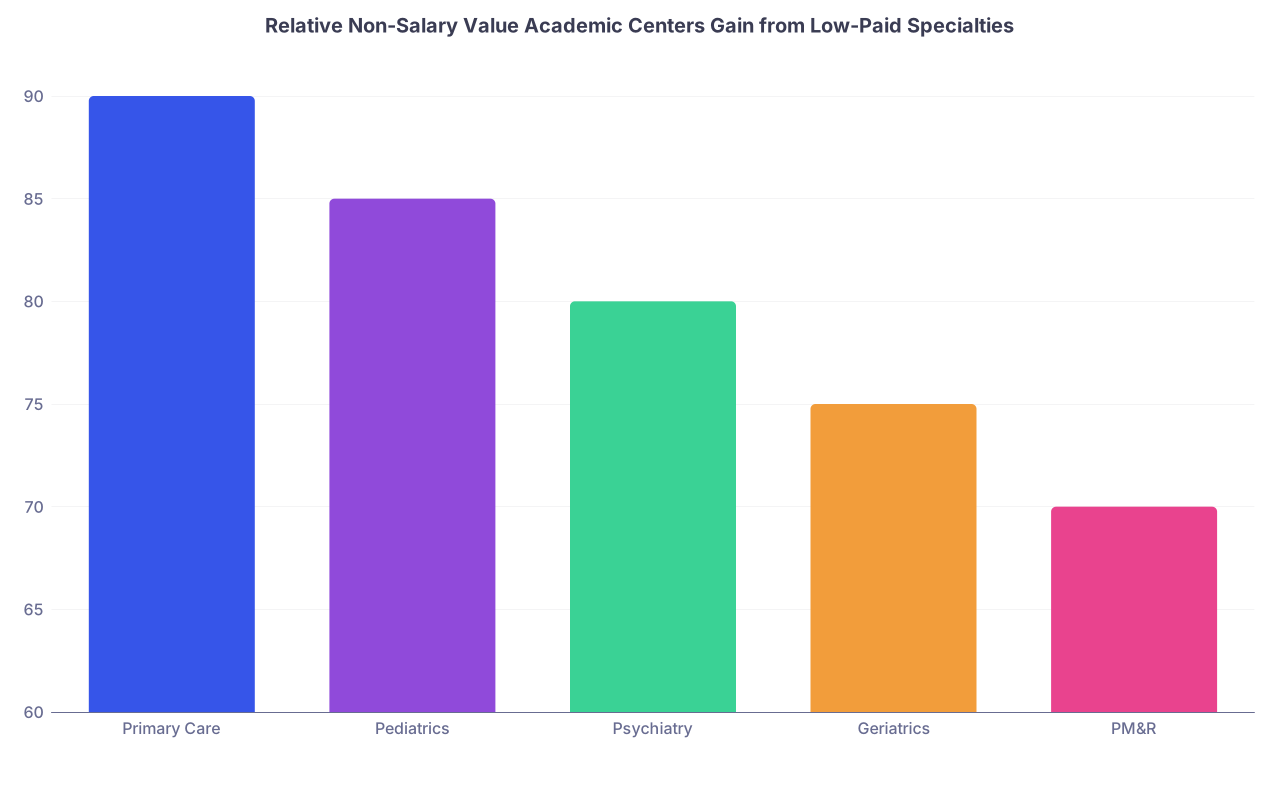
| Category | Value |
|---|---|
| Primary Care | 90 |
| Pediatrics | 85 |
| Psychiatry | 80 |
| Geriatrics | 75 |
| PM&R | 70 |
Final reality check
Here’s what most students get wrong: they look at individual salary reports and assume that’s how institutions think. Academic centers do not operate that way.
They see low-paid specialties as:
- Structurally indispensable to the clinical and financial ecosystem
- Cheap engines for research, quality metrics, and value-based contracts
- Flexible sources of leadership, education, and system-level talent
You are not “less valuable” to them. You are often more important than the superstar proceduralist they brag about on the website. They just won’t hand you a corresponding paycheck.
So if you choose one of these fields, do it with your eyes open and your spine straight:
- Your specialty is probably propping up the hospital more than you realize.
- The gap between what the institution gains from you and what it pays you is real and persistent.
- Your leverage is not in RVUs—it’s in how central your work is to the system’s survival and reputation. Use that, or you’ll spend a career doing mission work for CEO bonuses you’ll never see.


