

The best-paid specialties don’t run the hospital. The “low-paying” ones do. And if you don’t understand why, you’re going to misplay your entire career strategy.
You’re being sold a narrow metric: RVUs, procedural pay, top-line salary. But inside every large system—academic or private—the people in real power are often hospitalists, general internists, pediatricians, psychiatrists, pathologists, family physicians, and occasionally PM&R or geriatrics. The cardiothoracic surgeon makes more money. The hospitalist writes their bylaws and decides what technology they’re required to use.
Let me walk you through why that happens, how leadership pipelines actually work, and what that means if you’re in (or considering) one of the “lowest paid specialties.”
The Money Lie: Revenue vs. Control
Here’s the first uncomfortable truth: the folks generating the most billable revenue are rarely the ones the C-suite trusts to run the place.
They’re seen as “producers,” not “architects.”
Surgeons, interventionalists, procedural subspecialists—administration sees them as indispensable income streams, but also as volatile, hard to manage, and usually too busy in the OR or cath lab to sit through a 3-hour quality committee meeting on a Wednesday afternoon.
The internal medicine hospitalist who finishes rounding by 3 pm? The pediatrician who already has an MBA and actually shows up to every committee? The psychiatrist who understands length-of-stay bottlenecks and readmissions? That’s who quietly gets pulled into leadership.
At one large academic center I know, the Chief Medical Officer, the Chief Quality Officer, the Chief of Staff, and the Residency Program Director Council chair were all from IM, Peds, or Psych. The top-billing surgeons there complained constantly about “admin” decisions that were literally being made by the “low paid” colleagues they dismissed as “just medicine.”
They weren’t wrong about the income differential. But they had no idea how badly they were outmaneuvered in the power game.
Why Leadership Pipelines Favor Lower-Paid Fields
There are five structural reasons some lower-paid specialties dominate leadership. None of them show up on those “top-earning specialties” infographics people pass around.
1. They Own the Inpatient Flow
Hospitalists, general internists, and sometimes family med in community settings control the bed board. They decide when people are admitted, transferred, downgraded, discharged. That’s the operational bloodstream of the hospital.
If you control:
- Length of stay
- Admission criteria
- Discharge timing and coordination
…you control cost, throughput, and a big piece of the quality metrics.
Hospital administrators obsess over three things: margins, metrics, and malpractice risk. Flow-sensitive metrics—30-day readmissions, LOS, ED boarding, sepsis bundle compliance—live or die with medicine and pediatrics.
So where do they recruit their first clinical leaders? Right from the services that drive those numbers.
A big system CMO once told me this flat out:
“We don’t promote surgeons to system leadership unless they’ve already proven they can think beyond their own OR block. Medicine and hospitalists prove that from day one.”
Translation: hospitalists and generalists are pre-screened by their job structures to think system-wide, not case-by-case. That’s leadership material.
2. Their Work Actually Fits Leadership Schedules
You know who never makes it to the 7 am “Strategic Quality Council” meeting? The orthopod who just spent all night fixing open fractures.
Leadership is meetings, email, conflict resolution, and committee work. Unsexy, slow, and relentlessly scheduled.
The usual weekly time reality:
- Hospitalist: 7-on/7-off or block scheduling, increasingly shift-based, predictable
- Outpatient IM/FM/Peds/Psych: clinic templates that can be carved out for half-days of admin
- Pathology: case-dependent but often more schedulable than OR-based work
- EM: shift work, yes—but usually nights/weekends/holidays, less overlap with weekday admin structures
- Surgical fields: OR days, clinic days, add-ons, cases running late, post-op emergencies
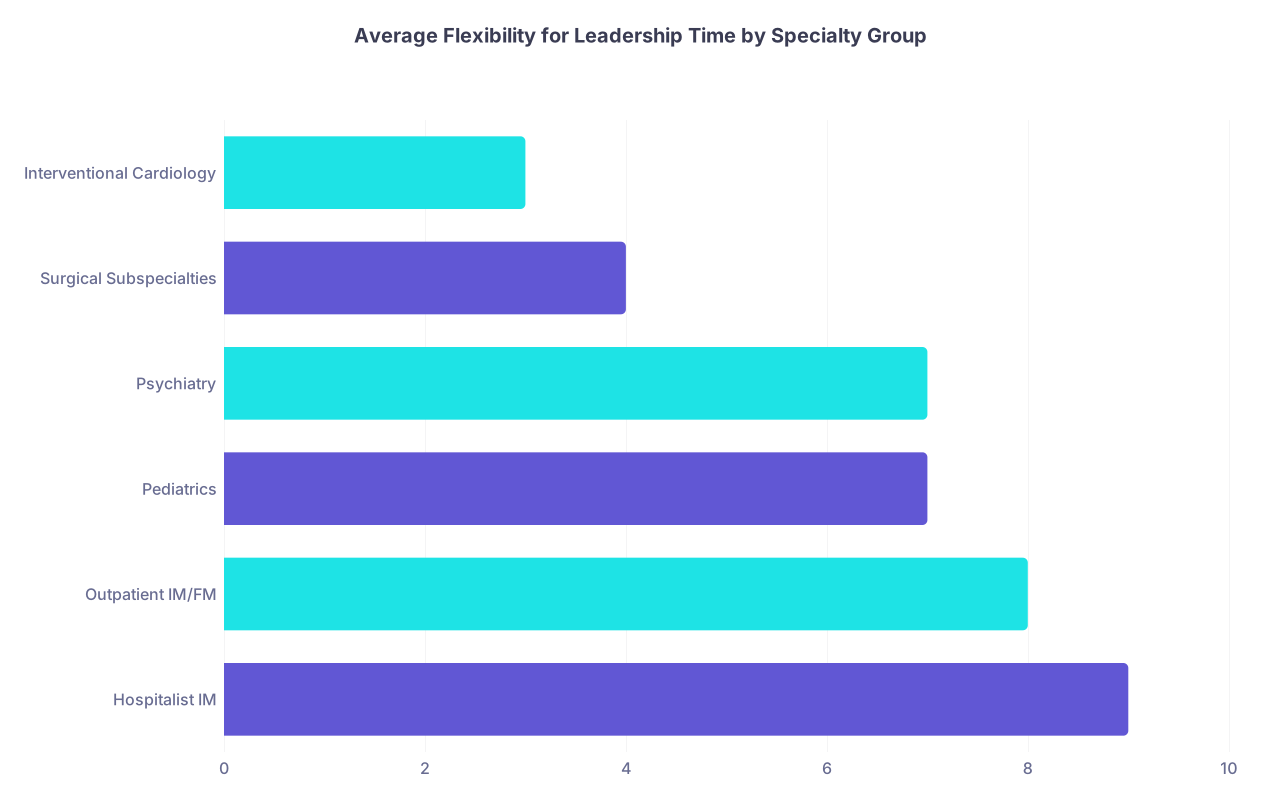
| Category | Value |
|---|---|
| Hospitalist IM | 9 |
| Outpatient IM/FM | 8 |
| Pediatrics | 7 |
| Psychiatry | 7 |
| Surgical Subspecialties | 4 |
| Interventional Cardiology | 3 |
Who can the hospital realistically put into a role that requires five committee meetings a month, plus emails, plus incident reviews, plus policy writing?
Not the person whose four-hour case routinely turns into a nine-hour ordeal.
So leadership paths naturally favor specialties where adjusting 4 clinic sessions to 3 is feasible, or where you can move from 1.0 FTE clinical to 0.7/0.5 as you accumulate responsibilities. It’s not a philosophical thing; it’s an operational one.
3. They Deal with Complexity, Not Just Procedures
Want to know who gets picked for Chief Medical Officer, Chief Quality Officer, or VP of Population Health?
The people who can fluently talk about:
- Multimorbidity
- Social determinants of health
- High utilizers and readmission patterns
- Medication reconciliation and polypharmacy
- Cost of care, not just charges
That screams internal medicine, family medicine, pediatrics, psychiatry, geriatrics. Not because surgeons aren’t intelligent, but because the day-to-day of high-complexity cognitive specialties forces you to think in systems.
I’ve sat in rooms where leadership candidates were informally vetted. A line I heard more than once:
“She’s a great proceduralist, but when we talk about social risk factors or complex discharge planning, she checks out. We need someone who sees the whole chessboard.”
The low-RVU cognitive specialties live on the “whole chessboard” every day. They see the failures of access, the insurance denials, the nursing home placement logjams, the medication copay disasters. That perspective aligns almost perfectly with what health systems are actually trying to fix at scale.
4. They’re “Cheaper” to Pull Out of Clinical
This part is ugly, but it’s real.
If the hospital pulls a high-revenue specialist out of clinical for 0.3 FTE admin time, they lose a lot of money. There’s a direct opportunity cost.
If they pull a lower-paid, mostly cognitive doctor out for 0.3 admin FTE, the financial hit on direct revenue is smaller, and the system tells itself they’ll “make it up” through quality gains, throughput improvements, shared savings, or reduced penalties.
So when a CMO is pitching a new leadership role to the CFO, the spreadsheet looks like this:
| Role Type | Typical Clinical FTE Lost | Direct Revenue Lost (Relative) | Admin Justification Easier? |
|---|---|---|---|
| Orthopedic Surgeon Lead | 0.2–0.3 | Very High | Hard |
| Interventional Cardiologist | 0.2–0.3 | Very High | Hard |
| Hospitalist/General IM Lead | 0.2–0.5 | Moderate | Moderate |
| Outpatient IM/FM/Peds Lead | 0.2–0.5 | Lower-Moderate | Easier |
| Psychiatry Lead | 0.2–0.5 | Moderate | Easier |
Do CFOs and CMOs say this out loud? Not usually. But when they whisper about it in their offices, that’s the logic.
Low-paid specialties are fundamentally more “affordable” to convert into leadership FTE. So they get converted. And over time, they accumulate power, titles, and decision authority that dwarfs the income gap.
5. They Attract the “Systems Thinkers” Early
There’s a selection bias no one mentions.
The student who daydreams about redesigning care models, public health, policy, medical education, or QI at scale? That student tends to gravitate toward IM, FM, Peds, Psych, maybe Path or PM&R. They’re not chasing $900K ortho income. They’re thinking: How do I fix the machine?
I’ve interviewed residents for chief roles and early admin tracks. The serious leadership-minded ones overwhelmingly came from:
- Internal Medicine (especially those who loved quality projects and complex cases)
- Pediatrics (heads full of population health and longitudinal care)
- Psychiatry (deep into systems of care, integration with primary care, SDOH)
- Family Medicine (community and systems-focused)
Surgery had some, but fewer. Those who do exist have to fight their own culture, which is heavily production and ego-oriented, not committee- and system-oriented.
So by PGY-2, the leadership short list in most programs is already skewed toward the “low-paid” disciplines. Then they get chief year, then small admin roles, then division leadership. It snowballs.
Which “Low-Paying” Specialties Quietly Run the Show
Let’s call it out specialty by specialty. This is where you’ll see the pattern clearly.
Internal Medicine (especially Hospitalists and Generalists)
These folks are everywhere in leadership:
- Program directors and APDs
- Chiefs of Medicine / Department chairs
- CMOs and Chief Quality Officers
- Hospitalist medical directors managing service lines
They sit at the nexus of inpatient medicine, complex comorbidities, and system cost. They’re trusted as “clinical grown-ups” who can talk to both specialists and administrators.
In one midwestern system, every single hospital’s Chief of Staff was originally internal medicine. Cardiology and GI made the money. IM wrote the rules.
Pediatrics
Peds looks “soft” from the outside. Inside systems, they’re taken very seriously. Why?
Because pediatrics is already population-health minded. Vaccination campaigns, screening schedules, developmental follow-up—they’ve functioned like mini public health departments for decades. That aligns exactly with where healthcare is being pushed: prevention, value-based care, risk contracts.
Hospitals love putting pediatricians into roles like:
- Quality and safety leadership
- Population health / outpatient strategy
- Education leadership (PDs, DIO roles)
Pay is lower. Influence over care models? Enormous.
Family Medicine
Family med often dominates in community systems and regional networks rather than big tertiary academic centers. They become:
- Medical directors of clinics and multisite outpatient networks
- Chief Medical Officers of smaller hospitals
- Leaders in ACOs, value-based programs, community initiatives
Their selling point: span of control across age groups and conditions. They see everything, everywhere. That’s leadership gold in any system trying to unify fragmented care.
One community network I know is run almost entirely by family med: CMO, VP of Clinical Affairs, and half the site medical directors. The neurosurgeon on staff? Makes more. Has no say in anything that matters above the OR.
Psychiatry
Psych is underestimated in leadership, but they’re everywhere in:
- Behavioral health integration projects
- Population health initiatives
- System-wide wellness / burnout / workforce strategy
- Risk and safety committees (especially around suicidality, restraints, capacity)
With the mental health crisis and integration mandates, psych has become central operationally. The average surgeon has no clue how much influence the behavioral health medical director has on system design. It’s massive.
Some systems have quietly elevated psychiatrists to high-ranking roles because they understand the single biggest cost-driver: poorly controlled behavioral health driving medical utilization.
Pathology
Path isn’t going to be CMO very often. But they control labs, diagnostics, and a huge wedge of quality and cost around testing.
Pathologists end up as:
- Lab directors
- Chairs of critical committees (transfusion, infection control, tissue committees)
- Key voices in quality initiatives involving diagnostics
They’re not visible. But if you look at any serious system-level conversation about diagnostic stewardship and quality, the pathologists are writing the playbook.
How This Plays Out in Residency: What You’ll Actually See
Let’s connect this to residency, since that’s what shapes careers.
Who Gets the “Chief” Titles?
Program directors will deny it publicly, but here’s the pattern I’ve seen over and over:
- Med/Peds/FM/Psych chiefs are often the ones who showed up to QI projects, committees, and were willing to do “boring” organizational work well.
- Surgery chiefs are mostly selected for service coverage, reliability, technical growth, and ability to police their own ranks. That’s leadership, but often inward-facing. Not system-facing.
Chief year in IM, Peds, FM, Psych is a leadership training academy. You run schedules, mediate conflicts, interact with hospital leadership, manage remediation, contribute to policy.
By the time those chiefs are 5-7 years post-residency, they’re division directors, program directors, service line leaders. Meanwhile some of their higher-paid colleagues are still solely heads-down in the clinic or OR.
Who Gets Invited to Committees?
Pay attention as a resident: who’s actually at the table for…
- Sepsis committee
- Readmissions task force
- EMR optimization
- Throughput and bed management
- Value-based care initiatives
Mostly hospitalists, general IM, Peds, FM, Psych. Rarely high-end procedural subspecialists. When they are there, they’re often outnumbered and outmaneuvered.
Residents in low-paid specialties get used to seeing “their people” run things. Residents in procedural fields often don’t even know these meetings exist.
Strategy: If You’re In a Low-Paid Specialty and Want Real Power
Income is one metric. Influence is another. If you’re going into or already in a “lower paid” field and you want to matter at system level, here’s the playbook that actually works.
1. Volunteer for the Boring Stuff Early
In residency, you’ll see QI projects, committee slots, workgroups that others roll their eyes at. Don’t grab everything; choose strategically.
Pick things that connect directly to:
- Readmissions
- LOS and bed management
- Sepsis / codes / rapid responses
- Transitions of care
- EMR build / documentation / order sets
That’s where the system’s real money and compliance risk lives. That’s what leaders above your PD are watching.
2. Get Fluent in the Language of Admin
You don’t need an MBA at 27. You do need to understand how hospital leaders think. Learn:
- What a DRG is
- How length of stay, case mix index, and readmissions affect money
- How quality metrics tie to reimbursement and penalties
- Basic structure of risk contracts and ACOs
You want to be the rare resident/fellow who can discuss both clinical nuance and financial/operational impact in the same paragraph. Those people get remembered.
3. Cultivate Relationships Above Your Pay Grade
Stop thinking your world ends at the residency program. If you’re genuinely leadership-minded:
- Find the CMO, CQO, or VP of Medical Affairs. Ask to shadow them for a day.
- Show up to open meetings where medical staff are invited. Actually contribute.
- When a project needs a physician lead from your department, raise your hand.
Hospital leaders are constantly scanning for “young talent” who can eventually step into bigger roles. Med, Peds, FM, Psych residents who show up to that world early get on lists you don’t even know exist.

| Step | Description |
|---|---|
| Step 1 | Resident in IM/Peds/FM/Psych |
| Step 2 | Chief Resident or QI Lead |
| Step 3 | Early Faculty with Admin Time |
| Step 4 | Division or Service Line Director |
| Step 5 | Department Chair or Program Director |
| Step 6 | CMO/CQO/VP Medical Affairs |
Notice how this pipeline fits best with the non-procedural fields. Their schedules and culture make these steps feasible.
What This Means If You’re Chasing a High-Pay Specialty
This isn’t an argument against procedural fields. If you love surgery or IR or ortho, do it. But stop expecting that your income will automatically equal influence.
If you’re a high-paid specialist and you also want to lead systems, you have to swim upstream.
You’ll need to:
- Sacrifice some clinical volume earlier than your peers
- Prove you care about more than your own service or OR block
- Show up consistently to system-level work (even when it’s scheduled horribly for you)
- Learn the same admin language your IM/Peds/FM colleagues live in
Some surgeons and proceduralists do this beautifully and end up CMO or system leaders. They’re just rarer because the default culture and incentives of those fields push in the opposite direction.
The Quiet Reality: Power vs. Pay
Inside hospital politics, the joke goes something like this:
“The orthopods buy the boats. The internists write the rules for where they can dock them.”
Crude, but not wrong.
Low-paying specialties win leadership roles because:
- They’re embedded where the system’s financial and quality levers actually are.
- Their work structures can flex into admin FTE without destroying margin.
- Their culture disproportionately attracts people who care about systems, not just procedures.
- They’re visible to the C-suite as reliable, scalable thinkers who can sit through the painful work of committees and policy.
You won’t see any of this on salary surveys or Reddit threads arguing over RVU multipliers.
But if you walk into morning hospital leadership huddles, QI steering committees, or executive councils, you’ll see the same pattern everywhere: hospitalists, general IM, Peds, FM, Psych, occasionally Path and PM&R quietly steering the ship.
Remember three things:
- Income and influence are separate currencies in medicine; low-paid specialties often dominate the second.
- Leadership pipelines are built around flexibility, complexity management, and system impact—traits baked into IM, Peds, FM, Psych, and similar fields.
- If you’re in one of these “low-paying” specialties and you want power, the path is open wider for you than for almost anyone else. Use it.


