

Last January, I sat in a conference room while the CFO quietly told a department chair: “We can’t afford more primary care FTEs next year. But we can afford three more ortho surgeons.” Downstairs, a family medicine resident was begging to keep a continuity clinic session from being cut. Same hospital. Same week. Completely different rules.
You’re training in – or thinking about – one of the lowest paid specialties and you’ve probably been told it’s about “mission,” “calling,” or “serving the underserved.” That’s the brochure version. Let me show you the back-room version: the politics, budgeting games, and strategic moves that decide how your specialty is valued, funded, and ultimately paid.
The Uncomfortable Truth: Your Salary Is a Political Outcome, Not Just a Market One
Every med student thinks specialty pay is mostly about RVUs and supply-demand curves. That’s only half the story. The rest is hospital and system politics.
There’s a very simple, ugly hierarchy that drives decisions inside hospitals and health systems:
Procedural = revenue center.
Cognitive / primary care = cost center (or at best, “downstream generator”).
So when leadership sits down to plan the next 3–5 years, they do not start with, “What improves population health?” They start with, “What protects margin and market share?”
That’s where the lowest paid specialties get crushed:
- Family Medicine
- Pediatrics
- General Internal Medicine (outpatient primary care)
- Psychiatry (in many markets)
- Geriatrics, Palliative Care, Endocrinology, Rheumatology, ID
You see “low salary.” I see: “Low internal political capital, weak bargaining power, and poor alignment with the way revenue is currently counted.”
Here’s how that plays out behind the scenes.
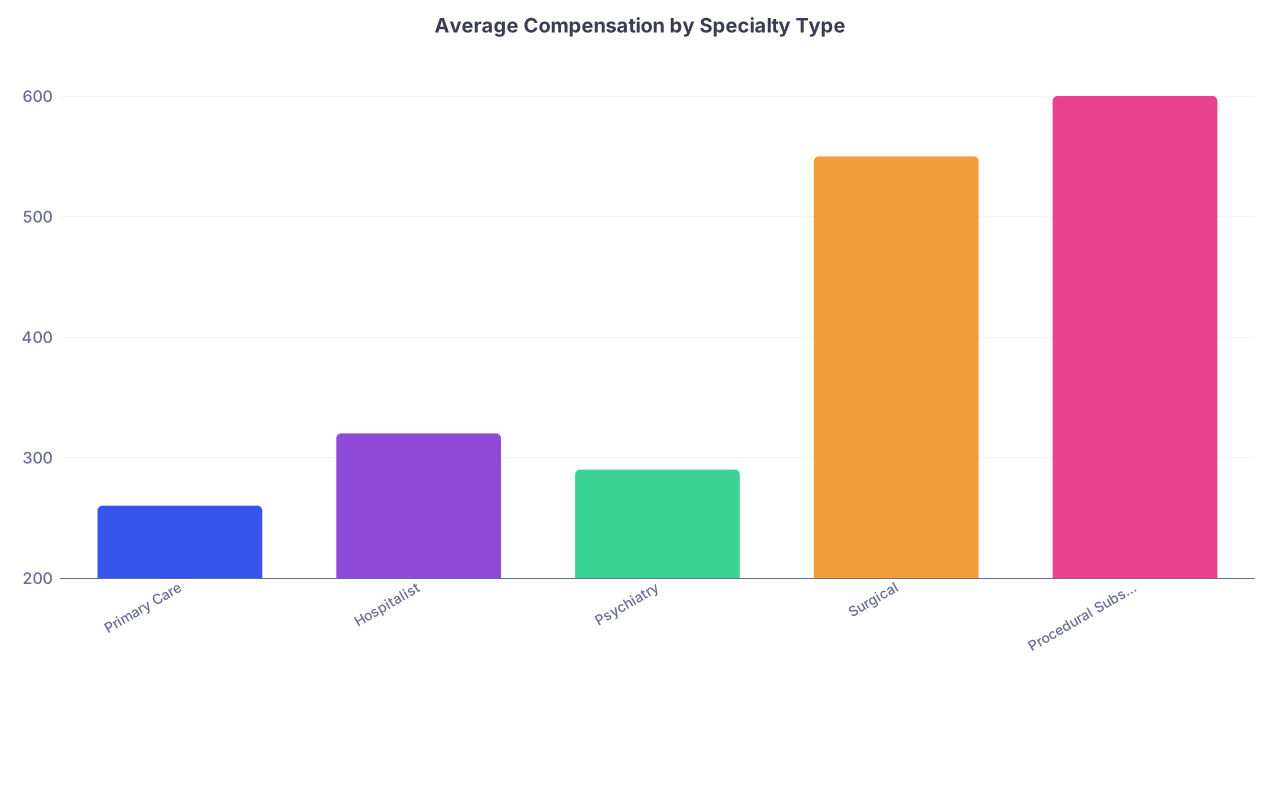
| Category | Value |
|---|---|
| Primary Care | 260 |
| Hospitalist | 320 |
| Psychiatry | 290 |
| Surgical | 550 |
| Procedural Subspecialty | 600 |
How Chairs and CFOs Actually Talk About Your Specialty
I’ve sat in those allocation meetings. You’re not in the room. You’re on the spreadsheet.
The dialog is roughly like this:
- “Our ortho guys are screaming about OR time; they brought in $40M last year.”
- “Cardiology wants two more interventionalists; they’re maxed on cath lab time.”
- “Peds clinic is losing money again. We might have to cut sessions or slow hiring.”
- “Psych requests more FTEs every year, but we have no payer mix to support it.”
Notice what’s missing? “We should invest because it’s the right thing for patients.” That comes later as window dressing.
Inside those rooms, your specialty is evaluated on:
- Direct margin (do you make more than you cost?)
- Indirect margin (do you feed profitable services?)
- Strategic necessity (do we have to have you to keep something else alive?)
- Brand / regulatory optics (will we look bad if we cut you?)
The surgical and interventional groups nearly always win on #1. Oncology, cardiology, and sometimes primary care win indirectly on #2 (“downstream referrals”). The lowest paid specialties? Often weak on every metric except “optics”.
That’s why you see this pattern:
| Specialty Group | Political Capital Level | Reason |
|---|---|---|
| Orthopedics | Very High | High revenue, strong referrals |
| Cardiology | Very High | Cath lab, downstream testing |
| Family Medicine | Low | Low margin per visit |
| Pediatrics | Very Low | Poor reimbursements, high needs |
| Psychiatry | Low | Access crisis but low margin |
Nobody tells the residents this at noon conference. But it’s exactly how their future is being priced.
Why Lowest Paid Specialties Keep Getting Squeezed
Let’s walk through the specific political levers that keep your specialty at the bottom of the pay ladder.
1. RVU Games and “Productivity” Metrics
You’ve heard of RVUs. What you haven’t seen is how easily they’re used as a political weapon.
The RVU system is inherently biased against complex cognitive work and chronic disease management. A 40-minute complex geriatric visit filled with decision-making, care coordination and family counseling is valued not much more than a quick procedure that takes a fraction of the time.
Then hospitals layer “productivity expectations” on top of that. I’ve seen:
- Primary care RVU targets that require 20–24 patients per clinic day just to be “baseline”
- Psychiatry benchmarks written by people who’ve never done a full intake in their lives
- ID docs asked to round on half the hospital and still “hit RVUs”
And here’s the kicker: these targets are often set using national MGMA data that’s heavily influenced by large, well-resourced systems… then applied to under-resourced, safety-net environments where seeing that volume safely is impossible.
When you inevitably “underperform,” leadership frames it as:
- “The service is not financially sustainable.”
- “We might need to reconsider the staffing model.”
- “Perhaps we can replace some MD time with APPs.”
That language is how actual FTE cuts and stagnant salaries get justified.
2. “Mission” as a Budgetary Trap
Watch what happens when a specialty leans too hard on the “mission” narrative.
Pediatrics, family med, geriatrics, palliative care – they attract people willing to sacrifice pay for purpose. Hospital leadership knows this.
So on the finance side, it turns into quiet assumptions:
- “They’ll accept lower comp; they’re here for the mission.”
- “We can delay their market adjustment a year; they’re not as money-driven.”
- “We don’t need big signing bonuses to recruit them.”
I’ve been in comp meetings where the logic was literally: “We need the money to land that new spine surgeon; primary care will live with a smaller raise this year.”
You think your altruism is invisible? It isn’t. It’s priced in.
3. The “We’ll Just Use APPs” Strategy
For a lot of low-paid specialties, the unspoken plan is: dilute MD FTE with cheaper labor.
Family med, peds, psych – these are prime targets for aggressive APP expansion. Not because the care is trivial, but because the billing looks similar on a spreadsheet.
I’ve watched systems brag about “improving access” by:
- Capping physician hires
- Hiring more NPs and PAs
- Then telling the MDs: “Your role is more supervisory, leadership-focused.”
That sounds flattering. Until you realize:
- Your leverage in comp negotiations drops
- Your call burden doesn’t drop
- Your ability to argue for more MD positions evaporates
In the long run, this depresses physician comp in those specialties. Hospitals quietly shift volume to lower-cost providers, then point to “blended productivity” numbers to justify stagnant salaries for docs.
Training Programs: How Residency Slots and Experiences Get Politicized
Residency expansion is not only about workforce needs. It’s also about cheap labor and strategic positioning.
Look at where programs are aggressively growing slots:
- IM hospitalist tracks
- EM (at least historically; this is changing now)
- Community FM programs attached to health systems hungry for “downstream” patients
- Transitional year / prelim spots that support other residencies
Now look at specialties that hospitals quietly underfund even though the country is short on them:
- Child psychiatry
- Geriatrics
- Palliative care
- ID, rheum, endo in many regions
Why? Because residents cost money in faculty time, supervision, and infrastructure. And if leadership doesn’t see a clear revenue or referral return, they’re slow to invest.
You’ll see things like:
- A “robust” family medicine program that actually has its clinic time slashed because the hospital needs more procedural clinic blocks.
- Pediatrics residents being cross-covered constantly because “we can’t justify hiring more peds hospitalists.”
- Psych residents inheriting massive outpatient panels because the system doesn’t want to pay for enough attending FTEs.
The politics are simple:
- Procedural residencies = investments in high-margin future faculty
- Cognitive residencies = service coverage with weaker long-term economic upside

| Step | Description |
|---|---|
| Step 1 | Leadership Retreat |
| Step 2 | Expand Procedural Slots |
| Step 3 | Grow Primary Care Limited |
| Step 4 | Freeze or Shrink Low Paid Specialties |
| Step 5 | Market as Community Benefit |
| Step 6 | Use APPs and Residents for Coverage |
| Step 7 | High Margin? |
| Step 8 | Downstream Value? |
You live the training consequences of that tree for 3+ years, then graduate into the pay structure it created.
How Different Systems Treat Low-Paid Specialties (and Why)
Not every hospital plays the game the same way. But the patterns are predictable.
| System Type | View of Low-Paid Specialties | Common Outcome |
|---|---|---|
| For-profit chain | Cost center / compliance necessity | Minimal staffing, high volume |
| Academic medical center | Mission + credential box | Prestige but undercompensated |
| Large non-profit system | Brand and network feeder | Heavy workload, modest pay |
| County / safety-net | Moral obligation | Overworked, underfunded |
Academics talk a big game about mission. Then they pay their general peds attendings 40–100k less than what those same people can get across town at a large non-profit. Why? Because “you get to teach” and “we’re an academic center.”
For-profit chains are more blunt. I’ve literally seen slide decks where:
- Primary care was labeled “loss leader”
- Behavioral health was described as “regulatory exposure” and “necessary to support ED operations”
In that world, you keep your job by:
- Keeping readmissions down
- Meeting access metrics
- Staying out of the CFO’s line of sight
But you’re not getting top-of-market comp.
What This Means For You If You’re Going Into a Low-Paid Specialty
You can’t change the whole system. But you can stop walking into it blind.
Here’s the insider playbook.
1. Stop Letting “Mission” Be Your Only Negotiating Position
Serve patients. Care deeply. Fine. But when you sit down at an offer table, you don’t lead with: “I’ll take whatever, I just want to help people.”
You ask:
- “How does leadership here view primary care / psych / peds in the strategic plan?”
- “What percentage of system revenue comes through this service line?”
- “What is your plan for APP integration and how does that affect MD comp and scope?”
The answers will tell you whether you’ll always be the budget afterthought.
2. Choose Environments Where Your Specialty Has Leverage
In some settings, low-paid specialties suddenly gain power because of the local ecosystem. A few examples I’ve seen repeatedly:
- In rural areas, a strong FM group can hold enormous sway because the hospital literally doesn’t function without them.
- In systems chasing value-based contracts, primary care, geriatrics, and palliative care become crucial for reducing costs and readmissions.
- In regions with severe psych shortages, psychiatry can command aggressive salaries at competing hospitals and use that to force local systems to pay up.
The market gives you some leverage. But you have to be willing to walk across the street when your hospital treats you like a cost center.
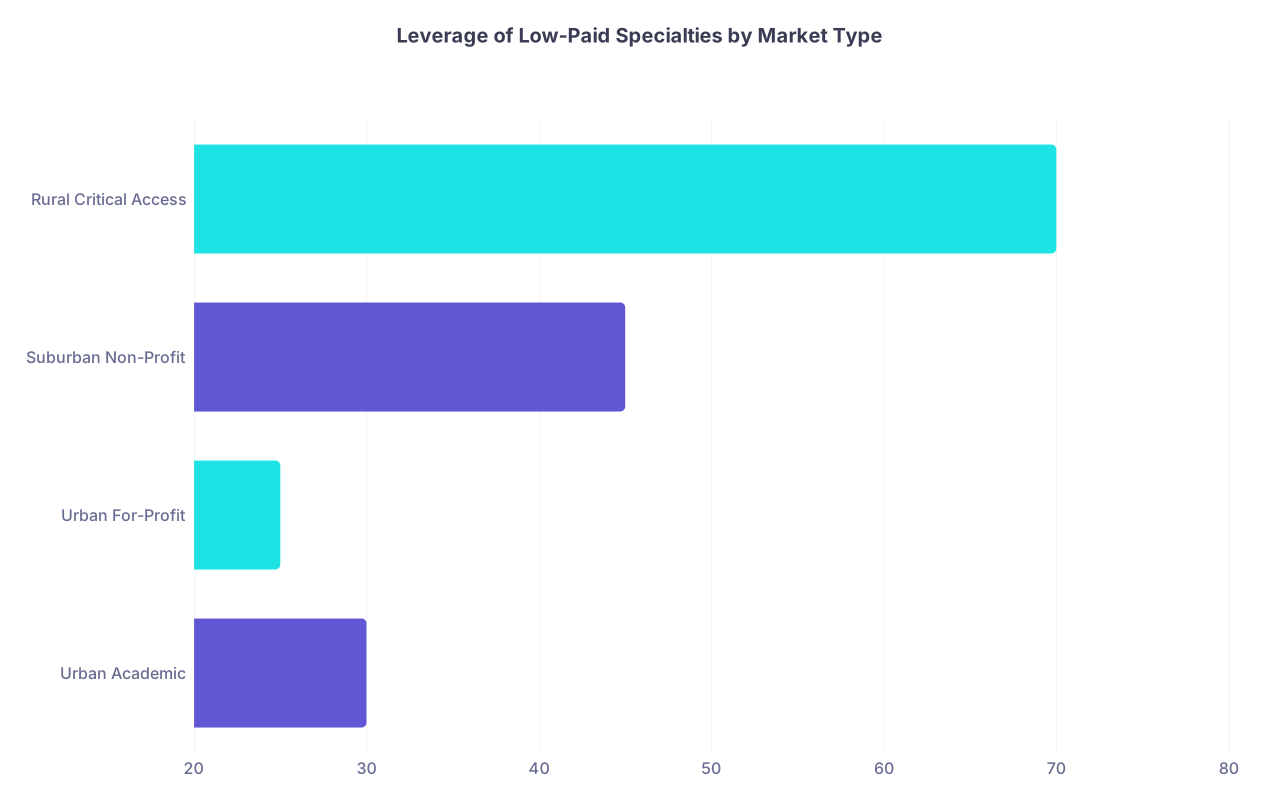
| Category | Value |
|---|---|
| Urban Academic | 30 |
| Urban For-Profit | 25 |
| Suburban Non-Profit | 45 |
| Rural Critical Access | 70 |
(Think of those numbers as “relative negotiation leverage,” not salaries.)
3. Protect Yourself from the APP Substitution Trap
You’re not going to stop hospitals from using NPs and PAs. But you can shape how that affects your career.
Red flags:
- Job descriptions where you’re “supervising a large team of APPs” but your own clinic volume is unchanged or increased
- Compensation not tied to actual supervisory workload
- Pressure to sign off on huge panels you never see
Healthier models:
- Clear MD-only panels for high complexity patients
- Protected time and pay for true supervision and teaching
- Shared RVU credit or hybrid comp acknowledging team care
If leadership insists “this is the future of care” but won’t pay you appropriately for risk, responsibility, and oversight, that tells you exactly how they view your specialty.
How Residents Get Socialized to Accept Low Pay (and How to Break That)
By the time you finish residency in a low-paid specialty, you’ve usually had 3–7 years of subtle conditioning:
- Program leadership telling you, “Nobody goes into peds to get rich.”
- Faculty normalizing 15–20 years of loan payments.
- Administration praising you for “doing more with less.”
Residents internalize this. They walk into their first job negotiations grateful just to get an offer. While over in ortho, PGY5s are comparing signing bonuses.
I’ve watched this exact contrast in the same hospital:
- Ortho chief resident turning down an offer because the RVU conversion factor was a few dollars lower than a competitor
- FM chief accepting the first offer, never asking about productivity benchmarks, quality bonuses, or non-clinical time
Guess which specialty’s comp improves faster over 5–10 years?
You can break that mold by:
- Seeing your “low-paid” status as a result of decisions, not destiny
- Talking openly with co-residents about salaries and offer structures
- Refusing to apologize for asking direct financial questions
You’re not being “unprofessional” when you ask why your comp plan looks like it was written on a napkin.
Where Things Are Quietly Shifting (And How to Ride That Wave)
Here’s the part most people don’t see: in some systems, the politics are starting to tilt.
As value-based care, ACOs, and capitation actually take hold (not just in marketing slides), the math shifts:
- Every unnecessary admission becomes a cost
- Every preventable readmission is a direct financial hit
- Every poorly controlled chronic disease moves the needle
Suddenly:
- Strong primary care panels are financially valuable
- Palliative care that prevents ICU overuse has hard ROI
- Geriatrics that keeps frail elders out of the hospital is gold
I’ve seen ACO-heavy systems where:
- Primary care salaries quietly jumped 50–100k over 5–7 years
- Palliative care went from a scrubbed-budget side service to a fully funded, rapidly expanding team
- Psych got protected because untreated mental illness was tanking quality metrics and readmission data
These are not the majority of systems yet. But they exist. And they’re hiring.

| Stage | Activity | Score |
|---|---|---|
| Fee For Service Era | Procedural dominance | 5 |
| Fee For Service Era | Primary care undervalued | 1 |
| Transition Period | ACO pilots | 3 |
| Transition Period | Care management investment | 4 |
| Value Based Maturity | Preventive care rewarded | 5 |
| Value Based Maturity | Unnecessary procedures penalized | 2 |
If you’re in a low-paid specialty and you want a future that doesn’t feel like permanent financial penalty, aim yourself toward systems that are actually living in that right-hand column, not just talking about it.
FAQ – The Questions Residents Ask Me in Hallways
1. “If I love a low-paid specialty, am I just doomed financially?”
No. You’re constrained, not doomed. The spread between the worst and best-paying jobs within the same low-paid specialty can be 100–200k. I’ve seen academic peds hospitalists making in the low 200s, and community peds hospitalists making mid to high 300s with better schedules. Same training. Different politics, payer mix, and leverage. The trap is assuming “this field pays X” instead of asking, “What environments in this field pay well and why?”
2. “Will doing a fellowship help my pay in these specialties?”
Sometimes. But not always, and not equally. In primary care, certain fellowships (sports med, HIV, addiction, hospice & palliative) can bump comp modestly, mostly by giving you niche value. In peds, NICU or PICU can move you out of the “lowest paid” tier. In psych, child and adolescent is financially powerful in many markets. But geriatric fellowship, for example, is high-need and often badly underpaid. Before you add years of training, look at actual offers people 3–5 years ahead of you are getting, not just national averages.
3. “How soon should I be thinking about this politics stuff – as an MS3, resident, or later?”
Earlier than you think, but not obsessively. As an MS3/MS4, use this lens to choose between specialties and practice settings with open eyes. In residency, start asking how your hospital treats your specialty when budgets get tight and what happens to graduates. By PGY3 and beyond, you should be talking candidly with recent alumni about their jobs, comp structures, and what they wish they’d known. The earlier you recognize that your pay is shaped by politics, the more options you keep open.
Key points to take with you:
- Your specialty’s “low pay” is not a moral judgment; it’s a direct result of hospital politics, RVU design, and how leadership labels you on their spreadsheets.
- You can’t fix the whole system, but you can choose environments where your specialty has leverage, and you can stop letting “mission” be used as an excuse to underpay you.
- The landscape is slowly shifting toward models where cognitive and primary care work actually drive revenue; if you understand where that’s happening, you can build a career in a “low-paid” field without living at the bottom of the heap.


