

How Not to Negotiate: Salary Errors Unique to Low-Paid Specialties
What if the way you’re “being reasonable” about salary is the exact reason you’ll be underpaid for the next decade?
If you’re going into a lower‑paid specialty—family medicine, pediatrics, psychiatry, general IM without procedures, geriatrics, some hospitalist gigs—you’re walking into a negotiation minefield most people do not recognize. The myths are different. The traps are different. And the power imbalance is often worse.
I’ve watched smart new attendings in primary care lock themselves into contracts that cost them hundreds of thousands of dollars. Not because they were greedy. Because they were naïve, rushed, or overly grateful to “just have a job.”
Let’s go through how not to negotiate, and how to avoid getting quietly crushed.
Mistake #1: Confusing “Mission-Driven” With “Poverty Contract”
If you’re in a lower‑paid specialty, people will weaponize your idealism against you.
Community health centers, academic pediatrics, safety‑net hospitals—some are fantastic. Some absolutely are not. The bad ones lean hard on language like:
- “We’re all here for the mission.”
- “Nobody is getting rich doing this.”
- “Our patients really need you.”
Here’s the trap: mission does not pay your loans. Mission does not fund your retirement. Mission will not rescue you when you burn out in three years because you’re seeing 24 patients a day for $180k.
The worst move you can make is not even trying to negotiate because you feel guilty.
You know it’s happening when:
- They pivot to “fit with our values” the moment you ask about compensation.
- They dismiss benchmarks: “MGMA doesn’t really apply to us” (it usually does, at least directionally).
- They praise you for “not caring about money” when you’ve barely mentioned it.
The corrective move:
- You can be mission‑driven and insist on market‑reasonable comp.
- Say, “I care deeply about this population. That’s why I need a sustainable arrangement so I can stay and serve them long term.”
If the response to that is defensive or manipulative? That’s not a mission. That’s exploitation.
Mistake #2: Comparing Yourself Only to Other Low-Paid Colleagues
I’ve heard new family docs say, “All my co‑residents are getting around $205k, so $195k is fine.”
No. That’s how underpaid markets normalize themselves.
In low‑paid specialties, the entire bell curve is often shifted down. If you only compare to your immediate peers, you’ll anchor yourself to a bad baseline.
You must compare:
- Across regions (your city vs. similar cost‑of‑living regions)
- Across employer type (private vs. hospital‑employed vs. FQHC)
- Across workload (clinic days, call, panel size, RVU requirements)
If you’re earning $200k as a primary care doc in a high‑COL city seeing 20+ patients per day, while someone 30 miles away is earning $240k with similar workload, you’re not “unlucky.” You probably just didn’t negotiate.
Use benchmarks, not vibes.
| Setting Type | Typical Range (Starting) | Notes |
|---|---|---|
| FQHC / Community | $190k–$230k | Often with loan repay |
| Hospital-employed | $210k–$260k | RVU or hybrid models |
| Private group (buy-in) | $200k–$260k | Depends on path to PE |
| Academic | $170k–$210k | Often lowest cash pay |
If an academic pediatrics job offers you $165k in a high‑cost city and tells you it’s “standard,” that’s not an answer. That’s a red flag.
Mistake #3: Ignoring the Real Money: RVUs, Bonus Structure, and Caps
A subtle way lower‑paid specialties get squeezed: terrible productivity structures that sound good on the surface.
Common rookie errors:
- Only looking at base salary, ignoring RVU thresholds.
- Not understanding how many patients you’d need to see to hit any bonus.
- Accepting RVU rates well below market because “primary care margins are thin.”
Here’s how you get played: they dangle a “potential total compensation of up to $260k” with:
- Base: $195k
- “Productivity bonus opportunities” that require unreachable RVU targets
- No transparency on historical earnings of other docs
You need hard numbers:
- What is the RVU target for base?
- What is the per‑RVU rate after the threshold?
- What are the average RVUs generated by current physicians?
- How many of them actually hit the higher tiers?
If no one has ever hit the upper level they’re quoting, it’s not a bonus plan. It’s a marketing line.
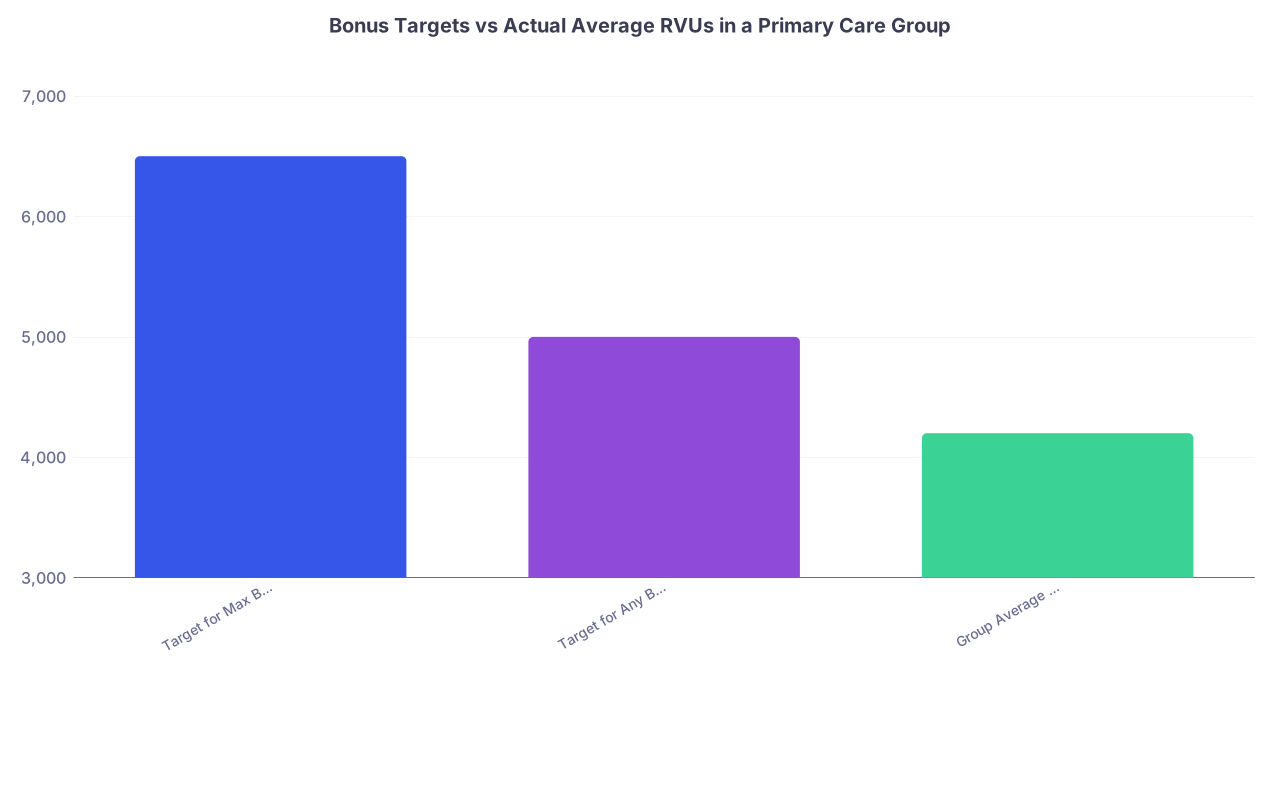
| Category | Value |
|---|---|
| Target for Max Bonus | 6500 |
| Target for Any Bonus | 5000 |
| Group Average RVUs | 4200 |
If you see something like this in real life—targets set thousands above what the group averages—you should either negotiate those thresholds down or assume the “up to” number is fiction.
Mistake #4: Taking Loan Repayment Without Doing the Math
Low‑paid specialties often lean hard on loan repayment as bait:
- NHSC
- State loan repayment programs
- Internal “forgivable loans”
- Sign‑on bonuses with clawbacks
The mistake? Treating $50k of loan repayment like it’s $50k of salary. It’s not.
You need to calculate:
- After‑tax value of the repayment.
- The salary discount you’re accepting to get it.
- The time commitment and penalties if you leave early.
Example I’ve actually seen (numbers tweaked, pattern real):
Job A (Community clinic):
- Salary: $195k
- Loan repayment: $50k/year for 3 years (through NHSC + employer)
- 2‑year penalty if you leave: must repay prorated amount
Job B (Private group):
- Salary: $240k
- No formal loan repayment
If you choose Job A because “$195k + $50k = $245k, so it’s actually better,” you’re doing sloppy math.
Loan repayment is usually pretax or taxed differently; salary is taxed as income, but that’s not the main point. The main point: loan repayment is time‑limited and conditional. A permanently lower base follows you every year—including after loan repayment ends.
If three years later you’re still at $205k while market has moved to $250k and your loans are almost gone, you’re stuck.
Don’t reject loan repayment. Just do the math like an adult, not like a panicked PGY‑3.
Mistake #5: Accepting “We Can’t Pay More” Without Testing It
Low‑paid specialties get this line constantly:
- “This is our standard starting salary.”
- “Our hands are tied by the system.”
- “Everyone starts at the same rate.”
Sometimes that’s true. Many times it’s just convenient.
Ways people in your shoes have gotten more even after hearing that line:
- Asking for a higher base with a shorter ramp to expected RVUs.
- Getting a guaranteed salary for 2–3 years instead of 1.
- Securing a larger sign‑on bonus, relocation, or CME funds.
- Negotiating protected time being counted as “worked hours” for bonus eligibility.
If they won’t budge on base, push on:
- Bonus structure (better per‑RVU rate, lower thresholds).
- Panel size caps (to prevent you from being turned into a volume machine).
- Call compensation (a huge area where low‑paid specialties get fleeced).
The mistake is believing “we can’t pay more” is the end of the conversation. It just means you should start negotiating the structure instead of the headline number.
Mistake #6: Underestimating Call, Non‑Visit Work, and “Little Extras”
In lower‑paid specialties, admins love to pretend everything you do outside the 20‑minute visit doesn’t exist.
So they fold it into your salary. Quietly.
Things that get ignored:
- After‑hours call (especially pediatrics and psychiatry).
- Inbox messages, refills, forms, disability paperwork.
- Mandatory quality projects, committees, and teaching.
- Nursing home rounds or additional site coverage.
If you negotiate only on base salary and skip these details, you’re volunteering to be an unpaid call center and scribe.
You want specific language in writing:
- Call schedule: frequency, expected volume, and compensation.
- Whether call is counted toward RVU or panel requirements.
- Whether after‑hours inbox time is recognized and protected in your schedule.
- Limits on how many locations you’re expected to cover.
If they say, “Everyone just pitches in” but can’t tell you who’s on call how often, you’ll be the one “pitching in” as the newest and least likely to push back.
Mistake #7: Letting “Flexibility” Replace Fair Pay
Low‑paid specialties are often sold on lifestyle:
- “We’re very flexible about your schedule.”
- “You can work 4 days a week.”
- “Lots of autonomy.”
Flexibility is great. It’s also a fantastic decoy to distract you from low compensation.
Common bait‑and‑switch:
- You’re quoted “0.8 FTE” but the workload is basically full‑time with a smaller paycheck.
- You start 4 days a week but the inbox and call effectively make it 5.
- You’re told you can ramp slowly, then end up with a panel of medically complex patients that burns you out.
You need hard boundaries:
- What exactly is full‑time? (Number of clinic sessions, hours, or RVUs.)
- If 0.8 FTE, are RVU targets also 0.8 of full‑time? (They often “forget” this.)
- How are you protected from “well, just this once” adding more sessions, sites, or admin tasks?
If you trade salary for flexibility, make sure you’re actually getting the flexibility in practice—not just in the recruiting brochure.
Mistake #8: Signing Without a Realistic Volume / RVU Scenario
In low‑paid specialties, your income will often live or die on volume. Yet almost nobody asks for concrete projections.
You should demand:
- Historical average RVUs or visits per day for new attendings over the last 2–3 years.
- Typical time to build a full panel.
- Expected payer mix (Medicaid, Medicare, commercial, uninsured).
Then build a simple scenario:
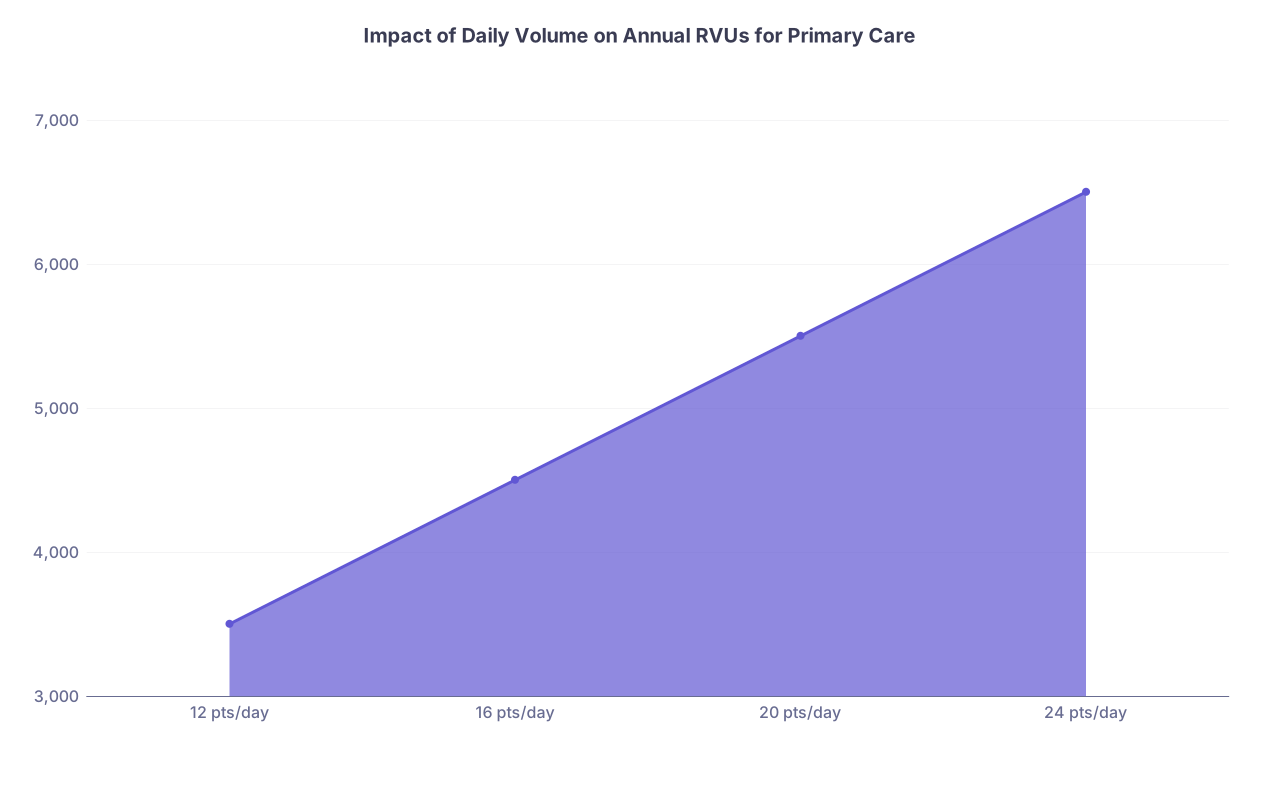
| Category | Value |
|---|---|
| 12 pts/day | 3500 |
| 16 pts/day | 4500 |
| 20 pts/day | 5500 |
| 24 pts/day | 6500 |
If your bonus kicks in at 6000 RVUs and average new attendings see ~16–18 patients per day, you won’t hit that threshold for a long time—if ever.
Red flags:
- They refuse to share actual productivity data.
- They haven’t tracked RVUs or visits carefully. (Translation: they have no idea if their “bonus” is realistic.)
- They quote only the outlier: “Oh, Dr. X made $320k last year!” (Dr. X may be working 6 days a week and doing procedures you won’t be doing.)
Don’t sign until you’ve stress‑tested the numbers against realistic volume, not fantasy high‑volume scenarios.
Mistake #9: Failing to Account for Cost of Living and Benefits Gaps
Low‑paid specialties are more sensitive to cost of living differences. A $210k job in a rural area is not the same as $210k in San Francisco.
I’ve watched people choose:
- $205k in a high‑COL metro with bad benefits over
- $230k in a lower‑COL secondary city with robust retirement and loan repayment
Then feel “stuck” five years later with no savings and no margin.
You must compare:
- Salary
- Benefits (health, disability, retirement matching, CME)
- Call and workload
- Loan repayment / sign‑on bonus
- Local cost of housing, childcare, and taxes
| Feature | Job A (Big City) | Job B (Smaller City) |
|---|---|---|
| Base Salary | $205k | $235k |
| 401k Match | 2% | 5% |
| Sign-on Bonus | $10k | $25k |
| Average Rent (2BR) | Very high | Moderate |
| Call | 1:4 | 1:6 |


The Bottom Line: How Not to Get Quietly Underpaid
Let me strip this down.
Two or three key things you cannot afford to screw up as a lower‑paid specialist:
Never accept “we’re mission‑driven” or “this is standard” as a reason to ignore fair market compensation and realistic productivity. Ask for data, push on structure, and walk if all you get is guilt and vibes.
Don’t fixate on base salary alone. RVUs, call, loan repayment, non‑compete terms, and cost of living can swing your real income—and your future options—more than that headline number.
Stop treating your work like a charity when your employer is running a business. You can care deeply about patients and still insist on a sustainable, professional deal. In low‑paid specialties, that’s not greed. It’s survival.


