

You’re a PGY-1 in pediatrics, sitting on call, scrolling your loan balance between pages of UpToDate. $320,000. Interest ticking while you’re trying to decide if you’re actually insane for choosing one of the lowest paid specialties. Your classmates going into ortho and derm are already talking about “buying” instead of “renting.” You’re just trying to figure out if you’ll ever be able to afford a kid or a house.
If that’s even close to your situation, this is for you. You like (or love) a low-paying specialty, you’ve got high debt, and you’re trying to decide: do I follow what I’m drawn to, or do I pivot for financial survival?
Let’s walk through this like adults—no inspirational posters, no “money doesn’t matter” nonsense, and no “just choose the highest salary” oversimplification.
Step 1: Get Real About the Numbers (Not Vibes)
You cannot make a responsible decision off vibes and anecdotes from attendings who paid $80k for med school in the 90s. You need your numbers, not anyone else’s.
Here’s what you need to calculate, on paper or in a spreadsheet:
- Total debt at graduation / now
- Interest rate(s)
- Likely repayment plan (standard, SAVE/IDR, PSLF track, private refinance)
- Target specialty and realistic post-training salary range
- Cost of living in areas you’d realistically live in
And yes, you need actual estimates, not guesses.
Low-paying specialties usually include things like:
- Pediatrics (especially general peds)
- Family medicine
- Internal medicine primary care
- Psychiatry (improving, but still lower than procedure-heavy fields)
- Geriatrics, palliative care, some pediatric subspecialties
- Academic positions in any of the above
| Specialty | Approx Salary Range (USD) |
|---|---|
| Family Medicine | 230k–260k |
| Pediatrics | 220k–250k |
| Psychiatry | 260k–310k |
| Hospitalist (IM) | 260k–320k |
| Cardiology | 500k–650k |
| Orthopedic Surgery | 600k–800k |
These ranges are rough, vary by region, and can be higher with extra shifts/rural work. But they’re good enough to model reality.
Then look at your debt. A common scenario:
- Debt: $300,000
- Interest: 6–7%
- Training length: 3 years vs 5+ years (matters for interest growth)
Use a basic loan calculator (or AAMC’s MedLoans Calculator) and run two or three scenarios:
- Standard 10-year repayment
- Income-driven repayment (SAVE or whatever is current when you read this)
- PSLF track (if you’re even remotely open to working in a qualifying job for 10 years after graduation)
You want to see:
- Monthly payments
- Total repaid
- What’s left after 10 years on PSLF if applicable
Now you’re not asking, “Can I afford pediatrics?” in general. You’re asking, “Can I afford pediatrics with $310k at 7%, living in X city, on IDR or PSLF?”
That’s the level you need.
Step 2: Understand What Actually Makes “Low-Paying” Work or Fail
I’ve seen people with $350k in debt live just fine as general pediatricians. I’ve also seen people with $220k panic in family medicine because they boxed themselves into awful cost-of-living and job choices.
The difference wasn’t the specialty. It was this stack of factors:
- Debt-to-income ratio
- Willingness to use PSLF or stick with IDR
- Cost of living they chose
- Lifestyle expectations (and their partner’s financial reality)
- Side income / leadership / niche work over time
If your debt is >2x your expected attending income, you need to be more deliberate. Not necessarily change specialties. Just less naive.
For example:
- Peds with $250k debt + PSLF + willing to work at a children’s hospital in a mid-cost city = doable, often very comfortable after 10 years
- Peds with $450k debt + wants private practice in Manhattan + refuses IDR/PSLF = that’s where things start to feel like a financial chokehold
You’re not deciding “peds or cards.” You’re deciding: for my numbers, what version of this specialty is feasible without putting future me in a bind?
Step 3: Narrow Your True Choice: Is It Really Passion vs Money?
Sometimes students say, “I love peds but maybe I should do anesthesia because of the money.” Then I watch them on anesthesia rotation: bored, disengaged, doing it because they “should.”
Here’s the ugly truth:
If you choose a higher-paying specialty you actively dislike purely for money, statistically you’re not guaranteed “happiness with money.” You’re pretty likely to end up:
- Burned out earlier
- More tempted to under-work or cut back
- Spending more to compensate for how miserable you are
That high salary on paper? It often becomes a high-spend, high-burnout lifestyle. Golden handcuffs.
So you have to answer two questions honestly:
- Do you actually like the higher-paying alternative enough to practice it daily for 20+ years?
- Is your interest in the low-paying specialty deep enough that you’d still choose it if you had no loans?
If your honest answers are:
- “I tolerate the higher-paying specialty, but I light up in clinic with kids or outpatients.”
- “Without loans, I’d choose the lower-paid specialty without hesitation.”
Then you’re not deciding passion vs security. You’re deciding: how do I design a financially sane life around the thing I actually like?
If, however, you’re pretty neutral between, say, outpatient IM and cardiology, or psych and anesthesia, then yeah, money becomes a legitimate tiebreaker. That’s rational, not “selling out.”
Step 4: Run Two Life Projections, Not Just Salary Comparisons
This is where most people get it wrong. They compare:
- Peds: 230k
- Ortho: 700k
And stop there. That’s lazy.
You want to compare actual lives:
Scenario A: Low-Paying Specialty You Love
Example: Pediatrics with PSLF
- 3-year residency at a children’s hospital (qualifying employer)
- 7–10 years attending at academic or non-profit children’s hospital (PSLF path)
- On SAVE/IDR the whole time
- Location: mid-cost city, not coastal insanity
You’d model:
Residency years: small income, controlled IDR payments
Years 1–10 as attending: 220k–260k, PSLF hit at year 10, remaining balance wiped out
Then ask:
- Monthly cash flow years 1–5, 5–10, 10+
- When can you realistically buy a home?
- What does retirement saving look like after loans vanish?
Scenario B: Higher-Paying Specialty You’re Lukewarm On
Example: Anesthesia in private practice
- 4-year residency + 1-year fellowship
- No PSLF if you go straight to private groups or ambulatory centers
- Salary: 400k–550k to start, potentially more
Then:
- Standard or refinanced 10-year repayment
- Higher initial pay, but also maybe higher cost of living if you chase big markets
- Maybe more weekend calls, less enjoyment
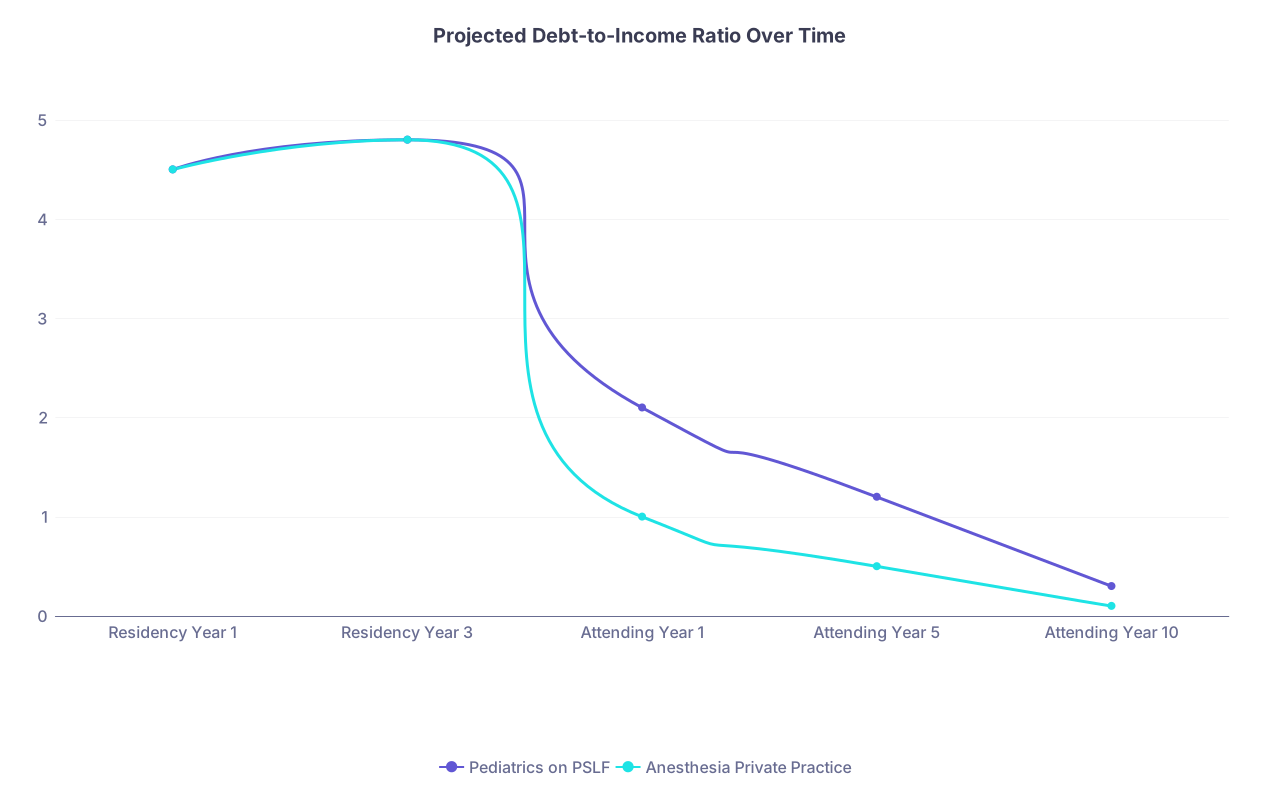
| Category | Pediatrics on PSLF | Anesthesia Private Practice |
|---|---|---|
| Residency Year 1 | 4.5 | 4.5 |
| Residency Year 3 | 4.8 | 4.8 |
| Attending Year 1 | 2.1 | 1 |
| Attending Year 5 | 1.2 | 0.5 |
| Attending Year 10 | 0.3 | 0.1 |
When you run this honestly, what you usually see is:
- The “rich” specialty pays loans off faster and creates more long-term net worth. That’s real.
- The “poor” specialty is often completely viable with PSLF/IDR and some intentional choices on location and lifestyle. Not glamorous early, but far from financial doom.
The responsible choice is not “maximize every dollar.” It’s:
Can I design the lower-paid path in a way that isn’t financially suffocating?
Step 5: Learn the Levers That Make a Low-Paying Specialty Work
This is where the rubber meets the road. If you’re going to choose a lower-paying specialty with high debt, you need to actually use the tools available.
Lever 1: PSLF and IDR – Use Them Intentionally
If you’re in the US and have federal loans, PSLF is not some scam myth. For many primary care, peds, psych folks it’s the single thing that makes your numbers work.
Smart ways to use it:
- Match at a 501(c)(3) or government hospital for residency and stay in qualifying jobs
- Get on SAVE/IDR early and stay on it
- Don’t refinance to private loans if PSLF is even remotely on the table
- Keep documentation and annual certifications tight
Is it subject to political risk long-term? Sure. But ignoring an existing legal program because “what if they cancel it” while you drown in payments is not rational either.
Lever 2: Location Arbitrage
A pediatrician making 250k in a low cost-of-living city who buys a 350k house and spends moderately can out-save and out-invest a 500k specialist stuck in San Francisco rent hell.
I’ve watched that play out repeatedly.
If you choose a low-paying field with high debt and insist on:
- Manhattan, SF, Boston, LA, or similar
- Private schools from kindergarten
- Luxury cars right out of residency
You will feel poor, stressed, and resentful. That’s not because of the specialty. That’s because of your choices.
If you instead:
- Pick a mid-tier city (think: Minneapolis, Columbus, Raleigh, Kansas City, etc.)
- Keep housing sane
- Delay the flashy stuff 3–5 years
You can absolutely build a solid financial foundation, even in peds or FM.
Lever 3: Niche, Extra Work, and Upside
“Low-paid” doesn’t mean you’re stuck at the bottom of the RVU food chain forever.
Real example patterns I’ve seen:
- Psych: General outpatient psych + telepsych moonlighting = substantial income bump without wrecking your life
- Family med: Do procedures (skin, joints, OB, addiction) or work in rural / under-served and your comp jumps significantly
- Peds: Inpatient shifts, NICU moonlighting, or urgent care peds on top of base salary
- Academic anything: Admin roles (program director, clerkship director), quality improvement leadership, or side consulting
You don’t need to become a workaholic. But being strategic about a niche and a slightly higher-intensity location/job can move you from “tight” to “comfortable.”
Step 6: Talk to the Right People (Not the Loudest)
You’ve probably heard some version of:
- “You’ll be fine, don’t worry about money, just follow your heart.”
- Or the opposite: “With your loans you’d be crazy to do X. You’ll regret it.”
Both extremes are lazy.
Find:
- One attending in your low-paying specialty who has high debt and is honest about it
- One attending in a higher-paid specialty who seriously considered something like peds or FM and can tell you why they didn’t
- One financially literate physician (any specialty) who can show you their actual plan and numbers
Ask them very specific questions:
- “What was your debt at graduation and what is it now?”
- “What do you actually take home monthly after taxes and retirement?”
- “What did you sacrifice to make this specialty work financially?”
- “When did you feel financially ‘okay’ for the first time?”
Listen less to attendings who:
- Paid off 60k in the 90s and now say “It always works out”
- Have a non-medical spouse pulling in 300k+
- Live an obviously inflated lifestyle but claim “You’ll be fine” without details
You want people who remember the grind and have receipts, not stories.
Step 7: Check Your Non-Negotiables
You are not just a walking debt number. You have real non-negotiables that alter the math:
- You absolutely want kids and want them before 35
- You must live near aging parents
- Your partner’s career locks you to a high cost-of-living city
- You or your partner have chronic health issues making extreme call/lifestyle specialties a bad fit
These matter more than a 100k salary difference in many cases.
If your partner is an engineer making 180k in a lower-cost city, guess what? Peds becomes a lot less scary. If your partner is an artist with no stable income and you both want three kids in New York City… then yeah, your choice of low-paying specialty becomes a bigger financial problem.
Make a short list:
- Where can I realistically live?
- Do I expect / want a dual-income household?
- What timeline do I have for major life goals?
Now compare: does the low-paying specialty + realistic financial strategy support those, or constantly fight them?
Step 8: How to Make the Decision Without Driving Yourself Crazy
You’re not going to get a 100% guaranteed right answer. You’re making a probabilistic bet on your future self.
Here’s a simple framework I use with people:

| Step | Description |
|---|---|
| Step 1 | High Debt Med Student or Resident |
| Step 2 | Choose Higher Paying Field You Like |
| Step 3 | Recheck Location and Lifestyle Assumptions |
| Step 4 | Consider Higher Paying but Acceptable Specialty |
| Step 5 | Choose Low Paying Specialty with Strict Plan |
| Step 6 | Low Paying Specialty Pulls You Strongly? |
| Step 7 | Debt to Income Reasonable with PSLF or IDR? |
| Step 8 | Willing to Move or Use PSLF? |
Translation:
- If you don’t feel a strong pull to a low-paying field, stop torturing yourself. Pick a higher-paying specialty you like and move on.
- If you do feel that pull, run your numbers with PSLF/IDR and location adjustments.
- If the math still looks absolutely terrible even with every rational lever pulled, then seriously consider a different field in the same “family” (e.g., hospitalist IM instead of outpatient pediatrics, or psych instead of peds, etc.).
- If the math looks tight but doable with discipline, and this is clearly what you want, then commit—with a written financial plan.
Step 9: Making Peace With the Tradeoff
The last part is psychological. I’ve seen people make perfectly viable choices and then ruin their own experience by constantly playing “what if” with ortho salaries in their head.
You cannot have everything. You know this.
If you pick pediatrics or family medicine or psych with high debt:
- Accept that you may not have the same house, car, or vacation photos as your derm classmates at year 5
- Decide in advance that this is an acceptable price for work you actually like
- Focus early years on debt strategy and financial literacy instead of lifestyle inflation
If you pick a high-paying specialty you’re lukewarm on:
- Accept that your workday might not light you up every time
- Use the financial upside aggressively: pay off debt fast, save enough to buy yourself optionality later (cut back FTE, academic drift, etc.)
- Don’t waste the advantage on mindless lifestyle creep
You’re not choosing good vs bad. You’re choosing which set of tradeoffs you’re willing to live with and not resent.
The Bottom Line
Three things I want you to walk away with:
- A low-paying specialty with high debt can absolutely be a responsible choice—but only if you’re honest about your numbers and willing to use tools like PSLF/IDR, sane geography, and modest early lifestyle.
- Choosing a higher-paying specialty you don’t like is not automatically the “mature” decision; it’s just a different risk—burnout, regret, and sometimes just as much financial chaos because spending expands with income.
- The right decision is the one where your career interest and a concrete, realistic financial plan both fit on the same page. If you can’t make the math and your non-negotiables live together, adjust the plan or the specialty—don’t just close your eyes and hope it works out.


