
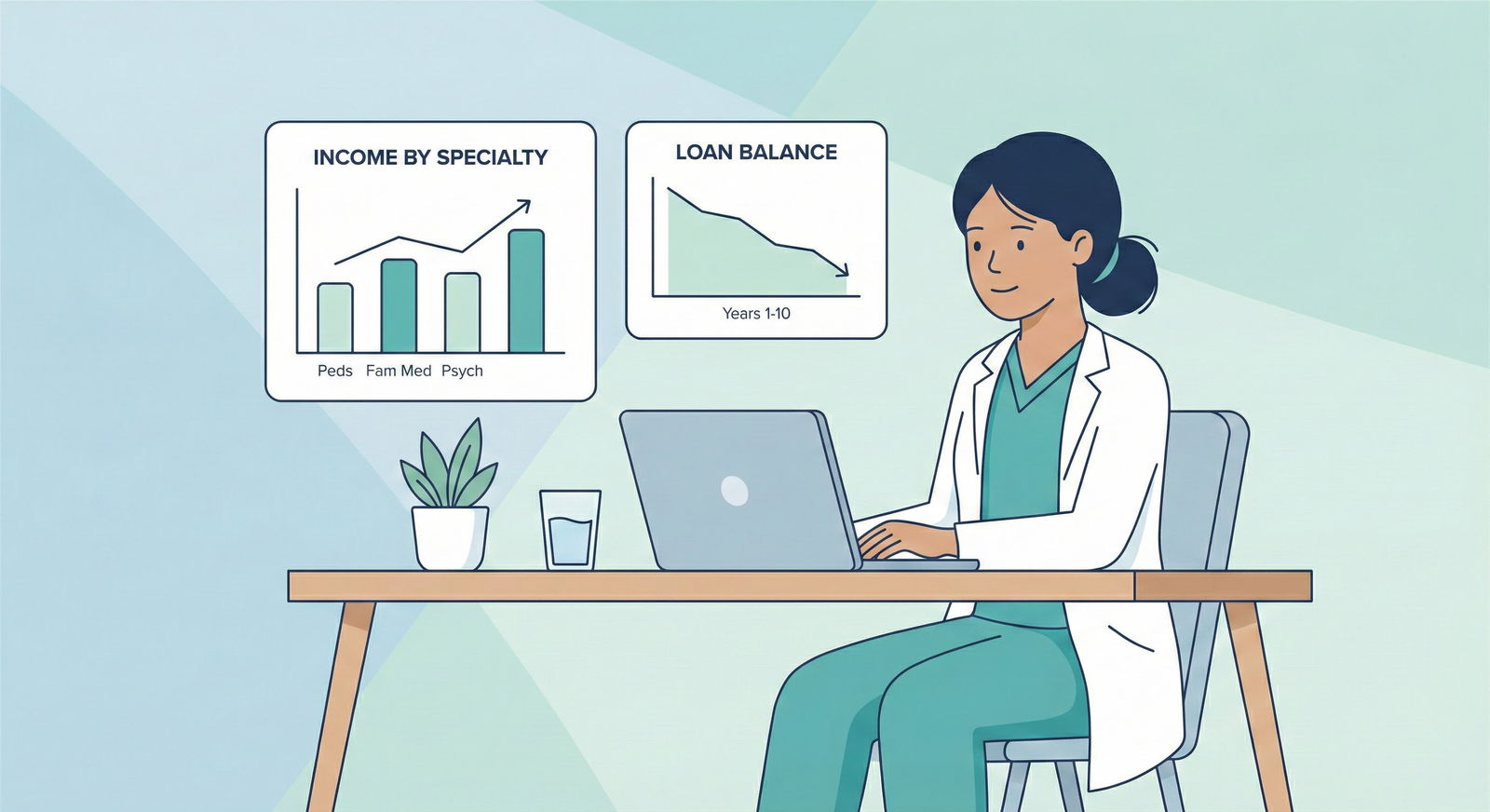
It’s 8:45 p.m. You just finished charting your last note in a community clinic. You’re a pediatrician, family med doc, psych resident, or maybe an academic hospitalist. You love your patients. You do real medicine. But the numbers keep hitting you: low RVUs, mediocre salary, high loans, and everyone online screaming about radiologists retiring at 50 and orthos buying their second vacation home.
You’re wondering: “I picked a low-paid specialty. Did I just kill any chance of early retirement?”
No. You did not. But the margin for error is smaller. You don’t get to be sloppy.
This is the playbook for you if you’re in (or headed toward) a lower-paid field and still want serious financial freedom by your 50s—or even 40s—without becoming a burned-out locums mercenary.
Let’s get specific.
1. Know What “Early Retirement” Actually Means for You
First thing: define the target or you’ll chase a fantasy.
For a low-paid specialty, “early retirement” realistically means one of three things:
- Classic FIRE: You stop working clinically entirely, live off investments.
- Coast / Barista FIRE: You scale down dramatically—0.3–0.5 FTE clinic, telehealth only, cash-work you enjoy—and your investments cover the rest.
- Financial independence with optional work: You could quit, but you keep doing 1–2 days/week because you like it.
The third is what most physicians actually want once they get close. But during intern year, you’re too tired to imagine that nuance.
Run your own numbers (not Instagram’s)
You don’t need a $10M portfolio. You need a number that matches your lifestyle.
As a rough rule of thumb:
- Annual spending × 25 = ballpark portfolio needed for full retirement.
- Annual spending × 15–20 = strong Coast / partial retirement territory.
So if you can live very comfortably on $120k a year:
- Full FIRE target ≈ $3M
- Coast / part-time freedom ≈ $1.8–2.4M
That’s the actual game.
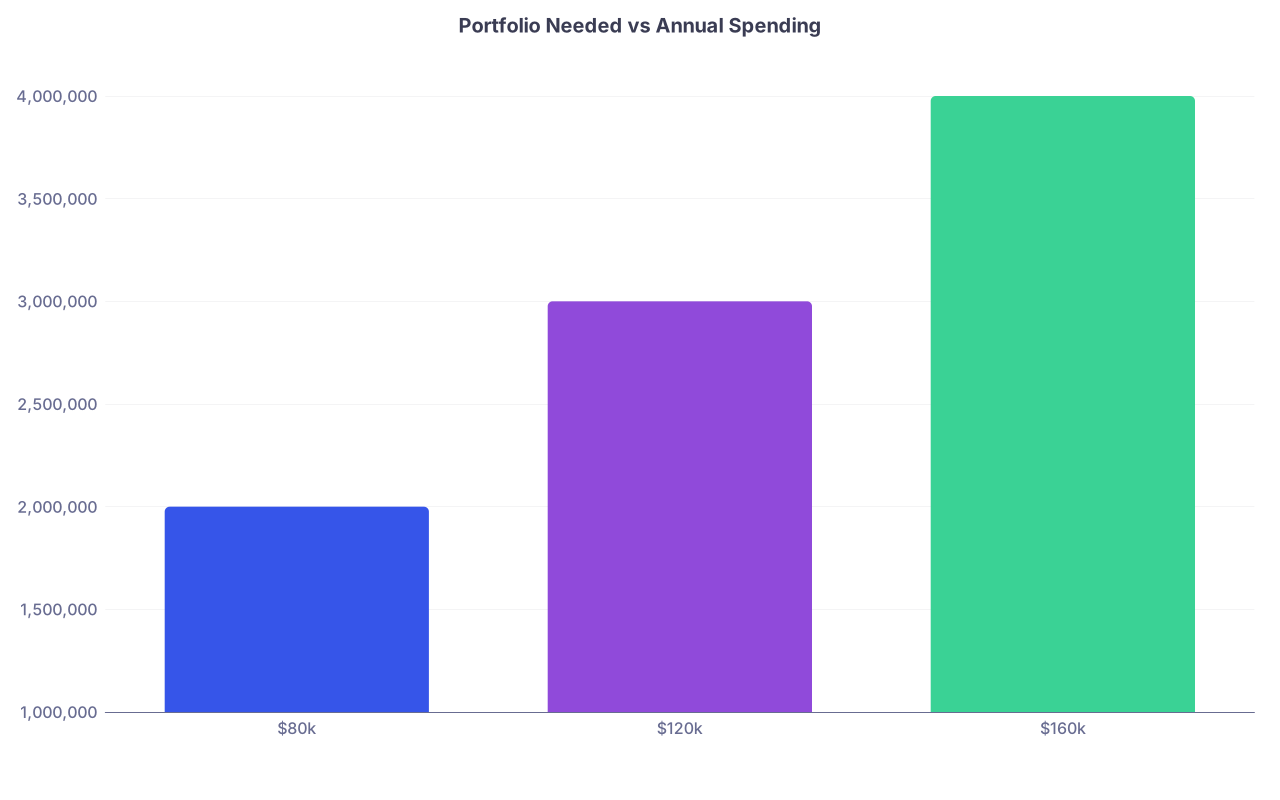
| Category | Value |
|---|---|
| $80k | 2000000 |
| $120k | 3000000 |
| $160k | 4000000 |
Low-paid specialties don’t kill early retirement. Lifestyle bloat does. Loan mismanagement does. Divorce can. Repeated bad job choices, definitely.
You’re playing a precision game, not a hopeless one.
2. Understand Your Specialty’s Real Financial Ceiling
If you’re in one of these:
- Pediatrics
- Family medicine
- General internal medicine (no procedures)
- Psychiatry (especially academic/CMHC)
- Geriatrics, palliative, adolescent med, addiction med
- Academic anything without heavy procedures
…then your default W-2 salary is likely to be in the bottom third of physician incomes.
But that’s the floor, not a fixed ceiling. There’s a spectrum.
| Role / Setting | Typical Range (USD) |
|---|---|
| Academic pediatrician | $170k–$230k |
| Community pediatrics (RVU) | $210k–$280k |
| Family med FQHC | $190k–$250k |
| FM outpatient private group | $230k–$320k |
| Outpatient psychiatrist | $220k–320k |
| Psych in high-demand markets | $280k–$400k+ |
What matters for early retirement is NOT the national median.
What matters:
- Your first 10 years post-residency income.
- How fast you ramp from “new attending” to “above-average earner in your field.”
- Whether you avoid the trap jobs that lock you into low raises and bad RVU contracts.
So while you’re in residency/fellowship:
- Talk to recent grads in your specialty. Ask what they actually make, not what MGMA says.
- Ask attendings: “If you had to maximize income in this specialty without burning out, what job structures would you pick?”
You’ll hear the patterns. “Avoid this chain.” “Don’t take the first VA offer.” “Do not sign a contract with unlimited work RVUs and terrible base.”
3. Solve the Loan Problem Early and Aggressively
You cannot plan early retirement from a low-paid specialty while winging your student loans. That combo kills your future.
You have exactly two rational lanes:
- Commit to PSLF / IDR forgiveness.
- Or commit to fast(ish) private refinance and pay-off.
Drifting in between is financial malpractice.
Lane 1: PSLF / IDR (great for low-paid specialties)
Low-paying specialties are often perfect PSLF candidates:
- You’re likely to work in non-profit hospitals, FQHCs, academics, VA, CMHC.
- Your income vs debt ratio may make IDR payments much more manageable early on.
- You get tax-free forgiveness at 10 years of qualifying payments.
Big mistakes I see constantly:
- Not consolidating FFEL or Perkins loans early.
- Switching jobs and breaking PSLF-qualifying employment without realizing.
- Forgetting to certify employment yearly.
- Paying extra toward loans while on track for PSLF (completely wasted).
If you’re in residency/fellowship right now in a qualifying institution, you should almost always:
- Be on SAVE or another IDR plan.
- Be submitting PSLF certification yearly.
- Not be overpaying.
You’re “buying” low mandatory payments now in exchange for long-term forgiveness—and that opens space for you to invest aggressively while young.
Lane 2: Refinance and crush
If:
- You’re not at a 501(c)(3) or PSLF-eligible employer
- You’re in private practice or for-profit systems long-term
- You hate the idea of 20–25 year IDR forgiveness
Then the play is:
- Refinance to the lowest rate you can get safely.
- Aim to kill the loans in 5–10 years.
- Accept some lifestyle compression early.
The key choice: lock this in the first year or two as an attending. Not after a decade of minimum payments.
4. Your First 5 Attending Years: Where You Win or Lose
You cannot slack on your first 5 years post-residency if you want early retirement from a low-paid specialty. That’s when your habits, baseline lifestyle, and savings rate get set. After that, everything hardens.
Here’s the rough framework I recommend for low-paid specialties:
Year 0–1 (final year of residency / early attending):
- Track every dollar you spend for 3–6 months. No guesswork. Know your burn rate.
- Keep lifestyle at “resident plus 30–40%,” not “quadruple.”
- Automatically save/invest at least 20% of gross income from your very first attending paycheck. Even 10% in month one is better than “I’ll start later.”
Year 2–5:
Your core move is to push your savings rate to 25–35% of gross, if you want meaningful early retirement options.
That usually looks like:
- Max 401(k)/403(b): currently $23k–$24k range per year (adjusts with inflation).
- Max Roth IRA or backdoor Roth: $6.5k–$7k range.
- Contribute to HSA if offered: triple-tax-advantaged, treat it like a stealth IRA.
- Extra into taxable brokerage.
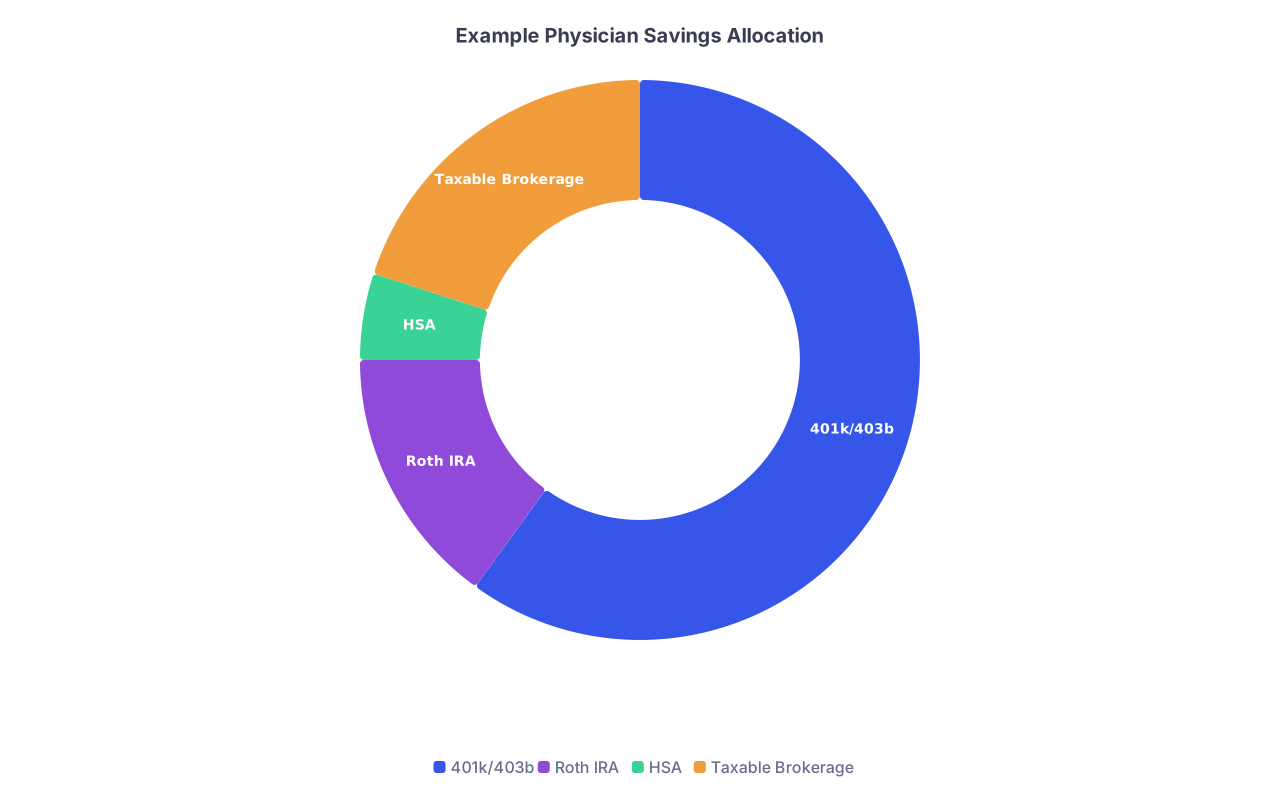
| Category | Value |
|---|---|
| 401k/403b | 60 |
| Roth IRA | 15 |
| HSA | 5 |
| Taxable Brokerage | 20 |
You’re not doing anything exotic. Just aggressively consistent.
5. Use Your Specialty’s Hidden Income Levers
Low-paid specialties often have non-obvious ways to increase income that don’t involve becoming a proceduralist.
Let’s run through some practical ones.
Family Med / IM / Peds
You can:
- Negotiate panel size vs comp: some RVU structures quietly underpay. Others reward productivity decently once you understand them.
- Do after-hours telemedicine: a few evenings a week, structured and scheduled, can add $20–40k/year.
- Layer in urgent care shifts: short runs of urgent care or quick-care work (judiciously) during first 3–5 attending years can accelerate savings.
Psychiatry
Honestly, psych is “low-paid” mostly on paper. Demand is huge. You can:
- Do part-time private practice with cash pay or high-paying commercial insurance.
- Offer niche services: ADHD evals, autism evals, forensic work, consultation hours.
- Structure hybrid W-2 + 1099: keep benefits from a base job, add 1–2 half-days of private work.
Academic roles
Academics pays in prestige, teaching satisfaction, and usually awful salaries. You’re trading money for mission.
If early retirement matters to you and you love academics, you probably need:
- Some side clinical work (moonlighting, telemed).
- To be brutally clear how long you want to stay academic.
- To seek leadership/medical director roles that come with stipends and partial admin time.
6. Control Lifestyle Creep Without Living Like a Monk
This is where low-paid specialties either win or die.
You will watch radiology friends buy Teslas and 4,000 sq ft houses at 33. If you copy them on a peds or FM salary, you’ll work forever. That’s just math.
Your job is not to live like a student forever.
Your job is to:
- Buy a house that’s comfortably below what the bank says you can afford.
- Limit car payments (one reasonable car at a time, avoid serial leasing).
- Cap fixed monthly obligations. Subscriptions, daycare, private school, 3rd streaming service, etc.
Here’s the mental framework:
- Every $10k/year of permanent lifestyle upgrade (house, car, etc.) requires about $250k more in retirement portfolio to sustain.
- Stack four of those? You just added $1M to the number you need to retire.
That’s why people in low-paid specialties feel stuck. Not because of the specialty. Because of silent, incremental lifestyle commitments.
7. Invest Simply, Automatically, and Long-Term
You are not going to “side-hustle” or day-trade your way to financial independence more efficiently than you can just consistently shovel 25–35% of your income into boring diversified investments.
If you want early retirement, you:
- Put your retirement accounts in low-cost index funds (US total stock, international, maybe some bonds).
- Use a simple allocation you can stick to: something like 80/20 stocks/bonds in your 30s–40s, dialed per your risk tolerance.
- Automate the contributions. You should not be manually moving money every month.
Your edge as a physician is steady high income, not financial brilliance. When that income is “only” $220–250k vs $450k, you can’t afford big mistakes:
- No whole life insurance as an “investment.”
- No speculative real estate with no reserves.
- No gambling with options because TikTok said so.
Simple, boring, automatic wins.
8. Build a Timeline You Can Actually See
“Retire early someday” is vague. Put dates and numbers on it.
You might map something like this:
- Age 30–34: Residency/fellowship. PSLF clock running or IDR payments minimized. Learn the basics of personal finance.
- Age 34–40: Early attending. Savings rate ramps to 25–35%. Kill bad debt. First $500k–800k net worth.
- Age 40–45: Peak earning years in your low-paid specialty—but now you’re competent, more efficient, hiring leverage. Cross $1.5–2M invested.
- Age 45–50: Decision point. Either scale back to 0.5 FTE, pure telehealth, niche consults, or go full FIRE depending on portfolio and burnout level.
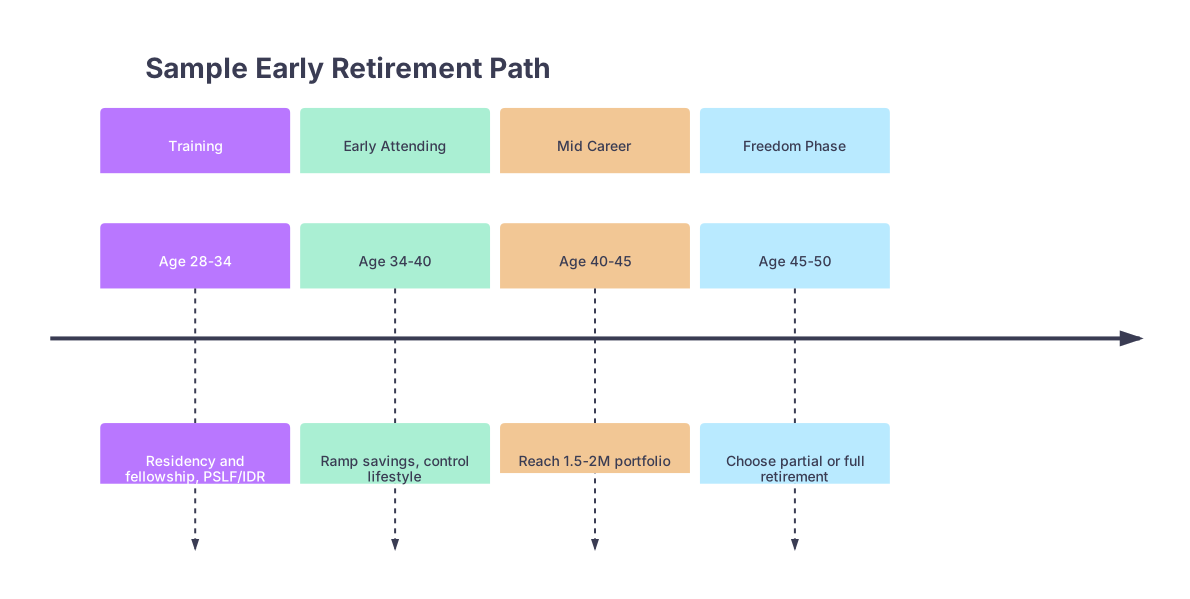
| Period | Event |
|---|---|
| Training - Age 28-34 | Residency and fellowship, PSLF/IDR |
| Early Attending - Age 34-40 | Ramp savings, control lifestyle |
| Mid Career - Age 40-45 | Reach 1.5-2M portfolio |
| Freedom Phase - Age 45-50 | Choose partial or full retirement |
That’s one scenario. You adjust for your age, debt, location, and family setup. But you need something like this written down.
9. Guardrails So You Don’t Blow It
If you’re in a low-paid specialty and serious about early retirement, you should avoid these traps:
Buying the “forever house” in year 1 of attending life.
Rent 1–2 years. Learn your job, your city, your spouse’s commute, your call schedule. Then buy.Underinsuring your biggest risks.
Disability insurance. Term life insurance if anyone depends on your income. This is boring but essential. You retire early by choice, not from an accident at 36.No plan for kids’ expenses.
If you want private school, multiple kids, and early retirement on a pediatrics salary, something has to give. Put all three on paper. Decide consciously.Staying too long in a bad-compensation job “for loyalty.”
Three years underpaid can cost you hundreds of thousands over your career. Do your job well, but don’t martyr your financial future to a broken system.Letting lifestyle drive your career decisions.
If your mortgage and car payments force you into picking the highest-paying but most miserable version of your specialty, you just killed the whole point of early retirement.
10. What to Do Right Now (Phase-by-Phase)
Let’s get concrete by where you are.
If you’re a med student choosing a low-paid specialty
- Ignore the “you’ll never make money in peds” noise. But do go in eyes open.
- Learn basic personal finance now. Books, podcasts, or one good blog beats TikTok.
- Avoid excessive loans for prestige. Community med school + peds > fancy MD + $450k loans.
If you’re a resident/fellow in a low-paid field
- Get your loan strategy nailed down this year. PSLF vs refinance path. No ambiguity.
- Start investing something in Roth IRA if you can. Even $100/month builds habit.
- Collect real compensation data from recent grads. Build a mental map of “good jobs” vs traps.
If you’re 0–5 years out
- Freeze your lifestyle for 12–24 months. Use that period to:
- Max retirement accounts.
- Build an emergency fund (3–6 months of expenses).
- Refine your budget.
- If your job pays poorly even by low-paid specialty standards, be ready to change.
If you’re mid-career and behind
You’re 40–45, low-paid specialty, little saved. It’s not over, but you’ve lost some compounding. So:
- Increase income where possible: a better job, some moonlighting, small private practice on side.
- Hit 30–40% savings rate for a 5–10 year sprint. Yes, it’s a sprint. Yes, it’s uncomfortable.
- Reset expectations: maybe not retiring at 50, but 55–60 with genuine flexibility is still a huge win.
FAQ (Exactly 5 Questions)
1. I’m going into pediatrics with $350k in loans. Is early retirement even realistic for me?
Yes, but you have to be disciplined. If you use PSLF correctly, choose at least a mid-range-paying peds job (not the absolute bottom of the scale), keep lifestyle modest your first 5 attending years, and save 25–30% of your income once loans are handled or forgiven, you can absolutely hit financial independence in your 50s or earlier. If you ignore loans, buy the big house early, and never increase savings beyond 10–15%, then no—your specialty plus your choices will box you in.
2. Should I avoid academics if I care about early retirement?
Not automatically, but you should be cautious. Academic pay can be brutally low in primary care fields. If you love teaching/research, you can still do academics, but you probably need one or more of: side clinical work (moonlighting, telemed), a partner with significant income, or a time-limited plan (e.g., 5–7 years academic, then transition). Blindly locking yourself into a $180k academic job for 25 years while holding big loans is a recipe for permanent financial stress.
3. How big a deal is it if I start “serious” saving at 40 instead of 30?
It’s a huge deal. The first decade of compounding is where your contributions have the most time to grow. If you start at 30 and invest $30k/year at 7%, you’ll likely have around $1.5M by 55. If you start at 40 with the same numbers, you’re closer to $600–700k. So starting late means you either work longer, save more aggressively, or both. Late is better than never, but it’s not equivalent.
4. Do I need side hustles outside medicine (real estate, businesses) to retire early in a low-paid specialty?
No. They can help, but they’re not mandatory. For most low-paid specialties, the highest-yield move is still: pick a decent-paying job in your field, control lifestyle, and invest 25–35% of income in boring diversified index funds. Real estate or businesses can accelerate things if done well, but they come with risk, time, and distraction. If you do them, treat them as advanced moves once your core financial habits are solid.
5. How do I talk about money with a spouse/partner who doesn’t care about early retirement?
You make it concrete, not theoretical. Instead of “I want to retire early,” try: “I want us to be in a position by 50 where we can both cut back to 2–3 days a week if we want, travel more, and not stress about bills.” Then show numbers. One evening, lay out: current income, spending, loans, what it would take for that scenario. Ask what they would want their 50s to look like. Most partners don’t care about “FIRE,” they care about options, time, and less stress. Frame it around that, not some internet acronym.
You chose a specialty that actually takes care of people. That choice did not kill your financial future—you just gave up the luxury of being financially sloppy. With clear targets, a strong first 5–10 years as an attending, and a refusal to let lifestyle balloon faster than your savings rate, you can absolutely build real freedom on a “low-paid” income.
Once you’ve sketched your numbers and tightened the early years, the next step is optimizing job choice—finding the specific roles in your specialty that pay fairly, respect your time, and still leave room for a life. That’s the next level of this game, and it’s where your early retirement timeline either speeds up or slows down. But that’s a story for another day.


