

The money conversation in dual-physician couples is usually dishonest.
Everyone pretends, “We’re both doctors, we’ll be fine.” Then one of you picks peds, psych, FM, heme/onc academia, or another low-paying path while the other drifts toward ortho, derm, gas, radiology, EM, or a procedural subspecialty — and suddenly the lifestyle you both imagined rests on one person’s paycheck.
If you’re in a dual-physician relationship where one chooses a low-paying specialty, you have three problems to solve:
- Money (obvious).
- Power and resentment (less obvious, more dangerous).
- Long-term lifestyle design (what your actual life looks like at 40, not 28).
I’m going to walk you through what to actually do. Not theory. The actual scripts, numbers, and decisions you need to put on the table now — early residency through first attending job.
Step 1: Get Brutally Clear On What “Low-Paying” Actually Means
Stop saying “we’ll be fine” and start writing down numbers.
Here’s the rough reality in the U.S. (these are typical ranges, not the shiny “top 10%” outliers):
| Category | Example Specialties | Typical Range (USD) |
|---|---|---|
| Primary Care | FM, IM, Peds | 220k–320k |
| Cognitive Subspecialty | Endo, Rheum, ID, Psych | 230k–350k |
| Hospital-based Mid | EM, Anesthesia, Cards IM | 350k–500k |
| Surgical/Procedural | Ortho, Derm, ENT, GI, Rad | 450k–900k+ |
| Academic Track (any) | Most fields in academia | 180k–300k |
The “low-paying” partner is usually:
- Primary care (FM, peds, general IM)
- Psychiatry (outside private, high-RVU setups)
- Academic anything
- Some non-procedural subspecialties (ID, rheum, palliative, geriatrics)
You need to anchor to actual combined after-tax income, not gross fantasy numbers.
Let’s say:
- Partner A: Ortho → 700k
- Partner B: Pediatrics academic → 230k
Combined gross: 930k. Sounds insane. People will tell you you’re rich and should “just stop worrying.”
Reality after taxes, retirement contributions, loan payments, childcare, and living in a HCOL area? You can absolutely overspend your way into being “doctor-poor” on that income if you’re undisciplined and if the higher earner is silently underwriting everything.
So first move: write down rough post-residency numbers.
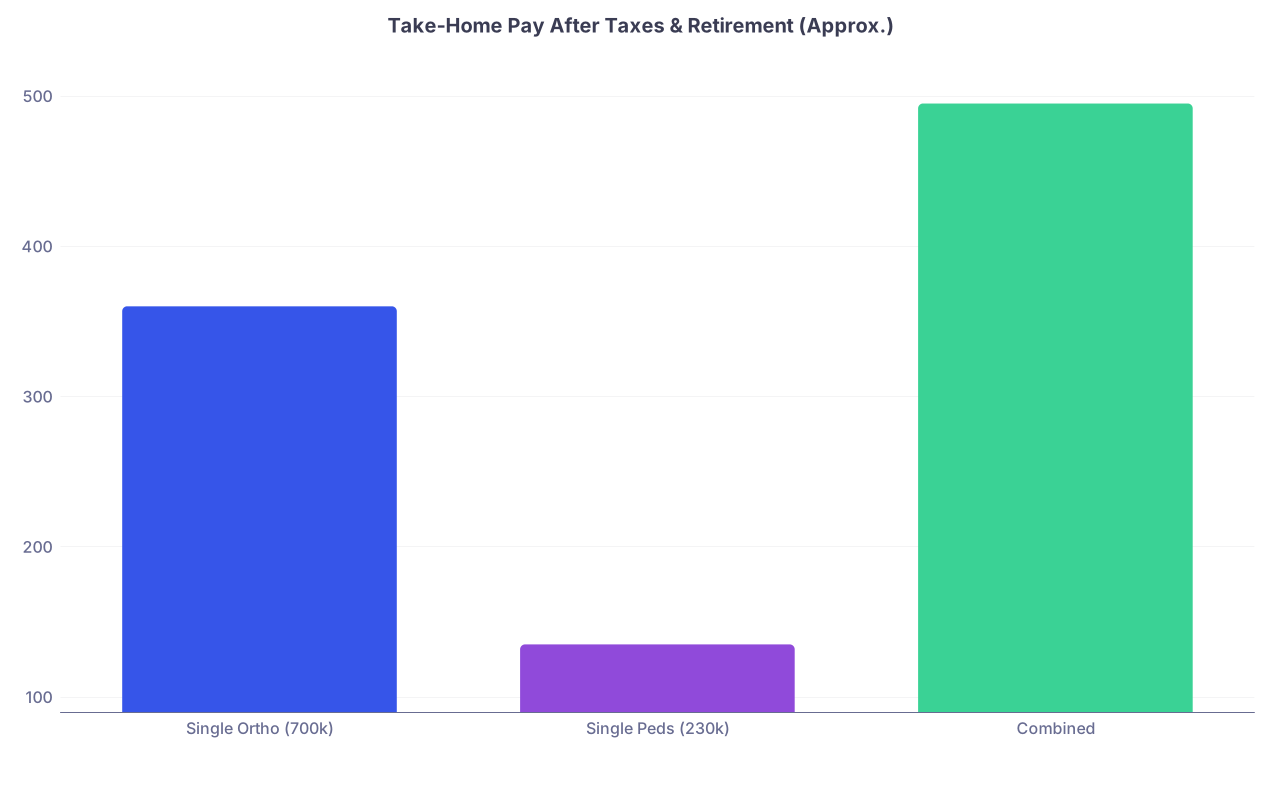
| Category | Value |
|---|---|
| Single Ortho (700k) | 360 |
| Single Peds (230k) | 135 |
| Combined | 495 |
Assumptions: high-tax state, ~30–35% effective tax plus 15–20% retirement savings. Numbers are rough but directionally correct.
Do this with your own projected salaries, not mine. Use realistic, mid-range offers, not best-case scenarios.
Step 2: Decide Up Front: Are You A “True Partners” Couple Or A “Roommates With Separate Wallets” Couple?
You don’t need a perfect model. You do need the same model.
I’ve seen three main setups:
Fully pooled money
“Our money is our money. We both work, we both spend, we both save.”
Works well if:- You have similar spending habits and values.
- You both accept that one might work harder/earn more at times but you’re still a team.
Proportional contribution
Bills are split based on percentage of income.
If Partner A earns 70% of income, they cover 70% of joint expenses.
Good for couples where:- There is a large and persistent pay gap.
- The lower earner wants to avoid feeling “subsidized” but can’t reasonably afford 50/50.
“Equal share” roommates model (most toxic in this scenario)
50/50 for everything.
Works only if incomes are similar. When one of you is derm and the other is peds? This is how resentment and secret credit card debt are born.
If one partner chooses a low-paying specialty and the other chooses a high-paying one, the default “equal 50/50 on everything” usually punishes the lower earner and quietly gives power to the higher earner.
My opinion: For dual physicians with a big pay gap, either fully pooled or proportional contribution is healthiest. The “we each pay 50% of everything” model is childish in this context.
Step 3: Have The Hard Conversation Before Matching (Or As Early As Possible)
You need one serious, sit-down conversation. Not half-joking bedside comments on a post-call Sunday.
Use clear prompts:
- “When we’re attendings, what lifestyle do you picture? House size, cars, travel, kids, private school vs public?”
- “If one of us makes 2–3x the other, how do we want to handle joint expenses?”
- “Is there a number where you’d be comfortable with me going part-time (or vice versa)?”
Script you can use (adapt as needed):
“We’re not the typical couple where one person is non-medical. We’re both physicians, but our incomes will not match. I do not want this turning into quiet resentment later. Can we talk openly about what we each expect with money, call schedules, and childcare when our salaries are different?”
If your partner dodges, dismisses, or shames you for wanting clarity, that’s not a money problem. That’s a relationship problem.
Step 4: Build A Joint Life Plan Around The Lower Income, Not The Higher One
This is the trick that almost no one uses, and it’s where couples get burned.
Plan your fixed lifestyle (mortgage, cars, daycare, base spending) as if you only had:
- The low-paying specialty salary
OR - The mid-point between you, not the total
Why? Because:
- The high earner might want to cut back later (burnout, health issues, academic switch).
- You might need/want to drop to 0.8 FTE for kids, elder care, or sanity.
- Medicine is volatile. Reimbursement changes. Group structures implode. Private equity gets weird.
So if Partner A (high earner) says, “We can easily afford a 1.5M house” and Partner B (lower earner) looks sick — listen to that. That’s your early warning.
Better framing: “Could we handle this mortgage on just the peds salary plus a modest part-time ortho income if we had to?”
If the answer is no, you’re stretching too far.
Step 5: Explicitly Protect The Lower Earner From Financial Power Imbalance
Money drives leverage. Leverage drives who gets to say no.
If one of you is pulling in 500–800k and the other is at 200–300k, and you structure your life around the higher income, this is what happens:
- Vacations are at the high earner’s comfort level.
- Neighborhood/house choice reflects the high earner’s risk tolerance.
- Private school vs public decisions get anchored to the “bigger” salary.
- The lower earner starts feeling like a “junior partner” at home, even if they work harder hours.
You solve this in a few ways:
Written agreements on savings goals
“We’ll save X% of combined income for retirement and Y% for kids’ college before we upgrade lifestyle.”Each partner gets individual “no-questions-asked” spending money
Same dollar amount, not the same percentage.Big decisions require two yes’s, not one
New house, private school, job change, extra car, second property? If either of you says no, it’s a no. Even if the high earner could pay for it alone.
Step 6: Talk Call, Hours, and Emotional Labor — Not Just Paychecks
Low-paying specialties often bring different types of strain:
- Pediatrics, FM, psych: often lower salary, but longer emotional drain, complex patients, more unpaid admin.
- Ortho, surgery, interventional: higher pay, more OR time, intense call, physical fatigue.
The danger is obvious: the higher earner says, “I work more and I make more,” and quietly expects the lower earner to absorb more housework and childcare because “they’re home more.”
I’ve watched this blow up more marriages than money itself.
You need to divide:
- Nights
- Weekends
- Kid pickups/drop-offs
- Sick days
- House admin (bills, groceries, logistics)
Based not only on schedule but on fairness.
If peds-spouse has a technically shorter schedule but is annihilated emotionally by child abuse cases, social work chaos, and constant parent demands, that matters. That’s work. Treat it as such.
Step 7: Decide How You’ll Handle Loans With Unequal Incomes
Big one. You two probably do not have the same:
- Loan balances
- Interest rates
- PSLF eligibility
- Tolerance for debt
You have to pick a lane:
Each pays their own loans
Works if:- Incomes are similar
- You’re doing separate or proportional finances
Loans are a shared marital problem
Common when:- You fully pool finances
- One has massive loans and much lower income (e.g., academic peds on PSLF, partner in private surgical practice)
If the low-earner is PSLF-eligible (peds at children’s hospital, psych at county, FM at FQHC) and the high-earner is private practice, the combined plan can get messy:
- Filing taxes separately vs jointly impacts IDR payments.
- High-earner income can blow up low-earner’s PSLF payment amount.
This is where you sit with an actual student loan specialist / planner and run the numbers.
Core principle though: if you’ve decided you’re “true partners,” then your combined loan picture is a joint optimization problem, not “your debt vs my debt.”
Step 8: Protect The High Earner From Quiet Martyr Syndrome
The high earner is at risk of becoming The Bank. When that happens, resentment gets… creative.
Signs:
- They start saying things like, “Well, I’m the one paying for X” in arguments.
- They subtly veto your lower-paying academic job because “we can’t afford less.”
- They brag about their salary more than is comfortable.
- Or the opposite: they never mention it but you can feel the weight of “I must not disappoint the family financially.”
If you are the high earner, here’s what you should not be doing:
- Using your income as leverage in arguments.
- Unilaterally deciding big purchases because “I’m paying anyway.”
- Expecting the low-earning partner to accept a career they hate just to keep up.
What you should be doing:
- Explicitly saying, “I don’t want you choosing jobs based only on money. I chose a higher paying specialty understanding I’d carry more financial weight. That’s part of my choice, not your burden.”
- Making sure major financial decisions are joint decisions.
- Being honest about your own burnout risk. Money does not immunize you from misery.
Step 9: Make An Exit Plan For Either Of You To Cut Back Later
Assume that at some point:
- Someone gets sick.
- Someone burns out.
- Someone wants research, admin, or teaching instead of pure RVU grind.
- Someone wants to go 0.6–0.8 FTE when kids show up.
If you’ve built your entire life on the high earner’s full-time grind and the low earner’s “extra,” you’re trapped. That’s a brittle system.
You want resilience:
- Could you cover essentials (mortgage, food, insurance, core childcare) on 1.2 FTE between you?
- Could either of you switch to a lower-paying but higher-satisfaction job without your life collapsing?
Write an actual line in the sand:
“Once our combined loans are paid off and we’ve hit $X in retirement savings, we give each other permission to reduce to Y FTE if we want.”
That one sentence turns a vague dream into a concrete shared goal.
Step 10: If You’re Still In Training: Here’s What To Do This Year
I don’t care if you’re PGY1 or PGY6 — you can start stabilizing this now.
Concrete moves:
- Run a realistic post-training budget based on both specialties.
- Decide your money model: fully pooled vs proportional vs some hybrid.
- Pick a “lifestyle anchor” — usually near what the lower earner alone could sustain.
- Have the debt/PSLF/tax filing conversation with actual numbers.
- Schedule a 60–90 minute “life design” talk once a year: jobs, geography, kids, hours.
And one thing you probably don’t want to hear:
If you’re the one choosing the low-paying specialty, be honest about it. Own it.
Say:
“I’m choosing this field knowing it pays less. I’m not asking you to subsidize my denial of that fact. I am asking that we build a life that doesn’t make me feel like a second-class partner because of it.”
That level of clarity is rare. It also earns you a different level of respect.

| Step | Description |
|---|---|
| Step 1 | Both in Training |
| Step 2 | Talk Money Expectations |
| Step 3 | Estimate Future Income |
| Step 4 | Fully Pooled |
| Step 5 | Proportional |
| Step 6 | Plan Lifestyle on Lower Income |
| Step 7 | Discuss Loans and PSLF |
| Step 8 | Set Savings and Cutback Goals |
| Step 9 | Annual Check In |
| Step 10 | Specialties Chosen? |
| Step 11 | Money Model? |

Quick Reality Check: When This Works Beautifully
I’ve seen dual-physician couples absolutely crush life with one lower-paying specialty:
- EM + academic pediatrics couple who capped their life at what peds could cover. EM partner went 0.7 FTE at 40 with zero drama.
- Ortho + FM where everything was fully pooled; they aggressively paid off loans, saved like lunatics early, then both traded down to calmer jobs.
- Psych + anesthesia where psych partner on PSLF intentionally stayed in a lower-paying county job, anesthesia went private, and they treated PSLF and anesthesia bonus checks as shared assets, not “mine vs yours.”
Common factor in the success stories: honesty early, joint decisions, and zero illusion that all physician incomes are equal.

| Category | Value |
|---|---|
| Anchored to High Earner | 80 |
| Anchored to Combined | 40 |
| Anchored to Low Earner | 15 |
(Values represent relative “risk of feeling trapped” — not exact stats, but the pattern holds. Highest when anchored to the highest income.)
FAQ (Exactly 4 Questions)
1. Is it “unfair” if the higher-earning partner pays more of the bills?
No. It is only unfair if it is unspoken, resented, or used as leverage. If you both agree that money is pooled or that contributions are proportional to income, that is not unfair; that is rational. The unfairness shows up when one person pretends to be okay with it but secretly feels exploited, or when the high earner later weaponizes their contribution in conflicts.
2. Should the lower-earning partner feel guilty for choosing a less lucrative specialty?
Guilt is useless here. You should feel responsible, not guilty. Responsible for understanding the financial impact of your choice, for being honest about what your salary can and cannot support, and for engaging as an equal adult in planning your joint life. If you’ve done that, and your partner has chosen to stay in the relationship with full awareness, guilt is just emotional noise.
3. Is keeping completely separate finances the best way to avoid power issues?
Usually not for married dual physicians with big income gaps. Fully separate finances can actually increase power imbalances because the high earner can afford much more private life than the lower earner. It also undermines the sense that you’re building something together. A hybrid (pooled for joint goals and needs, separate “fun money” accounts) tends to work better in practice.
4. What if we completely disagree on lifestyle — one of us wants a “doctor lifestyle,” the other wants to be frugal?
Then you have a values problem, not a specialty-income problem. You can compromise on house size or vacation frequency; you cannot fix a fundamental mismatch where one person needs constant visible status and the other wants security and options. You sit down, you run actual numbers, you name your non-negotiables, and if the gap is still huge, you have to be honest: that’s not a math issue. That’s a relationship compatibility issue, and it might not be fixable with spreadsheets.
Key points to leave with:
- Build your shared life on the lower income, not the higher one.
- Decide explicitly how money, loans, and big decisions are shared — don’t drift.
- Protect both partners from resentment by treating income differences as a joint design problem, not a quiet power struggle.


