

The most dangerous residency programs are not always the most malignant. The most dangerous are the ones that quietly underpay you and fail to support you, while smiling through recruitment season.
If you match into an undersupported, low-paid program in a low-paid specialty, you can dig yourself into a five- to ten‑year hole before you even realize what happened. I have watched residents do this. They thought they were being “grateful to match.” They were being set up.
Let me walk you through the traps so you do not become one of them.
1. The Quiet Trap: Low-Paid Specialty + Low-Paid Program
There is a world of difference between choosing a low‑paid specialty at a solid, well‑resourced program and choosing that same specialty at a chronically underfunded, understaffed residency that pays at the bottom of the market.
Choosing the first is a values decision. Choosing the second is often a mistake.
Low‑paid specialties (on average):
- Pediatrics
- Psychiatry
- Family Medicine
- Internal Medicine (categorical, non‑hospitalist track)
- Geriatrics, PM&R, some pathology and OB‑GYN roles relative to others
Now combine them with a residency that:
- Sits in the bottom 10–20% of pay for the region
- Offers minimal or no meal stipends, parking, or housing support
- Has thin faculty coverage, frequent unfilled rotations, or high attending turnover
- Has few fellows or mid‑levels to help shoulder clinical load
That is where residents get crushed.
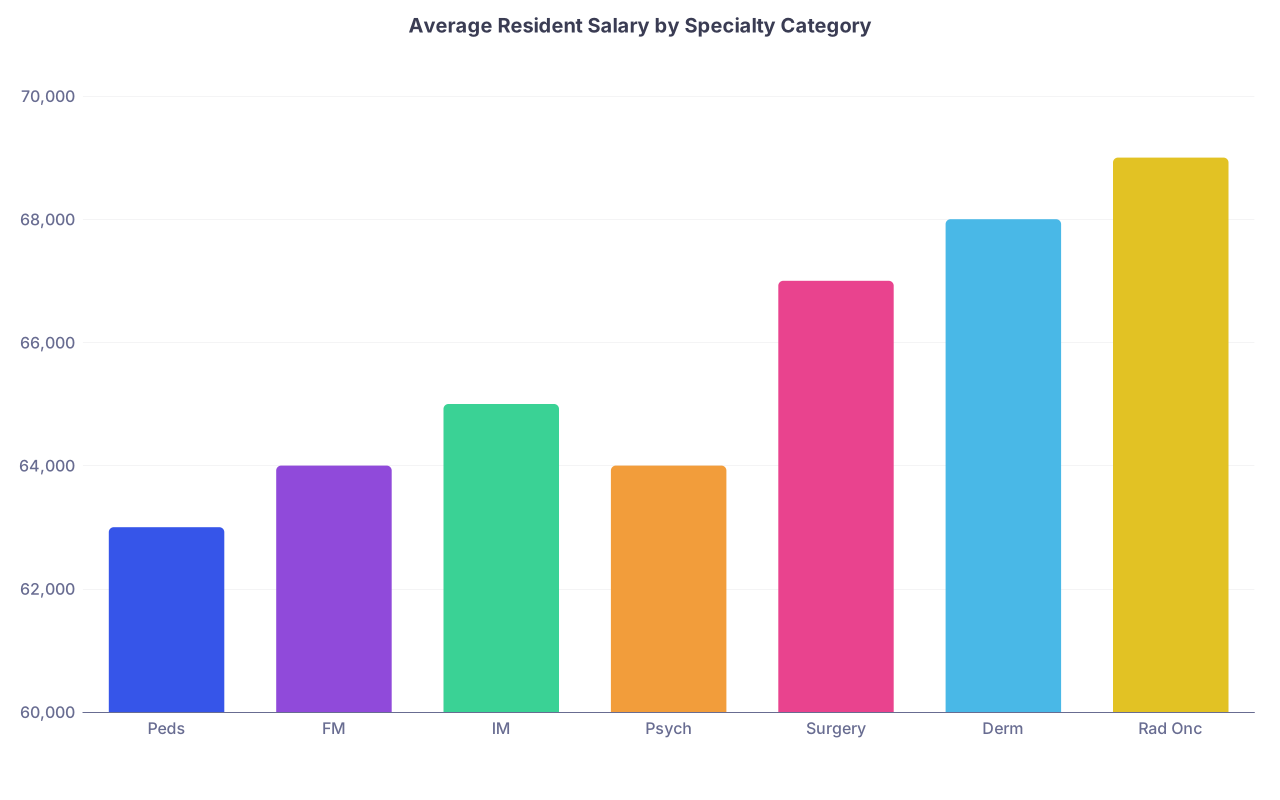
| Category | Value |
|---|---|
| Peds | 63000 |
| FM | 64000 |
| IM | 65000 |
| Psych | 64000 |
| Surgery | 67000 |
| Derm | 68000 |
| Rad Onc | 69000 |
Note: resident pay is usually set by institution, not specialty, but the programs and hospitals that cluster certain low‑paid specialties often also cluster poor funding and weaker benefits. You see it in community pediatrics, bare‑bones family medicine, or psych programs bolted onto struggling safety‑net hospitals.
The mistake is assuming “all residencies pay about the same and support is probably fine.” They do not. And in the lowest‑paid specialties, that gap hurts more.
You are already picking a specialty with flatter lifetime earnings. Pair that with:
- Higher local cost of living
- Minimal benefits
- Poor moonlighting options
- Weak training support
and suddenly your “I’ll be fine, I’m a doctor” narrative collapses under reality.
2. Red Flags: How Undersupported, Low-Paid Programs Reveal Themselves
Programs rarely tell you: “We are underfunded and you will feel like free labor.” But the signs are there if you stop drinking the “we are a family” Kool‑Aid.
Structural red flags
These are not subtle:
Residents working constant extra hours off the clock
You hear: “We try not to log all the hours; it just creates problems with ACGME.” Translation: you will work 70–80 hours labeled as 60.Chronic violation of work‑hour rules without a real reporting mechanism
You hear: “Technically we report, but it goes nowhere.” That is not “flexibility.” That is exploitation.High PGY-2+ attrition
If you see 10 PGY‑1s, 7 PGY‑2s, 6 PGY‑3s, people are voting with their feet.No dedicated chief time or chiefs doing full‑time clinical load
This means administrative chaos and no one to advocate for residents.Very few advanced practice providers, scribes, or ancillary staff
You will be the doctor, the clerk, the transporter, and the social worker.
Financial red flags
You are not just choosing a learning environment. You are choosing the next three to seven years of your financial health.
Salary obviously below peer hospitals in the same city
If other programs in town pay $68–72k for PGY‑1 and this one proudly offers $60–62k, ask why.Minimal or no benefits that matter to residents
No meal money, no parking reimbursement, no exam fee coverage, no relocation support.No increase or a token increase in pay across PGY years
I have seen programs with $500/year raises. In a 7% inflation year.No real support for board exams or required certifications
If you are paying Step 3, in‑training exams, and mandatory courses entirely out of pocket, that adds up fast.
| Program Type | Base Salary | Meal Stipend | Parking | Exam Support |
|---|---|---|---|---|
| Academic IM | $68,000 | $2,000 | Free | Step 3 fee |
| County Peds | $66,500 | $1,500 | Subsidy | In‑training |
| Community FM (bad) | $60,500 | $0 | $150/mo | None |
| Psych at VA-affiliate | $69,500 | $1,800 | Free | Step 3 fee |
The community FM program in that table exists in every region. Change the name, same story.
3. Why It Hurts More in Low-Paid Specialties
If you go into neurosurgery or ortho at a low‑paid, undersupported program (also a bad idea), you at least have a high‑earning runway later to help you dig out. It is painful, but the math can recover.
In pediatrics or family medicine or psychiatry? The damage sticks.
Debt-to-income squeeze
Residents in low‑paid specialties often:
- Graduate with $250k–400k in loans
- Start attending life around $220k–260k (and less in some primary care roles)
- Face long payback horizons even with PSLF or REPAYE/SAVE
Now drop your residency pay by $5–10k per year below regional norms at a program with fewer benefits. Over three years:
- $10k/year below peers × 3 years = $30k
- Add benefits you did not get (exam fees, meals, parking, relocation): easily another $8–12k
You have effectively lost $40k+ in early career cash flow compared to a resident across town at a better‑supported institution. In the years that compound most for your investments.
And you did it while being more exhausted, less supported, and more likely to burn out.
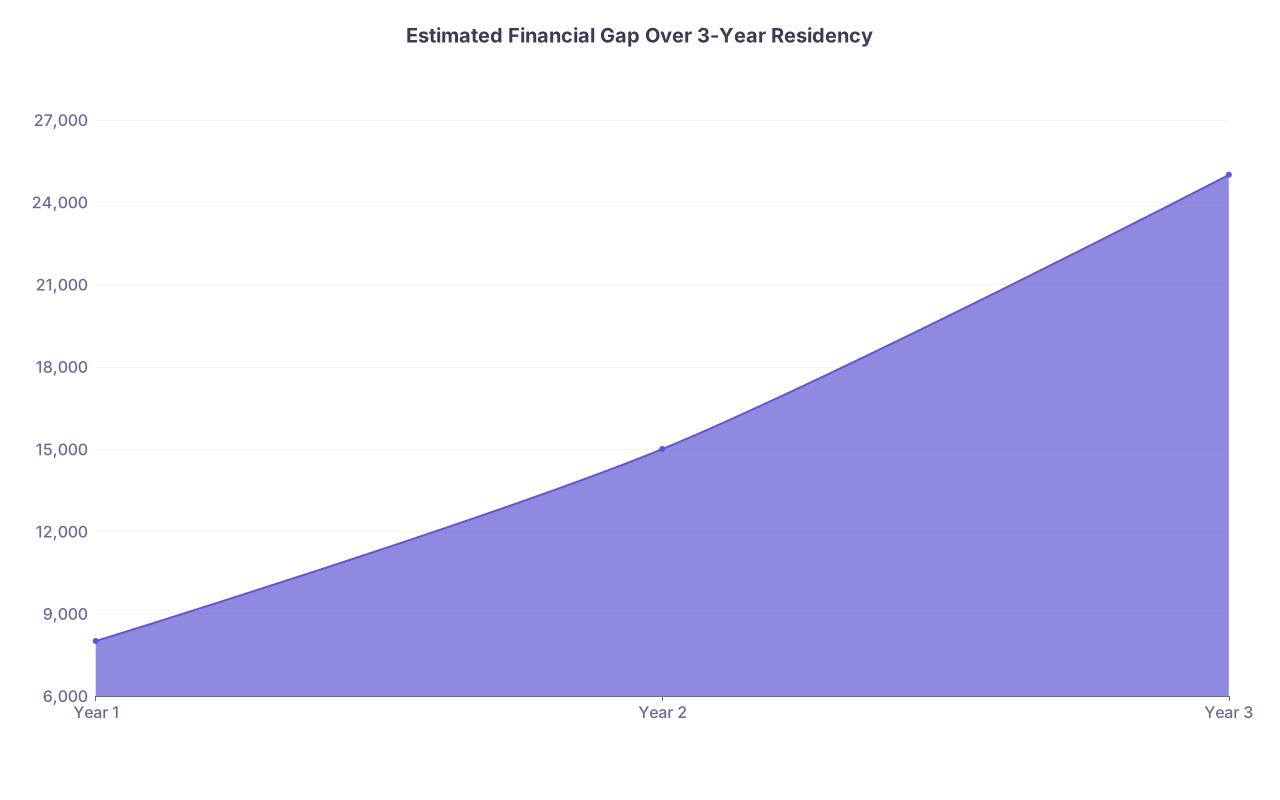
| Category | Value |
|---|---|
| Year 1 | 8000 |
| Year 2 | 15000 |
| Year 3 | 25000 |
Burnout hits harder when your future income is limited
Residents in low‑paid specialties often choose them because they care about patient relationships, mental health, children, continuity. You do not fix that passion by telling them to just “tough it out.”
When you combine:
- Heavy service obligations
- Little mentorship
- Poor coverage and constant cross‑coverage
- Low pay with rising cost of living
it is not just “tough training.” It is demoralizing. I have seen pediatrics interns crying in stairwells because they could not afford another rent hike, working 65–70 hours a week, and being told “we all went through it.”
That kind of environment pushes good people out of the field or into jobs they never wanted (e.g., high‑volume urgent care grind just for money) simply to survive.
4. How to Spot Undersupported Programs Before You Rank Them
You cannot rely on program websites or recruitment dinners. Everyone looks shiny on their own brochure.
You have to interrogate the details.
Use the resident room, not the conference room
On interview day or a second look, the most honest data comes from:
- The resident workroom
- The cafeteria at 9 pm
- The night float sign‑out
Pay attention to what you see and hear:
- Computers with sticky notes saying “DO NOT LOG DUTY HOURS”
- Residents joking about “ACGME‑compliantish” schedules
- PGY‑3s openly talking about moonlighting to afford basic living, not just to save
- People whispering “email me from your personal account, I’ll tell you the real story”
If several residents say some version of, “We are really understaffed right now but it is getting better,” assume it is not getting better.
Ask questions that programs cannot easily spin
You need questions that force concrete details, not fluffy answers.
For support:
- “How many residents left the program in the past three years, and why?”
- “Who actually covers when a resident is out sick? Fellows? Attendings? Another resident?”
- “How often do you have unfilled rotations or scramble to cover services?”
- “When residents report duty‑hour violations, what actually happens next?”
For money:
- “What is your PGY‑1, PGY‑2, and PGY‑3 salary? Any recent or upcoming adjustments?”
- “Is parking free or subsidized? How much per month do residents pay?”
- “Do you provide meal stipends for call and night shifts? How is it structured?”
- “Which exam and licensure costs does the program or GME pay for, and which are on the resident?”
Then watch their body language. If leaders get defensive, vague, or start word‑salading, you have your answer.

| Step | Description |
|---|---|
| Step 1 | Interview Day |
| Step 2 | Ask about support |
| Step 3 | High risk - reconsider |
| Step 4 | Lower risk |
| Step 5 | Ask about pay and benefits |
| Step 6 | Ask about hours and coverage |
5. Hidden Costs That Make “Cheap” Programs Expensive
Undersupported low‑paid programs often blindside residents with expenses they never budgeted for.
Here is what you should not have to cover fully out of pocket during residency at a decent institution:
- Step 3 exam
- Required in‑training exams
- State license (at least not completely)
- DEA registration (often shared or partially supported)
- Mandatory courses: BLS, ACLS, PALS, NRP, etc.
Yet I have seen residents in low‑resourced FM and pediatrics programs write checks for every one of these while making $60k in a city where rent for a tiny apartment is $1,800/month.
Transportation is another one:
- Paid parking vs $150–300/month
- Need for a car in a multi‑site community program vs in‑city public transit at an academic center
- Gas and tolls for distant clinic sites
And then there is time cost. If your program has poor ancillary support, you will waste hours per week:
- Chasing prior authorizations
- Calling SNFs and rehab facilities because there is no case manager available
- Doing clerical tasks nurses or clerks do at better‑staffed hospitals
Those are hours you are not using to read, rest, moonlight (if allowed), or apply for fellowships.
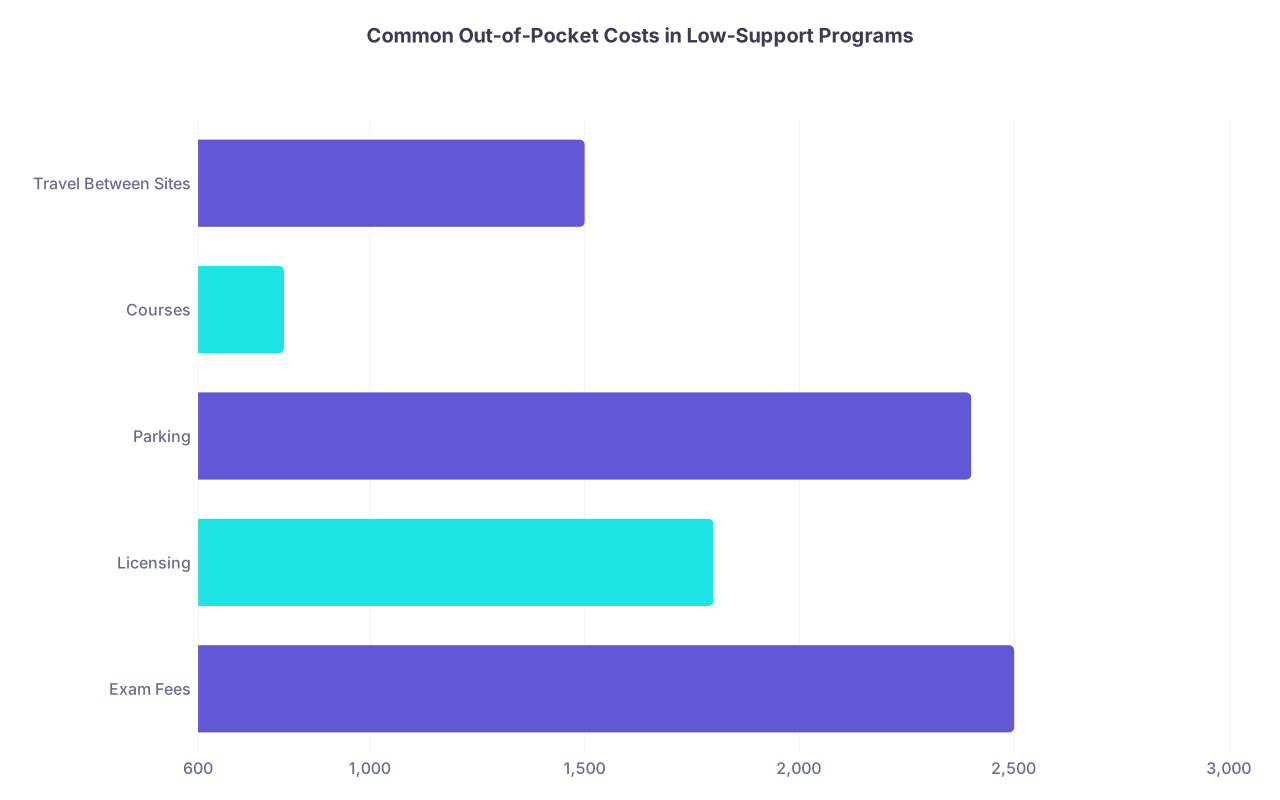
| Category | Value |
|---|---|
| Exam Fees | 2500 |
| Licensing | 1800 |
| Parking | 2400 |
| Courses | 800 |
| Travel Between Sites | 1500 |
You cannot “grind your way out” of a structurally bad setup. You just burn out slower.
6. How to Prioritize Offers When Everything Looks Compromised
Sometimes you do not have a buffet of great options. Maybe your Step scores are average, you applied late, or you have geographic constraints. Fine. You still have choices within your constraints.
In low‑paid specialties, the hierarchy should be:
- Support and culture (real, not advertised)
- Training quality and career trajectory
- Cost of living and benefits
- Raw salary
People often flip #1 and #4. That is how they get trapped.
A slightly higher salary at a toxic, undersupported place is not a win. You lose it all to burnout, transfers, or taking whatever attending job you can just to escape.
But when comparing two weak programs, pay and costs suddenly matter much more. If both are service heavy and mediocre, the one with:
- Cheaper housing
- Better benefits
- More reasonable commute
- Lower hidden costs
may be the only thing that keeps you afloat.
Do not be romantic here. If your choices are between “grind with minimum support in San Francisco” and “grind with minimum support in a low‑cost city with family nearby,” the second one protects you more over the long term—even if the name brand is weaker.
7. Concrete Moves to Avoid the Trap
Here is how you keep yourself out of the worst corner.
Research pay before you even apply.
Look up GME salary scales for hospitals. If they are clearly low for the region, think hard before wasting an application slot there—especially in a low‑paid specialty.Cross‑check with cost of living.
A $64k PGY‑1 in a cheap Midwestern town may be healthier than $70k in coastal urban insanity. Run rough numbers: rent, loans, transport, food.Message current residents privately.
Not the smiling recruitment squad, the random PGY‑2 you find on Doximity or a hospital directory. Ask: “What do you wish you had known before matching there?” Listen to what they avoid saying as much as what they tell you.Rank with a floor, not just a ceiling.
Do not rank programs below your personal safety floor. You are allowed to say, “I would rather SOAP or reapply than spend three years there.” Counterintuitive, but often smart.Consider preliminary or transitional years strategically.
Sometimes doing a solid transitional year at a better‑paid, well‑supported program while reapplying beats locking yourself into a three‑year low‑support disaster in a low‑paid specialty.As an MS3/MS4, do away rotations where you think you might want to live.
See the real culture. The worst programs cannot hide for four weeks.

8. Specific Specialty Pitfalls: What I See Over and Over
Let me be very blunt by specialty category.
Pediatrics
- Trap: County or community peds programs where residents are essentially the only real workforce on massive service lines, with anemic ancillary staff and low pay.
- Red flag quotes: “We have so much volume you will never worry about your numbers” + “We are working on improving our moonlighting options.” Translation: constant grind, limited income.
Family Medicine
- Trap: Unopposed FM programs at struggling community hospitals that brag about “full‑spectrum” training but in practice use residents as cheap manpower to keep the hospital open. Low salary, minimal benefits, and heavy clinic load with weak teaching.
- Red flag quotes: “We cover everything here; the specialists are thin” + “There is a lot of independence early.” That is code for minimal supervision and high risk.
Psychiatry
- Trap: Newly created or rapidly expanded psych programs attached to underfunded state hospitals or private chains that see residents as a billing engine. Thin psychotherapy training, poor didactics, low pay, and unsafe inpatient ratios.
- Red flag quotes: “We are growing fast” + “We are still building our curriculum.” Translation: you are the beta test while slightly underpaid.

Internal Medicine (Categorical)
- Trap: IM programs at hospitals that lost subspecialty fellowships or strong faculty and now function as pure service programs. Residents cover multiple services, low staff support, and salary several thousand below nearby academic centers.
- Red flag quotes: “Our graduates feel very confident as hospitalists” with no real fellowship placement data and vague responses to “What fellowships did last year’s graduates match into?”
Psychiatry and Pediatrics Combined Programs, Med‑Peds
- Trap: Hybrid programs where one side (usually peds) is underfunded, pulling the whole experience down. You get the worst of both worlds: long calls on the weaker side and minimal financial or structural support.
You get the pattern. Low‑paid specialty, underfunded setting, you as the patch.
9. When You Are Already There: Minimizing Damage
If you are already stuck in an undersupported, low‑paid residency, pretending everything is fine is not brave, it is expensive.
Here is what to consider:
Transfer possibilities. Quietly explore transfers after PGY‑1. It is more common than you think, especially if your program clearly underperforms ACGME norms.
Maximize external support. Find mentors outside your institution (online communities, specialty societies), not just in your department.
Ruthless financial triage.
- Get on an income‑driven repayment plan optimized for your situation.
- Cut fixed costs: move, get roommates, ditch car if possible.
- Avoid lifestyle creep entirely; your residency environment already pushes you toward burnout.
Document everything. Duty‑hour violations, unsafe coverage, lack of supervision. If nothing changes, your records may help if you seek transfer or escalate to the DIO/ACGME.

FAQ (Exactly 3 Questions)
1. Are all low-paid specialties bad choices financially?
No. The mistake is not the specialty itself. The mistake is combining a modest‑earning specialty with a chronically low‑paid, undersupported residency in a high‑cost or chaotic environment. Pediatrics or psychiatry at a strong, supportive program where you are well trained and reasonably compensated can be an excellent long‑term choice. The trap is saying “I love kids, I will make it work anywhere” and ignoring pay, support, and cost of living.
2. Should I ever rank a program I know is underpaying compared to others nearby?
Only if there is a compelling offset that truly matters: dramatically lower cost of living, unique training opportunity, family support nearby, or a specific career pathway that is realistic and documented (for example, fellowship pipelines with real numbers). Even then, you should rank it above a minimum safety floor only if the culture and resident support are clearly strong. Low pay plus weak support is not worth it just to avoid the SOAP.
3. If all my interview offers seem mediocre, how do I decide?
Stop chasing prestige and start comparing: honest resident reports, duty hours, ancillary support, pay and benefits, and local living costs. Ask sharp questions about coverage, attrition, and finances. Then choose the program where: you are least likely to burn out, you can afford to live without constant financial panic, and graduates actually land in jobs or fellowships that match what you want. Survival and trajectory beat name recognition every time.
If you remember nothing else, remember this:
- A low‑paid specialty plus an undersupported, low‑paid program is not “paying your dues.” It is a compounding financial and emotional liability.
- Programs show you who they are if you ask the right questions and listen to residents outside the scripted sessions. Use that information before you rank, not after you match.


