

What if the “academic discount” everyone warns you about… doesn’t actually apply the same way in the lowest paid specialties?
Let’s talk about that.
I’m talking about fields like:
- Pediatrics (especially general peds and outpatient)
- Family medicine
- General internal medicine (non-hospitalist, primary care heavy)
- Psychiatry (in many regions, still relatively low paid compared with procedure-heavy fields)
- Geriatrics, palliative, adolescent medicine, ID, etc. (often “subspecialties” that don’t pay like subspecialties)
If you’re in or headed toward one of these, you’ve probably heard both of these:
- “Go private if you want to make any money.”
- “Academics is the only way to have balance and some protection.”
Both over-simplified. And sometimes just wrong.
Here’s the answer you’re actually looking for.
The Money Question: Who Really Pays More?
Let’s skip the fluff. You want to know: where’s the better paycheck?
Short version: In most low-paid fields, private practice or hospital-employed non-academic jobs pay more on paper. But academics can come surprisingly close in some markets, and occasionally beat low-end private offers once you adjust for call, RVUs, and benefits.
Here’s a realistic comparison for a new attending, assuming US, non-coastal but not rural nowhere.
| Specialty | Academic Base ($) | Hospital/Private Base ($) | Common Bonus? |
|---|---|---|---|
| Pediatrics | 180k–220k | 220k–280k | Yes |
| Family Med | 190k–230k | 230k–300k | Yes |
| Gen IM (outpt) | 190k–230k | 230k–300k | Yes |
| Psychiatry | 230k–260k | 260k–340k | Often |
| Geri/Palliative | 190k–220k | 220k–260k | Sometimes |
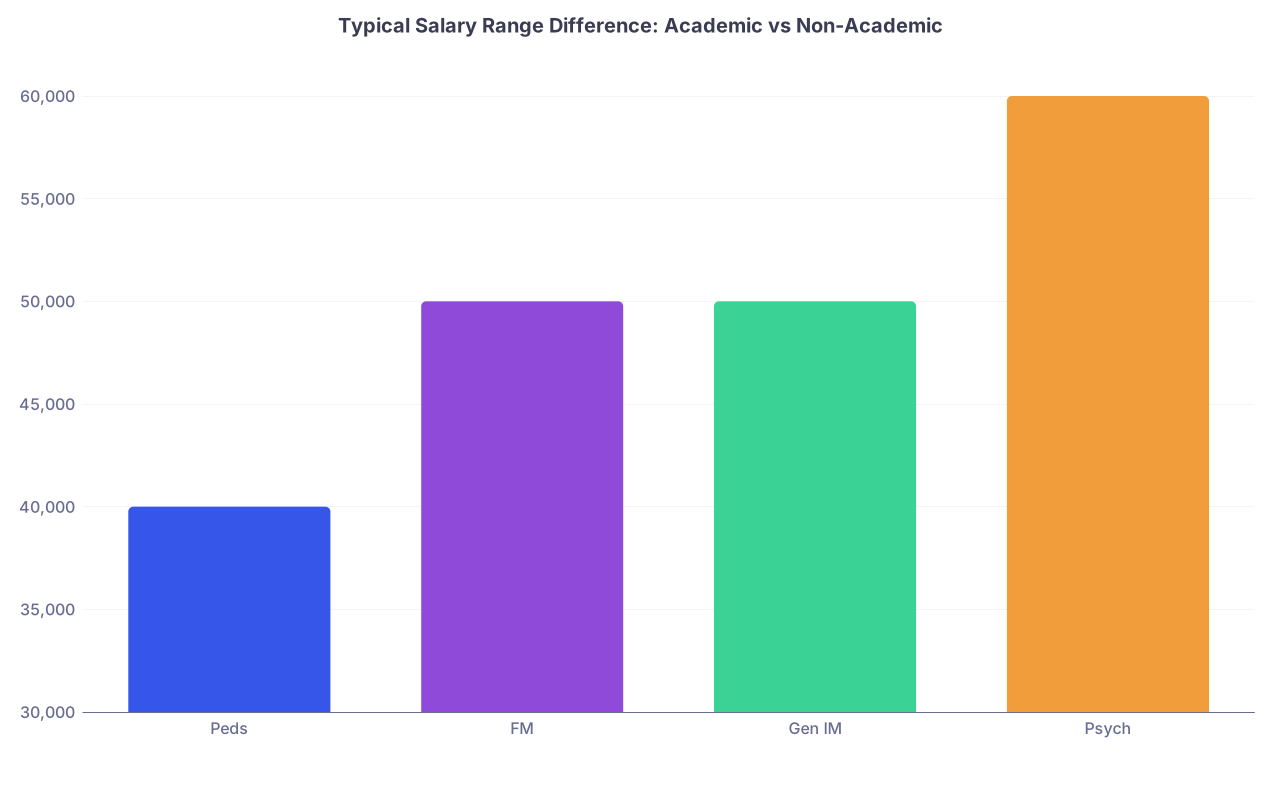
| Category | Value |
|---|---|
| Peds | 40000 |
| FM | 50000 |
| Gen IM | 50000 |
| Psych | 60000 |
That “academic penalty” in these fields is often around $30–70k/year for early career. Not nothing. But also not the half-a-million gap you see between academic rheum and private derm.
Where you really lose money in academics:
- If your academic job is high RVU, low base, and no protected time (yes, those exist)
- If you’re in a high-COL city where academic centers underpay and private groups don’t
- If you want to moonlight but your contract blocks or limits it
Where academics can be surprisingly competitive:
- Psychiatry in saturated markets (some academic systems now pay very well to keep people)
- Primary care in large systems that tie comp to panel size + quality, not pure RVUs
- Hospital-employed academic-affiliated roles where “academic” is mostly a title and teaching a few residents
Bottom line: If pure income is your top priority in a low-paid field, non-academic usually wins. But the gap is smaller than you think, and sometimes academics is “good enough” when you factor in lifestyle and benefits.
Lifestyle: Clinic Grind vs Academic Chaos
Don’t just chase the bigger number and ignore what your life feels like day-to-day.
Here’s how it actually looks in practice.
Typical Clinic Load
Academic primary care peds/FM/IM:
12–18 patients/day if there’s real teaching + research
18–22/day if “academic” in name only and mainly clinicalNon-academic (hospital employed/private):
18–25+ patients/day; 20+ is common in primary care
For psychiatry: 10–14/day mix of new and follow-ups
Academics can give you more variety: teaching students, supervising residents, maybe a QI project or two. It can also give you chaos—too many committees, vague expectations, and “just one more” initiative.
Non-academic is usually more straightforward: clinic, maybe some admin, maybe some leadership if you want it. But it can turn into a pure RVU treadmill if you’re not careful.
Call and Nights
Low-paid doesn’t always mean low call. A few patterns:
- Pediatrics: Academic inpatient peds can have busy resident coverage, nights, and weekends. Outpatient private peds often has home call and nursery coverage, but intensity varies a lot by group size and hospital support.
- Family med / IM: Academic jobs may have teaching service weeks and clinic. Private or hospital-employed outpatient often has phone-only call, but can be very frequent in smaller groups.
- Psych: Many academic roles have limited or no overnight call and shared weekend rounding or consults. Private practice can be call-heavy or nearly call-free depending on setup (outpatient-only vs mixed).
If you want to minimize nights/weekends in a low-paid field, hospital-employed non-academic outpatient often wins. Academic inpatient-heavy roles can be fatiguing.
Mission, Meaning, and Burnout Risk
Money will not save you from a job you hate. Especially in a “heart” specialty like peds, FM, psych, geri, palliative—where moral distress is common.
Here’s the actual trade:
Academics offers:
- Teaching (students, residents, fellows)
- Structural support for QI, education, sometimes research
- A feeling you’re “shaping the field”
- Often more diverse and complex patients
Non-academic offers:
- More autonomy over how you practice
- Easier to narrow your scope (e.g., outpatient-only, or specific age ranges)
- Potential to design your own niche (ADHD clinic, college health, perinatal psych, etc.)
- Less bureaucracy from GME, promotions, and academic committees
Burnout patterns I’ve seen:
Academic burnout:
“I’m doing 2.0 FTE worth of work for 0.8 FTE pay.”
Clinic, teaching, research, committees, mentorship… all piled on loosely defined “academic time.”Private/hospital burnout:
“I’m booked out 3 months, 25 patients a day, every slot double-booked, and admin doesn’t care as long as RVUs go up.”
Academic can be more meaningful but also more fragmented. Private can be more straightforward but also more relentlessly clinical.
You need to decide: do you want variety and teaching enough to tolerate extra meetings and lower pay? Or do you want a simpler job that may feel more repetitive but pays more and lets you set clearer boundaries?
Career Growth: Promotions vs Ownership
Let’s talk long game. Five, ten, fifteen years out.
In Academic Medicine
You’re playing the title game:
- Assistant → Associate → Full Professor
- Medical director, clerkship director, residency PD, division chief, VP of something
In low-paid fields, the problem is this: a lot of these leadership roles don’t pay proportionally more. Some pay a small stipend and more headaches. Some are great springboards into system-level jobs (CMO, VP of quality, etc.). But promotions themselves don’t always fix the base-pay issue.
You do get:
- More CV currency (if that matters to you)
- Easier entry into national guidelines groups, boards, societies
- Platforms to build niche expertise (e.g., autism care in peds, integrated behavioral health in FM)
In Non-Academic Practice
Your “promotion track” looks more like:
- Partnership (if private group)
- Medical director roles (clinic, service line)
- Expanding scope: adding ancillaries, NP/PA supervision, group ownership
- Clinical leadership in hospital systems (service chief, quality director)
In a lot of low-paid specialties, the real way to meaningfully boost income outside academics isn’t the base salary—it’s:
- Ownership (equity in the practice, ancillaries)
- Scaling your effort (supervising multiple APPs, adding a specialized clinic)
- Smart side work (consulting, telehealth, expert work, medical directorships)
If that kind of entrepreneurial stuff makes you tired just reading it, academics might be more psychologically aligned with you. If that excites you, private or hospital-employed with future leadership opportunities will likely make you happier.
When Academics Makes More Sense in a Low-Paid Field
Let me be blunt: you don’t choose academics in a low-paid specialty because of the paycheck. You choose it because it fits your brain and your values. But there are specific situations where it’s clearly the better move.
You should lean academic if:
- You genuinely love teaching and see yourself doing it for decades, not just “maybe a few lectures.”
- You want protected time for:
- QI
- Curriculum design
- Research (even small clinical or educational projects)
- You care about being in a big-team environment with:
- Subspecialists across the hall
- Residents who can share some of the clinical load
- Institutional supports (social work, psychology, care coordinators)
It makes especially strong sense in:
- Child psychiatry, addiction psych, consult-liaison: academic jobs often come with structured teams and support that private practice just can’t match.
- Complex care pediatrics, NICU follow-up, palliative care: academic centers are usually where this actually happens at scale.
- Geriatrics: many good geriatric practices live inside academic or big-system models for a reason—frail, complex patients need infrastructure.
The pay may be lower, but the work itself often fits the complexity that drew you to the field.
When Private or Hospital-Employed Is the Better Move
On the flip side, non-academic is often the smarter choice if:
- You want to prioritize:
- Loan payoff
- Geo-flexibility
- More control over your schedule
- You don’t care strongly about:
- Publishing
- Climbing the academic title ladder
- Teaching being a core part of your identity
And it’s almost a no-brainer if:
- Your academic offers are dramatically below MGMA medians (and not improving after negotiation).
- Every “protected time” promise is vague and non-contractual.
- You see senior faculty clearly burned out and underpaid compared with your mentors in community practice.
For a lot of people in peds, FM, gen IM, and psych, a big health-system-employed outpatient job with some teaching opportunities (precepting, occasional lectures) is the sweet spot: non-academic pay, mini-academic feel.
A Practical Framework to Decide
Here’s a simple filter I’d actually use with a resident trying to choose between an academic and non-academic job.
Rate each from 1–5:
- How much do I need to prioritize income in the next 5–7 years?
- How central is teaching to my professional identity?
- How much do I value autonomy over schedule and clinical style?
- How much do I want a stable, structured environment vs building something?
- How allergic am I to committees, evaluations, and promo rules?
Then look:
- If 1 (income) is 4–5 and 2 (teaching) is 1–2 → lean non-academic.
- If 2 is 4–5 and 1 is 1–3 → lean academic.
- If both 1 and 2 are 3–5 → strongly consider hybrid:
- Hospital-employed with teaching responsibility but non-faculty appointment
- Academic-affiliated community practice with residents rotating through
Remember: you’re not marrying the model forever. You can do 3–5 years academic to build a niche and then jump to higher-paying community or telehealth roles. Or do private first to kill loans, then move to academic once your financial pressure drops.
Common Traps to Avoid (Regardless of Path)
A few mistakes I’ve seen over and over:
- Taking an “academic” job that’s 100% clinical, no protected time, no real promotion pathway. That’s just low-paid clinic work with students sometimes shadowing you.
- Taking a “private” job that’s RVU-gouging, understaffed, and effectively gives you less control than a decent academic shop.
- Believing any promise about reduced clinic or protected time that’s not in writing.
Get the actual numbers:
- Expected patients/day
- RVU targets and historical averages for your colleagues
- Explicit % protected time and what it’s for
- Who covers call and how often—specifics, not “light call”
FAQ: Academic vs Private Practice in Low-Paid Specialties
Is academic medicine always lower paid than private practice in low-paid fields?
No. It’s usually lower, but not always. In some markets, an academic psychiatry or primary care job can match or beat low-end community offers once you factor in benefits, retirement match, and realistic RVU expectations. The gap tends to be smaller than in procedure-heavy fields, often $30–70k early on, though it can grow with experience in private practice.Does academic medicine give better work-life balance in pediatrics or family medicine?
Sometimes, but not automatically. If you have true protected time and a reasonable clinic load (e.g., 14–18 patients/day with residents), academics can feel saner and more varied. If the “academic” job is still 22–24 patients/day plus teaching and committees, it can be worse than a straightforward outpatient community job with phone-only call and no extra obligations.Can I do research in private practice or only in academics?
You can absolutely do research outside academics, but it’s harder to get support. In academics, you get infrastructure: IRB help, statisticians, mentors, residents to help collect data. In private or hospital-employed settings, you can still do QI and some clinical projects, but you’ll likely do it on your own time with less support. If research is core to your identity, academics is usually the easier route.What about loan repayment—does academic or private give me more options?
That depends more on employer type than “academic vs private.” Jobs at non-profit hospitals or universities often qualify for PSLF, which can be huge in low-paid specialties. Some academic and non-academic systems also offer direct loan repayment bonuses. Pure private groups may not qualify for PSLF but can offer higher salaries and signing bonuses. You need to compare total 10-year outcomes, not just year-one salary.If I start in academics, can I switch to private practice later (or vice versa)?
Yes. People do this all the time. Academic to private is common once loans are manageable or promotion fatigue hits. Private to academic happens when people want more teaching, a more structured career path, or burnout from pure RVU grind. Just don’t let yourself get clinically rusty—keep broad skills that are transferable.Is partnership in private practice still worth it in low-paid fields like primary care or psych?
It can be, but it’s not automatic gold. In pediatrics or family med, partnership might mean modestly higher income plus profit from ancillaries, but not a huge windfall. In psychiatry, partnership can be very lucrative if the group is well-run and leverages telehealth, APPs, or high-demand niches. You need real numbers: buy-in, past distributions, and who controls major decisions.What’s one red flag in each path I should run from?
Academic red flag: “We expect you to see 24 patients a day, teach residents, and do scholarly work, but we don’t specify protected time in the contract.” That’s code for overwork and underpay.
Private/hospital red flag: “We don’t track RVUs closely, but our doctors all do fine.” Translation: you’re going to carry a heavy load with no transparency. Always demand concrete data on volume, RVUs, and what your actual schedule would look like.
Open a blank note and write two columns: “Why academic for me” and “Why non-academic for me.” List at least five specific reasons in each column—not generic stuff—and then cross out anything that’s about other people’s expectations. What’s left is where you should be aiming.


